
Reviewed · ARCHAEOLOGIST-LED TOURS
Pompeii: Tour with Archaeologist Guide & Skip-the-Line Entry
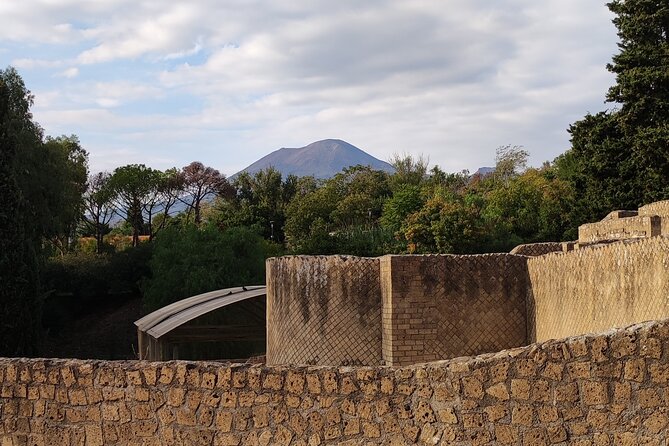
Pompeii is easier to understand when someone points out the small clues: the road design, horse-tie spots, shop counters, theater spaces, and traces of everyday life. This two-hour guided walk takes you through the main sights while explaining how the city functioned before Vesuvius buried it in AD 79.
I like the priority entry, which saves time at a busy archaeological site, and I like that the guide adds meaning to walls and foundations that could otherwise blur together. The main thing to consider is the pace: two hours gives you a strong introduction, not a complete visit to all of Pompeii.
In This Review
- Key points
- Why a guide changes the Pompeii visit
- Entering through Porta Marina
- Teatro Piccolo and the city’s public life
- House of Menander and private Pompeii
- Thermopolium and the everyday food trade
- Stabian Baths and Roman daily routine
- Lupanare and Pompeii’s less polished side
- The Civil Forum and Pompeii’s civic center
- What the two-hour format does well
- Audio equipment and group size
- Is $57 a fair price?
- Getting there and handling delays
- What to bring and what to leave behind
- Cancellation and booking flexibility
- Who should book this Pompeii tour?
- Should you book it?
- FAQ
- How long does the Pompeii tour last?
- What is included in the price?
- Which languages are available?
- Is the ticket line skipped?
- Where does the tour start and finish?
- Do I need to bring identification?
- Can I bring a large bag or bicycle?
Key points
- See Pompeii’s major sights in two focused hours, including the House of Menander, Thermopolium, Stabian Baths, Lupanare, and Civil Forum.
- Enter with a Pompeii Express ticket, avoiding the regular ticket line.
- Learn from an authorized archaeology guide, with tours offered in Italian, Spanish, French, English, and German.
- Expect practical audio support when the group is larger than eight, or an audio guide paired with an English-speaking guide in smaller language groups.
- Stay inside Pompeii afterward to continue exploring at your own pace.
- Plan for walking over an uneven ancient site, since the tour is not suitable for wheelchair users or people with mobility impairments.
Why a guide changes the Pompeii visit
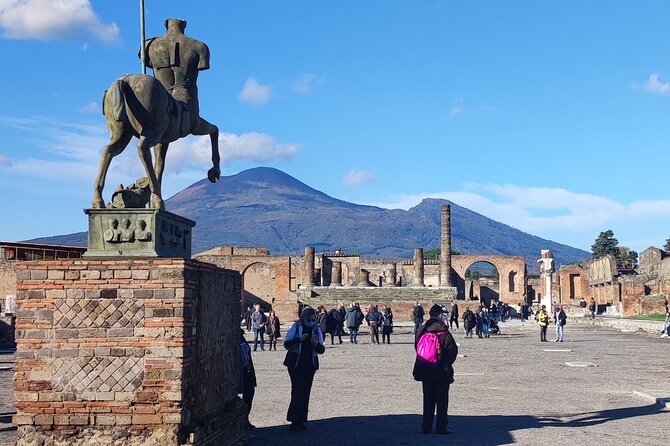
Pompeii can look simple at first glance: broken walls, paved streets, empty rooms, and scattered columns. The trouble is that the site is so large, and many buildings are hard to interpret without context. A guide helps you see the city as a place where people worked, ate, bathed, worshiped, watched performances, and lived at different social levels.
That is the real value of this experience. You are not just looking at ruins. You are learning what each space was used for and how it fitted into daily life. Guides have pointed out details such as the design of the roads and the places where horses could be tied, details that are easy to miss when you walk alone.
The tour also covers Pompeii’s long story, beginning with its foundation in the seventh century BC and ending with the eruption of Mount Vesuvius in AD 79. The guide connects the visible remains with art, customs, crafts, and ordinary routines, giving the site a human scale.
The tour has a strong reputation, with a 4.5 rating from 478 reviews. The most consistent praise concerns the guides’ clear explanations, humor, patience, and ability to make the ruins understandable. Angelo, Teresa, Lilian, Paolo, Roberta, Mario, Imme, and others are singled out in the feedback, but your exact guide depends on the date, language, and group.
More Pompeii excavation visits:
- Pompeii: Entry Ticket and Guided Tour with an Archaeologist
★ 4.8 · 19,459 reviews - Pompeii: Small Group Tour with an Archaeologist
★ 4.8 · 12,264 reviews - Pompeii: Skip-the-Line Entrance Ticket with Audio Guide
★ 4.0 · 2,509 reviews
Entering through Porta Marina
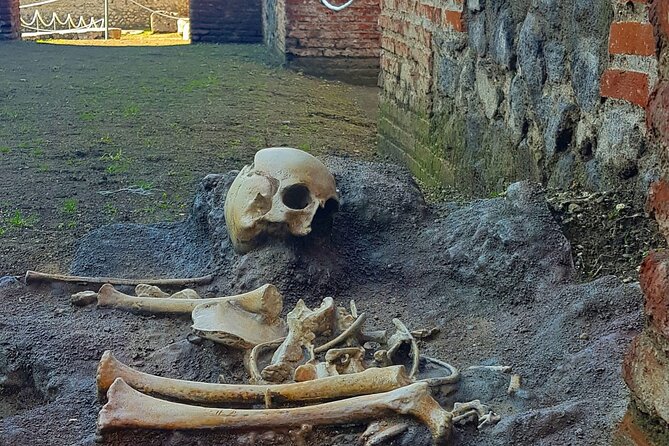
The tour begins at the designated welcome box and meeting point in the Pompeii area, listed as Guide Pompei. Finding the correct place matters, because one person had difficulty with the check-in location even though the tour itself ran well. Allow a little extra time to locate the welcome box rather than arriving at the last minute.
Porta Marina is the first scheduled stop, with about 10 minutes of guided explanation. This entrance gives you an immediate sense of Pompeii as a real city with controlled access, streets, and movement through its gates.
The short stop is useful as an orientation. You begin to see that Pompeii was not a random collection of houses left behind. It was an organized urban center, and the guide sets up the rest of the visit by explaining how to read the site.
Teatro Piccolo and the city’s public life
The next stop is Teatro Piccolo, or the small theater, with around 10 minutes of explanation. The theaters are among the places where Pompeii feels most recognizably human. They show that public entertainment was part of city life, just as shops, baths, and dining spaces were.
A guide can help you notice the design rather than simply admire the stonework. The point is not only that an ancient theater survives, but what its layout tells you about public gatherings and performance.
The stop is brief, so do not expect a long discussion of every theatrical building. It works best as a compact introduction to Pompeii’s public culture before the tour shifts toward homes and commercial spaces.
House of Menander and private Pompeii

The House of Menander receives about 15 minutes. This is one of the most useful stops for seeing how private life fit into the city’s larger structure.
The guide brings attention to the relationship between rooms, decoration, and household activity. Pompeii’s preserved houses help reveal differences in comfort, taste, and status, and the House of Menander gives you a chance to look beyond bare walls and imagine how domestic spaces were organized.
This is also where a specialist guide earns the admission price. Without explanation, you may notice paintings, courtyards, thresholds, or rooms but miss their purpose. The guide links those features to the people who used them.
Because the full archaeological area is extensive, the stop cannot cover every house. Still, it gives you a clear example of Pompeii’s private side, which balances the public buildings later in the route.
More tours led by an archaeologist:
- Pompeii 3hours Villa of Mysteries tour with an Archaeologist
★ 4.8 · 486 reviews - Pompeii and Herculaneum: Guided Tour with an Archaeologist
★ 5.0 · 164 reviews - Pompeii: Guided Tour with Archaeologist with max. 12 People
★ 5.0 · 155 reviews - Pompeii: 2-Hour Guided Tour with an Archaeologist
★ 4.9 · 151 reviews
Thermopolium and the everyday food trade
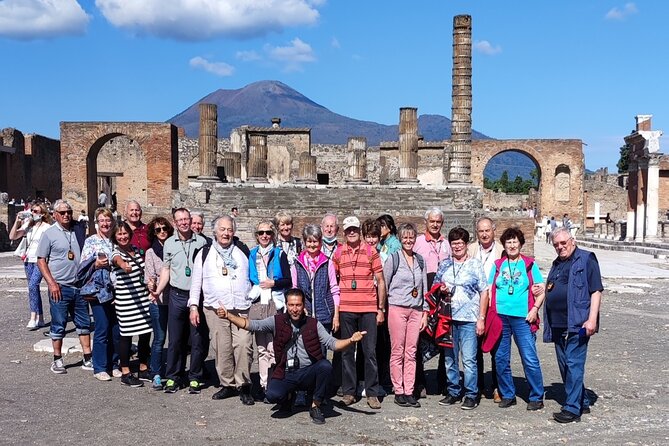
The Thermopolium is scheduled for approximately 15 minutes. This stop focuses on one of the more vivid parts of ancient urban life: the sale of prepared food and drink.
The counter and shop layout help you picture Pompeii as a working city, not simply a residential center. The site’s commercial spaces are valuable because they connect archaeology with ordinary habits. People needed meals, drinks, services, and places to gather, and the Thermopolium gives the guide a practical way to explain those routines.
This is one of the stops where details matter. You can listen for the small clues about how the shop operated and who might have used it. A self-guided visit might leave you with a quick look and little explanation. Here, the guide supplies the missing story.
Stabian Baths and Roman daily routine
The Terme Stabiane, or Stabian Baths, also receives about 15 minutes. Roman baths were not only places to wash. They were part of social life and civic routine, and this stop helps show how public facilities served a city.
The guide explains the buildings and their design, allowing you to understand how the different spaces worked together. The preserved remains are especially helpful when you are trying to picture an active building rather than a quiet ruin.
Again, the timing is short but purposeful. You get the main idea and the historical setting without spending the whole afternoon in one complex. If baths are a particular interest, you will want to use your free time after the guided portion to see more on your own, if those areas are open during your visit.
Lupanare and Pompeii’s less polished side
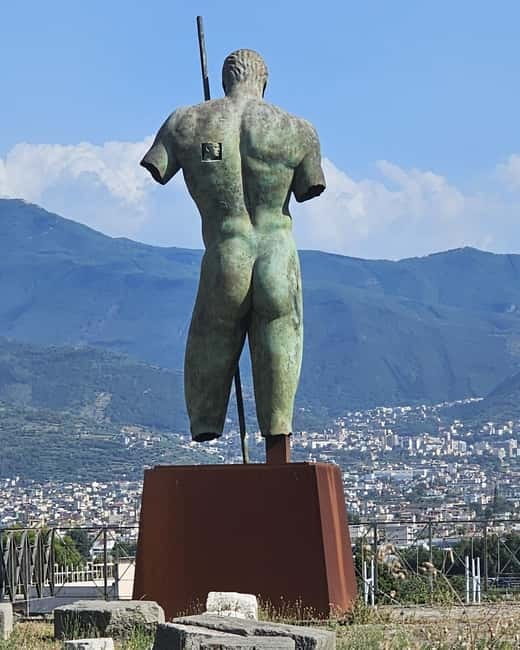
The Lupanare is given the longest scheduled stop, around 20 minutes. Its subject matter is direct and sometimes awkward, but it is an important part of understanding Pompeii as it really was.
The stop helps place commercial sex within the broader life of the city. It also reinforces one of the tour’s strengths: the guide does not reduce Pompeii to grand public monuments. The route includes ordinary, practical, and less respectable corners of Roman life.
This area can become crowded. One useful benefit of having a guide is that the group may be taken to less busy spots when possible, making it easier to hear and see what is being explained. That is not a guarantee, but it is a genuine advantage on a crowded day.
The Civil Forum and Pompeii’s civic center
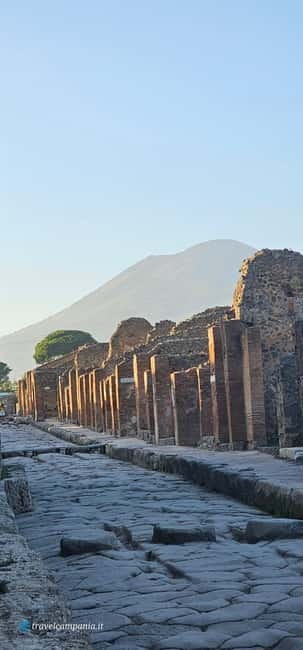
The final main stop is the Civil Forum, with about 15 minutes of guided commentary. This was the civic heart of Pompeii, so it brings together many of the themes introduced earlier: public life, administration, religion, commerce, and the city’s layout.
The forum is a good place to pause and connect the individual stops. You have seen an entrance, theaters, a private house, a food shop, baths, and the Lupanare. Here, the guide explains how those pieces belonged to one urban system.
The route includes another 10 minutes of free time at the forum. That small pause is welcome. You can take photographs, look back at details you missed, or ask a final question before the guided part ends.
What the two-hour format does well

Two hours is a smart length for a first visit, especially if Pompeii is part of a larger day trip. The tour moves through the main highlights without asking you to spend half a day listening to explanations in one place.
Several guides are praised for keeping the group engaged, using humor, and explaining a lot without making the walk feel like a lecture. Teresa, for example, is described as professional and funny, while Mario is praised for helping a family that arrived late and making the experience welcoming. Lilian and Paolo are also noted for clear, engaging presentations.
The guide-led format is particularly useful for mixed-age groups. One guide was praised for handling a range of ages and nationalities, while another made sure the group could explore without feeling rushed. That patience matters at Pompeii, where uneven ground, heat, crowds, and the sheer size of the site can wear people down.
The limitation is simple: this is a highlights tour. Pompeii is too large to cover fully in two hours. The good news is that the guide often gives suggestions for what to see afterward, and the tour ends back at the meeting point, allowing you to stay on and continue exploring if your ticket and schedule permit.
Audio equipment and group size
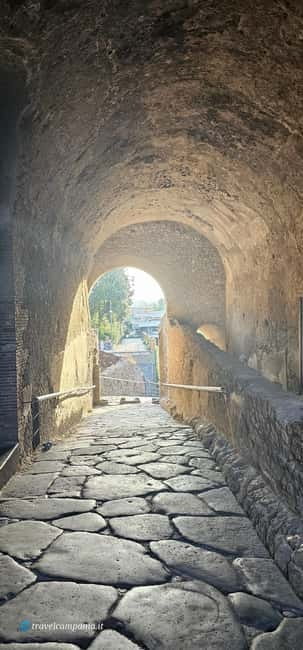
The tour uses a radioguide when the group has more than eight participants. This is a practical feature at an open archaeological site, where people spread out and nearby groups can make it hard to hear.
The equipment has generally worked well, and one guide used it effectively in a crowded setting. One person found the earpieces too loud, so check the volume before the commentary begins. The audio system is useful, but you should still stay close enough to see the guide’s gestures and the feature being discussed.
For groups of no more than four people in the same language, the arrangement may be an audio guide plus a tour guide in English. That detail is worth noticing if you are booking in a language other than English. The available languages are Italian, Spanish, French, English, and German, but the precise format can vary with group size.
Is $57 a fair price?
At $57 per person, the cost covers the Pompeii Express entrance ticket and an authorized guide with archaeology expertise. Transport, lunch, and gratuity are not included, so you need to arrange your own route to Pompeii and budget for food separately.
I consider the price reasonable if you want the site explained rather than simply entered. Pompeii’s admission is only one part of the experience. The greater benefit here is the structure: someone selects important places, explains what you are seeing, and helps you use limited time well.
The value is strongest for a first visit, a short stay, or a day trip where you cannot spare several hours to read signs and find your way around. If you already know Pompeii well and prefer to wander silently, the guide may feel less necessary.
A tip is not included. You can decide after the tour based on the quality of the guiding and the help provided.
Getting there and handling delays
Transport is not included, so you must reach the meeting point yourself. The directions have generally been straightforward, but do not underestimate the need to find the welcome box before the start time.
The operator has shown some flexibility with delays. Train problems have led to missed starting times, and in one case the team helped arrange general access so the visitor did not lose the whole Pompeii visit. Another booking was moved to a later tour after a delayed train, and a family running late was accommodated on an earlier departure.
That flexibility is helpful, but it is not a reason to cut things close. Contact the operator as soon as you know there is a problem. If you are coming by fast train from Rome, build in a cushion for delays and the walk to the meeting point.
What to bring and what to leave behind
Bring a passport or national ID card for every participant, including children. A copy of a passport or ID card is accepted according to the activity information.
Large bags are not allowed inside the tour. Bikes, alcohol, and drugs are also prohibited. The site has free lockers at the gates for backpacks, which is useful if you are carrying luggage or a day bag.
Water is important, especially because the visit involves walking outdoors. Water fountains are available inside the site, although they may not be clearly marked. Ask your guide or staff where to find them.
Wear shoes suited to uneven ancient paving and expect a fair amount of walking. The tour is not suitable for wheelchair users or people with mobility impairments. It is also listed as unsuitable for people over 95 years old.
Cancellation and booking flexibility
You can cancel up to 24 hours in advance for a full refund. The reserve-now, pay-later option lets you hold a place without paying immediately, which is useful when your Campania schedule is still changing.
You need to provide the names and ages of all participants when booking. Check the available starting times for your date, since the tour lasts about two hours and the schedule can affect trains, lunch, and your plans to continue around Pompeii.
Who should book this Pompeii tour?
I would choose this for a first visit, especially if you are unsure how to read an archaeological site. Families, couples, and small groups who want a clear route will get more from Pompeii with the explanations than by wandering without a plan.
It also suits anyone making a short visit from Naples, Sorrento, or Rome. The two-hour format leaves room for travel and further exploration, while the priority entry reduces the risk of losing time before the tour starts.
You may want something else if you have mobility limits, dislike walking on uneven ground, or want a slow full-day study of the ruins. Independent visitors can also stay longer and move at their own speed, but they will need to supply their own context.
Should you book it?
Yes, if you want Pompeii to make sense quickly. The strongest part of this experience is the guide, not simply the skip-the-line entry. Guides such as Angelo, Teresa, Lilian, Paolo, and Mario have been praised for clear explanations, humor, patience, and practical advice for continuing alone afterward.
The route gives you an efficient look at major parts of the city, from Porta Marina and Teatro Piccolo to the House of Menander, Thermopolium, Stabian Baths, Lupanare, and Civil Forum. At $57, it is a fair choice for the structure and context, provided you understand that two hours covers highlights rather than the whole site.
Book it if you value interpretation and have limited time. Skip it only if you prefer complete independence, already know Pompeii well, or need an accessible route.
FAQ
How long does the Pompeii tour last?
The guided tour lasts approximately two hours. A short period of free time is included at the Civil Forum, and you may be able to continue exploring Pompeii afterward.
What is included in the price?
The price includes a Pompeii Express entrance ticket and an authorized guide with expertise in archaeology. Transport, lunch, and tips are not included.
Which languages are available?
Tours are offered in Italian, Spanish, French, English, and German. The exact guiding format can depend on the number of people booked in each language.
Is the ticket line skipped?
Yes. The activity includes priority access so you can avoid the regular ticket line.
Where does the tour start and finish?
The meeting point is the welcome box in the Guide Pompei area. The activity ends back at the meeting point.
Do I need to bring identification?
Yes. Bring a passport or ID card for each participant, including children. A copy of a passport or ID card is accepted.
Can I bring a large bag or bicycle?
No. Bags and bicycles are not allowed, and alcohol and drugs are also prohibited. Free lockers are available at the gates for backpacks.
More Skip the Line in Pompei Campania
- Pompeii: Skip-the-line-Ticket and Guided Tour
★ 4.6 · 1,152 reviews - Pompeii: Guided Tour with Skip-the-Line Entry
★ 4.9 · 812 reviews - Pompeii: Skip-the-Line Entry Ticket with Digital Guide App
★ 4.1 · 770 reviews - Pompeii: Skip-the-Line Entry & Audioguide
★ 3.8 · 225 reviews
Newest reviews from Pompei Campania
- From Sorrento: Pompeii & Vesuvius tour small group★ 4.8 · 4 reviews
- Pompeii Private Tour for Kids and Their Families★ 4.8 · 4 reviews
- From Naples_ Pompeii Tour_Skip the line ticket + audioguide★ 4.3 · 4 reviews
- Pompeii, skip-the-line ticket with smartphone audio guide on App★ 3.0 · 4 reviews
- Pompeii Guided Experience – Tour Service Only★ 4.6 · 4 reviews
- From Naples Port:Pompeii+Vesuvius tour★ 4.3 · 4 reviews
- 2-Hour Pompeii Child-Friendly Tour★ 5.0 · 4 reviews
- Naples: Amalfi Coast, Sorrento and Pompeii Day Trip★ 4.4 · 5 reviews
Archaeologist-Led Tours, compared.

Entry Ticket and Guided Tour with an Archaeologist
Read our review →
Pompeii Small Group Tour with an Archaeologist
Read our review →
Pompeii and Herculaneum Small Group Tour with an Archaeologist
Read our review →
Skip the Line Guided Tour of Pompeii led by an Archaeologist
Read our review →
Exclusive Tour with Archaeologist and Entry Tickets
Read our review →
Pompeii Private Tour with an Archaeologist and Skip The Line – 3 hours
Read our review →
Pompeii Skip-the-line Tour with Archaeologist Guide
Read our review →Browse the lists this tour appears in