

Reviewed · AUDIO TOURS
Pompeii: Skip-the-Line Entrance Ticket with Audio Guide
Pompeii is not a tidy little ruin you can check off in an hour. It is a full Roman city, with streets, houses, theaters, baths, shops, gardens, and public spaces spread across a huge archaeological site. This ticket gives you skip-the-line entry, a map, and an audio guide so you can set your own pace instead of being tied to a group.
I like two things here: the ticket office is close to the Pompeii Scavi train station and entrance, and the self-guided format gives you time to stop for the details that catch your eye. The audio commentary is available in five languages, including English, French, German, Italian, and Spanish.
The main catch is that skip-the-line does not mean you will walk straight through every queue. You still need to exchange your voucher, collect the audio guide, and pass the entrance checks. Bring headphones, water, sunscreen, and an ID document, and do not arrive expecting to bring a large suitcase inside.
In This Review
- Key points at a glance
- What this Pompeii ticket really gives you
- Getting your ticket at Pompeii Scavi station
- Entering the ruins without a fixed group
- Roman public life at the amphitheater and theaters
- Houses, banquets, and frescoes frozen in place
- Plaster casts and the human side of Pompeii
- How useful is the audio guide?
- The optional live guide upgrade
- Heat, water, bags, and the seven-hour mistake
- Price and value at $39.97
- Who should book this Pompeii experience?
- My verdict on the Pompeii audio-guide ticket
- FAQ
- Where do I collect the Pompeii ticket?
- Is the ticket entrance skip-the-line?
- Is the audio guide included?
- Which languages are available for the audio guide?
- Do I need to bring headphones?
- What sights can I see inside Pompeii?
- Can I explore Pompeii at my own pace?
- Are children charged for this experience?
- Can I bring luggage into Pompeii?
- Can I cancel for a refund?
Key points at a glance

- Exchange your voucher above Pompeii Scavi station: The Tempio Travel office is on the first floor of the Circumvesuviana station at Via Villa dei Misteri 1, close to the archaeological entrance.
- Use the map to handle Pompeii’s size: The ruins can feel maze-like, so the printed map is not a minor extra. It helps you plan instead of wandering until your energy runs out.
- Listen at your own speed: The audio guide lets you pause, skip, or return to commentary, though you need to bring your own headphones.
- See more than the famous plaster casts: The route can include the Roman amphitheater, small theater, public gym, houses, banquet rooms, frescoes, and streets where daily life unfolded.
- Start early for cooler conditions: Much of the site has little shade, and one cafe is available inside, so a morning visit makes practical sense.
- Ask about a live guide upgrade: Some visitors were offered a roughly two-hour guided tour for an extra €10, with guides including Alfonso and Alfonso-Marie praised for lively explanations. That option is not the standard audio-guide inclusion, so confirm availability and price on arrival.
What this Pompeii ticket really gives you

The core product is simple: admission to Pompeii, an audio guide, and a map. You are not joining a fixed walking tour, so the experience depends on how you use your time and how much preparation you bring with you.
That freedom matters at Pompeii. You might want ten minutes with a faded fresco, while somebody else in your group wants to move quickly to the amphitheater. With a self-guided ticket, you do not have to keep up with either a guide or a large group.
The audio guide adds context to what can otherwise feel like a long succession of broken walls. It explains how Romans lived, entertained themselves, held banquets, and used public buildings. The commentary is available in English, French, German, Italian, and Spanish.
There is one practical weakness. An audio guide is only helpful when you can match the commentary to the correct building or street. A few people found the system hard to follow, especially when it was not clear which number or site the recording referred to. Use the map, listen for location clues, and do not feel obliged to hear every track.
More Pompeii excavation visits:
- Pompeii: Entry Ticket and Guided Tour with an Archaeologist
★ 4.8 · 19,459 reviews - Pompeii: Small Group Tour with an Archaeologist
★ 4.8 · 12,264 reviews - Naples: Pompeii and Mt. Vesuvius with Lunch and Wine Tasting
★ 4.5 · 2,454 reviews
Getting your ticket at Pompeii Scavi station
Your first task is not entering the ruins. It is finding the activity provider’s office and exchanging your voucher.
The office is at the Circumvesuviana train station on the first floor, at Via Villa dei Misteri 1 in Pompei. It is very close to the Pompeii entrance, which makes this a convenient arrangement if you arrive by train from Naples or another stop along the line.
The location is easy to miss if you expect to collect the ticket at the archaeological gate itself. Look for the Tempio Travel office near the station, not a general ticket window inside the ruins. Several people found the pickup process easy once they were in the right place, while others felt the instructions were less clear than they should have been.
Give yourself a little time for the exchange, especially if you arrive before the office opens or during a busy morning. One early arrival had to wait until after 9 a.m. to collect the ticket. The advertised skip-the-line benefit applies to the ticket queue, not necessarily to the voucher exchange or security process.
The provider may also have free parking available at Osteria Nonna Cherubina on Via Andolfi 46, if the parking is open and spaces remain. Treat that as a possibility, not a guaranteed parking arrangement.
Entering the ruins without a fixed group

Once you have the entry ticket, map, and audio guide, you can approach the archaeological entrance. The ticket is designed to save time at the ticket office, which is useful during high-demand periods, but you may still encounter a short line to enter.
The site is enormous by the standards of most ancient ruins. You can see major highlights in a few hours, but you will not cover every street and building in one casual visit. Some people spend around three and a half hours inside, while others stay much longer, especially when they arrive early and take time with the houses and artwork.
This is where the self-guided format earns its keep. You can build a short route around the main public buildings, or make a longer day of it. If you are visiting Pompeii for a second time, the audio guide can help you choose areas you missed before rather than repeating only the most famous sights.
The tradeoff is navigation. Pompeii’s streets can feel confusing, and it is easy to underestimate the distance between two points. Keep the map in hand, decide on a few priorities, and save some energy for the walk back toward the exit.
Roman public life at the amphitheater and theaters

The Roman amphitheater is one of the major stops on the site. It helps you picture Pompeii as a working city rather than a collection of abandoned walls. Public entertainment drew crowds, and the building’s scale gives you a sense of how organized Roman civic life could be.
The small theater offers a different mood. It was intended for more intimate performances, and its compact form is easier to understand when you are standing inside it. The audio guide can help explain the purpose of the building and the role of performance in Roman society.
You can also visit the public gym, another reminder that Pompeii had facilities for more than housing and commerce. These public spaces are useful early stops because they give you a framework for the city. After that, the private homes and shops feel less isolated.
Do not rush these buildings simply because the preserved houses seem more visually dramatic. The theaters and gym help explain how residents spent time together, and that social setting is part of what makes Pompeii feel like a city.
More Pompei Campania tours worth comparing
- Pompeii: Skip-the-line-Ticket and Guided Tour
★ 4.6 · 1,152 reviews - Pompeii: Guided Tour with Skip-the-Line Entry
★ 4.9 · 812 reviews - Pompeii: Skip-the-Line Entry Ticket with Digital Guide App
★ 4.1 · 770 reviews - Pompeii: Tour with Archaeologist Guide & Skip-the-Line Entry
★ 4.5 · 478 reviews
Houses, banquets, and frescoes frozen in place
The private buildings are where the visit often becomes most personal. You can walk through spaces connected with cooking, dining, courtyards, and household routines. Some rooms still contain decorative painting, and the frescoes can be far more affecting than photographs suggest.
Look closely at the surviving color and painted detail. Pompeii’s artwork was not an occasional luxury placed in a museum. It formed part of the setting in which people ate, received visitors, and moved through their homes.
The banquet rooms are especially useful for understanding Roman domestic life. The audio guide can explain how these rooms functioned and what they reveal about status and daily habits. Without commentary, you may see a beautifully painted room but miss why its shape, decoration, or position in the house mattered.
The condition of the buildings varies. Some rooms are closed, some streets are uneven, and not every famous house will be open during your visit. That uncertainty is normal at a large archaeological site. Use the map to adjust your route instead of treating a closed building as a ruined plan.
Plaster casts and the human side of Pompeii
Pompeii can feel grand when you are looking at theaters and villas. The casts bring the disaster back to individual people and animals.
These forms were made from cavities left in the hardened volcanic material, preserving the positions of citizens and pets caught in the eruption. They are difficult to look at, but they are also the clearest reminder that this was a lived-in city, not an empty stage built for modern visitors.
The audio guide is useful here because it can supply context without turning the moment into a rushed group presentation. You can listen, pause, and take in the scene quietly. I would not plan to move through this section quickly just to reach another landmark.
Pompeii’s appeal is partly architectural, but the casts change the emotional weight of the whole visit. They connect the public streets, decorated rooms, and ordinary household objects with the people who used them.
How useful is the audio guide?
The audio guide is a good middle ground between wandering without context and committing to a live tour. It gives you background on the tragedy, the city’s buildings, and Roman daily life while leaving the route in your hands.
Its success depends on how carefully you use it. Bring your own headphones, as a headset is not included. One useful approach is to connect your headphones before entering, keep the device easy to reach, and use the map to identify your next stop before starting the commentary.
Some people received a phone to use as the guide. The supplied information also says headphones are required, so pack a pair with a compatible connection. A simple wired pair may be useful if you are unsure what device you will receive.
You should not expect the audio guide to replace a human guide in every situation. It cannot answer a question about a particular wall or adjust the explanation to your interests. It does, however, work well for an independent visit, especially if you prefer to linger in quiet rooms or skip sections that do not interest you.
The optional live guide upgrade
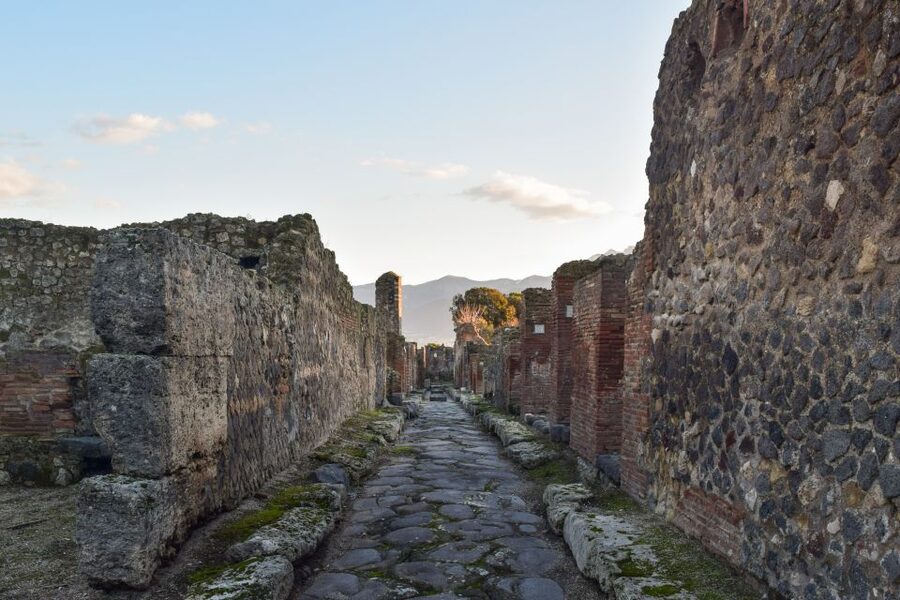
Although the booked activity is self-guided, you may be offered a live tour upgrade at the meeting point. The extra charge cited in the supplied information was €10, and the guided portion lasted about two hours in one case.
Alfonso and Alfonso-Marie were singled out for energetic, clear presentations. Another guide, Astrid, was praised for handling a mixed-language group and involving people in small imagined scenes from Pompeii’s past. These names are useful to know, but you should not assume a particular guide will lead your visit or that the live option will always be available.
A live guide makes sense if you want the main story explained in a clear sequence. Pompeii is so large that a good guide can point out the important buildings and help you avoid spending your best energy on aimless turns.
The audio guide makes more sense if you value independence, want to stay longer than a standard tour, or are visiting with people who have different interests. The optional upgrade can be good value, but ask exactly what is included before paying.
Heat, water, bags, and the seven-hour mistake
Pompeii is exposed. Much of the walking route has little shade, and the stone streets and open courtyards can become tiring in hot weather. Wear sunscreen, carry plenty of water, and consider arriving near the start of the day to avoid the worst heat and crowds.
There is only one cafe available on site according to the supplied details. That makes it unwise to depend on buying every drink or snack after you enter. Food and drinks are not included in the ticket.
A long visit can easily become a half-day or full-day outing. One person spent about seven hours walking around and only realized later how much sun exposure had accumulated. You may not need that much time, but the warning is useful: plan rests and do not measure your day only by how many buildings you have seen.
Large bags and luggage are not allowed. Leave suitcases elsewhere before arriving at the entrance. Bring an accepted ID document, such as a passport, ID card, or driver’s license, because identification is listed among the things to bring.
Price and value at $39.97
At $39.97 per person, this is not the cheapest way to enter Pompeii. The value comes from combining admission, ticket-queue convenience, a map, and an audio guide in one booking, especially when your time is limited.
The price makes more sense if you are arriving by train and want a clear pickup point near the entrance. It also helps if you are visiting at a busy time and would rather pay for convenience than stand at the ticket office.
The value is weaker if you only want basic admission and are comfortable sorting out the official entrance yourself. The audio guide also depends on your patience with the device and map. If you would prefer a person to lead you from one highlight to the next, you may end up paying extra for the live upgrade.
Children aged 0 to 17 go free under the stated conditions. European Community visitors aged 18 to 24 with identification pay €2. Check the exact booking terms for your date, since the adult price shown here does not describe every age category.
Free cancellation is available up to 24 hours before the activity for a full refund, and the reserve-now, pay-later option can help if your Campania plans are still shifting.
Who should book this Pompeii experience?
I would choose this option if you want Pompeii without a coach itinerary or a fixed group schedule. It suits independent visitors, couples, families with different attention spans, and anyone arriving by the Circumvesuviana train.
It is also a sensible choice for a second visit. You can use the map and commentary to reach corners you missed before, then stop whenever a fresco, house, or street deserves more time.
I would be more cautious if you dislike handling audio equipment, find maps frustrating, or want a guide to explain every stop in person. In that case, ask about the live tour upgrade before you commit. The site is large enough that professional direction can save both time and sore feet.
My verdict on the Pompeii audio-guide ticket
This is a practical way to visit one of Italy’s most important archaeological sites. The nearby pickup office, flexible schedule, map, and five-language audio guide give you a useful structure without forcing you into a long group tour.
The experience works best when you arrive early, bring headphones and water, and accept that the skip-the-line benefit does not remove every queue. If you want total independence, book it as offered. If Pompeii feels too large to tackle alone, see if a live guide such as Alfonso or Alfonso-Marie is available for the extra fee.
FAQ
Where do I collect the Pompeii ticket?
Exchange your voucher at the Tempio Travel office on the first floor of the Circumvesuviana train station at Via Villa dei Misteri 1, 80045 Pompei.
Is the ticket entrance skip-the-line?
The ticket provides skip-the-line access to the Pompeii ticket office. You may still need to wait for voucher exchange, entrance checks, or other access procedures.
Is the audio guide included?
Yes. An audio guide and map are included with the activity.
Which languages are available for the audio guide?
The audio guide is available in English, French, German, Italian, and Spanish.
Do I need to bring headphones?
Yes. Headphones are listed among the required items, and a headset is not included.
What sights can I see inside Pompeii?
You can visit highlights including the Roman amphitheater, small theater, public gym, Roman homes, banquet areas, frescoes, and casts of citizens and pets.
Can I explore Pompeii at my own pace?
Yes. This is a self-guided visit, so you can choose your route and spend as much time as you wish during the activity period.
Are children charged for this experience?
Children from 0 to 17 years old go free under the stated conditions. European Community visitors aged 18 to 24 with identification pay €2.
Can I bring luggage into Pompeii?
No. Luggage and large bags are not allowed.
Can I cancel for a refund?
You can cancel up to 24 hours in advance for a full refund. The booking also offers a reserve-now, pay-later option.
More Audio Tours in Pompei Campania
- Pompei: Audio guide of the archeological site
★ 3.4 · 13 reviews - Pompeii, skip-the-line ticket with smartphone audio guide on App
★ 3.0 · 4 reviews - Pompeii: Entry Ticket with Optional Audio Guide
★ 4.2 · 12,360 reviews - Ercolano: Herculaneum Entry Ticket with Optional Audio Guide
★ 4.1 · 581 reviews
More Self-Guided Tours in Pompei Campania
- Pompeii: Skip-the-Line Ticket with Audio Guide and Map
★ 4.0 · 117 reviews - From Naples: Vesuvius & Pompeii with Transfer & Audio Guide
★ 4.0 · 58 reviews - Pompeii & Herculaneum: Skip-the-line & Digital Guide App
★ 4.0 · 35 reviews - Pompeii: Skip-the-Line Ticket with Audio Guide and Map
★ 4.0 · 14 reviews
Newest reviews from Pompei Campania
- From Sorrento: Pompeii & Vesuvius tour small group★ 4.8 · 4 reviews
- Pompeii Private Tour for Kids and Their Families★ 4.8 · 4 reviews
- From Naples_ Pompeii Tour_Skip the line ticket + audioguide★ 4.3 · 4 reviews
- Pompeii, skip-the-line ticket with smartphone audio guide on App★ 3.0 · 4 reviews
- Pompeii Guided Experience – Tour Service Only★ 4.6 · 4 reviews
- From Naples Port:Pompeii+Vesuvius tour★ 4.3 · 4 reviews
- 2-Hour Pompeii Child-Friendly Tour★ 5.0 · 4 reviews
- Naples: Amalfi Coast, Sorrento and Pompeii Day Trip★ 4.4 · 5 reviews
Audio Tours, compared.


Herculaneum Entry Ticket with Optional Audio Guide
Read our review →




Browse the lists this tour appears in