
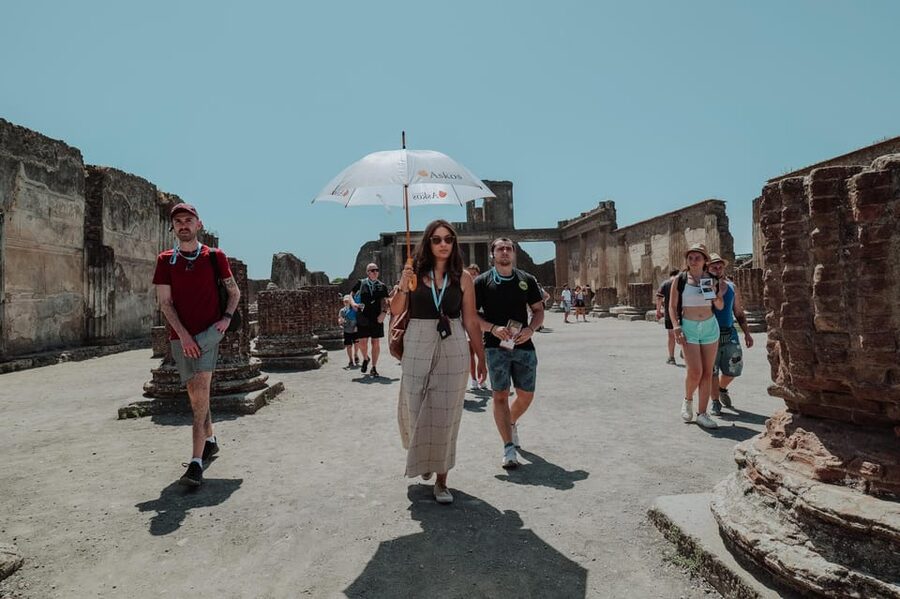
Reviewed · ARCHAEOLOGIST-LED TOURS
Pompeii 3hours Villa of Mysteries tour with an Archaeologist
The best part of this Pompeii tour comes at the end: the Villa of the Mysteries, where an archaeologist explains the famous frescoes rather than leaving you to puzzle them out alone. You also get a strong run through Pompeii’s major houses, public buildings, temples, and streets in three hours.
I like the way the guides use their site experience to adjust the route around crowds. Guides such as Teresa, Julia, Anna Sorrento, and Antonella have earned praise for clear storytelling, humor, and a knack for showing daily Roman life through small details. I also like that the ticket includes the main archaeological park and Villa of the Mysteries.
The tradeoff is simple: Pompeii is enormous, and three hours cannot cover the whole city. You will see many of the key places, but plan extra time afterward if you want a slower look at the remaining houses and streets. The walk is also demanding, with uneven ancient paving and little shade.
In This Review
- Key points to know before you book
- Starting at Porta Marina Superiore
- Reading Pompeii through its private houses
- Public Pompeii: theaters, baths, and business
- The political and religious center
- Why the Villa of the Mysteries matters
- What the archaeologist adds
- Three hours, walking, and the right pace
- Is $88 a fair price?
- Who should book this Pompeii tour?
- Should you book the Villa of the Mysteries tour?
- FAQ
- Where does the Pompeii tour meet?
- How long does the tour last?
- Is the Villa of the Mysteries included?
- Is an archaeologist included as the guide?
- Which languages are available?
- Is transportation included?
- What should I wear and bring?
- Is the tour suitable for wheelchair users?
Key points to know before you book

- The Villa of the Mysteries is included: You finish in one of Pompeii’s most intriguing buildings, with access included in the Pompeii Plus ticket.
- An archaeologist leads the walk: The guide adds context about frescoes, houses, construction, religion, commerce, and ordinary Roman routines.
- The route covers major highlights: Expect the House of the Vettii, House of the Faun, Lupanare, Forum Baths, theaters, basilica, forum, and temples.
- Crowd timing matters: Experienced guides may visit popular houses at quieter moments, which can make a major difference at busy times.
- Bring water and proper shoes: Refill stations are available, but one may not appear early in the route. Flip-flops are not suitable.
- The tour is best for mobile visitors: It is not suitable for wheelchair users or people with mobility impairments.
Starting at Porta Marina Superiore

Your meeting point is at Via Villa dei Misteri, 2, by the Pompeii entrance called Porta Marina Superiore. Look for a guide holding an ASKOS TOURS sign. This is the entrance to use, so do not assume every Pompeii gate will place you near the group.
The tour includes skip-the-ticket-line entry, which saves useful time at a major archaeological site. That matters here because even a few minutes lost at the entrance cuts into a short, tightly planned visit.
Bring your passport or ID card, even though the most important practical items are less official: water, sun protection, and comfortable closed-toe shoes. Pompeii’s ancient streets are uneven, and the surface can be tiring after several hours.
The experience runs in rain or shine. In summer, a hat is a smart addition. Small pets weighing up to 10 kilograms are allowed inside the park, but they must stay on a leash.
More Pompeii excavation visits:
- Pompeii: Entry Ticket and Guided Tour with an Archaeologist
★ 4.8 · 19,459 reviews - Pompeii: Small Group Tour with an Archaeologist
★ 4.8 · 12,264 reviews - Pompeii: Skip-the-Line Entrance Ticket with Audio Guide
★ 4.0 · 2,509 reviews
Reading Pompeii through its private houses
The tour begins by showing you how Pompeii worked at street level. Instead of treating the ruins as a collection of broken walls, the archaeologist connects rooms, courtyards, paintings, and household objects to the lives once lived there.
That approach is especially useful in the House of the Vettii, one of the city’s best-known residences. Here, your guide can point out the relationship between decorated rooms, wealth, social status, and domestic space. The frescoes are not just colorful decoration. They help you see how Roman homeowners presented themselves to visitors.
The House of the Faun gives a different sense of scale. Its size and decoration suggest the wealth of an elite household, and it helps explain how a private home could also function as a place for receiving clients and displaying status. You may find that the house is easier to understand with a guide because the surviving walls do not always make the original layout obvious.
The House of Menander adds another view of high-status domestic life. The tour places these houses within the wider city, so you are not simply moving from one impressive room to another. You begin to see a pattern: Pompeii’s homes reveal family life, business, social rank, art, and the way Roman residents wanted others to see them.
The House of the Tragic Poet is another stop where small details matter. A guide can explain the meaning of its decoration and help you notice features that are easy to pass without context. This is one of the clearest reasons to choose an archaeologist-led walk instead of relying only on a map or audio guide.
One practical note: you may not enter every room of every house. Access can vary, and one useful criticism of the experience is that some people would prefer more time inside individual homes. The route favors breadth, so you see many important buildings rather than studying one residence at length.
Public Pompeii: theaters, baths, and business

The tour then shifts from private life to the places where Pompeii’s residents gathered, traded, worshiped, and watched performances.
At the Large Theatre, your guide explains the role of public entertainment in Roman society. The structure also gives you a sense of how Pompeii used architecture to organize large crowds. It is a different experience from standing in a quiet house because the scale helps you picture the city as a functioning community.
The Lupanare, or brothel, is one of the most talked-about stops. Its small rooms and surviving images offer a direct, sometimes uncomfortable look at commercial sex in Roman Pompeii. This is not a stop for delicate euphemisms, but the guide’s explanation helps put the building into its social and economic setting.
The Forum Baths show how practical services were part of public life. The baths were places for washing, exercise, conversation, and social contact, not just facilities for getting clean. Your guide can help you follow the engineering and room sequence, details that are easy to miss when looking at the remains on your own.
These stops work well together. The theater shows leisure, the Lupanare shows commerce and private transactions, and the baths show routine social life. Together, they make Pompeii feel less like a frozen disaster site and more like a city where people had ordinary habits, arguments, errands, and entertainments.
The political and religious center
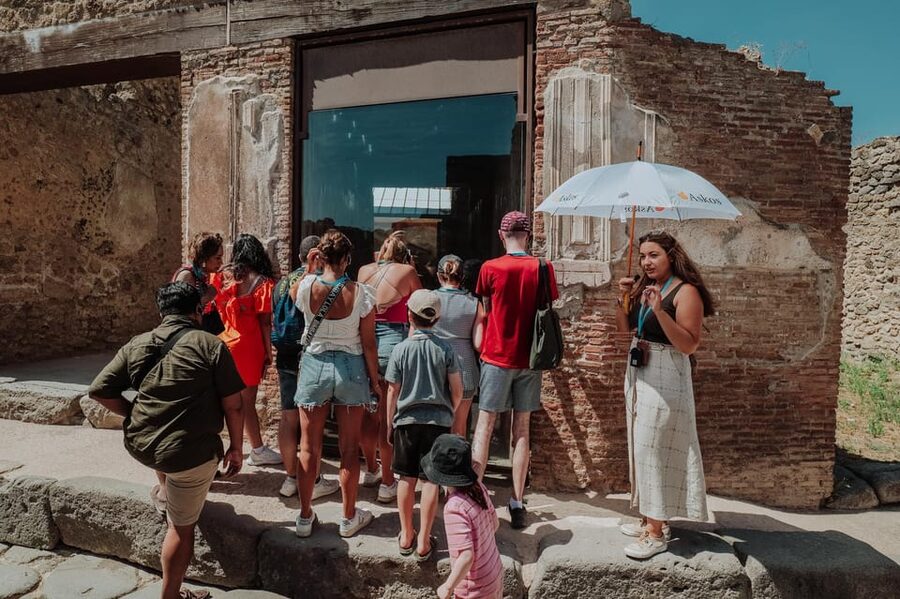
The route includes the Basilica, the main forum, and the Temple of Apollo. This is where the city’s civic, legal, commercial, and religious roles come into focus.
The basilica was not a church in the later Christian sense. It was a major public building linked to legal and business activity. In the nearby Foro Civile di Pompei, or civic forum, you can see the core of Pompeii’s public life. Temples and civic buildings surrounded this open area, and your guide explains how movement through the forum reflected the city’s political structure.
The Temple of Apollo brings religion into the picture. Ancient temples were not isolated monuments for occasional ceremonies. They formed part of the daily civic setting, with religious practice tied to public identity and community life.
I find this section especially useful after seeing the houses. The private buildings tell you about status and family life. The forum and basilica show how those same people participated in public affairs, law, business, and ritual.
The route is planned to avoid the worst crowding when possible. That does not mean Pompeii will be empty, particularly in the busiest months. It does mean a guide with local experience can sometimes postpone a popular building until the line or cluster has eased.
More tours led by an archaeologist:
- Pompeii: Tour with Archaeologist Guide & Skip-the-Line Entry
★ 4.5 · 478 reviews - Pompeii and Herculaneum: Guided Tour with an Archaeologist
★ 5.0 · 164 reviews - Pompeii: Guided Tour with Archaeologist with max. 12 People
★ 5.0 · 155 reviews - Pompeii: 2-Hour Guided Tour with an Archaeologist
★ 4.9 · 151 reviews
Why the Villa of the Mysteries matters
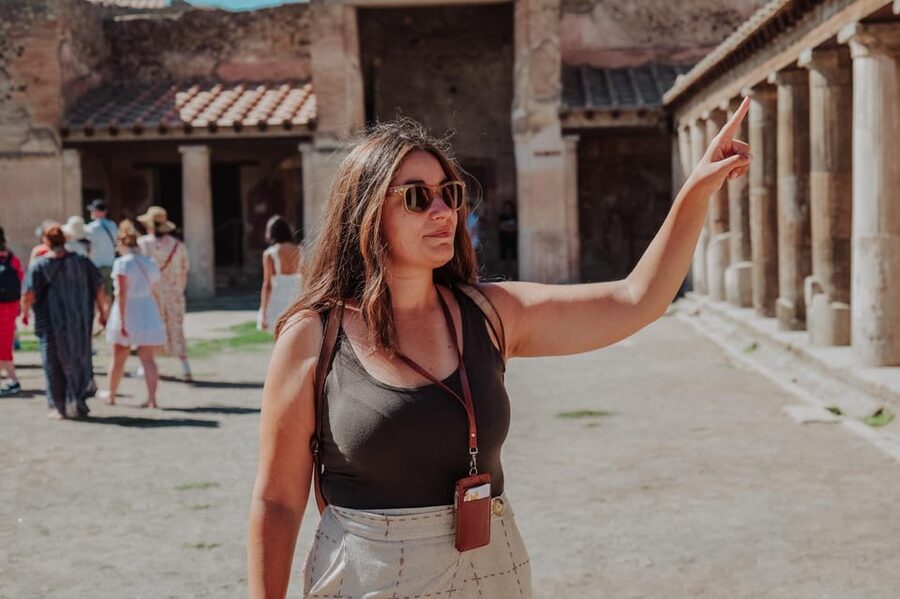
The Villa of the Mysteries is the tour’s special reason to book. It sits beyond the central cluster of Pompeii’s most famous streets, and its distance helps create a quieter finish to the visit.
The villa is known for its large, vivid fresco cycle. The scenes have prompted long discussion about their meaning, and your archaeologist guide explains the main interpretations without reducing the room to a single easy answer. That makes the visit more rewarding than simply taking photographs of the painted walls.
The building also changes your sense of Pompeii. Much of the central city feels urban and tightly packed. The villa offers a different setting, with a large residence and surrounding space that help you consider how wealthy people lived outside the busiest civic core.
One useful benefit is that the Villa of the Mysteries area also gives you access to a quieter part of the site, including another villa and a cemetery area. You may find this a good place to pause, especially after walking through the crowded central ruins. Bring your own snack if you expect to rest there, since food and drinks are not included.
The villa is not a quick add-on. It is a worthwhile part of the three-hour route, but its inclusion also means less time for other parts of Pompeii. If you want to see every street, shop, and house, you will need to remain afterward and explore independently.
What the archaeologist adds
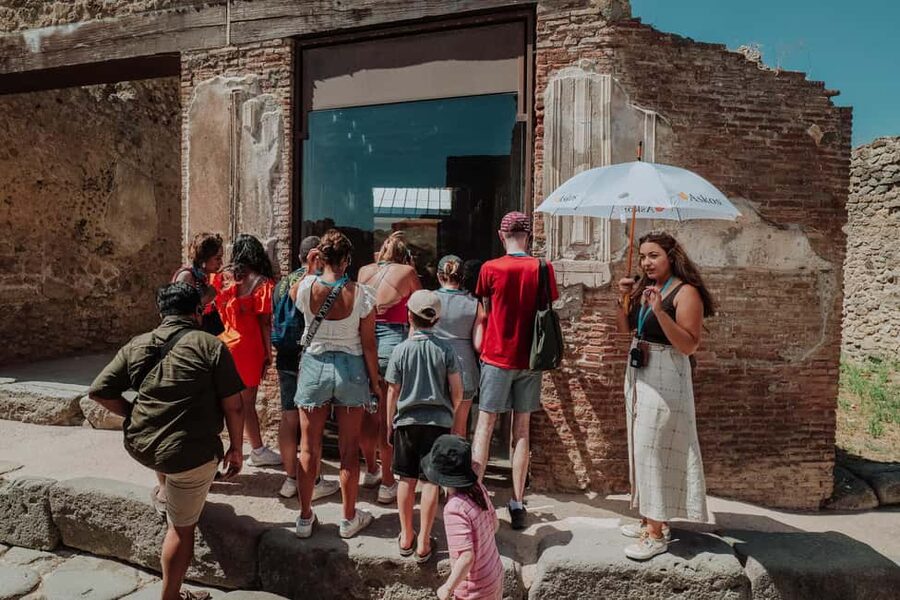
The guides are the main reason this experience works. The strongest guides bring professional site experience, clear English or another chosen language, and a lively way of explaining difficult subjects.
Teresa is particularly associated with fieldwork at Pompeii, and her background can add a useful view of how excavation and preservation continue today. Julia has also been praised for combining detailed site knowledge with humor and energy. Anna Sorrento is noted for explaining daily life and steering the group around delays at busy attractions.
Other guides named by participants include Sarah, Theresa, Yolanda, Rafael, Antonella, Alexandra, Michele, Roberta, Rafaella, GianCarlo, Sophia, Anna, and Teresa. The exact guide depends on the date and language, but the pattern is clear: you are booking a guided interpretation of Pompeii, not simply a ticket with a person leading the way.
The small-group format helps. One group was reported at ten people, which is small enough to hear the guide and ask questions without the stop becoming a private tour. Headsets were also used on one tour, making it easier to follow commentary when the group spread out.
That said, guide quality can vary by individual, as it does on any shared tour. The repeated strengths are subject knowledge, passion, clear speech, humor, and willingness to answer questions. If you want to examine one fresco or room for a long time, tell the guide early. The three-hour plan has many stops, so the pace stays active.
Three hours, walking, and the right pace
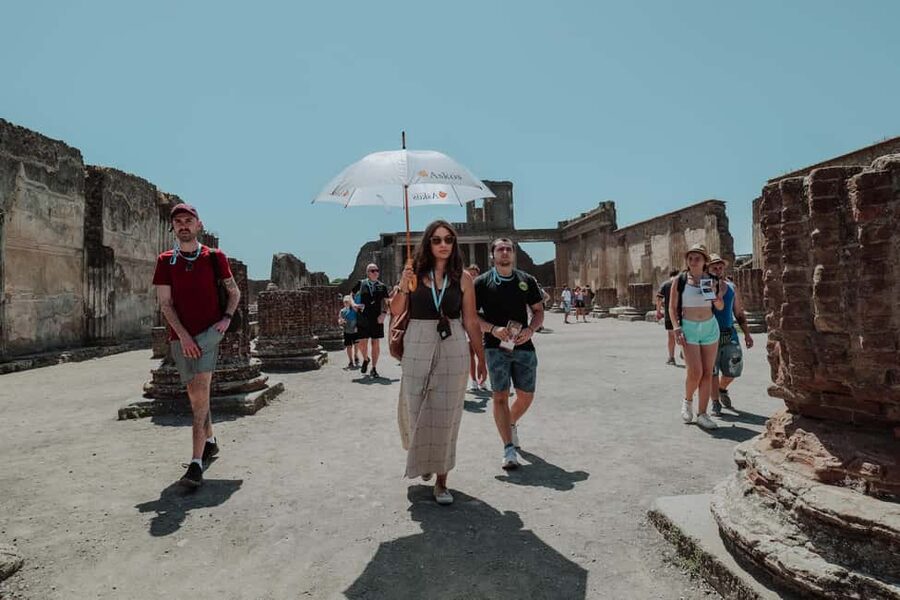
Three hours is a good introduction, not a complete Pompeii visit. You cover a broad route through houses, civic buildings, religious sites, entertainment spaces, and the Villa of the Mysteries. For a first visit, that variety is a strong use of time.
The downside is physical. Pompeii covers a large area, and the ancient paving can be rough. You will be on your feet for much of the tour, with limited chances to sit. People with mobility limitations should not book this particular format, as it is not suitable for wheelchair users or people with mobility impairments.
The heat can also affect your enjoyment. Water refill stations exist, but one may be some distance into the route. I would fill a bottle before entering and carry more water than you think you need on a hot day. A hat is recommended in summer, and closed-toe shoes are essential.
A few participants found that the tour ran slightly beyond its stated end time. If you have a train, lunch reservation, or another timed activity immediately afterward, allow some extra margin. The guide may also offer suggestions for continuing on your own, but you should not count on leaving at the exact minute.
The good news is that the tour does not have to end your Pompeii visit. Your admission gives you the chance to stay and continue exploring after the guided portion. Several hours afterward can turn this from a highlights tour into a fuller day.
Is $88 a fair price?
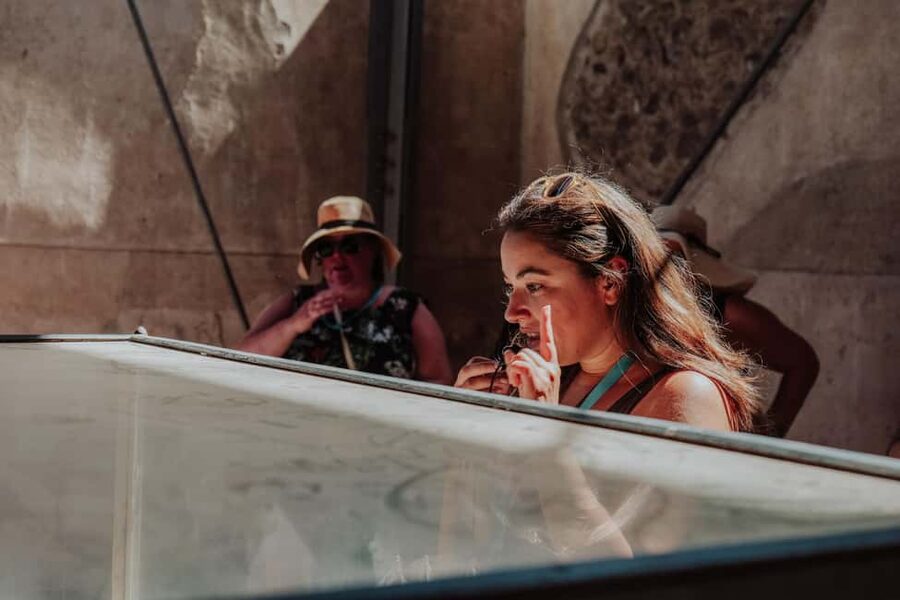
At $88 per person, this is not the cheapest way to enter Pompeii. You are paying for the archaeological guide, a small group, skip-the-line entry, and access to both the main archaeological park and Villa of the Mysteries.
For me, the value depends on how much context you want. Pompeii is vast, and its remains can be confusing when you do not know what you are looking at. A strong guide helps you distinguish a private house from a public building, understand why a room mattered, and connect a painted wall to Roman daily life.
The price is easier to justify if you have only one visit to Pompeii or are coming from Naples or the Amalfi Coast on a tight schedule. It is less compelling if you already have a detailed guidebook, plenty of time, and a strong interest in wandering without a fixed route.
Families should check the booking terms carefully. Admission rules for younger visitors may differ from the adult tour price, and the tour fee may not always reflect free archaeological-site entry for people under 18. This is worth clarifying before you pay, especially if you are arranging a visit after a date change.
Free cancellation up to 24 hours before the tour and reserve-now, pay-later booking make the purchase less rigid. Those terms help if your Campania plans are still shifting.
Who should book this Pompeii tour?
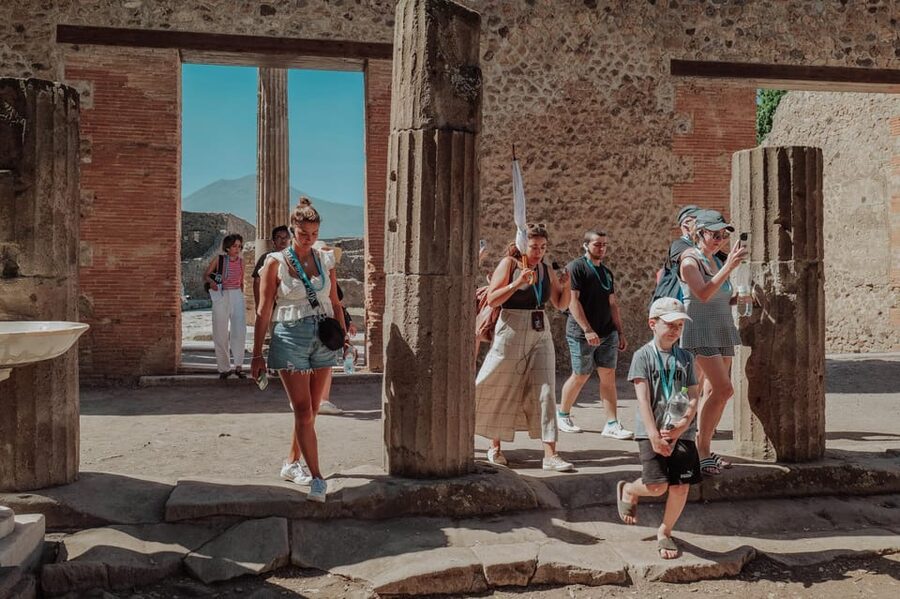
I would choose this tour if you want the major sights explained by an archaeologist and prefer a planned route over figuring out Pompeii on your own. It suits first-time visitors, history fans, families with teenagers, and anyone who wants the Villa of the Mysteries included without arranging a separate visit.
It is also a good fit if crowds bother you. The guide may change the order of stops to avoid packed rooms, and that can preserve time and patience at the site’s most popular houses.
I would hesitate if you want a slow photographic walk, have limited stamina, or need wheelchair access. I would also avoid booking it back-to-back with another timed activity unless you leave a generous buffer.
For the best day, choose sturdy shoes, bring water and a hat, use the restroom before entering, and keep several extra hours free if you can. Pompeii is larger than the three-hour route, and the included ticket is most useful when you take advantage of the chance to keep exploring.
Should you book the Villa of the Mysteries tour?
Book it if you want meaning, not just monuments. The archaeologist-led commentary turns frescoes, houses, baths, temples, and streets into evidence of real lives. The Villa of the Mysteries gives the tour a distinctive finish, while the broad route ensures you see Pompeii’s major types of buildings.
The main caution is the pace. Three hours flies by, and you will not see the entire archaeological park. At $88, the tour earns its price when expert explanation and efficient crowd management matter more to you than independent wandering.
If that sounds right, this is a strong way to begin Pompeii. Stay afterward, explore at your own speed, and let the guided walk give shape to the much larger city around you.
FAQ
Where does the Pompeii tour meet?
The guide meets you at the Porta Marina Superiore entrance to the Pompeii ruins at Via Villa dei Misteri, 2. Look for the ASKOS TOURS sign.
How long does the tour last?
The guided tour lasts three hours. Starting times vary, so check availability when booking.
Is the Villa of the Mysteries included?
Yes. The Pompeii Plus entrance ticket includes the Archaeological Park and the Villa of the Mysteries.
Is an archaeologist included as the guide?
Yes. The tour is led by an archaeologist guide.
Which languages are available?
Guiding is available in German, Italian, French, English, Spanish, and Portuguese.
Is transportation included?
No. Transportation to and from Pompeii is not included.
What should I wear and bring?
Wear comfortable closed-toe shoes. In summer, bring a hat and water. Flip-flops are not suitable, and you should carry a passport or ID card.
Is the tour suitable for wheelchair users?
No. The tour is not suitable for wheelchair users or people with mobility impairments. Small pets up to 10 kilograms are allowed in the archaeological park if kept on a leash.
Newest reviews from Pompei Campania
- Pompeii Private Tour for Kids and Their Families★ 4.8 · 4 reviews
- From Sorrento: Pompeii & Vesuvius tour small group★ 4.8 · 4 reviews
- From Naples_ Pompeii Tour_Skip the line ticket + audioguide★ 4.3 · 4 reviews
- Pompeii, skip-the-line ticket with smartphone audio guide on App★ 3.0 · 4 reviews
- Pompeii Guided Experience – Tour Service Only★ 4.6 · 4 reviews
- From Naples Port:Pompeii+Vesuvius tour★ 4.3 · 4 reviews
- 2-Hour Pompeii Child-Friendly Tour★ 5.0 · 4 reviews
- Naples: Amalfi Coast, Sorrento and Pompeii Day Trip★ 4.4 · 5 reviews
Archaeologist-Led Tours, compared.

Entry Ticket and Guided Tour with an Archaeologist
Read our review →
Pompeii Small Group Tour with an Archaeologist
Read our review →
Pompeii and Herculaneum Small Group Tour with an Archaeologist
Read our review →
Skip the Line Guided Tour of Pompeii led by an Archaeologist
Read our review →
Exclusive Tour with Archaeologist and Entry Tickets
Read our review →
Pompeii Private Tour with an Archaeologist and Skip The Line – 3 hours
Read our review →
Pompeii Skip-the-line Tour with Archaeologist Guide
Read our review →Browse the lists this tour appears in