
Reviewed · ARCHAEOLOGIST-LED TOURS
Pompeii: Exclusive Tour with Archaeologist and Entry Tickets
Pompeii is not a pile of ruins to glance at and leave. It is a full Roman city, with streets, shops, homes, temples, theatres, and election-era civic buildings laid out beneath Vesuvius. A good archaeologist helps you read those details quickly, and this tour gives you that useful introduction without spending your first half hour in an entry queue.
I like the small-group format and the included headset, since Pompeii is large, busy, and often noisy. I also like the guides’ focus on ordinary life: bread ovens, taverns, baths, trade, and house design matter just as much as the Forum. The main consideration is time. Two hours is a strong orientation, not enough to see the whole archaeological park.
In This Review
- Key points to know before booking
- Why an archaeologist helps at Pompeii
- Meeting at Porta Marina beside the Circumvesuviana
- The Forum, Basilica, and civic Pompeii
- Three temples and Pompeii’s religious center
- Forum Baths and the Macellum
- Roman homes: the Tragic Poet, Vettii, and Faun
- Taverns, bakeries, and the Lupanare
- The Theatre District and the final view
- What two hours can and cannot do
- Price, group size, and overall value
- Who should book this Pompeii tour?
- Should you book it?
- FAQ
- How long does the Pompeii tour last?
- Where is the meeting point?
- Are Pompeii entry tickets included?
- Which languages are available?
- Can I book a private tour?
- What should I bring?
Key points to know before booking

- Enter at Porta Marina beside the train station: The meeting point is outside the Porta Marina entrance, directly in front of Pompei Scavi, Villa dei Misteri station.
- A real archaeologist leads the walk: Guides such as Antonio, Riccardo, Livio, Raffaele, and Loredana are praised for clear explanations, humor, and site knowledge.
- The route covers Pompeii’s big story: You visit the Forum, temples, baths, market, houses, taverns, brothel, and Large Theatre.
- The plaster casts add a solemn human focus: At the Macellum, the eruption becomes more than an ancient date in a textbook.
- Two hours leaves room for your own exploration: The guide points out what to return to after the group visit.
- Private booking is available: You can choose a shared small group or a private slot, depending on your budget and preference.
Why an archaeologist helps at Pompeii
Pompeii can overwhelm you before you have worked out what you are seeing. The paved streets stretch far beyond the main entrance, and many buildings look plain until someone explains how they functioned. A guide turns scattered walls into a city with a social order.
That is the chief value here. You are not just told that a building is a bath or a market. You learn how it fitted into Roman daily life, trade, politics, religion, and home life. Guides also bring up the work of excavation and the way archaeologists interpret what survives.
The strongest feedback centers on the guides’ delivery. Antonio is repeatedly praised for passion, clear explanations, and a good sense of pace. Riccardo is singled out for his command of Pompeii, Latin, and Greek, as well as his friendly manner. Livio receives particular praise for combining warmth, humor, and precision. Raffaele and Loredana are also noted for making the site understandable to adults and children.
That range of names matters less than the pattern: this is a guide-led experience where the human quality of the explanation makes the difference. The headset is a practical bonus. You can hear the guide while standing near a busy doorway or moving through a crowded space, instead of trying to stay shoulder to shoulder with the group.
More Pompeii excavation visits:
- Pompeii: Entry Ticket with Optional Audio Guide
★ 4.2 · 12,360 reviews - Pompeii: Archaeological Park Tour with Ticket on request
★ 4.5 · 2,283 reviews - Pompeii Ruins Private Tour with Optional Skip-the-Line Entry
★ 4.9 · 732 reviews
Meeting at Porta Marina beside the Circumvesuviana
The tour begins outside Pompeii’s Porta Marina entrance, just in front of Pompei Scavi, Villa dei Misteri station on the Circumvesuviana railway. Look for a guide holding a sign marked Pompei VIP.
Take the meeting point seriously. Pompeii has three train stations in the wider town, and arriving at the wrong one can turn a simple start into a rushed dash. Check that your train is heading to Pompei Scavi, Villa dei Misteri, not merely a station labeled Pompei.
Porta Marina is a fitting entrance. It was one of the ancient city gates, and passing through it gives the tour an immediate sense of arrival. You do not begin with a long transfer or a separate bus ride. Transportation is not included, so you must arrange your own route to the ruins.
Skip-the-line entry is useful here, especially at busy times. It does not shorten the walk inside the park, but it gets the history lesson started sooner. Bring your passport or identity card, including for children, because the ticket system requires the full names and ages of all participants. A photo of the document is accepted according to the provided instructions.
The Forum, Basilica, and civic Pompeii
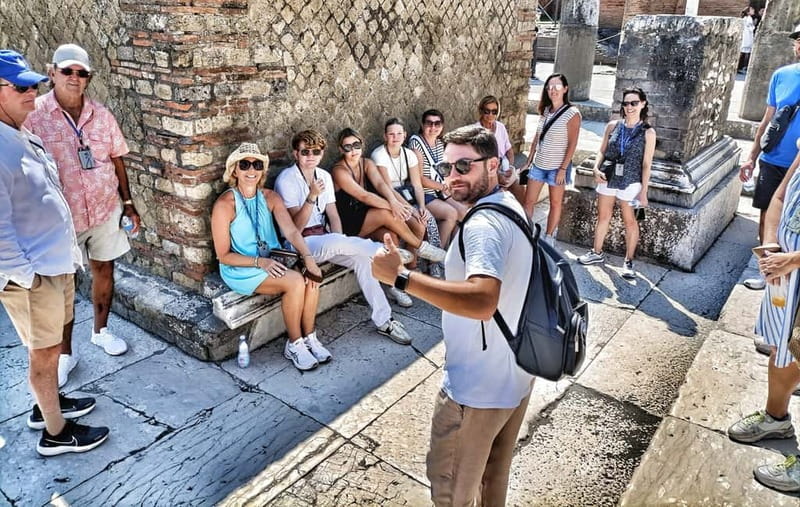
The first major section brings you to the Basilica and the Foro Civile, Pompeii’s civic center. This is where the city’s public life took shape. The Forum was used for politics, commerce, ceremonies, and religious activity, so it offers the best early lesson in how Pompeii worked as a community.
The Basilica helps you picture the legal and commercial side of Roman life. Its surviving columns and open spaces require some imagination, but the guide’s context gives them purpose. Rather than seeing another rectangle of stone, you begin to understand where business and public affairs took place.
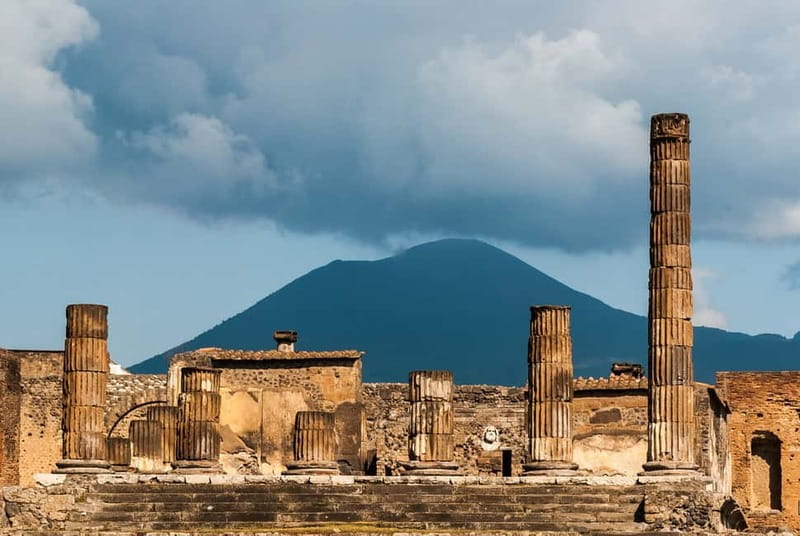
The Forum is also one of the most visually powerful parts of the visit. Mt. Vesuvius and the surrounding Campania setting form the backdrop, while the ruined temples and civic buildings show the city’s scale. The wide space can feel exposed in strong sun or rain, so water, a hat, and comfortable shoes are not optional comforts.
Three temples and Pompeii’s religious center
The route continues to the temples of Jupiter, Apollo, and Venus. Together, they show how religion was woven into the city’s public design. Their position near the Forum is a reminder that worship, authority, and civic identity were closely connected.
The Temple of Jupiter is especially useful for understanding the Forum’s commanding arrangement. The Temple of Apollo brings a different layer of age and tradition, while the Temple of Venus connects the city to one of Rome’s most important deities.
You will not spend hours at each temple during a two-hour tour. That is both a strength and a limitation. The guide gives you the framework, but you will need extra time later if you want to inspect columns, altars, and architectural fragments at a slow pace.
More tours led by an archaeologist:
- Pompeii: Skip-the-Line Tickets and Tour with Archaeologist
★ 4.9 · 467 reviews - Pompeii: Skip-the-Line Guided Tour with Expert Archaeologist
★ 4.8 · 196 reviews - Pompeii: Entry Ticket and Guided Tour with an Archaeologist
★ 4.8 · 19,459 reviews - Pompeii: Small Group Tour with an Archaeologist
★ 4.8 · 12,264 reviews
Forum Baths and the Macellum
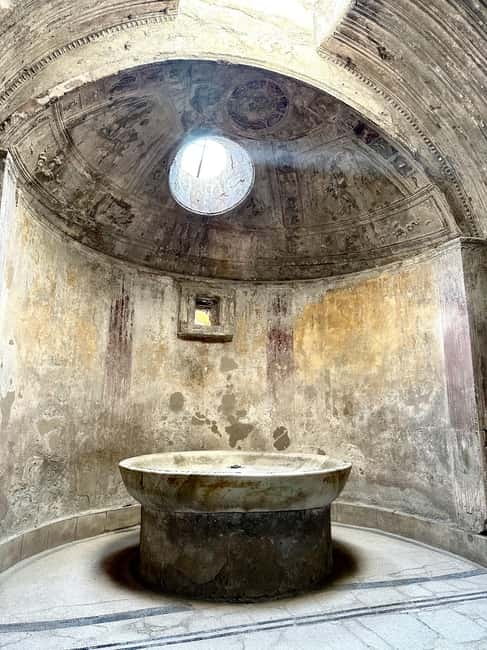
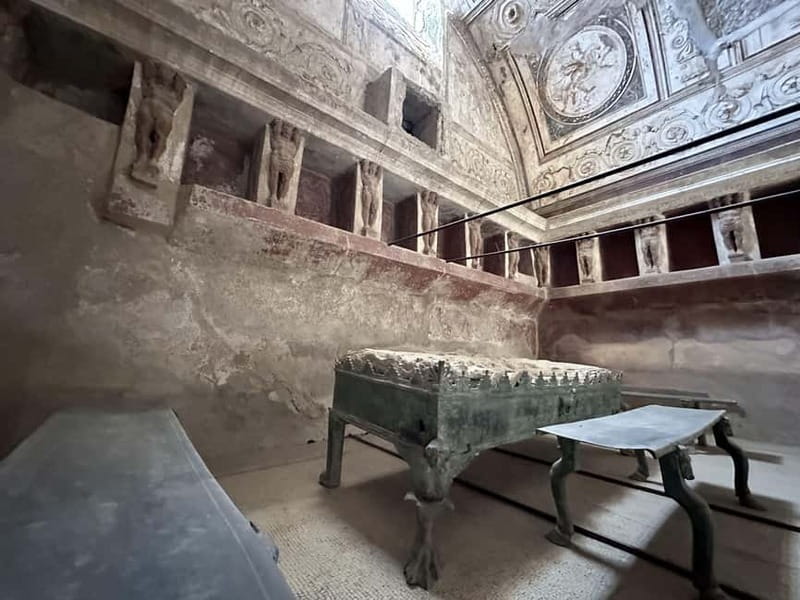
The Forum Baths offer a more intimate look at daily life. Roman baths were places for washing, exercise, social contact, and routine. Even a short stop here helps balance the grand public spaces with the practical side of city living.
Next comes the Macellum, the central market. This is one of the emotionally heavier stops because of the plaster casts of eruption victims. The casts were created from voids left in the ash, preserving the shapes of people caught in the disaster. They bring the eruption down to a human scale.
The subject can be upsetting, especially for children, so pay attention to how your group responds. The guide’s role is important here. A careful explanation avoids turning the casts into a spectacle and instead places them within the wider story of the city, its people, and the excavation process.
Roman homes: the Tragic Poet, Vettii, and Faun
Pompeii’s private houses are among its greatest rewards, and this route includes three famous examples.
The House of the Tragic Poet is known for its decorative details and literary associations. Here, the point is not simply the floor plan. The house gives you a glimpse of how status, decoration, mythology, and hospitality came together in a Roman home.
The House of the Vettii is one of the more lavish residences on the route. Its frescoes and mosaics show how wealthy owners used art to display taste and social position. Look for the contrast between grand rooms intended to impress and the more functional spaces that kept the household running.
The House of the Faun helps convey the scale of elite Pompeian homes. Its broad layout and decorative work make it easier to picture the gap between a wealthy residence and the smaller homes or rented rooms elsewhere in the city.
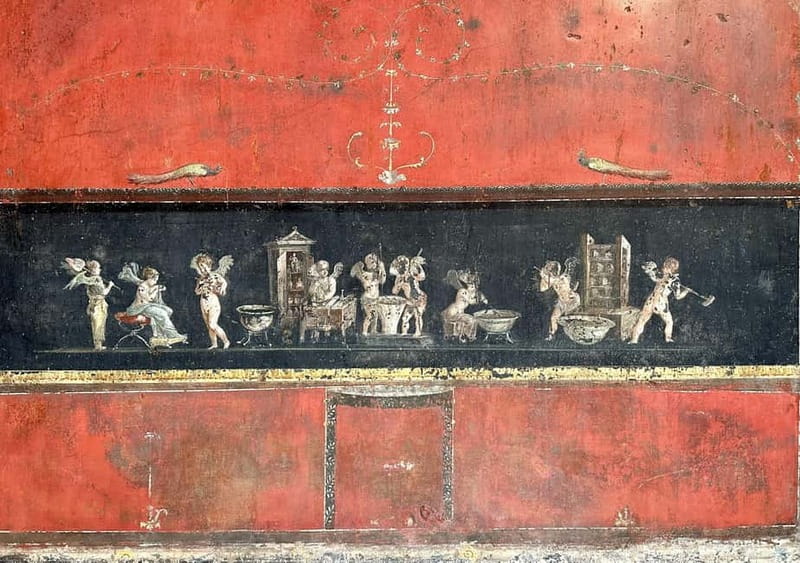
These houses are a major reason to choose a guide. Without explanation, frescoes can blur into a parade of attractive walls. With context, you can look for patterns in room use, decoration, entrances, courtyards, and the way a house announced its owner’s wealth.
One practical warning: access to individual buildings can change as preservation work continues. The route includes these sites, but exact interior access may depend on the park’s conditions on the day.
Taverns, bakeries, and the Lupanare
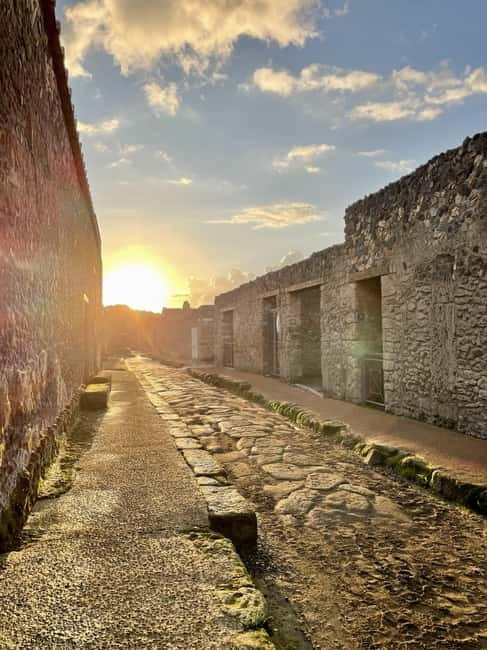
The thermopolia, or small food and drink counters, are among the most memorable places in Pompeii. Their stone counters and storage jars point to a city where people bought prepared food and drink close to home or work.
Ancient bakeries add another useful detail. You can connect the city’s streets to the everyday task of making bread, rather than viewing Pompeii only through its grand monuments. These are the stops that help you picture workers, customers, smells, errands, and meals.
The Lupanare, Pompeii’s famous brothel, brings a different kind of evidence about Roman society. Its rooms and imagery can interest adults, but families may want a quick explanation before entering. The stop is brief within the larger route, yet it is a good reminder that Pompeii was a lived-in city with ordinary pleasures, private business, and less polished corners.
The tour’s attention to taverns and working spaces is one of its best features. Many first-time visitors focus only on temples and villas. I find that the food counters, bakeries, and small commercial rooms make the city easier to understand.
The Theatre District and the final view
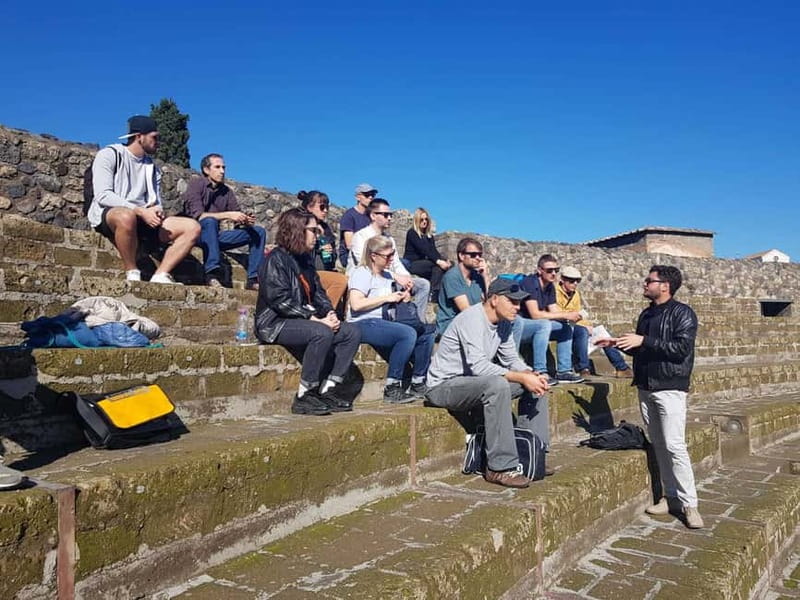
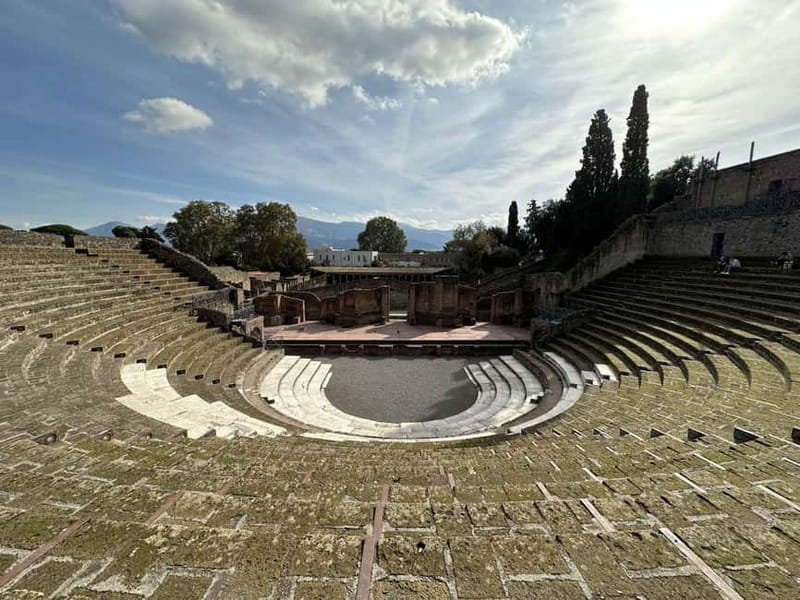
The Large Theatre is the route’s final listed stop. It offers a change of scale and mood after the houses and shops. Here, you can think about entertainment, public gatherings, and the role of performance in Roman urban life.
The Theatre District also gives the walk a satisfying finish. You have moved from civic power to religion, markets, homes, food, sex, and leisure. That broad sweep is useful because Pompeii is not one story. It is a city made of many overlapping lives.
The group returns toward Pompeii’s entrances, with drop-off at the ruins or Piazza Esedra. Your guide also points out what deserves a closer look after the group visit. This is important. The two-hour route is designed to give you a working map, then let you choose your own priorities.
What two hours can and cannot do
Two hours is a sensible length for a first visit if you have limited time or want structure. It keeps the pace moving and prevents you from getting lost among dozens of streets and buildings. Several guide comments praise the timing, the organized route, and the chance to stop for photographs without losing momentum.
You should still think of this as an introduction. Pompeii is large enough to fill most of a day, especially if you want to study frescoes, walk side streets, visit the museum inside the site, or return to buildings that were closed during the guided walk.
One visitor specifically wished for more time and stayed on for the rest of the day. That is a good plan if your schedule allows it. Take the guided tour early, note the buildings you want to revisit, then continue at your own pace.
Evening times can be appealing during hot periods. One family found a later visit cooler, less crowded, and useful for seeing recently opened areas with frescoes and buildings. Starting times vary, so check availability before booking.
Price, group size, and overall value
At $50 per person, the tour is not the cheapest way to enter Pompeii. You are paying for admission, a licensed archaeologist, a headset, a small shared group, and a planned route through major buildings.
I consider that fair value for a first visit. Pompeii’s size makes wandering without a plan surprisingly inefficient, and the guide helps you spend your limited energy on places that matter. The cost makes even more sense if you are visiting from Sorrento or Naples and have only part of a day.
A private booking changes the value calculation. It costs more than joining the shared group, but it gives you a more personal pace and more room for questions. Private guiding received especially warm praise from people who had already taken a standard group visit and found the private format much more engaging.
The included entry ticket is also helpful for planning. You do not need to buy admission separately, and skipping the ticket line reduces uncertainty at the start. Food, drinks, and transportation are not included, so budget for those separately.
Who should book this Pompeii tour?
I would choose this tour if you are visiting Pompeii for the first time, want a clear explanation of what you see, or have only two to three hours for the site. It is particularly useful for families and mixed-age groups because the guides keep the information moving and make room for questions and photographs.
It also suits history fans who want more than dates and names. The guides bring in daily work, language, trade, house design, excavation methods, and the eruption. If you are traveling alone, the meeting-point support is reassuring, and one guide has been praised for contacting a solo participant before the start.
I would not choose it as your only plan if you want a slow photographic study of every house or hope to cover the entire park. You will be moving at a purposeful pace, and some spaces may be busy or temporarily unavailable.
The site is not suitable for people with mobility impairments or wheelchair users. Expect uneven ancient paving, outdoor walking, and weather exposure. Wear sturdy comfortable shoes, carry water, and skip swimwear, alcohol, drugs, pets, and electric wheelchairs, which are not allowed.
Should you book it?
Book this tour if you want Pompeii to make sense quickly. The strongest reason is not simply skip-the-line access. It is the combination of a licensed archaeologist, a compact route, a headset, and enough free time afterward to follow your own interests.
Choose the shared option for the best balance of price and structure. Choose private guiding if you value questions, a flexible pace, or a more personal visit. Either way, arrive at the correct Porta Marina meeting point with your identification ready.
If you can spare the whole day, treat the two-hour walk as your introduction rather than your complete Pompeii visit. If you have limited time, it is a smart way to see the city’s essential public spaces, homes, working quarters, and theatres without wandering past the meaning.
FAQ
How long does the Pompeii tour last?
The guided experience lasts two hours. Afterward, you can continue exploring the ruins on your own, and the guide points out places worth seeing after the group visit.
Where is the meeting point?
Meet outside Pompeii’s Porta Marina entrance, directly in front of the Pompei Scavi, Villa dei Misteri train station on the Circumvesuviana. The guide holds a Pompei VIP sign.
Are Pompeii entry tickets included?
Yes. Skip-the-line admission and Pompeii’s Express entry ticket are included.
Which languages are available?
The tour is offered in English, Italian, French, and Spanish.
Can I book a private tour?
Yes. You can choose a shared small-group tour or a private booking.
What should I bring?
Bring a passport or identity card, including for children, comfortable shoes, and water. A photo of the identity document is accepted for the ticket-name requirement.
Newest reviews from Pompeii Archaeological Site
- From Naples: Pompeii & Sorrento Shore Excursion with Lunch★ 5.0 · 6 reviews
- Pompeii 3-Hour Walking Tour★ 5.0 · 8 reviews
- From Sorrento: Pompeii and Vesuvius Tour by Express Train★ 4.0 · 12 reviews
- Pompeii: Skip-the-Line Guided Archaeological Discovery Tour★ 4.2 · 13 reviews
- 2-Hour Private Walking Tour of Pompeii★ 4.7 · 22 reviews
- Mount Vesuvius Wine Tasting and Lunch from Pompeii★ 4.3 · 43 reviews
- Pompeii: Skip-the-Line Ticket and Virtual Museum★ 4.5 · 66 reviews
- Pompeii: Skip-the-Line Tour for Kids and Families★ 4.9 · 72 reviews
Archaeologist-Led Tours, compared.

Entry Ticket and Guided Tour with an Archaeologist
Read our review →
Pompeii Small Group Tour with an Archaeologist
Read our review →
Pompeii and Herculaneum Small Group Tour with an Archaeologist
Read our review →
Skip the Line Guided Tour of Pompeii led by an Archaeologist
Read our review →
Pompeii Private Tour with an Archaeologist and Skip The Line – 3 hours
Read our review →
Pompeii Skip-the-line Tour with Archaeologist Guide
Read our review →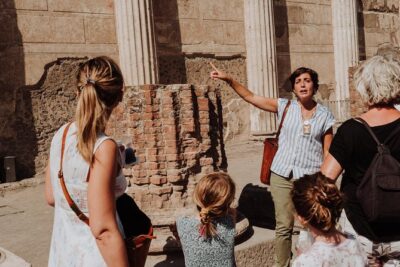
Browse the lists this tour appears in