
Reviewed · ARCHAEOLOGIST-LED TOURS
Pompeii and Herculaneum: Guided Tour with an Archaeologist
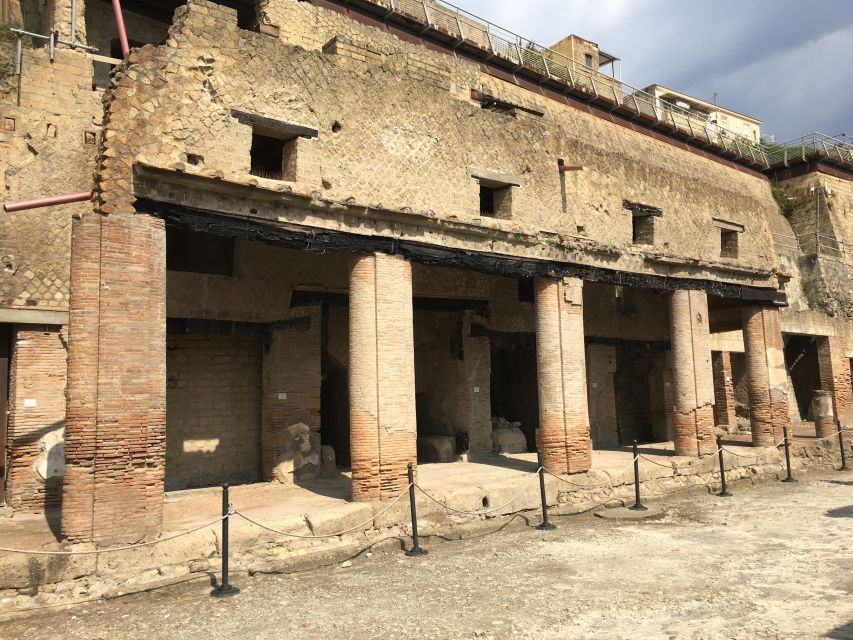
Pompeii shows you a whole Roman town frozen by disaster. Herculaneum, reached later by train, gives you something different: better-preserved houses, wood, mosaics, marble, jewelry, and human remains. With archaeologist Benedetto leading, you get more than a walk past old walls. You get help reading what those walls meant.
I like the small group of up to 10 and Benedetto’s ability to adjust the route around crowds. I also like the pairing of the two sites in one day. Pompeii gives you the broad city picture, while Herculaneum feels smaller, quieter, and more intimate.
The main drawback is the pace and heat. Five hours includes about three and a half hours of guided sightseeing, a lunch break, and the transfer between sites. You will walk on uneven ancient surfaces, often without much shade, so this is not a good choice for wheelchair users or anyone with serious mobility limits.
In This Review
- Key points to know before booking
- Why seeing Pompeii and Herculaneum together works
- Meeting Benedetto at Ristorante Suisse
- Pompeii’s theatres and streets, about two hours
- Lunch and the move to Herculaneum
- Herculaneum’s preserved homes, about 90 minutes
- What makes Benedetto a strong guide
- Is $141.61 a fair price?
- Heat, walking, and what to bring
- Who should book this tour?
- Should you book it?
- FAQ
- How long does the Pompeii and Herculaneum tour last?
- Is transportation between Pompeii and Herculaneum included?
- Are the entrance tickets included?
- Do I need to provide identification?
- What languages are available?
- Is the tour suitable for wheelchair users?
- Does the tour include lunch?
Key points to know before booking
- Two cities, two very different moods: Pompeii is sprawling and busy, while Herculaneum is more compact and often calmer.
- An archaeologist leads the walk: Benedetto brings academic training, site experience, humor, and a talent for explaining Roman life in plain language.
- The Pompeii route covers the essentials: Expect theatres, decorated houses, shops, bakeries, snack bars, baths, the Lupanare, the Forum, and plaster casts of victims.
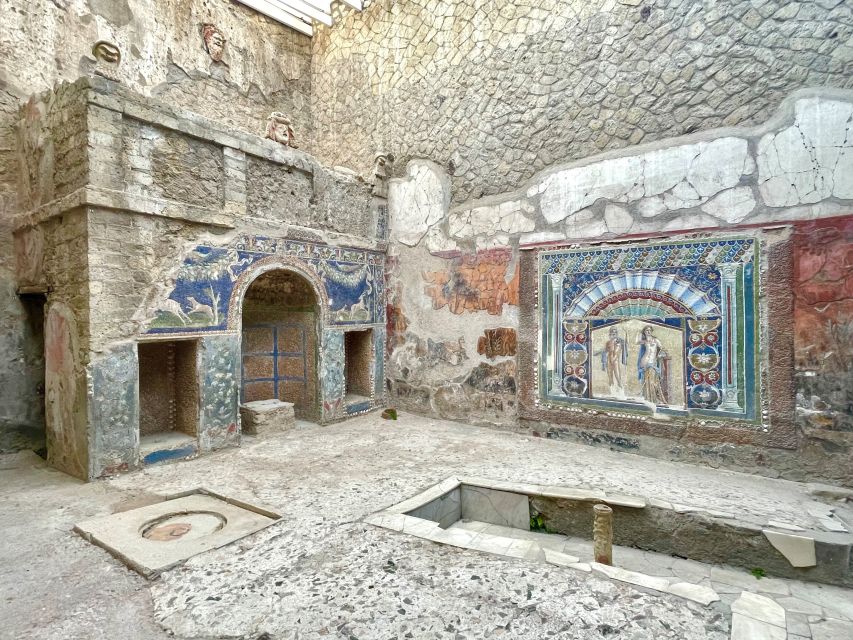
- Herculaneum rewards the second half of the day: Its preserved wood, mosaics, frescoes, marble, jewelry, and skeletons help you picture private Roman life.
- Transportation is not included: The plan uses a train of about 20 to 30 minutes between the sites, although Benedetto may help arrange a taxi when conditions make that useful.
- Bring original identification: Pompeii tickets are named, and the full first and last names of all participants must be supplied after booking.
Why seeing Pompeii and Herculaneum together works
If you have only seen photographs of Pompeii, it is easy to think the site is mainly about ruins and tragedy. In person, its real strength is scale. You walk through streets, public buildings, homes, shops, and places where ordinary Romans ate, bathed, worked, worshipped, and socialized.
Herculaneum adds a sharper sense of domestic life. The two cities were both struck by the eruption of Vesuvius in AD 79, but their burial and preservation were different. That difference shapes the visit. Pompeii helps you understand the layout of a Roman city. Herculaneum lets you look more closely at the details inside it.
I consider this combination a smart use of a day in Campania. You do not simply repeat the same type of ruin twice. The first site gives you context for the second, and the second helps fill in the human details that can be harder to see at Pompeii.
The tour is offered as a private experience or a small group. The maximum group size is 10, which matters in places where paths narrow and large tour groups gather. A small party also makes it easier to ask questions without turning the guide’s explanation into a speech for a crowd.
More Pompeii excavation visits:
- Pompeii: Entry Ticket and Guided Tour with an Archaeologist
★ 4.8 · 19,459 reviews - Pompeii: Small Group Tour with an Archaeologist
★ 4.8 · 12,264 reviews - Pompeii: Skip-the-Line Entrance Ticket with Audio Guide
★ 4.0 · 2,509 reviews
Meeting Benedetto at Ristorante Suisse
The meeting point is Ristorante Suisse, near the Pompeii entrance. Benedetto is scheduled to wait there with a sign showing your name, so look for him rather than wandering toward the ticket gates on your own.
His communication before the tour is one of the practical strengths of this experience. He has helped participants sort out train questions, directions, lunch plans, and changing transport conditions. That assistance is useful around Pompeii, where the entrance, rail station, restaurants, and archaeological grounds are not all in the same place.
The restaurant also provides a convenient place to get organized. You can use the meeting time to check that everyone has water, comfortable shoes, sun protection, and original identification. Food and drinks are not included, so any breakfast or lunch there is your own expense.
Pompeii’s theatres and streets, about two hours
The Pompeii portion begins at Porta Marina Inferiore and moves through the theatre area. Starting here gives the tour a useful shape. You see public entertainment spaces first, then move into the homes, shops, and working parts of the city.
Pompeii is enormous compared with many ancient sites, and you cannot absorb every street in a single visit. A guide earns the fee by choosing a route that connects the most important areas instead of leaving you to spend half the morning studying a map.
Expect to pass ancient houses decorated with mosaics, frescoes, and marble. These details are not just pretty remains. They help show how Roman homes used decoration to express status, taste, and ideas about family life. Benedetto’s archaeology background is especially useful here because he can explain what you are seeing without reducing every room to a list of dates.
The route also includes shops, old bakeries, and Roman snack bars. These are among the most effective places for understanding everyday Pompeii. Public monuments may grab attention, but a bakery or food counter makes the city feel occupied by people with ordinary routines.
The public baths add another piece of the picture. They show how much Roman life depended on shared facilities and social spaces. You are not only looking at impressive stonework. You are learning how residents spent time, met neighbors, and took part in the habits of urban life.
The famous Lupanare is also on the route. It is a memorable stop, but it can be crowded and its subject matter is not suited to every young child. The tour is recommended for families, and Benedetto is praised for keeping children involved, including a 10-year-old on one tour, but parents may still want to prepare younger children for the frank nature of the site.
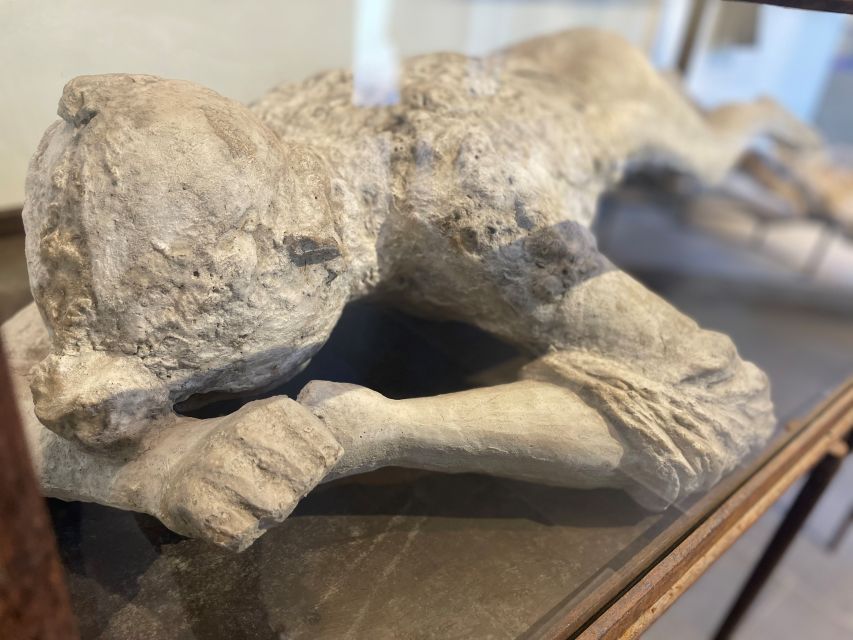
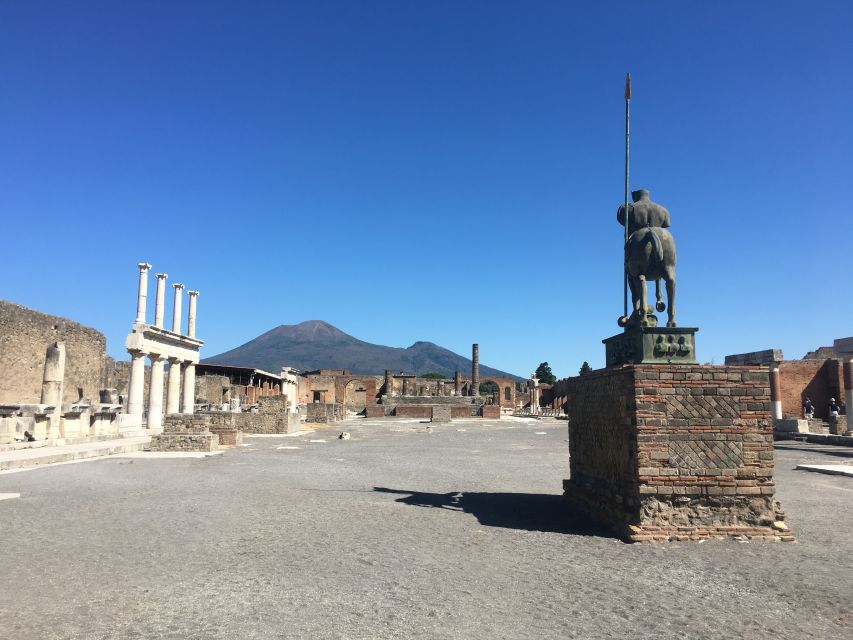
The Pompeii visit finishes at the Forum, the city’s main public center. Here you see the setting for public buildings and civic life, along with plaster casts of victims. These casts are powerful, but the guide’s context matters. Without explanation, they can become only a dramatic image of the eruption. With explanation, they help connect the disaster to the people who lived in the city.
Expect roughly two hours inside Pompeii. That is enough for a guided overview of major areas, but not enough to see every open house or street. If you want a slow, exhaustive archaeological study, you will need more time on your own. For a first visit, the focused route is a sensible trade.
Lunch and the move to Herculaneum
After Pompeii, you get about an hour for lunch. Food and drinks are not part of the price, and you should treat this as both a meal break and a chance to rest your feet.
Ristorante Suisse is directly associated with the meeting point and can be useful for food before or around the visit. Still, you are not locked into a provided meal. Benedetto has advised groups on places to eat and has helped organize lunch plans, but the exact choice and cost remain yours.
The transfer to Herculaneum takes about 20 to 30 minutes by train, according to the planned schedule. Transportation is not included, so budget separately for this part. Conditions can change, too. Rail problems have affected plans, and Benedetto has sometimes helped groups arrange a shared taxi from Pompeii to Herculaneum instead.
That flexibility is valuable, but do not assume a taxi is guaranteed or included. Ask about the day’s transport plan if you have a tight schedule or are traveling with a larger family group. The listed finish is at the Archaeological Park of Herculaneum, while the meeting information also says the activity ends back at the meeting point. Confirm the return arrangement when you book.
More Herculaneum excavation visits:
- Pompeii: Small-Group Tour of Pompeii and Herculaneum
★ 4.8 · 867 reviews - From Naples: Pompeii and Herculaneum VIP Tour with Lunch
★ 4.4 · 129 reviews - Pompeii & Herculaneum: Skip-the-line & Digital Guide App
★ 4.0 · 35 reviews - Pompeii, Herculaneum, and Vesuvius: Full-Day Tour
★ 3.7 · 21 reviews
Herculaneum’s preserved homes, about 90 minutes
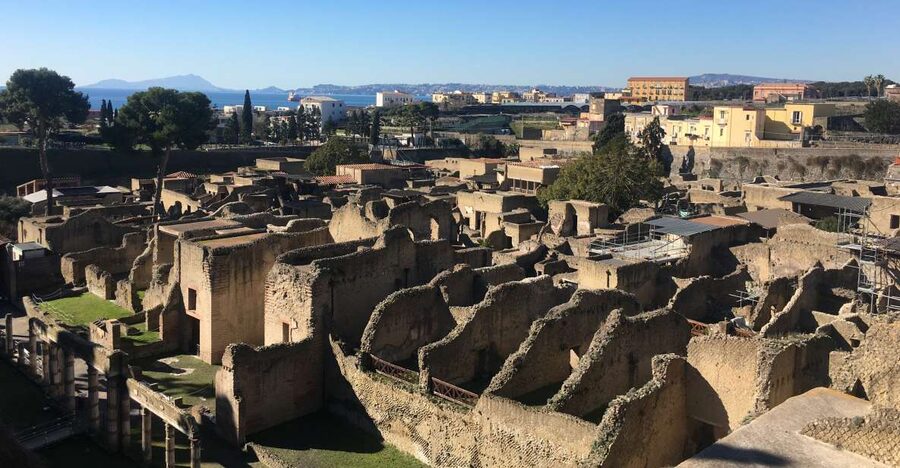
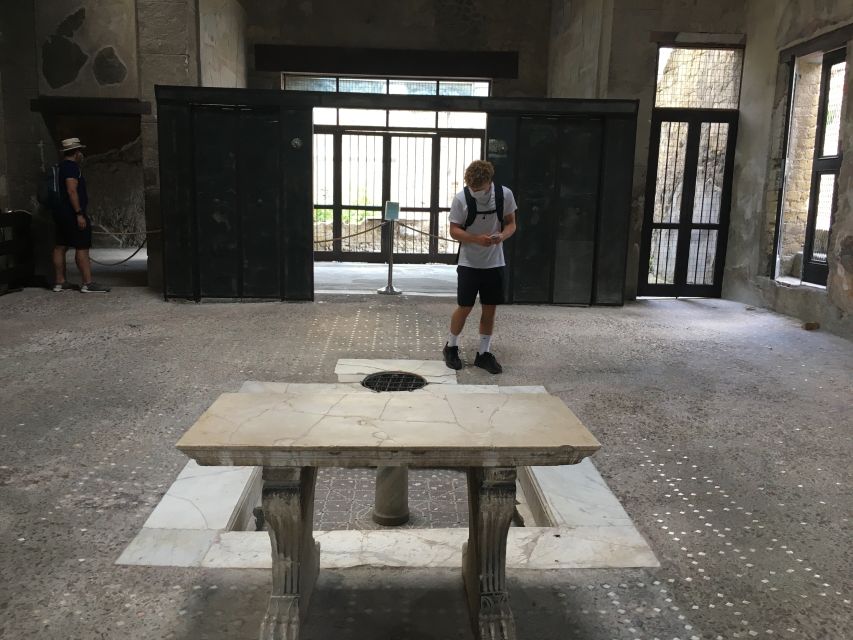
Herculaneum is smaller than Pompeii, but it is not a lesser version. In some ways, it gives you a closer look at Roman domestic life because more household material survived.
The tour focuses on residences with frescoes, marble, and mosaics. These homes can feel more concentrated than the broad streets of Pompeii. You see how rooms were decorated and how private spaces differed from public buildings.
Preserved wood is one of Herculaneum’s great surprises. Wooden elements rarely survive at ancient sites, so their presence helps you picture construction and furnishings in a way bare stone cannot. Jewelry and other small objects add another human scale to the visit.
The site also includes skeletons and other remains connected with the eruption. As at Pompeii, these are serious and emotional parts of the tour. An archaeologist can explain what the evidence shows while avoiding sensational treatment.
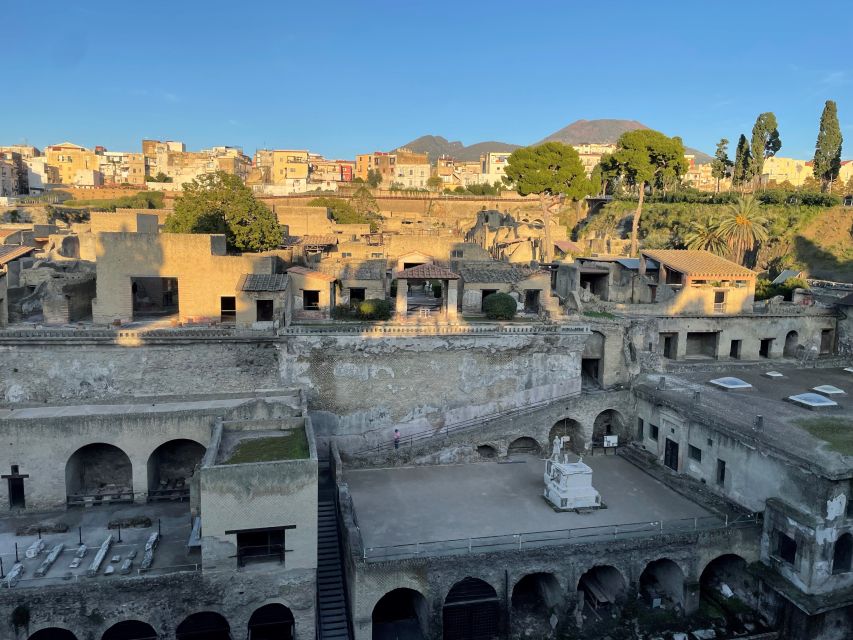
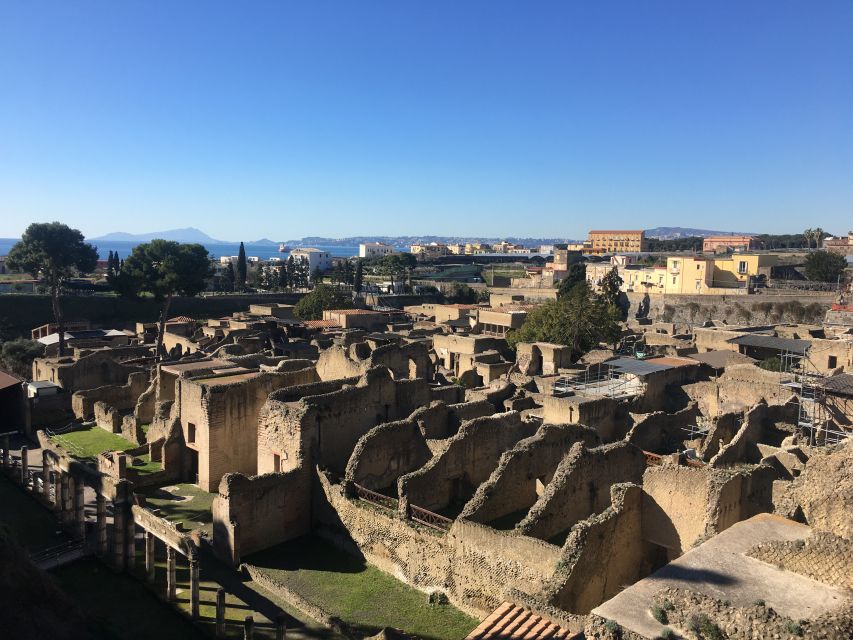
Many people find Herculaneum easier to appreciate after Pompeii because they already understand the basic Roman setting. You can compare the two cities instead of trying to build the entire picture from scratch. Herculaneum’s compact size also makes the final portion of the day feel less demanding, though you will still be walking over ancient, uneven ground.
The quieter setting can be a major advantage. Pompeii may have more famous individual sights, but Herculaneum often gives you more breathing room to look at decoration and building materials. If you are interested in photography, mosaics, wall painting, or architecture, allow yourself time to pause rather than rushing from room to room.
What makes Benedetto a strong guide
The most praised part of this tour is Benedetto himself. He is an archaeologist with a doctorate, and his professional background shapes the experience in useful ways. He explains archaeology, history, the Roman social world, and the physical evidence at both sites.
Just as important, he is described as friendly, funny, patient, energetic, and fluent in English. That mix matters. A guide can know a great deal and still make a long archaeological walk tiring. Benedetto’s humor and open question-and-answer style help keep the day relaxed.
He also knows how to work with a small group. His route may shift to avoid large clusters, and he can adapt the conversation when your party becomes interested in a particular home, object, or aspect of Roman culture. That is more useful than a fixed speech delivered at the same spots every time.
Families should pay attention to this point. The tour is designed with families in mind, and Benedetto has been effective at explaining Pompeii to children. He also looks for shade during hot weather and pays attention to the group’s needs. That does not remove the physical demands of the site, but it can make the day more manageable.
Groups larger than eight receive headsets. This is a small detail with a big practical effect. Pompeii can be noisy and crowded, and it is easy to lose the guide’s words when you stand several feet away. Smaller groups may not need them, but confirm how communication will work for your party.
Is $141.61 a fair price?
At $141.61 per person, this is not a bargain-basement Pompeii visit. It is priced as a specialist guided experience with entry tickets and an archaeologist, not as a basic admission ticket.
The value depends on what you want from the sites. If you are comfortable reading maps, researching Roman architecture, and managing the route alone, you can spend less by visiting independently. But you will need to choose your own highlights, understand the transfer, and make sense of remains that can be hard to read without context.
I think the price makes more sense for a first visit, a family group, or anyone who wants both Pompeii and Herculaneum in one organized day. You are paying for the guide’s training, site knowledge, crowd management, and help with practical problems. Entry tickets are included, and groups stay small.
Transportation and food are extra. Add those costs before comparing this tour with other options. The five-hour length is also worth considering. You get a strong overview, not unlimited time. If you want a full day at Pompeii alone, this schedule will feel too short.
Heat, walking, and what to bring
Wear comfortable shoes. This is a walking tour over old streets and uneven archaeological surfaces, and the route is not suitable for wheelchair users or people with mobility impairments.
Bring your passport or national ID card in original form. A photograph or photocopy should not be treated as an acceptable substitute because the instructions specifically require original identification. Pompeii tickets are named, so provide every participant’s first and last name after booking.
Pack water, a hat, and sun protection. Hot weather can make the open areas of Pompeii tiring, and even a well-planned route cannot turn the site into a cool indoor museum. Spring can be more comfortable than the height of summer, but you should still plan to hydrate.
The tour is available in English, Italian, and French. You can choose between a private tour and a small group, depending on availability. The private option should suit families or friends who want the most control over questions and pace, while the shared option offers a lower per-person cost when available.
Free cancellation up to 24 hours before the start and reserve-now, pay-later booking make this easier to fit into a changing Campania schedule. Still, check the exact starting time and transport details before committing your day.
Who should book this tour?
I would choose this tour if you want both archaeological sites but do not want to spend hours planning the route yourself. It is especially well suited to first-time visitors, families with older children, photographers, and people who prefer explanation over simply walking among ruins.
It is also a good fit if you value a guide who can answer questions at an academic level without making the tour stiff. Benedetto’s humor and personal attention are a large part of the appeal.
I would think twice if you have limited mobility, dislike walking in heat, or want to explore every corner at your own pace. The route is focused, and the combined visit requires a transfer, a lunch break, and steady movement.
Should you book it?
Book this experience if the idea of seeing Pompeii’s full city life and Herculaneum’s preserved homes in one day appeals to you. Benedetto’s archaeological training, lively manner, and skill at avoiding crowded routes add real value, especially for a first visit.
Skip it if you prefer independent touring or want several hours at one site rather than a carefully chosen overview of two. For most people who want context, efficient sightseeing, and a small group, the combination is worth considering. Just bring water, wear serious walking shoes, carry original identification, and confirm the transport and end point before the day begins.
FAQ
How long does the Pompeii and Herculaneum tour last?
The activity lasts five hours. The planned schedule includes about two hours at Pompeii, one hour for lunch, roughly 20 to 30 minutes by train, and about 90 minutes at Herculaneum.
Is transportation between Pompeii and Herculaneum included?
No. Transportation is not included in the price. The planned transfer is by train, and the journey takes about 20 to 30 minutes. Benedetto may help arrange a taxi when needed, but taxi costs are not listed as included.
Are the entrance tickets included?
Yes. Entry tickets for Pompeii and Herculaneum are included, and the tour includes skip-the-ticket-line access.
Do I need to provide identification?
Yes. Bring your original passport or ID card. Pompeii tickets are named, so you must provide the first and last name of every participant after booking.
What languages are available?
The tour is available in English, Italian, and French.
Is the tour suitable for wheelchair users?
No. The experience is not suitable for wheelchair users or people with mobility impairments because it involves walking through archaeological sites with uneven surfaces.
Does the tour include lunch?
No. You receive free time for lunch, but food and drinks are not included in the price.
More Tours Led by an Archaeologist
- Pompeii 3hours Villa of Mysteries tour with an Archaeologist
★ 4.8 · 486 reviews - Pompeii: Tour with Archaeologist Guide & Skip-the-Line Entry
★ 4.5 · 478 reviews - Pompeii: Guided Tour with Archaeologist with max. 12 People
★ 5.0 · 155 reviews - Pompeii: 2-Hour Guided Tour with an Archaeologist
★ 4.9 · 151 reviews
Newest reviews from Pompei Campania
- From Sorrento: Pompeii & Vesuvius tour small group★ 4.8 · 4 reviews
- Pompeii Private Tour for Kids and Their Families★ 4.8 · 4 reviews
- From Naples_ Pompeii Tour_Skip the line ticket + audioguide★ 4.3 · 4 reviews
- Pompeii, skip-the-line ticket with smartphone audio guide on App★ 3.0 · 4 reviews
- Pompeii Guided Experience – Tour Service Only★ 4.6 · 4 reviews
- From Naples Port:Pompeii+Vesuvius tour★ 4.3 · 4 reviews
- 2-Hour Pompeii Child-Friendly Tour★ 5.0 · 4 reviews
- Naples: Amalfi Coast, Sorrento and Pompeii Day Trip★ 4.4 · 5 reviews
Archaeologist-Led Tours, compared.

Entry Ticket and Guided Tour with an Archaeologist
Read our review →
Pompeii Small Group Tour with an Archaeologist
Read our review →
Pompeii and Herculaneum Small Group Tour with an Archaeologist
Read our review →
Skip the Line Guided Tour of Pompeii led by an Archaeologist
Read our review →
Exclusive Tour with Archaeologist and Entry Tickets
Read our review →
Pompeii Private Tour with an Archaeologist and Skip The Line – 3 hours
Read our review →
Pompeii Skip-the-line Tour with Archaeologist Guide
Read our review →Browse the lists this tour appears in