
Reviewed · ARCHAEOLOGIST-LED TOURS
Pompeii: Entry Ticket and Guided Tour with an Archaeologist
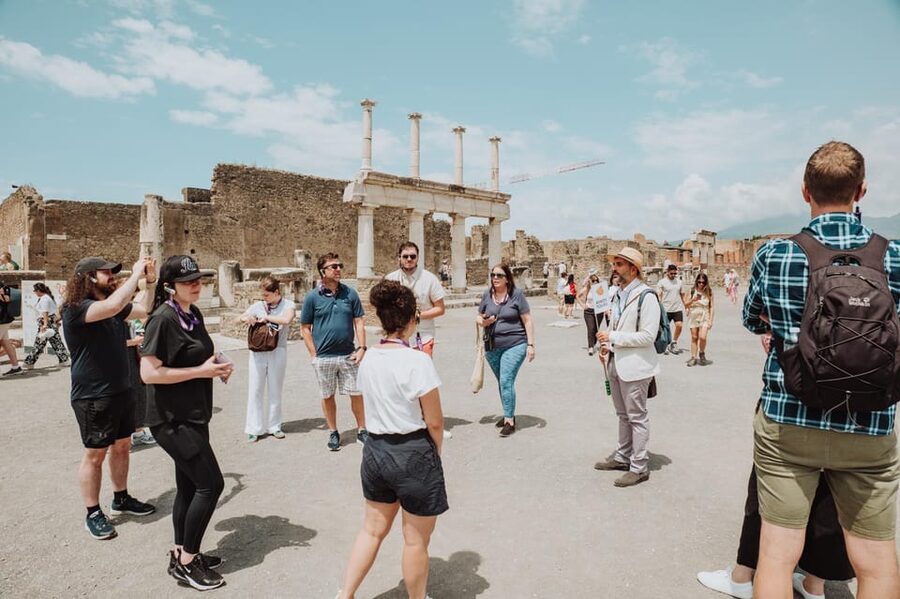
Pompeii is easier to understand when someone helps you read its battered streets, painted walls, shops, temples, and homes. This two-hour archaeologist-led walk takes you from the Marina Gate and Forum to the House of the Faun, Lupanar, House of Menander, and the plaster casts of victims.
I like the small group of up to 20 and the skip-the-ticket-line entry, both useful at a huge site where it is easy to lose time and miss the point. I also like that guides such as Teresa, Anna Sorrento, Raffaella, Sergio, and Alfredo have a knack for explaining ordinary Roman life, not just dates and emperors.
The main drawback is the ground underfoot. Pompeii’s ancient paving is uneven, and you may climb steps, walk a long way, and spend two hours in sun or rain. Bring water, wear solid shoes, and do not book this if you need a wheelchair-friendly route.
In This Review
- Key points at a glance
- Why a guide changes Pompeii
- Starting at the Marina Gate and Apollo Temple
- The Forum, where Pompeii gathered
- The House of the Faun and private wealth
- The Lupanar and the less polished side of Roman life
- The House of Menander and everyday Roman interiors
- Shops, food, and the Macellum
- The Forum Baths and the plaster casts
- What the two-hour pace feels like
- Price, languages, and practical value
- Who should book this Pompeii tour?
- Should you book it?
- FAQ
- How long is the Pompeii guided tour?
- What places are included on the route?
- Is Pompeii entry included?
- What languages are available?
- Is the tour suitable for wheelchair users?
- Can I cancel or pay later?
Key points at a glance
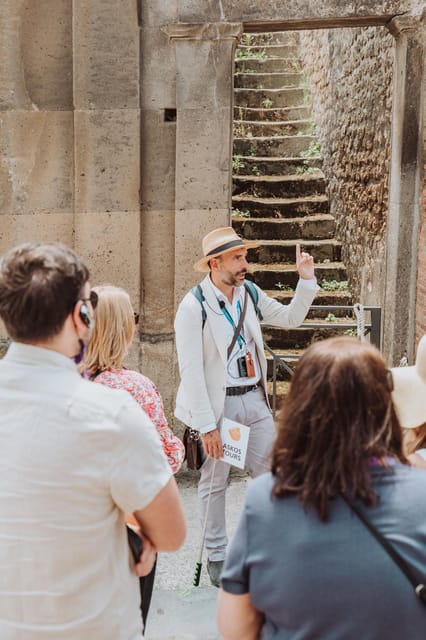
- A focused route through Pompeii’s essential sights: See the Marina Gate, Apollo Temple, Forum, House of the Faun, Lupanar, House of Menander, Macellum, and Forum Baths.
- An archaeologist adds useful context: The tour connects buildings with food, work, religion, family life, public bathing, and Roman society.
- Small-group size matters: With up to 20 people, you have a better chance of hearing the guide and asking questions than on a large coach-style visit.
- Skip-the-line entry saves energy: You use the Pompei Express entrance ticket and avoid waiting in the ticket queue.
- You can keep exploring afterward: Guides offer suggestions for seeing more of the enormous site once the formal walk ends.
- The tour works in six languages: Choose English, Spanish, French, Italian, Portuguese, or German when booking.
Why a guide changes Pompeii

Pompeii is not a single monument you can take in during a quick photo stop. It is a whole Roman town, buried by the eruption of Mount Vesuvius in 79 AD and preserved in a way that makes small details unusually important.
Without help, you can walk past a bakery, shrine, bathhouse, or wealthy home without knowing what made it special. A guide gives those stones a job and a setting. You begin to see where people shopped, worshipped, ate, bathed, met friends, and displayed their status.
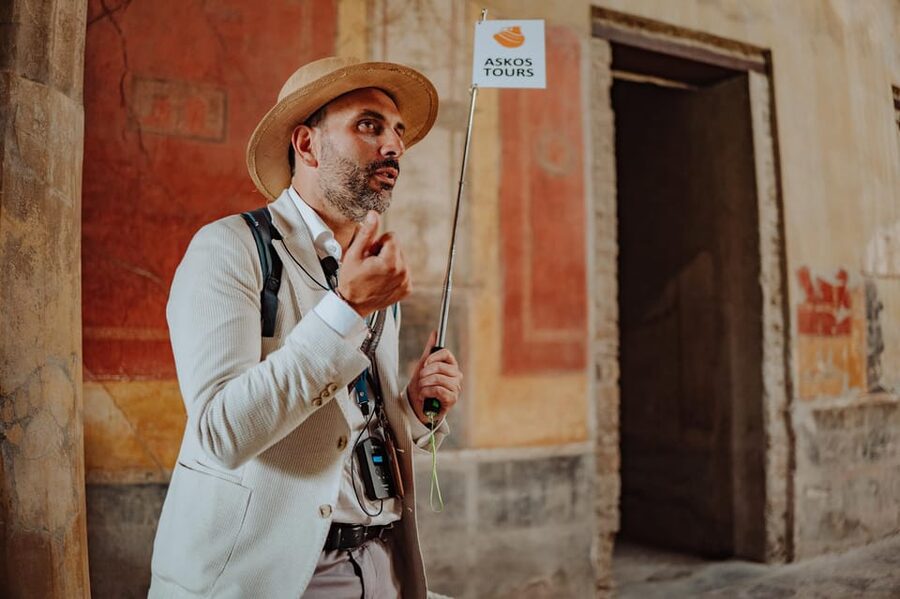
That is the real value of this tour. The archaeologist does not simply point at a column and give you a date. The best guides explain how the pieces fit together. Mario, for example, is praised for linking architecture with mythology, sociology, art, Roman philosophy, and daily life. Other guides, including Teresa and Alexandra, are noted for clear explanations, humor, and an easy way of making difficult subjects stick.
The route also helps you get your bearings. Pompeii is vast, and the streets can feel confusing even after you have studied a map. One guide advised allowing extra time after the walk because there is much more to see, while also warning that it is easy to get lost. That is useful advice: treat the guided portion as your introduction, not the complete visit.
More Pompeii excavation visits:
- Pompeii: Small Group Tour with an Archaeologist
★ 4.8 · 12,264 reviews - Pompeii: Skip-the-Line Entrance Ticket with Audio Guide
★ 4.0 · 2,509 reviews - Naples: Pompeii and Mt. Vesuvius with Lunch and Wine Tasting
★ 4.5 · 2,454 reviews
Starting at the Marina Gate and Apollo Temple
The usual meeting area is near Via Villa dei Misteri 2, though the exact point can vary with the option you book. Check your confirmation carefully and arrive with enough time to find the group. The included Pompei Express entrance ticket covers admission, while hotel pickup, transport, food, and drinks are not part of the package.
The walk begins around Porta Marina, one of Pompeii’s principal entrances. You may spend about 10 minutes passing through this area as the guide explains how the city connected to the outside world. It is a good opening because it puts Pompeii in practical terms: this was a working town with routes for people, goods, and public business.
Next comes the Temple of Apollo, also covered as a pass-by stop. Here, the guide can place religion within the wider Roman town. The temple is not treated as an isolated relic. It forms part of a civic center where religious, political, and commercial life overlapped.
These first stops are brief, so do not expect extended time at every column. Their purpose is to orient you before the longer sections at the Forum and major houses.
The Forum, where Pompeii gathered
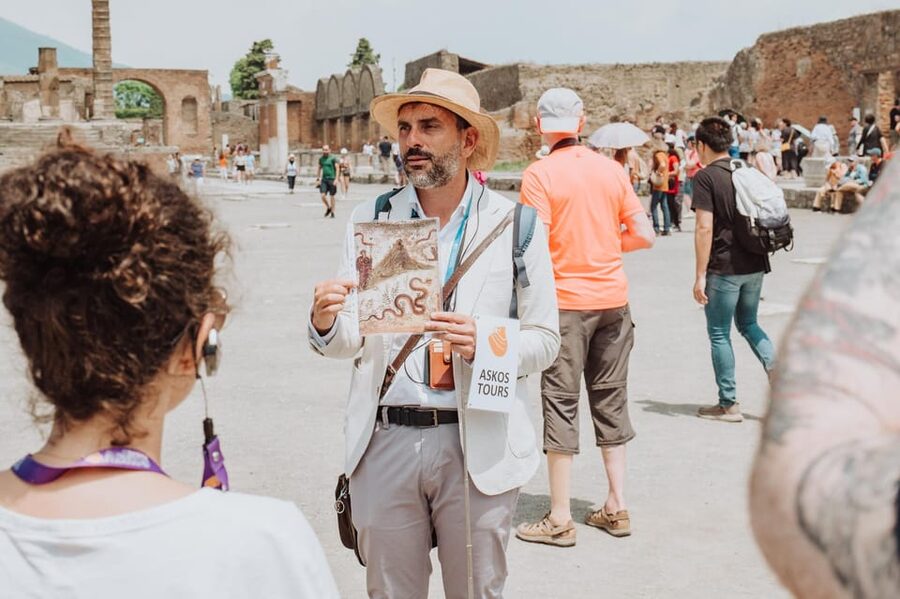
The Foro Civile di Pompei receives roughly 20 minutes. This is one of the most important parts of the walk because the Forum was the town’s public heart.
Look around before focusing on individual ruins. The scale and open space help you understand how Pompeii’s public life was organized. Temples, civic buildings, markets, and gathering areas met here, so the guide can explain more than architecture. You get a picture of who held power, where public business happened, and how religion shaped everyday routines.
I find this kind of explanation especially useful at Pompeii because many buildings are partial. A modern eye sees broken walls and scattered columns. A trained guide helps you picture the original relationship between those structures.
The Forum is also where the tour’s pace begins to make sense. Two hours is enough for a strong introduction, but not enough to inspect every room, inscription, fresco, and street. You will see the main pieces and get a plan for the rest.
The House of the Faun and private wealth
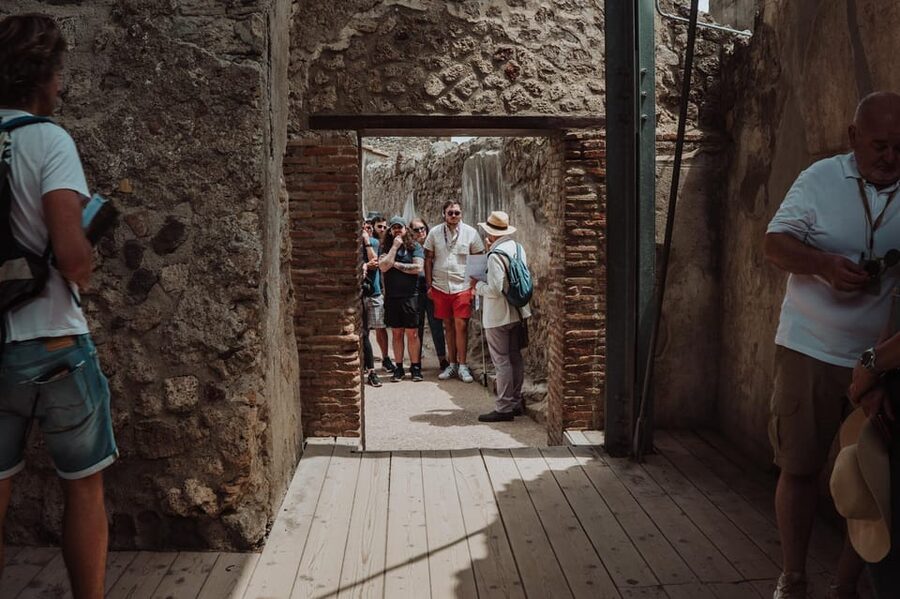
The House of the Faun gets about 20 minutes of guided attention. It is one of Pompeii’s celebrated residences and a key stop for understanding wealth, taste, and domestic space.
The house is valuable not only because it is large or famous, but because it lets you compare private life with the public buildings you have already seen. Your guide can point out the layout and details that reveal how a prosperous household presented itself.
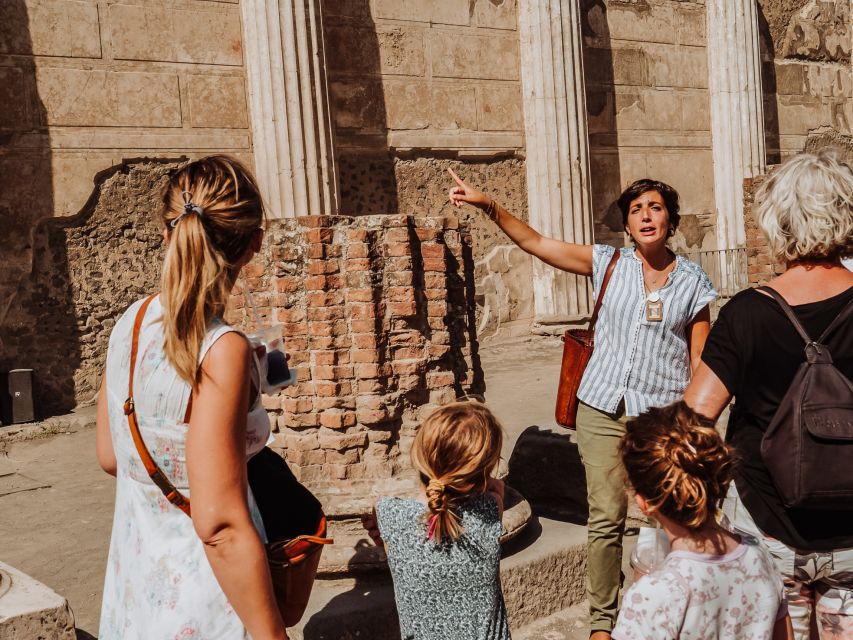
This is where an archaeologist’s training pays off. A guide may show you features you would otherwise walk past, then explain what they tell you about status and home life. The supplied descriptions emphasize the value of seeing Pompeii through the eyes of its ancient residents, rather than treating the city as a collection of scenic ruins.
Allow time for photos, but listen first. The most interesting details are often not the grandest ones. Small features can reveal how rooms were used and how a household welcomed guests.
More tours led by an archaeologist:
- Pompeii 3hours Villa of Mysteries tour with an Archaeologist
★ 4.8 · 486 reviews - Pompeii: Tour with Archaeologist Guide & Skip-the-Line Entry
★ 4.5 · 478 reviews - Pompeii and Herculaneum: Guided Tour with an Archaeologist
★ 5.0 · 164 reviews - Pompeii: Guided Tour with Archaeologist with max. 12 People
★ 5.0 · 155 reviews
The Lupanar and the less polished side of Roman life
The Lupanar, or brothel, receives another 20-minute guided visit. It is one of Pompeii’s most talked-about buildings, but the useful part is not simply its notoriety.
The stop gives your guide a chance to discuss a side of Roman urban life that is often left out of polished accounts of temples and villas. Expect the explanation to focus on the building and its social setting. This is a direct look at how commercial and personal life could overlap in an ancient town.
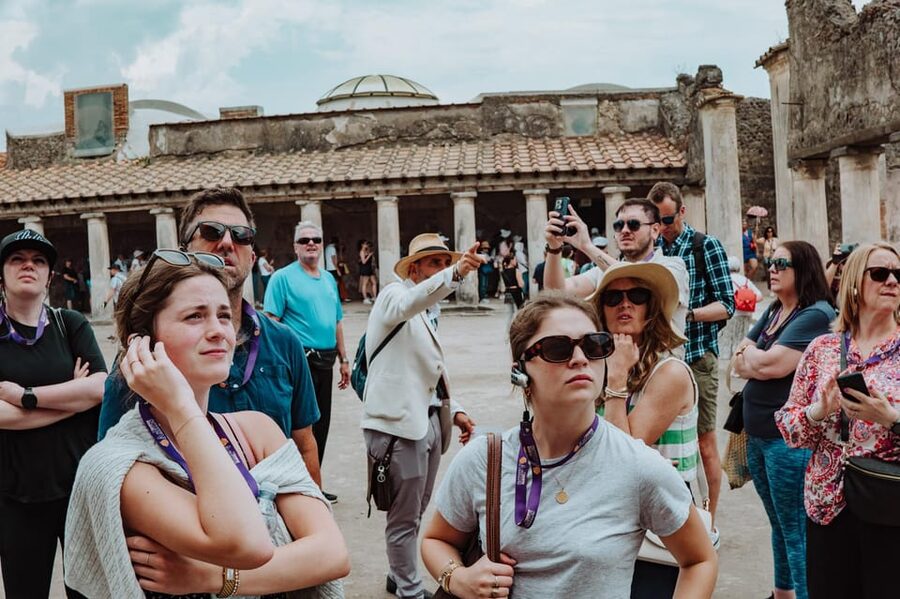
Because the Lupanar is popular, crowds may gather around the entrance or inside narrow spaces. If your group uses audio equipment, stay close enough to hear. Headsets are supplied for groups of 10 or more, but one recent account found the earpiece awkward in large crowds and had to hold it directly to the ear.
That is a minor equipment issue, not a reason to reject the tour. It is simply worth knowing that audio clarity depends on staying near the guide and keeping the receiver positioned properly.
The House of Menander and everyday Roman interiors
The House of Menander is scheduled for about 20 minutes. Like the House of the Faun, it moves the story indoors and gives you a better sense of domestic Pompeii.
The name points to the kind of cultural taste found in elite Roman homes, while the rooms and decoration help explain how a household expressed education, wealth, and identity. A good guide will connect what you see here with the people who lived and worked in such spaces.
Several guides are praised for bringing attention to regular people, not only the wealthy. That balance matters. Pompeii can easily become a parade of grand houses, yet the site is most affecting when you remember that servants, shopkeepers, laborers, families, and customers also used these streets.
The tour’s strongest thread is this movement between public and private life. You see civic Pompeii at the Forum, social and commercial life at the Lupanar, and household life in the residences.
Shops, food, and the Macellum
The Macellum receives around 10 minutes. This market building helps you picture Pompeii as a place where people bought food and met one another, not as a quiet town of empty walls.
The route also includes the Termopolium, an ancient food counter. This is one of the more memorable details for many people because it makes Roman eating habits feel close to modern experience. You are looking at a place designed to serve prepared food or drink, not merely a decorative room.
The Macellum and Termopolium are valuable stops for readers who prefer social history to grand monuments. Your guide can turn a counter, wall, or work surface into evidence of how people ate, traded, and moved through the city.
Do not expect a long meal break. Food and drinks are not included, and the activity is a continuous walking tour. If you plan to stay inside Pompeii afterward, carry water before entering or arrange your supplies in advance.
The Forum Baths and the plaster casts
The Forum Baths are covered for about 10 minutes. Public baths were important social spaces, and this stop rounds out the picture of Roman daily life. The guide can explain how bathing fit into the rhythm of the town and why these buildings mattered beyond washing.
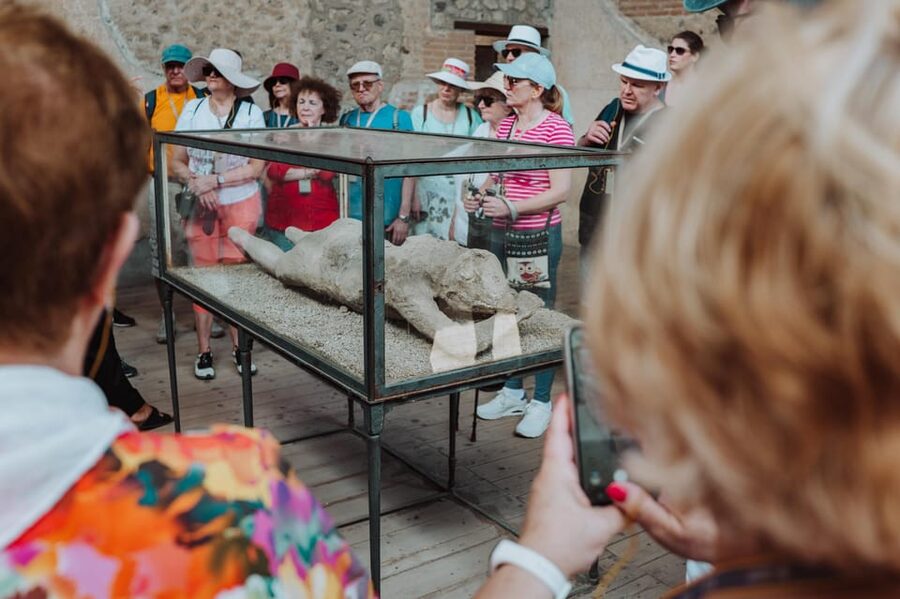
The route also includes the plaster casts of victims. This is the most emotionally difficult part of the visit for many people. These forms preserve the final positions of people caught by the eruption, turning the disaster from an abstract historical event into something painfully human.
The guide’s role here is important. A factual explanation can provide context without turning the casts into spectacle. Take your time, and remember that the tour moves through an active archaeological site where conditions and access can change.
The historic theaters are also included in the broader route. Together, the baths, theaters, market, homes, and Forum show a town with entertainment, work, worship, food, and civic life. Pompeii becomes a community rather than a ruin field.
What the two-hour pace feels like
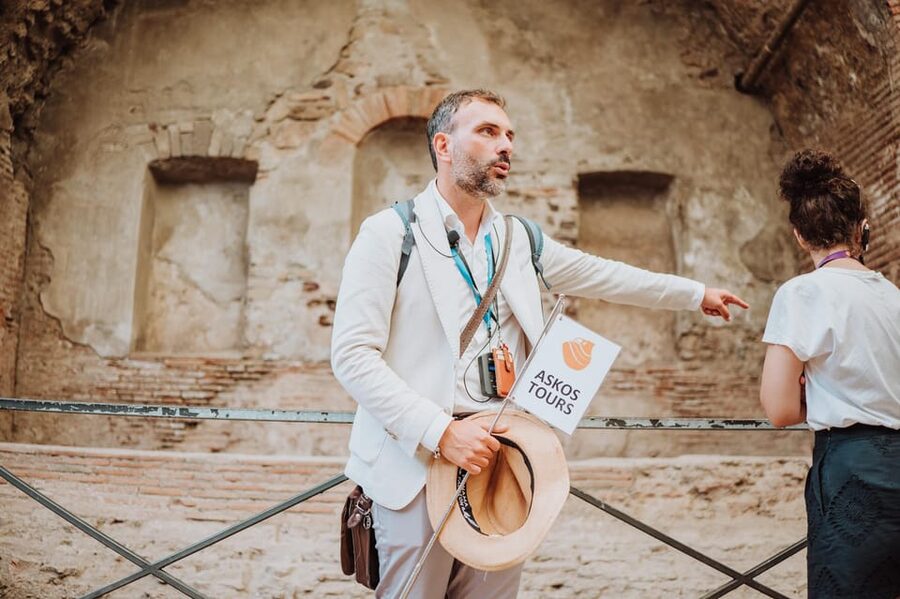
Two hours is a sensible length for a first visit. It is long enough to cover the major landmarks without making the history blur into one long lecture. Many guides keep the pace lively, add humor, and leave room for photos and questions.
You will walk a considerable distance. The ancient streets are uneven, and some areas require steps. A tour guide cannot remove those physical demands, so this experience is not suitable for wheelchair users, people with mobility impairments, or anyone using a mobility scooter.
Weather matters. The site offers little relief from hot sun or steady rain, and the open ruins can feel exposed. Several accounts describe enjoyable tours in poor weather, but a rain jacket, water, and comfortable shoes remain sensible choices. In warm conditions, hydration becomes even more important.
The group limit of 20 is a useful compromise. It is not a private tour, but it is small enough for a guide to maintain a route and answer questions. For groups of 10 or more, headsets are included. Keep close to the guide in busy areas so you do not lose the signal or the group.
Price, languages, and practical value
At $35 per person, this is fairly priced for Pompeii if you want an organized introduction rather than a self-guided wander. The admission ticket is included, the ticket line is skipped, and you get an archaeologist guide for two hours. Those three pieces remove much of the friction from a first visit.
The value depends on how you travel. If you already know Pompeii well and enjoy reading signs at your own pace, you may prefer a basic entry ticket and several hours alone. If this is your first visit, $35 buys structure at a site where it is easy to miss major buildings or waste time finding them.
The strongest value comes after the formal tour. Guides often suggest what to see next, and you can remain to explore more of the ruins on your own. Plan for that possibility. The guided walk is only an introduction to a very large archaeological area.
Tours are offered in English, Spanish, French, Italian, Portuguese, and German. Free cancellation is available up to 24 hours before the start, and you can reserve now and pay later, which helps if your Campania schedule is still shifting.
Who should book this Pompeii tour?
I would choose this tour for a first-time visitor who wants the major landmarks explained in plain language. It also suits anyone arriving by train from Naples, since one booking account describes a delayed train being handled with a change to a later time slot, though you should not assume every late arrival can be accommodated.
It is a good fit for history fans, families with older children, and anyone who wants stories about ordinary Roman life rather than a list of dates. The guides are repeatedly praised for humor, strong English, clear directions, and the ability to make Pompeii feel inhabited again.
I would think twice if you want a quiet, slow study of frescoes or plan to spend only a short time at the site. You may also find the route tiring if uneven paving and long walks are difficult.
Should you book it?
Book it if you want Pompeii to make sense on your first visit. The archaeologist-led route covers the Forum, major homes, baths, market, brothel, theaters, and plaster casts, then gives you a useful plan for continuing alone.
Skip it only if you already know the site well or strongly prefer total independence. At $35, with entry and skip-the-line access included, this is a practical way to turn a confusing ancient city into a readable one. Bring water, wear sturdy shoes, and leave extra time after the two-hour walk.
FAQ
How long is the Pompeii guided tour?
The tour lasts two hours. You can check available starting times when booking.
What places are included on the route?
The route includes Porta Marina, the Temple of Apollo, the Forum, the House of the Faun, the Lupanar, the House of Menander, the Macellum, and the Forum Baths. It also includes sights such as the Termopolium, theaters, and plaster casts along the way.
Is Pompeii entry included?
Yes. The Pompei Express entrance ticket is included, along with skip-the-ticket-line access.
What languages are available?
The live guide service is available in English, Spanish, French, Italian, Portuguese, and German.
Is the tour suitable for wheelchair users?
No. The activity is not suitable for wheelchair users or people with mobility impairments. Mobility scooters are also not allowed, and the ancient paths can be uneven with some steps.
Can I cancel or pay later?
You can cancel up to 24 hours in advance for a full refund. The reserve now and pay later option lets you hold a place without paying immediately.
Newest reviews from Pompei Campania
- Pompeii Private Tour for Kids and Their Families★ 4.8 · 4 reviews
- From Sorrento: Pompeii & Vesuvius tour small group★ 4.8 · 4 reviews
- From Naples_ Pompeii Tour_Skip the line ticket + audioguide★ 4.3 · 4 reviews
- Pompeii, skip-the-line ticket with smartphone audio guide on App★ 3.0 · 4 reviews
- Pompeii Guided Experience – Tour Service Only★ 4.6 · 4 reviews
- From Naples Port:Pompeii+Vesuvius tour★ 4.3 · 4 reviews
- 2-Hour Pompeii Child-Friendly Tour★ 5.0 · 4 reviews
- Naples: Amalfi Coast, Sorrento and Pompeii Day Trip★ 4.4 · 5 reviews
Archaeologist-Led Tours, compared.

Pompeii Small Group Tour with an Archaeologist
Read our review →
Pompeii and Herculaneum Small Group Tour with an Archaeologist
Read our review →
Skip the Line Guided Tour of Pompeii led by an Archaeologist
Read our review →
Exclusive Tour with Archaeologist and Entry Tickets
Read our review →
Pompeii Private Tour with an Archaeologist and Skip The Line – 3 hours
Read our review →
Pompeii Skip-the-line Tour with Archaeologist Guide
Read our review →
Browse the lists this tour appears in