
Reviewed · ARCHAEOLOGIST-LED TOURS
Pompeii Small Group Tour with an Archaeologist
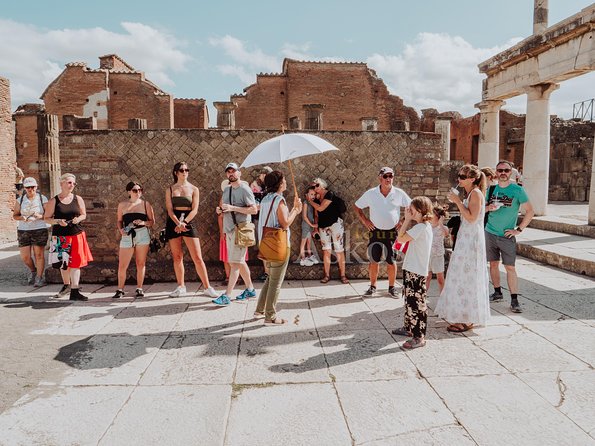
Pompeii makes a poor museum and a superb guided walk. Its streets, homes, shops, baths, theaters, and wall paintings are spread across a huge archaeological park, so the real trick is knowing where to look and what you are seeing. This tour puts an archaeologist guide beside you from the Porta Marina Superiore entrance and leads you straight to the site’s major landmarks.
I like two things right away: the route gives you a useful overview in about two hours, and the guide explains Pompeii through the lives of its residents, not just dates and building names. I also like that you can stay inside the ruins afterward and continue at your own pace.
The main consideration is the group size, which can reach 20 people per guide. That is still small enough to follow a guide, but it may feel crowded at popular rooms and mosaics. The site also has uneven paving, steps, ramps, and some steep stretches, so sturdy shoes matter.
In This Review
- Key points to know before booking
- Why Pompeii is better with a guide
- Meeting at Porta Marina Superiore
- Basilica and Forum: Pompeii’s public heart
- The Forum granaries and the plaster casts
- Walking an original Pompeii street
- House of Menander: art and status behind the walls
- Stabian Baths: a look at daily Roman life
- The Lupanar and Pompeii’s less polished side
- House of the Faun: Pompeii at its grandest
- The Odeon and Teatro Grande
- What the two-hour schedule really gives you
- Group size, headsets, and guide quality
- Is $35.67 a fair price?
- Who should book this Pompeii walk?
- Should you book it?
- FAQ
- Where does the Pompeii tour meet?
- How long does the tour last?
- What does the ticket include?
- What sites are included on the route?
- Can I continue exploring Pompeii after the tour?
- Is the tour suitable for people with mobility issues?
- What happens if I cancel?
Key points to know before booking
- A licensed archaeologist leads the walk: Guides such as Alessandra, Paolo, Teresa, Amedeo, Vincenzo, and Antonio have been praised for clear explanations, humor, and strong storytelling.
- The route covers Pompeii’s essential sights: You visit the Basilica, Forum, plaster casts, House of Menander, Stabian Baths, Lupanar, House of the Faun, Odeon, and Teatro Grande.
- The Pompeii Express ticket is included: You meet at Porta Marina Superiore and enter with the group’s admission arranged.
- The tour ends inside the ruins: This is useful because you can keep exploring after the guide finishes instead of walking back to the entrance immediately.
- Expect a lot of walking: Original Roman paving, ramps, steps, and little shade make comfortable shoes, sunscreen, a hat, and water important.
- The $35.67 price is good for a first visit: You are paying for site admission plus a focused guided route, though a smaller private group would suit visitors who want more time for questions.
Why Pompeii is better with a guide
Pompeii is not one monument with a clear path around it. It is an entire buried city, and the scale can catch you off guard. You can walk for a long time while seeing impressive walls and paving stones without understanding what each space once did.
That is where this tour earns its keep. The guide gives each building a purpose and a human setting. The Basilica becomes a place for business and public dealings. The Forum becomes the city’s main square rather than just a broad open space. A bath complex becomes part of ordinary Roman life, not simply another set of old walls.
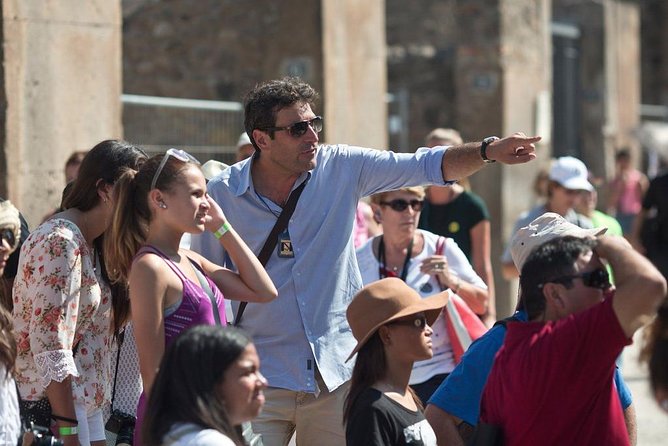
The best guides also connect the ruins to the eruption and its aftermath. Alessandra has been especially praised for explaining current excavations and future preservation work, while Paolo has been noted for his concern for protecting the site. Guides including Teresa and Vincenzo are described as strong storytellers, and Amedeo is praised for keeping children involved.
You should not expect every guide to tell the same story in exactly the same way. Each guide chooses certain places for fuller explanation, which can make the route feel personal and lively. It also means one guide might spend longer on a house, while another gives more time to public buildings or the eruption casts.
More Pompeii excavation visits:
- Pompeii: Entry Ticket and Guided Tour with an Archaeologist
★ 4.8 · 19,459 reviews - Pompeii: Entry Ticket with Optional Audio Guide
★ 4.2 · 12,360 reviews - Pompeii: Small Group Tour with an Archaeologist
★ 4.8 · 12,264 reviews
Meeting at Porta Marina Superiore
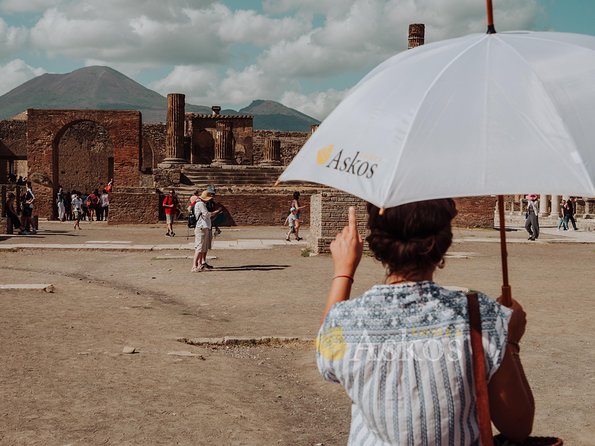
The meeting point is at Via Villa dei Misteri 2, by the main entrance known as Porta Marina Superiore. Look for the guide holding a sign with Askos Tours at the top. Arrive with enough time to identify the meeting spot and settle in before the scheduled departure.
The included Pompeii Express entrance ticket is intended to get the group inside without the standard ticket-buying delay. The tour provider describes this as skip-the-line access, though you should still allow time for meeting the guide and passing site checks.
Late arrival is a serious risk here. Pompeii is large, phone reception inside can be poor, and the guide cannot easily leave a moving group to find people who arrive late. If you miss the start by a substantial amount, you may receive the entrance ticket but be unable to join the guided walk, with no refund for a late cancellation or missed start.
Basilica and Forum: Pompeii’s public heart
The first major stop is the Basilica, an open portico that sheltered merchants and public activity. It is a useful introduction because your guide can explain how business and civic life worked in a Roman city before you move into the private homes.
From there, the route continues to the Forum. This was Pompeii’s main public square, and its broad scale helps you grasp how important the city once was. Your guide can point out the arrangement of public buildings and explain how the Forum fit into daily life.
This opening section is less about ornate decoration and more about orientation. I like that choice. If you start with a famous fresco or a body cast, you may remember the shock but miss the city’s basic structure. Starting with the public center gives the rest of the walk a clear frame.
The Forum granaries and the plaster casts
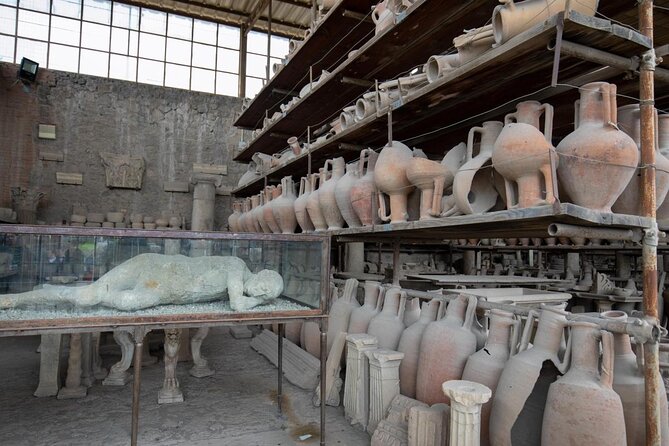
At the Forum granaries, you see marble tables, fountain elements, and plaster casts connected with victims of the eruption. The casts include people, a dog, and a tree. This is one of the most emotional moments of the tour, and it deserves a little quiet attention.
The casts are not simply displays of tragedy. They also show how archaeologists recorded empty spaces left in the hardened volcanic material. Your guide can help you understand what you are looking at without reducing the scene to a grim spectacle.
This stop can be difficult for children or anyone sensitive to images of death. At the same time, it gives the eruption a human scale. The rest of Pompeii can feel like an open-air architectural site. Here, the lives interrupted in the disaster come sharply into view.
More tours led by an archaeologist:
- Pompeii and Herculaneum Small Group Tour with an Archaeologist
★ 5.0 · 1,350 reviews - Skip the Line Guided Tour of Pompeii led by an Archaeologist
★ 5.0 · 703 reviews - Pompeii: Exclusive Tour with Archaeologist and Entry Tickets
★ 4.9 · 634 reviews - Pompeii Private Tour with an Archaeologist and Skip The Line – 3 hours
★ 5.0 · 564 reviews
Walking an original Pompeii street
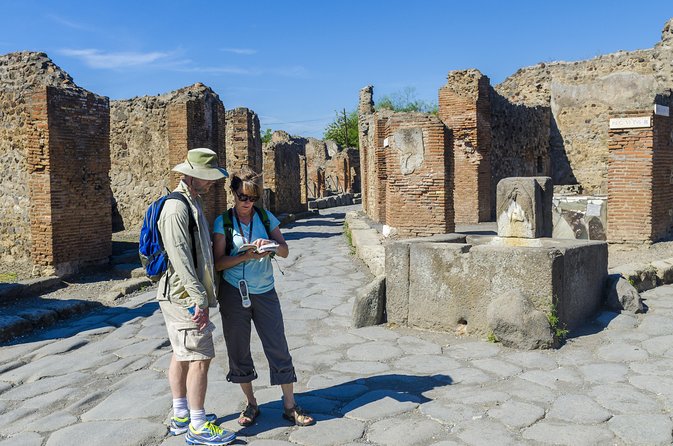
Between the main stops, you walk along the city’s original paved roads. These streets are among the most memorable parts of Pompeii, but they are also where the physical demands of the tour become clear.
The ground is uneven, and some routes include steps, ramps, and short steep climbs. Large paving stones can make a smooth modern walking rhythm impossible. Wear trainers or sturdy walking shoes, not thin sandals or footwear with poor grip.
Summer brings strong sun and limited shade. Bring a small bottle of water, sunglasses, sunscreen, and a hat. The tour runs all year, rain or shine, so check the weather and dress for exposed walking rather than an indoor museum visit.
House of Menander: art and status behind the walls
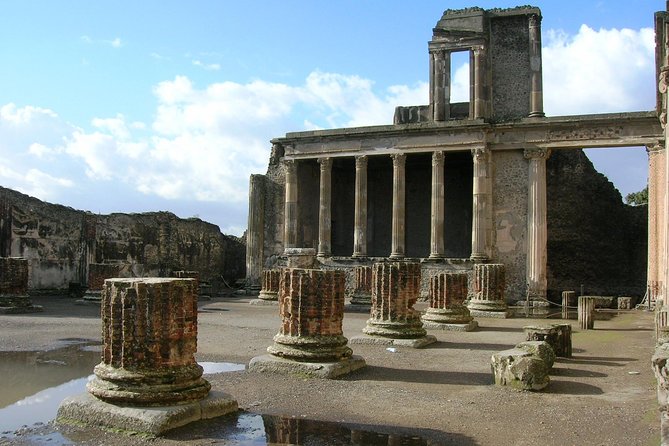
The House of Menander is one of Pompeii’s most impressive private residences. Its architecture, decoration, and contents reflect the wealth and social position of its owners.
This is where the archaeologist guide’s training becomes particularly helpful. A large Roman house is not always easy to read from the remaining walls. You need help seeing how rooms connected, how decoration signaled status, and how a residence functioned as more than a family home.
The stop is also a good balance to the public buildings earlier in the route. Pompeii was not only forums and official spaces. It was a city of households, social rank, private ceremonies, domestic work, and carefully displayed wealth.
Stabian Baths: a look at daily Roman life
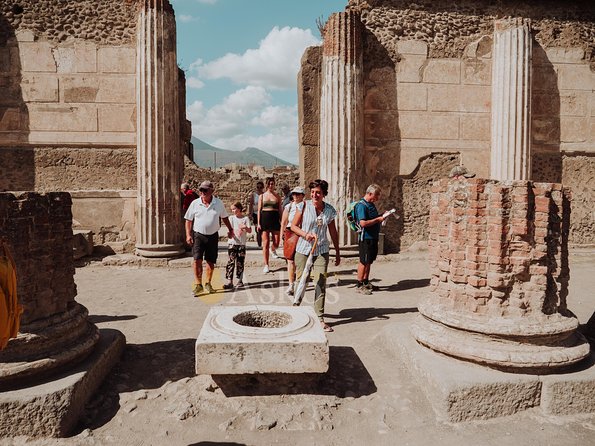
The Stabian Baths occupy a broad area near the Brothel lane, the Holconius crossroads, and Via Stabiana. They are described as Pompeii’s oldest thermal complex, making them an important stop for understanding public bathing.
Your guide can explain the baths as a social setting as well as a place for washing. Roman bath complexes were part of the rhythm of city life, and the layout gives you a better sense of the engineering and organization behind them.
The baths can be challenging to appreciate on a rushed self-guided visit because several rooms may look similar at first glance. A guide helps you separate function from appearance and notice details you might otherwise pass by.
The Lupanar and Pompeii’s less polished side

The Lupanar is Pompeii’s most famous brothel. It is a small, popular stop, so the group may need to wait while everyone gets a look inside.
The attraction is not only the subject matter. The rooms, wall images, and compact layout reveal a less formal side of Roman urban life. The guide can place the building in the wider setting of the city and explain what can and cannot be confidently inferred from the evidence.
This stop may not suit every family, particularly if you are visiting with young children. For older children and teenagers, the guide’s measured explanation can make it a useful lesson in how archaeologists interpret ancient spaces without turning the subject into a joke.
House of the Faun: Pompeii at its grandest
The House of the Faun was one of Pompeii’s largest and most impressive private residences. Its name comes from a statue of a dancing faun, and its scale gives you a striking sense of how much space wealthy residents could command.
This is one of the places where the two-hour route can feel selective rather than exhaustive. You will see an important residence and its major features, but you will not have time to inspect every room at length. That is a fair trade for reaching several different parts of Pompeii in one visit.
If you are fascinated by Roman houses, mosaics, and domestic design, you may want to return to this area after the tour ends. The guided visit gives you the basic structure and meaning, then your extra time lets you look more closely.
The Odeon and Teatro Grande
The brief stop at the Teatro Piccolo, or Odeon, introduces Pompeii’s smaller theater. It is followed by Teatro Grande, the city’s largest and most important theater.
The contrast between the two venues is useful. You can see that entertainment in Pompeii was not a single activity in a single building. The theaters formed part of civic and social life, and their design helps show how performances fit into the city.
Teatro Grande is the final scheduled stop, which gives the tour a satisfying finish. The route has moved from government and commerce to homes, baths, private pleasures, and public entertainment. You leave with a broad picture of the city rather than a string of unrelated ruins.
What the two-hour schedule really gives you
Two hours is enough for a strong first orientation, not a complete visit to Pompeii. The site is too large for that. The route moves at a practical pace and gives you access to major landmarks, but each stop receives roughly 10 to 15 minutes.
I like this format for a first visit because it prevents Pompeii from becoming overwhelming. The guide selects a sensible sequence, handles the basic navigation, and explains the sites while you still have energy. Several guides also point out areas worth seeing on your own after the official walk.
Do not treat the end of the tour as the end of your Pompeii visit. The walk finishes inside the ruins, so use that advantage. Continue to a building that caught your interest, revisit a house, or follow another route if you have the time and energy.
One caution: get clear directions before separating from the guide. A useful practical criticism of the experience is that some visitors may not receive enough help locating the best exit afterward. Pompeii’s internal paths can be confusing, and the entrance is not always the most convenient place to finish your day.
Group size, headsets, and guide quality
The maximum group size is 20 people per guide. That is smaller than a large coach excursion, but it is not an intimate private tour. At popular rooms, you may need to wait for people at the back of the group to reach the guide or view a key detail.
Headsets are supplied for groups of 16 or more. They should make it easier to hear while standing near busy areas, but equipment can occasionally cause delays. One poor experience involved a late start and headset problems, followed by a long stationary explanation. That is not the normal expectation to plan around, but it is a fair reminder that the flow can vary.
The strongest praise centers on the guides themselves. Alessandra is described as engaging, precise, and especially good with families. Paolo is praised for his care with the site and his patient answers. Teresa is noted for pacing the walk around the group’s abilities, while Vincenzo brings humor to the archaeological setting.
You should book this tour for the guide’s interpretation, not just for admission. If you only want a ticket and prefer to wander alone, the guided portion may feel restrictive. If you want to understand what you are looking at, the added explanation is the main value.
Is $35.67 a fair price?
At $35.67 per person, the price is reasonable for a licensed guide, included Pompeii Express admission, and a focused two-hour route. You avoid paying separately for a full private guide while still getting more context than a map or audio-only visit can offer.
The value is strongest if Pompeii is new to you and you have limited time. The guide helps you see the major public spaces, a wealthy home, baths, the brothel, theaters, and the eruption casts without spending your first hour trying to understand the map.
The value is less clear if you already know the site well or want long, quiet periods at individual houses. The group can include up to 20 people, and the schedule does not allow every room to receive equal attention. Visitors who want a slower pace or tailored accessibility support should ask about a private option instead.
Free cancellation is available up to 24 hours before the start time. Within 24 hours, cancellation changes are not accepted and the payment is not refunded.
Who should book this Pompeii walk?
I would choose this tour for first-time visitors, families with older children and teenagers, and anyone arriving with only part of a day. It is also a good fit if you want an archaeologist’s explanation of the site but do not want to pay private-tour prices.
The route suits people who enjoy a mixture of civic buildings, houses, public baths, intimate spaces, and theaters. It also works well for visitors who plan to keep exploring after the guide finishes.
Think twice if you have significant mobility limitations. Mobility scooters are not allowed, and the tour is not recommended for people with mobility issues because of steps, ramps, uneven paving, and short steep climbs. Contact the provider about a suitable private tour if you need a route adapted to your needs.
Small dogs up to 10 kilograms and 40 centimeters in height are permitted, subject to leash and carrying rules inside buildings. Service animals are allowed. Children must be accompanied by an adult, and anyone under 18 should bring an ID card or passport.
Should you book it?
Book this tour if you want Pompeii to make sense quickly. The archaeologist guide gives you a clear route through a very large site, and the mix of public buildings, homes, baths, casts, and theaters covers the city’s major themes.
I would especially consider it if you can stay inside afterward and explore alone. That combination gives you the best balance: expert context first, personal wandering second.
Skip it only if you strongly prefer complete independence, need a very slow pace, or want a private guide with more time at selected buildings. For most first visits, $35.67 is a sensible price for getting your bearings and seeing the highlights without missing the human story behind the ruins.
FAQ
Where does the Pompeii tour meet?
Meet at Porta Marina Superiore, the main entrance of the Pompeii Archaeological Park, at Via Villa dei Misteri 2, 80045 Pompei. The guide holds a sign with Askos Tours at the top.
How long does the tour last?
The guided experience lasts approximately two hours.
What does the ticket include?
The tour includes a Pompeii Express entrance ticket, guidance for the full tour, and a licensed guide with an archaeological background. Headsets are included for groups of 16 or more.
What sites are included on the route?
The route includes the Basilica, Forum, Forum granaries with plaster casts, House of Menander, Stabian Baths, Lupanar, House of the Faun, Teatro Piccolo, and Teatro Grande.
Can I continue exploring Pompeii after the tour?
Yes. The tour ends inside the ruins, allowing you to continue exploring independently after the guided portion.
Is the tour suitable for people with mobility issues?
It is not recommended for travelers with mobility issues because the site has steps, ramps, uneven ground, and some steep climbs. Mobility scooters are not allowed. You can contact the provider about a suitable private tour.
What happens if I cancel?
You receive a full refund if you cancel at least 24 hours before the start time. Cancellations or changes made within 24 hours are not accepted and are not refunded.
Newest reviews from Pompeii Ruins
- Private Tour Pompeii and Winery★ 5.0 · 4 reviews
- Visit the Pompeii ruins from Salerno with Pizza Lunch★ 5.0 · 4 reviews
- Pompeii Private Tour for Kids and Their Families★ 4.8 · 4 reviews
- From Sorrento: Pompeii & Vesuvius tour small group★ 4.8 · 4 reviews
- Pompeii Sorrento and Positano Tour★ 5.0 · 4 reviews
- From Naples_ Pompeii Tour_Skip the line ticket + audioguide★ 4.3 · 4 reviews
- Pompeii Private Half-Day Tour from: Naples,Sorrento, Amalfi Coast★ 5.0 · 4 reviews
- Pompeii, skip-the-line ticket with smartphone audio guide on App★ 3.0 · 4 reviews
Archaeologist-Led Tours, compared.

Entry Ticket and Guided Tour with an Archaeologist
Read our review →

Pompeii and Herculaneum Small Group Tour with an Archaeologist
Read our review →
Skip the Line Guided Tour of Pompeii led by an Archaeologist
Read our review →
Exclusive Tour with Archaeologist and Entry Tickets
Read our review →
Pompeii Private Tour with an Archaeologist and Skip The Line – 3 hours
Read our review →
Pompeii Skip-the-line Tour with Archaeologist Guide
Read our review →
Browse the lists this tour appears in