
Reviewed · ARCHAEOLOGIST-LED TOURS
Pompeii and Herculaneum Small Group Tour with an Archaeologist
Pompeii gives you the grand Roman city: a forum, theaters, baths, villas, shops, and streets frozen by Vesuvius. Herculaneum is smaller but more intimate, with carbonized wood, vivid frescoes, and remarkably preserved houses. Seeing both in one day helps you understand how Roman life worked at different scales.
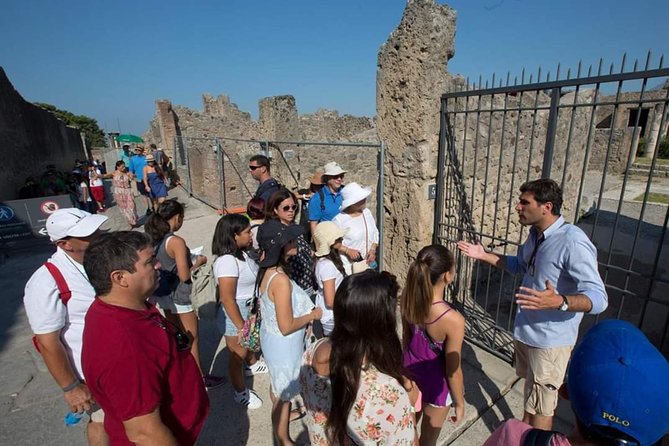
I like the archaeologist-led commentary, especially when guides such as Michele, Diego, Michael, Paulo, and Antonio connect a plain wall or threshold with daily life. I also like the transport options, included admission, and skip-the-line entry. The catch is simple: two hours at Pompeii is enough for highlights, not a full visit, and the day can feel hurried.
In This Review
- Key points to know before booking
- Why seeing Pompeii and Herculaneum together works
- Pompeii begins with the city’s public heart
- Villas, baths, and the clues they leave behind
- Pompeii’s theaters show another side of Roman life
- The lunch break is practical, not atmospheric
- Getting between the sites
- Herculaneum reveals the details Pompeii often loses
- Herculaneum’s baths and houses reward close attention
- What the archaeologist guide adds
- Timing, group size, and physical demands
- Is $77.09 a good value?
- Should you book this Pompeii and Herculaneum tour?
- FAQ
- How long does the tour last?
- How much does the tour cost?
- Are Pompeii and Herculaneum admission tickets included?
- Where do I meet the guide?
- How do I travel from Pompeii to Herculaneum?
- Is transportation included from Naples?
- Is transportation included from Sorrento?
- Does the Rome option include train tickets?
- Is lunch included?
- How many people can join the tour?
- Can I cancel for a refund?
Key points to know before booking
- Two major Roman sites in one day: Spend about two hours at Pompeii, then about two hours at Herculaneum.
- Archaeologist guides: Guides including Michele, Diego, Michael, Paulo, Antonio, and Alfredo have earned strong praise for clear explanations and lively storytelling.
- Admission is included: The package covers Pompeii Express and Herculaneum entry tickets.
- Transport depends on your starting point: Naples, Sorrento, and Rome departures use a minibus, while the Pompeii option uses the Circumvesuviana train to Herculaneum.
- Lunch is not included: Plan for a short break at your own expense, and consider carrying a snack.
- Small group format: The maximum group size is 20, with headsets supplied so you can hear the guide.
Why seeing Pompeii and Herculaneum together works
Pompeii and Herculaneum were both buried by the eruption of Mount Vesuvius in AD 79, but they tell different stories. Pompeii is the sprawling city. Its broad streets, public buildings, theaters, and huge private homes show how an entire community functioned.
Herculaneum is more compact. It feels less like walking through a city plan and more like entering a set of Roman houses. Its preservation is the surprise. Wooden partitions, door frames, balconies, and household details survived because the eruption buried the town in hot volcanic material.
That contrast is the main reason I like this tour. At Pompeii, you see the civic machine. At Herculaneum, you see domestic life close up. A guide can make the comparison clear instead of leaving you to sort out two enormous archaeological sites with a map and a guidebook.
The price is $77.09 per person. That is a reasonable package if you need transport from Naples, Sorrento, or Rome and want both admission tickets and guided visits handled together. The value is weaker if you are already staying beside Pompeii and prefer to explore slowly. In that case, the tour gives you structure and expertise, but less free time.
More Pompeii excavation visits:
- Pompeii: Entry Ticket and Guided Tour with an Archaeologist
★ 4.8 · 19,459 reviews - Pompeii: Entry Ticket with Optional Audio Guide
★ 4.2 · 12,360 reviews - Pompeii: Small Group Tour with an Archaeologist
★ 4.8 · 12,264 reviews
Pompeii begins with the city’s public heart
The Pompeii portion lasts about two hours, beginning at the meeting point at Porta Marina Superiore for the Pompeii departure. The route moves through several of the city’s most important public and private spaces.
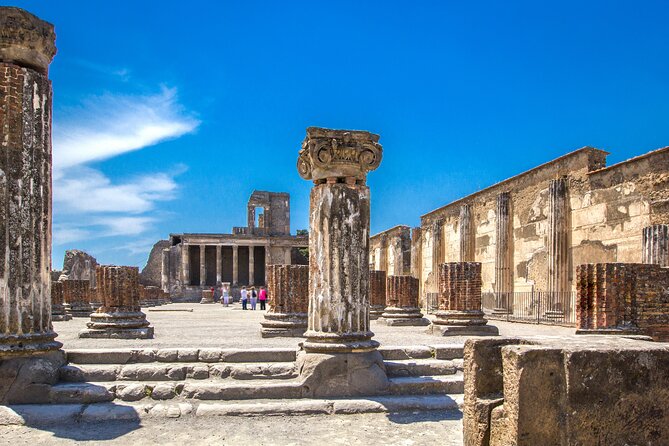
The Basilica comes first. This was an open portico used for business and other public activity. It is not the easiest place to appreciate without context, since much of its meaning comes from understanding how Roman civic and commercial life operated. Your archaeologist guide can explain why the building mattered even though its walls are now incomplete.
From there, you reach the Forum, Pompeii’s main square. This is the city’s political and religious center, framed by temples, civic buildings, and public spaces. You will also walk along Pompeii’s main street, where the ancient road layout gives you a better sense of the city as a working place rather than a collection of ruins.
The time here is short. The guide needs to keep the group moving, so you should expect explanation and orientation rather than long periods to sit, sketch, or photograph each view.
Villas, baths, and the clues they leave behind
The House of Menander is one of Pompeii’s most impressive residences. Its size, decoration, and contents show the wealth of an elite household. The name comes from a painted image of the Greek playwright Menander, a reminder that Roman domestic taste drew heavily from Greek art and literature.
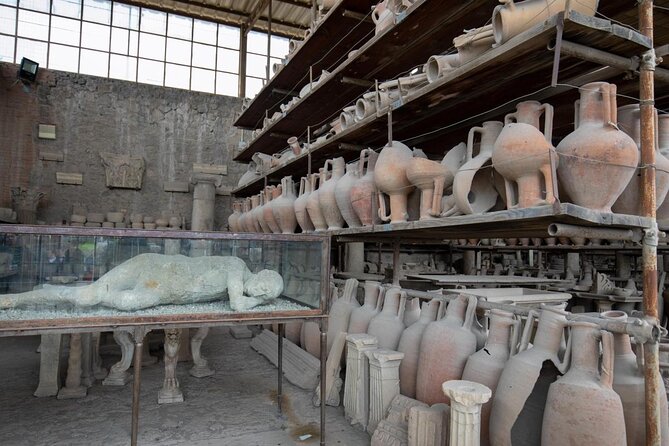
The Granaries of the Forum offer a different kind of experience. Here, you can see marble tables, fountain basins, architectural pieces, and some of the plaster casts associated with the eruption. The casts are emotionally difficult. They are not simply archaeological objects; they preserve the final positions of people and animals caught in the disaster.
The Stabian Baths show how public bathing worked in ancient Pompeii. This is the oldest thermal complex in the city and occupies a large area near several streets and crossroads. A guide’s explanation helps you distinguish the practical parts of a bath complex, including areas for changing, washing, and social life.
The Lupanar, Pompeii’s famous brothel, is another popular stop. Its small rooms and surviving erotic paintings often draw attention, but the more useful lesson is how the building fits into the ordinary street life of the city. It is a quick visit, and crowds can make it hard to linger.
The House of the Faun is one of Pompeii’s grandest private homes. Its scale, courtyards, and decoration show what an elite residence could look like. The house is especially helpful for seeing how Roman homes were arranged around open spaces, with rooms leading from one part of the property to another.
Pompeii’s theaters show another side of Roman life
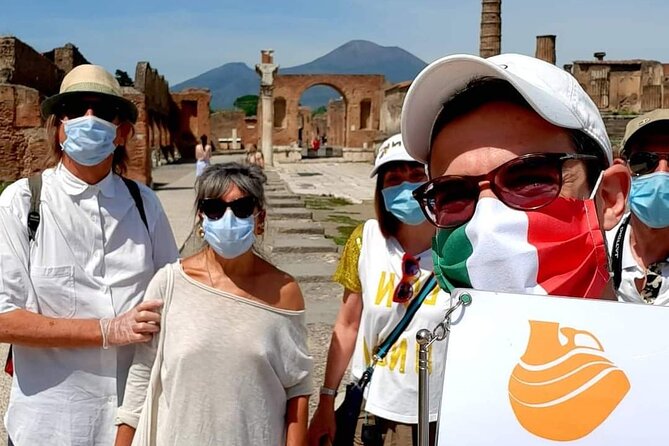
The Odeon, also called the Teatro Piccolo, was a smaller theater designed for performances that needed a more intimate setting. The Teatro Grande was the city’s main theater and could accommodate much larger events.
These stops add welcome variety after the houses and baths. They also make the city feel social. Pompeii was not only a place of work, worship, and household routine. It was a place where people gathered for performances and public events.
Some tour members have found the Pompeii schedule too quick, particularly because the site is so large. That is a fair concern. You may see the Forum, House of the Faun, baths, brothel, theaters, and selected plaster casts, but you will not cover every neighborhood or building.
One useful approach is to treat the Pompeii visit as a strong introduction. If the city grabs you, plan a second visit with more time. The guided route helps you avoid missing the central sights, while a return visit lets you explore at your own pace.
More Herculaneum excavation visits:
- Pompeii: Small-Group Tour of Pompeii and Herculaneum
★ 4.8 · 867 reviews - Guided Day Tour of Pompeii and Herculaneum with Light Lunch
★ 4.5 · 311 reviews - Private Day Tour to Vesuvius, Herculaneum & Pompeii with Pick Up
★ 5.0 · 279 reviews - Pompeii and Herculaneum: Guided Tour with an Archaeologist
★ 5.0 · 164 reviews
The lunch break is practical, not atmospheric
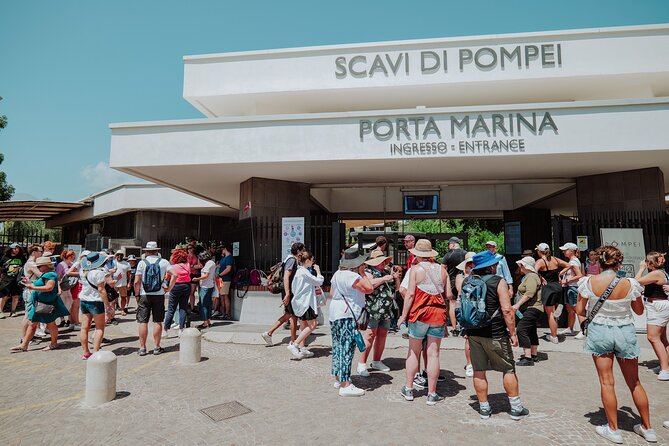
After Pompeii, there is a short lunch break before the transfer to Herculaneum. Meals and drinks are not included, and one reported schedule used a mall stop with several food choices, including pizzerias.
This arrangement is practical, but it may not match the mood you want after visiting an ancient city. If you dislike spending part of the day in a modern commercial setting, bring a picnic or snack where permitted, or plan to buy something quickly. The break is not designed as a food tour, and a long restaurant meal would make the already tight schedule even tighter.
For Pompeii departures, it is especially sensible to carry a snack before boarding the train. The transfer to Herculaneum takes about 30 minutes, followed by a walk of roughly 10 minutes from Ercolano Scavi station.
Getting between the sites
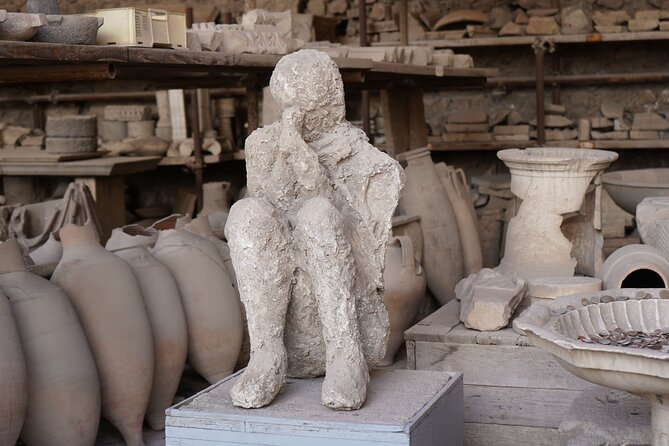
The transport plan changes with your departure city.
From Naples, you meet outside Starhotels Terminus and travel by modern minibus. The same applies to the Sorrento option, which meets at Piazza Angelina Lauro. The Rome option includes train tickets to and from Naples, plus full-day transport service. You are dropped at Naples station at the end of the day.
If you start in Pompeii, you meet at Porta Marina Superiore and receive a one-way Circumvesuviana train ticket to Herculaneum. The guide accompanies you during this transfer, but the return to Pompeii is not part of the tour. If your car or accommodation is in Pompeii, you need to arrange your own return.
That detail matters. The Pompeii departure is useful if you want to see both sites without arranging the train yourself, but it is not a round-trip transport package. Check your end point before booking.
Herculaneum reveals the details Pompeii often loses
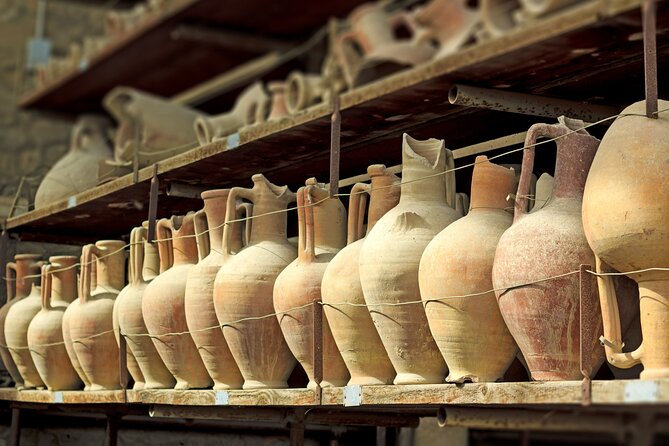
The Herculaneum visit lasts about two hours. You enter with the guide and visit a series of houses, public buildings, and baths.
The House of the Deer takes its name from marble statues of stags found in its peristyle. The terrace of Marcus Nonius Balbus honors a major local benefactor who restored and built public buildings. His funeral altar and inscription show how civic generosity could shape a Roman town.
The College of the Augustales was linked to the cult of the emperor Augustus and may also have served as a local administrative center. The Casa del Rilievo di Telefo is unusual because it had private access to the adjoining Suburban Baths. These buildings help show the connection between private wealth, public service, and religious duty.
The House of the Wooden Partition is one of Herculaneum’s memorable stops. Its elegant wooden divider survived in carbonized form, offering a rare look at a material that usually disappears from ancient sites. The House of the Skeleton gets its name from human remains found in an upper room in the 19th century.
These are the moments when Herculaneum feels different from Pompeii. Pompeii gives you streets and scale. Herculaneum gives you the texture of rooms, doors, furniture details, and household design.
Herculaneum’s baths and houses reward close attention
The Central Baths were built around the beginning of the first century AD and were divided into separate men’s and women’s sections. They are smaller than the Stabian Baths at Pompeii, but the comparison is useful. You can see how similar public needs were handled in two neighboring towns.
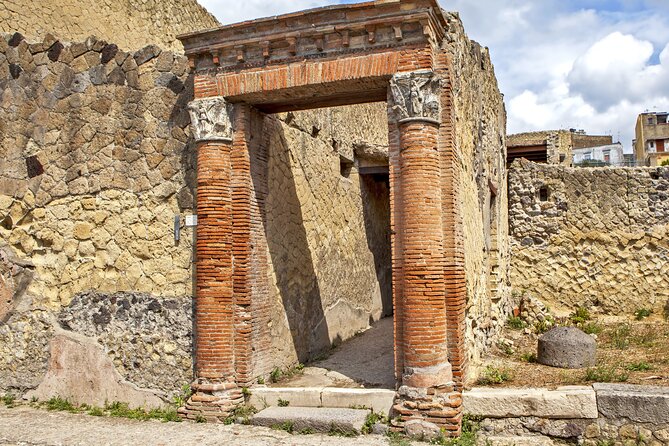
The House of the Black Hall is a luxurious mansion with a monumental entrance. Carbonized doorposts and a lintel remain in place, making the doorway unusually expressive. The Casa Sannitica has an atrium surrounded by a gallery with Ionic columns, along with rooms decorated with frescoes.
The Casa del Bel Cortile has an unusual plan. Instead of the more familiar atrium arrangement, it centers on a courtyard with a stairway and stone balcony. The House of the Grand Portal adds more decorated rooms, colonnades, frescoes, and charred wooden elements.
A guide is most useful here because the buildings can look like a maze of walls at first. Paulo, Diego, Michael, Michele, and Antonio are among the guides praised for answering questions, explaining small details, and making the architecture easier to read. Alfredo has also been singled out for an efficient, patient approach that suits visitors with a strong interest in archaeology.
What the archaeologist guide adds
This is not simply a walk between famous ruins. The guide helps you connect architecture with ordinary behavior: where people bathed, how they entered a home, what a theater was used for, and why a wealthy house needed several courtyards.
The guides have different personalities. Michele is described as engaging and clear, Diego brings enthusiasm to daily life in ancient Rome, and Michael has a strong academic background with experience working at Pompeii. Paulo is praised for patient explanations, while Antonio combines historical detail with humor.
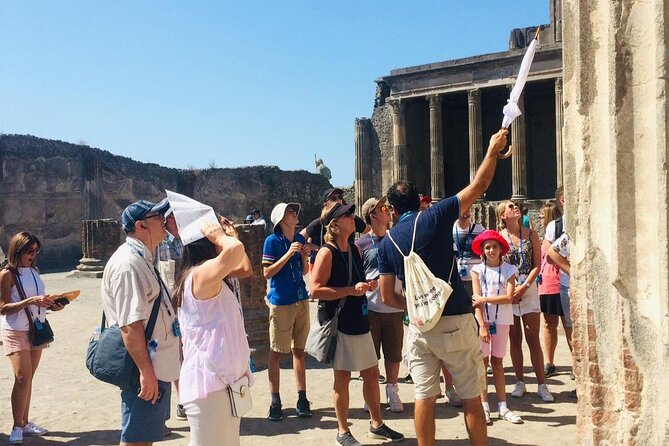
You should still ask questions. The interactive format is one of the best parts of the tour, particularly if you enjoy architecture, archaeology, or Roman social life. Headsets are provided, which makes it easier to follow in a group, though one complaint involved the guide moving too quickly and the headset connection dropping. Stay close enough to keep the signal and ask the guide to pause if needed.
Timing, group size, and physical demands
The full experience lasts about six to 11 hours, depending on your departure city and transport arrangements. The site visits themselves are roughly two hours each, with travel and a short lunch break between them.
The maximum group size is 20. That is small enough for a more personal explanation than a large coach tour, but it is not a private tour. You may need to keep pace with the group, especially at Pompeii.
Expect substantial walking over ancient streets and uneven archaeological surfaces. Wear sturdy shoes, carry water, and protect yourself from sun or rain. The tour is not recommended for people with visual impairments unless they have a dedicated personal assistant.
The early start can help limit crowds, according to the operating schedule described for some departures. Still, conditions vary, and Pompeii can feel busy. Rain does not stop the tour, so check the forecast and bring suitable clothing.
Is $77.09 a good value?
For $77.09, you receive guided visits at both sites, admission to Pompeii and Herculaneum, headsets, and transport for the selected departure option. From Naples and Sorrento, that is a useful bundle because arranging two archaeological entries and transport independently takes time.
The Rome option is more involved. Train tickets to Naples and full-day transport are included, but the day is long. You should choose it for convenience and the chance to see both sites, not for a relaxed pace.
The value depends on your priority. If you want expert orientation and the main sights, the price is fair. If you want to study frescoes, wander side streets, or photograph each building without interruption, buy or arrange visits with more time instead.
Free cancellation is available up to 24 hours before the start time. Changes or cancellations made inside that window are not accepted for a refund.
Should you book this Pompeii and Herculaneum tour?
Book it if you have one day, want both sites, and prefer a guide to explain what you are seeing. It is especially suitable for first-time visitors from Naples, Sorrento, or Rome who value transport and a planned route.
Skip it if Pompeii is your main reason for coming and you want a full day there. Two hours cannot do justice to a site of this size. Also think twice if a mall lunch stop or a brisk walking pace would bother you.
For most first visits, I like the combination. Pompeii gives you the broad Roman city, Herculaneum supplies the close-up household details, and a good archaeologist turns walls and fragments into readable human spaces. Just arrive ready to walk, carry a snack, and accept that this is a focused highlights tour rather than a slow archaeological study.
FAQ
How long does the tour last?
The total duration is approximately six to 11 hours, depending on the departure option and transport arrangements.
How much does the tour cost?
The listed price is $77.09 per person.
Are Pompeii and Herculaneum admission tickets included?
Yes. Admission to both archaeological sites is included, including Pompeii Express entry and Herculaneum entry.
Where do I meet the guide?
Pompeii departures meet at Porta Marina Superiore. Naples departures meet outside Starhotels Terminus. Sorrento departures meet at Piazza Angelina Lauro. Rome departures use the Starhotels Terminus meeting point in Naples after the included train connection.
How do I travel from Pompeii to Herculaneum?
The Pompeii option includes a one-way Circumvesuviana train ticket. The journey takes about 30 minutes, followed by a walk of about 10 minutes from Ercolano Scavi station.
Is transportation included from Naples?
Yes. The Naples option includes round-trip transport to and from the area outside Starhotels Terminus, using a modern minibus.
Is transportation included from Sorrento?
Yes. The Sorrento option includes round-trip transport to and from Piazza Angelina Lauro.
Does the Rome option include train tickets?
Yes. The Rome option includes train tickets to and from Rome to Naples, along with full-day transportation service.
Is lunch included?
No. Meals and drinks are not included. A short lunch break is provided, and you pay for your own food.
How many people can join the tour?
The maximum group size is 20 people. Headsets are supplied for all participants.
Can I cancel for a refund?
You can cancel up to 24 hours before the experience start time for a full refund. Cancellations or changes made less than 24 hours before the start time are not accepted.
More Tours Led by an Archaeologist
- Pompeii Small Group Tour with an Archaeologist
★ 5.0 · 6,593 reviews - Skip the Line Guided Tour of Pompeii led by an Archaeologist
★ 5.0 · 703 reviews - Pompeii: Exclusive Tour with Archaeologist and Entry Tickets
★ 4.9 · 634 reviews - Pompeii Private Tour with an Archaeologist and Skip The Line – 3 hours
★ 5.0 · 564 reviews
Newest reviews from Pompeii Ruins
- Private Tour Pompeii and Winery★ 5.0 · 4 reviews
- Visit the Pompeii ruins from Salerno with Pizza Lunch★ 5.0 · 4 reviews
- Pompeii Private Tour for Kids and Their Families★ 4.8 · 4 reviews
- From Sorrento: Pompeii & Vesuvius tour small group★ 4.8 · 4 reviews
- Pompeii Sorrento and Positano Tour★ 5.0 · 4 reviews
- From Naples_ Pompeii Tour_Skip the line ticket + audioguide★ 4.3 · 4 reviews
- Pompeii, skip-the-line ticket with smartphone audio guide on App★ 3.0 · 4 reviews
- Pompeii Private Half-Day Tour from: Naples,Sorrento, Amalfi Coast★ 5.0 · 4 reviews
Archaeologist-Led Tours, compared.

Entry Ticket and Guided Tour with an Archaeologist
Read our review →
Pompeii Small Group Tour with an Archaeologist
Read our review →
Skip the Line Guided Tour of Pompeii led by an Archaeologist
Read our review →
Exclusive Tour with Archaeologist and Entry Tickets
Read our review →
Pompeii Private Tour with an Archaeologist and Skip The Line – 3 hours
Read our review →
Pompeii Skip-the-line Tour with Archaeologist Guide
Read our review →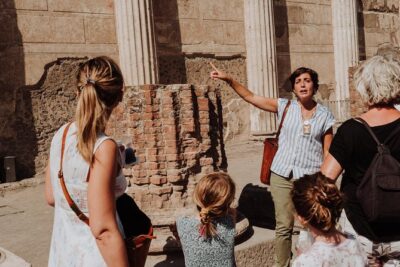
Browse the lists this tour appears in