
Reviewed · SKIP THE LINE
Pompeii: Skip-the-Line Entry & Audioguide
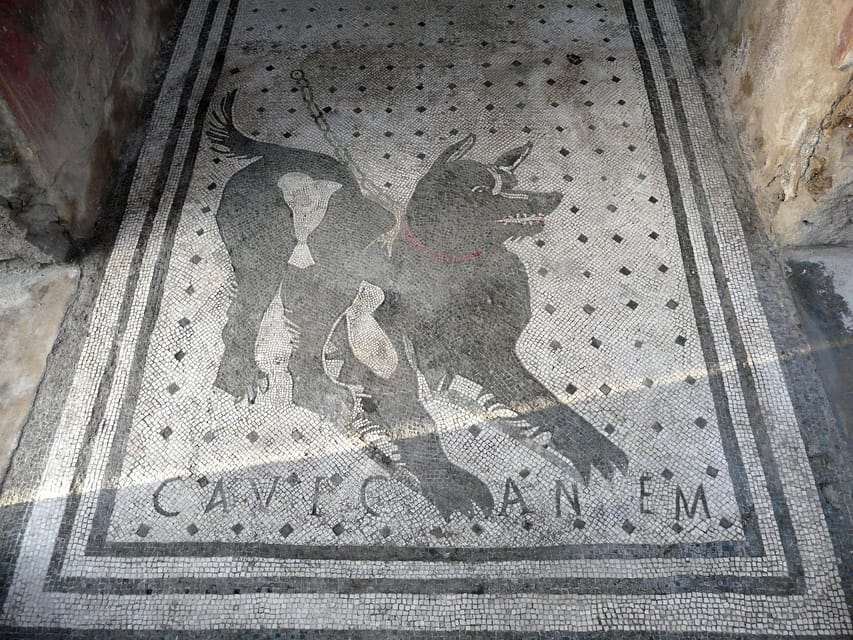
Pompeii is far more than a field of broken columns. It is an ancient city you can walk through, street by street, with shops, fountains, houses, theaters, and public buildings still laid out beneath Mount Vesuvius. The audioguide helps turn scattered walls and faded paintings into a picture of daily Roman life.
I like the freedom to set your own pace, and I like having both a paper map and audio commentary to help you find the main sights. The skip-the-line entry can also save useful time, especially when the entrance is busy. The main drawback is value: at $53 per person, this can cost more than buying entry and audio service directly, so compare prices before paying.
In This Review
- Key points to know before booking
- Pompeii is best understood on foot
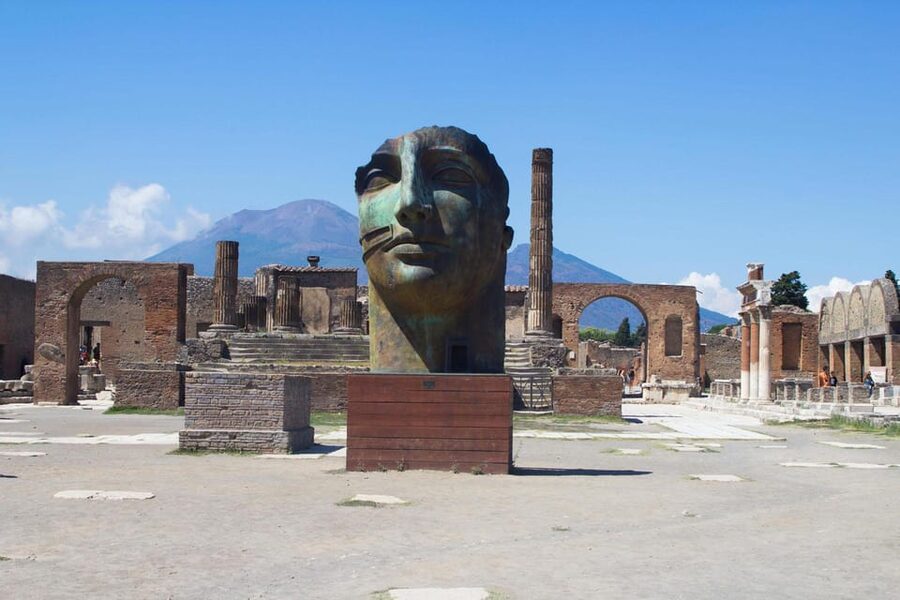
- Starting at the forum beneath Vesuvius
- Following the streets of the ancient city
- Roman homes, shops, and fading frescoes
- Baths, aqueducts, and the practical Roman city
- Amphitheater and theaters
- What the audioguide adds
- Skip-the-line entry and the real value of $53
- Meeting point, identification, and what to carry
- Who should choose this Pompeii visit
- Should you book Pompeii Skip-the-Line Entry and Audioguide?
- FAQ
- Where is the meeting point?
- What does the ticket include?
- Is a guided tour included?
- How long can I stay at Pompeii?
- Which languages are available for the audioguide?
- Is Villa dei Misteri included?
- Do I need identification?
- Can I bring a dog?
- Are food, drinks, transportation, or hotel pickup included?
Key points to know before booking
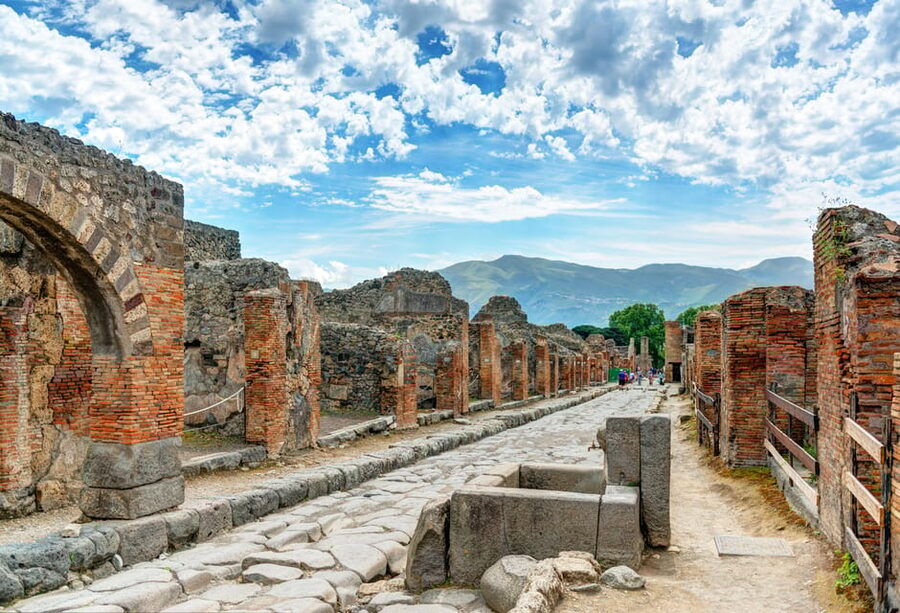
- The forum gives you the best first look at Pompeii: Begin here to understand the city’s civic and religious center before exploring its side streets.
- The audioguide works in eight languages: Choose from Italian, English, French, Spanish, German, Portuguese, Chinese, and Japanese.
- This is mainly a self-guided visit: You can stay for as little as two hours or use the ticket for most of a day.
- Villa dei Misteri is not included: Plan separately if this famous site is important to you.
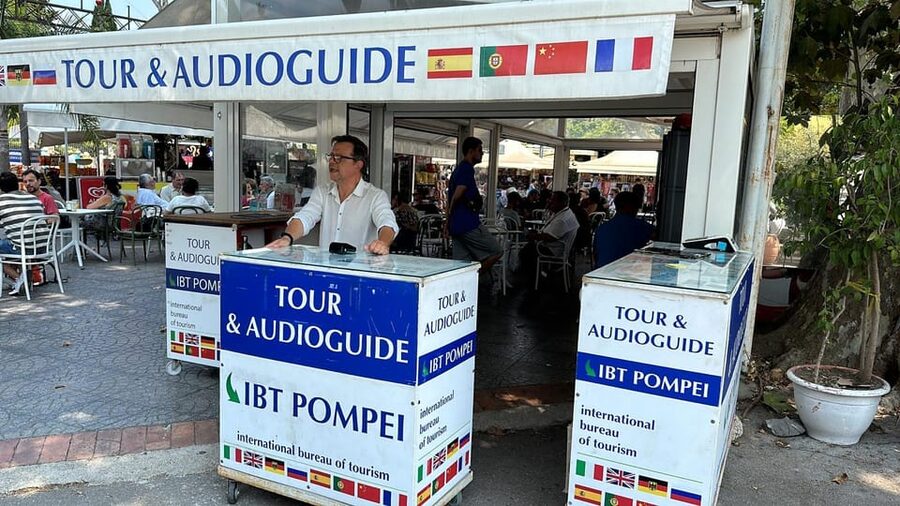
- The meeting point is outside the park: Go to the IBT Center, also called Touristation, next to Chalet Donna Lucia.
- The price deserves a careful check: The $53 rate includes entry, audio commentary, and a map, but direct on-site prices cited in booking feedback have sometimes been lower.
Pompeii is best understood on foot
The great strength of this experience is simple: you enter an ancient Roman city and walk through its actual streets. Pompeii was destroyed by the eruption of Mount Vesuvius in 79 AD, but the buried city preserved an unusual amount of its street plan, walls, decoration, and public buildings.
You will not see a polished museum display here. You will see worn paving stones, roofless rooms, broken columns, fountains, and walls marked by centuries of weather. That raw quality is part of the place. You can look into a private house, step near an old shop counter, and follow a road toward the forum with Vesuvius in the distance.
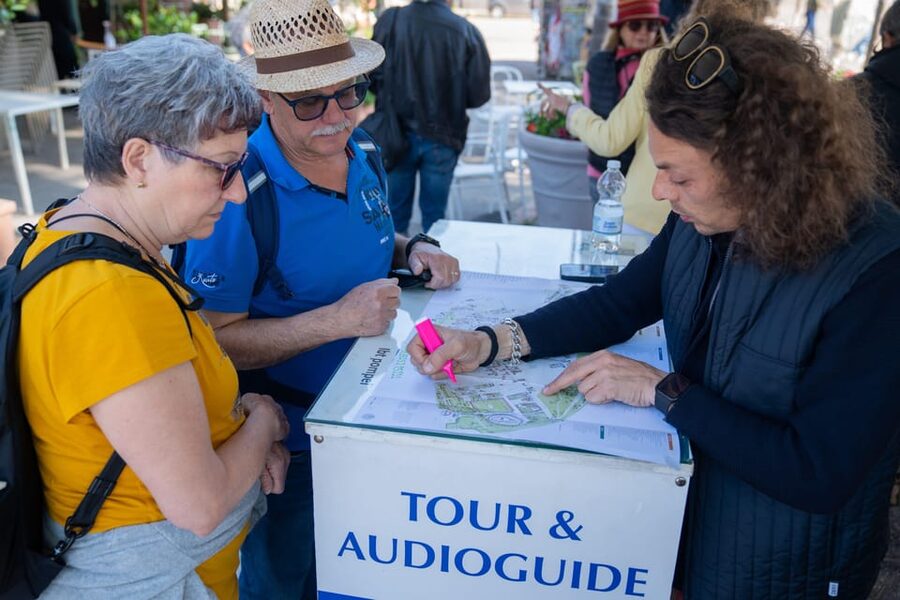
The activity gives you an audioguide and paper city map, rather than requiring you to stay with a guide. That makes it a good match for visitors who want context but do not want a fixed walking route. You can pause the commentary, skip a room, or spend extra time wherever the remains catch your eye.
A guided tour is available if you select that option. If you choose the standard self-guided version, expect to manage your own route and timing.
More Pompeii excavation visits:
- Pompeii: Entry Ticket and Guided Tour with an Archaeologist
★ 4.8 · 19,459 reviews - Pompeii: Small Group Tour with an Archaeologist
★ 4.8 · 12,264 reviews - Pompeii: Skip-the-Line Entrance Ticket with Audio Guide
★ 4.0 · 2,509 reviews
Starting at the forum beneath Vesuvius
The central forum is the natural place to begin. This broad public space was the heart of Pompeii, surrounded by civic, religious, and commercial buildings. Even in ruin, the scale helps you picture the city as a working community rather than a collection of isolated monuments.
Look closely at the columns, doorways, and surrounding foundations. The forum is also where the view toward Mount Vesuvius gives the visit its strongest sense of place. The volcano is not just a distant backdrop. Its presence explains why this city stopped in time.
The audioguide can help you sort out the different functions of the buildings around the square. Without some explanation, a row of columns can look much like another row of columns elsewhere in Italy. With the commentary, you get a clearer idea of how public life was organized and why the forum mattered.
I recommend not rushing through this first area. Spend a few minutes with the map and use the forum as your reference point. Pompeii is large enough that a quick visit can become a blur of walls and stones. A short pause at the start helps you choose which parts deserve your attention.
Following the streets of the ancient city
From the forum, the visit opens into Pompeii’s network of streets. These roads are one of the site’s most effective features because they show how the city worked at ground level.
You will find remains of fountains, an aqueduct system, houses, businesses, statues, and public baths. The streets link these pieces together. Instead of seeing Roman life as a series of museum objects, you see where people moved, bought goods, washed, worked, worshipped, and met one another.
The fountains and water structures are especially useful for understanding the practical side of the city. They remind you that Pompeii was not only a place of temples and grand public buildings. It was also a functioning town with systems for water and everyday trade.
The map matters here. Pompeii contains many paths and open areas, and the most famous buildings may not all sit close together. Use the printed map to mark what you have seen and to avoid spending your entire visit circling the same blocks.
Allow at least two hours for a meaningful introduction, which is the shortest duration given for this activity. If you have most of a day, you can take a slower route and spend more time with the houses, paintings, theaters, and public buildings. The flexible duration is one of the better features of the ticket.
Roman homes, shops, and fading frescoes
Pompeii becomes most personal inside its private homes and commercial spaces. The remains of a house can show more about daily life than a grand monument does. You might see room layouts, courtyards, thresholds, fountains, and fragments of wall decoration.
The colorful frescoes are often incomplete, but even a surviving patch can change how you read the building. These walls were not plain stone interiors. They carried painted scenes, patterns, and color, giving the homes and businesses a more finished appearance than the ruins first suggest.
The shops offer another useful contrast. Their remains place commerce directly on the same streets where people lived. You can compare the practical spaces of business with the more formal areas around the forum and the theatrical spaces used for public entertainment.
Do not expect every fresco or building to be perfectly preserved. Pompeii’s appeal is not that every room looks complete. It is that enough pieces remain for the audioguide and your imagination to connect them.
More Pompei Campania tours worth comparing
- Pompeii: Skip-the-line-Ticket and Guided Tour
★ 4.6 · 1,152 reviews - Pompeii: Guided Tour with Skip-the-Line Entry
★ 4.9 · 812 reviews - Pompeii: Skip-the-Line Entry Ticket with Digital Guide App
★ 4.1 · 770 reviews - Pompeii: Tour with Archaeologist Guide & Skip-the-Line Entry
★ 4.5 · 478 reviews
Baths, aqueducts, and the practical Roman city
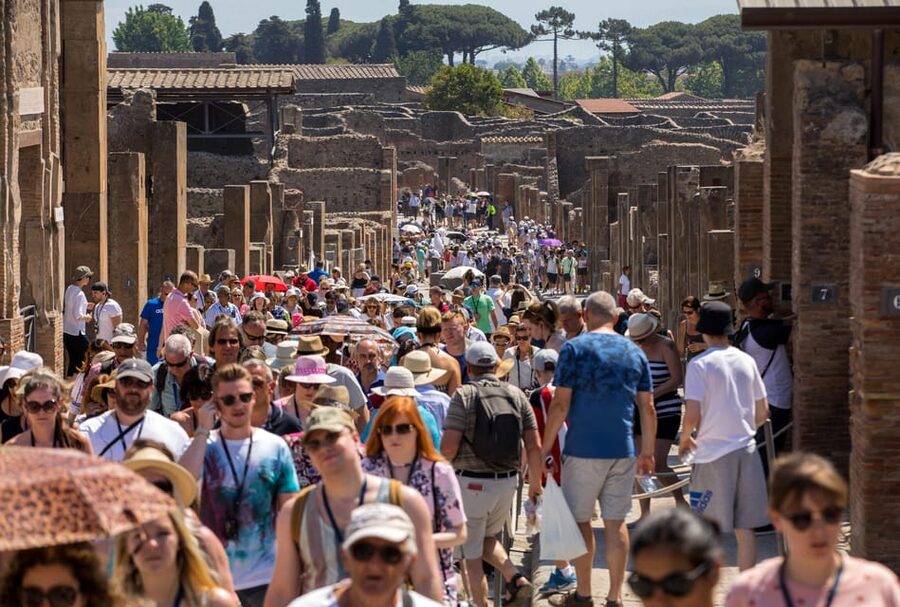
The public baths show how Roman cities combined daily routine with social life. The remains of bath buildings, water channels, and fountains help you see the infrastructure behind the public spaces.
This is a good part of the visit for anyone who wants more than dramatic ruins. The aqueduct and water features explain how Pompeii supported its population. A wall or basin may seem modest compared with a theater, but it tells you how people actually used the city.
The audioguide is helpful here because practical remains can be hard to interpret at a glance. You may recognize a large building but not understand its original purpose. Audio commentary gives you a reason to stop and look at details such as doorways, channels, columns, or room divisions.
For families and first-time visitors, these parts can also break up the more formal monuments. The variety keeps the walk from becoming one long sequence of temples and foundations.
Amphitheater and theaters
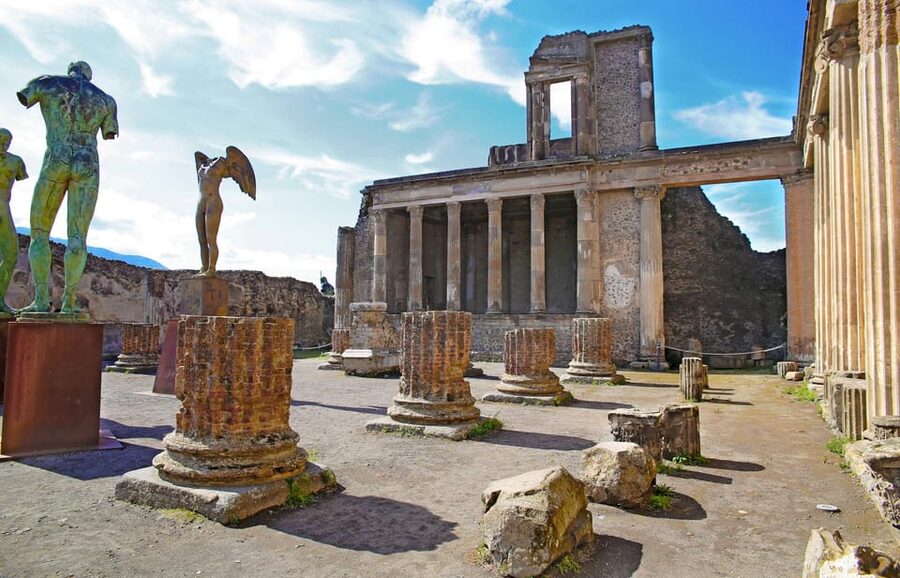
Pompeii’s amphitheater is one of the major stops. Its surviving structure gives you a clear sense of a venue built for large crowds. The site also includes a dramatic theater, where the shape of the seating and performance area shows how public entertainment fit into Roman life.
These buildings are worth seeing even if you are not especially interested in ancient architecture. They are easy to picture because their basic purpose remains clear. You can stand in the performance space, look up toward the seating, and imagine the noise and movement of a full audience.
The contrast between the theaters and private homes is useful. One shows Pompeii as a place of public spectacle, while the other shows smaller domestic routines. Together with the forum, baths, shops, and streets, they give you a fuller view of the city.
The main practical issue is time. With only two hours, you may need to choose between lingering over the theaters and seeing more houses and side streets. If the amphitheater is a priority, check your map early and plan your route instead of leaving it for the final minutes.
What the audioguide adds
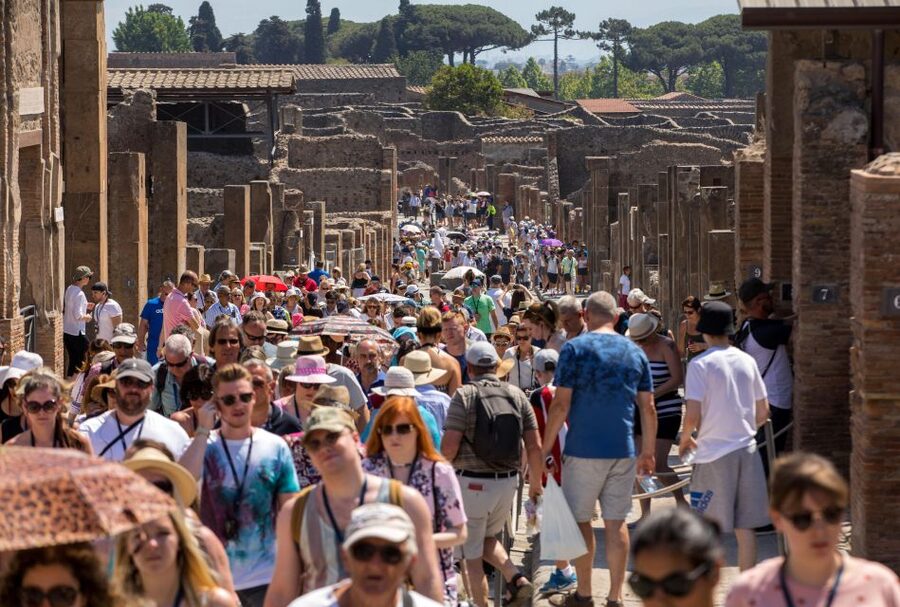
The audio service is available in Italian, English, French, Spanish, German, Portuguese, Chinese, and Japanese. That wide language choice makes this option useful for mixed-language groups and for anyone who prefers listening to reading small signs.
The English commentary has been described as useful, while an introductory briefing from Daniel was specifically praised for making the start easier. If Daniel is leading the introduction on your date, listen carefully before setting off. A short orientation can help you understand how the ticket, map, and audio service fit together.
The audioguide is not the same as having a guide beside you. You will not be able to ask follow-up questions, and the pace is entirely yours. That is a strength if you prefer quiet exploration, but a weakness if you want a detailed conversation about architecture, religion, or the eruption.
I would use the audio selectively. Listen at the forum, major homes, baths, theaters, and amphitheater, then walk between stops without constant commentary. That approach keeps the visit from feeling like a long series of instructions.
Skip-the-line entry and the real value of $53
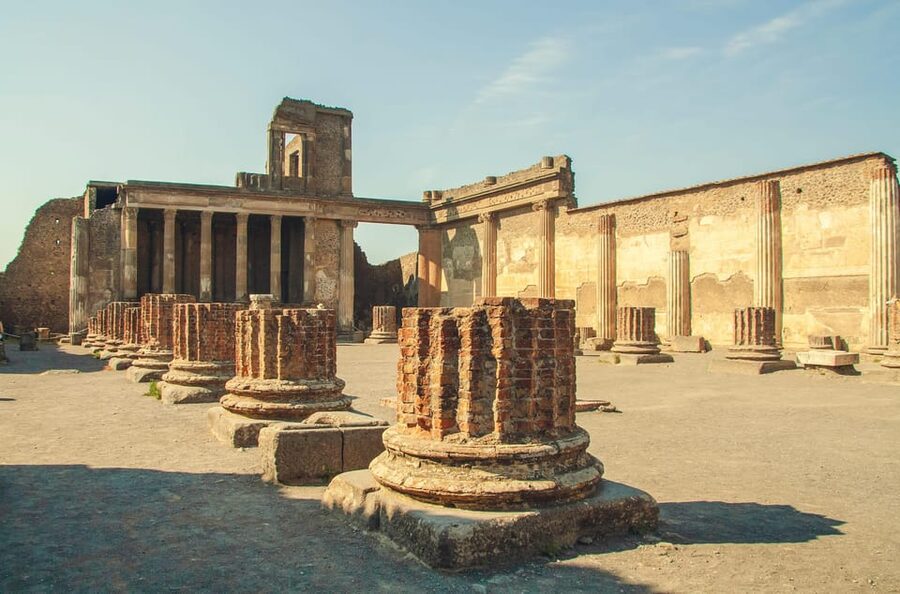
The listed price is $53 per person. It includes entry to Pompeii Archaeological Park, an audioguide, and a paper map. A guided tour is included only if you select that version. Food, drinks, transport, and hotel pickup are not included.
Skip-the-line sounds attractive, but it is important to understand what you are paying for. The benefit is avoiding the ticket line at the archaeological park, not gaining private access to every monument. If the entrance is quiet, the time saved may be small.
Price comparisons require care. Booking details connected with this activity have produced complaints about paying much more than direct entry, with one price comparison citing €18 for admission and another citing €22 for an audio device. Another note put the total on-site price at €78 with audio included, which shows that prices may vary by date, seller, and package.
For that reason, I would check the official Pompeii price and the cost of an audio service before booking. At $53, the ticket can make sense if you value advance arrangements, the meeting-point assistance, and the convenience of a skip-the-line product. It is less convincing if you are comfortable buying entry yourself and waiting a short time.
The non-refundable policy adds another reason to check your plans carefully. You should be certain of your date before paying.
Meeting point, identification, and what to carry
The meeting point is the IBT Center, also called Touristation, next to Chalet Donna Lucia. The location is described as easy to find, but clear directions matter because you do not begin at the forum itself. Build in enough time to locate the center and collect your materials.
Bring a passport or other accepted ID card. Identification is required for all participants, so do not assume one document for the whole group will be enough.
Large bags and luggage are not allowed, and smoking, alcohol, and drugs are prohibited. Food and drinks are not included, so plan around the fact that this is a walking visit through a large archaeological area.
Small dogs are permitted in the archaeological area if kept on a leash, but they must be carried inside buildings. Other pets are not allowed. Visitors with certified disabilities receive free admission, according to the stated conditions.
Who should choose this Pompeii visit
I would recommend this option to you if you want to explore independently but still want basic historical guidance. It suits people who dislike being tied to a group schedule, families who need to stop often, and visitors who want to choose between a short visit and a longer day inside the ruins.
It also works well if you need audio commentary in one of the eight listed languages. The combination of audio service and map gives you enough structure to find the major areas without committing to a full guided walk.
You may prefer another arrangement if you want a specialist guide, personal questions answered, or the lowest possible admission price. The guided option may solve some of that, but the details of the guide and group size are not specified, so check carefully before selecting it.
This is not the right ticket if Villa dei Misteri is essential to your Pompeii plan. Entrance to that site is excluded, so you will need to arrange it separately.
Should you book Pompeii Skip-the-Line Entry and Audioguide?
Book it if convenience matters more than getting the lowest price, and if you like setting your own route. The forum, streets, homes, water systems, baths, frescoes, amphitheater, and theaters give you plenty to see, while the audioguide supplies useful context without forcing you into a group.
Think twice if the $53 price is stretching your budget. Direct entry and audio options may cost less, and the skip-the-line advantage may be modest on a quiet day. Check the current direct price, bring your ID, confirm that Villa dei Misteri is not included, and choose the guided version only if you specifically want that format.
FAQ
Where is the meeting point?
Meet at the IBT Center, also called Touristation, next to Chalet Donna Lucia.
What does the ticket include?
It includes skip-the-line entry to Pompeii Archaeological Park, an audioguide, and a paper city map.
Is a guided tour included?
A guided tour is included only if you select the guided-tour option when booking.
How long can I stay at Pompeii?
The stated duration ranges from two hours to one day. Check availability for the specific starting times and duration offered.
Which languages are available for the audioguide?
The audioguide is available in Italian, English, French, Spanish, German, Portuguese, Chinese, and Japanese.
Is Villa dei Misteri included?
No. Entrance to Villa dei Misteri is not included.
Do I need identification?
Yes. All participants must bring a passport or ID card.
Can I bring a dog?
Small dogs are permitted in the archaeological area if they stay on a leash. They must be carried inside buildings. Pets otherwise are not allowed.
Are food, drinks, transportation, or hotel pickup included?
No. Food, drinks, transport, and hotel pickup and drop-off are not included.
Newest reviews from Pompei Campania
- From Sorrento: Pompeii & Vesuvius tour small group★ 4.8 · 4 reviews
- Pompeii Private Tour for Kids and Their Families★ 4.8 · 4 reviews
- From Naples_ Pompeii Tour_Skip the line ticket + audioguide★ 4.3 · 4 reviews
- Pompeii, skip-the-line ticket with smartphone audio guide on App★ 3.0 · 4 reviews
- Pompeii Guided Experience – Tour Service Only★ 4.6 · 4 reviews
- From Naples Port:Pompeii+Vesuvius tour★ 4.3 · 4 reviews
- 2-Hour Pompeii Child-Friendly Tour★ 5.0 · 4 reviews
- Naples: Amalfi Coast, Sorrento and Pompeii Day Trip★ 4.4 · 5 reviews
Skip the Line, compared.

Skip-the-Line Entrance Ticket with Audio Guide
Read our review →



Skip-the-Line Entry Ticket with Digital Guide App
Read our review →
Pompeii Ruins Private Tour with Optional Skip-the-Line Entry
Read our review →
Skip-the-Line Pompeii Guided Tour from Sorrento
Read our review →
Skip the Line Guided Tour of Pompeii led by an Archaeologist
Read our review →Browse the lists this tour appears in