
Reviewed · HERCULANEUM TOURS
Pompeii: Small-Group Tour of Pompeii and Herculaneum
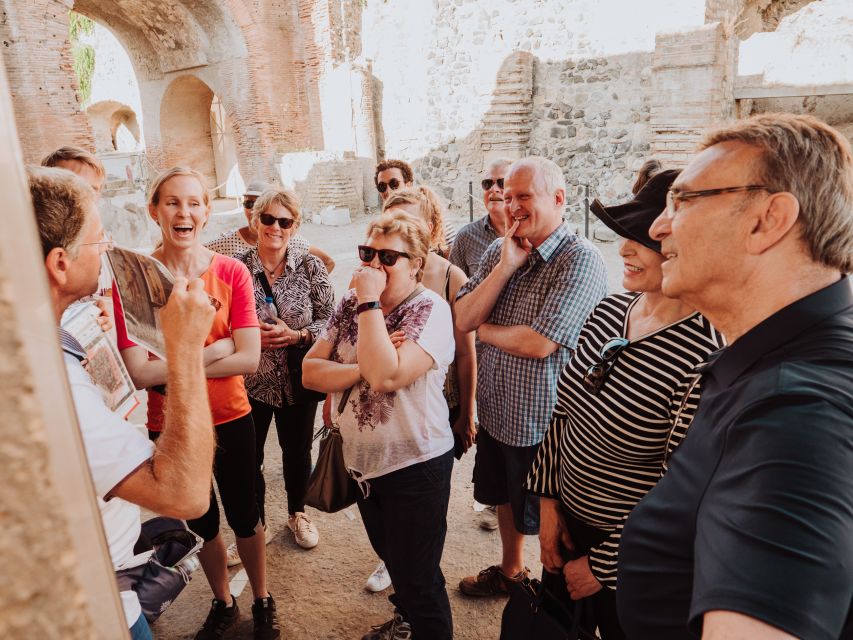
Pompeii gives you the scale of a Roman city, while Herculaneum shows you the fine detail of Roman life. I like that an archaeologist guide explains both sites in context, and I like the efficient combination of guided walks, included entry tickets, and a short train ride between them. The main drawback is the pace: five and a half hours, with two hours of walking at each site, makes for a full and tiring day.
I also appreciate the small-group limit of 20 people. Guides such as Diego, Paolo, Vincenzo, Alfredo, Sergio, Julia, and Amedeo have been praised for clear explanations, humor, and the ability to bring the ruins to life. Just be ready for a short 30-minute lunch break, hot sun, uneven ground, and a final stop in Herculaneum rather than a return to Pompeii.
In This Review
- Key points at a glance
- Why seeing both cities changes the story
- Meeting at Pompeii’s Porta Marina Inferiore
- Two hours inside Pompeii’s vast ruins
- The 30-minute break, and why it feels short
- The train from Pompeii to Ercolano
- Two hours in Herculaneum’s preserved streets
- How much walking and effort should you expect?
- Is an archaeologist guide worth paying for?
- Who should book this combined visit?
- Should you book this Pompeii and Herculaneum tour?
- FAQ
- How long does the Pompeii and Herculaneum tour last?
- Where does the tour begin?
- How can I recognize the guide?
- Does the tour include entry tickets?
- Is lunch included?
- How do I get from Pompeii to Herculaneum?
- Where does the tour finish?
- Is the tour suitable for wheelchair users?
Key points at a glance
- Two famous Roman cities in one half-day: Visit Pompeii and Herculaneum during a single, tightly planned experience.
- Archaeologist-led sightseeing: Your guide explains buildings, daily life, eruption layers, excavations, and preservation.
- Pompeii first, Herculaneum second: Begin at Porta Marina Inferiore, then travel by the Circumvesuviana train to Ercolano.
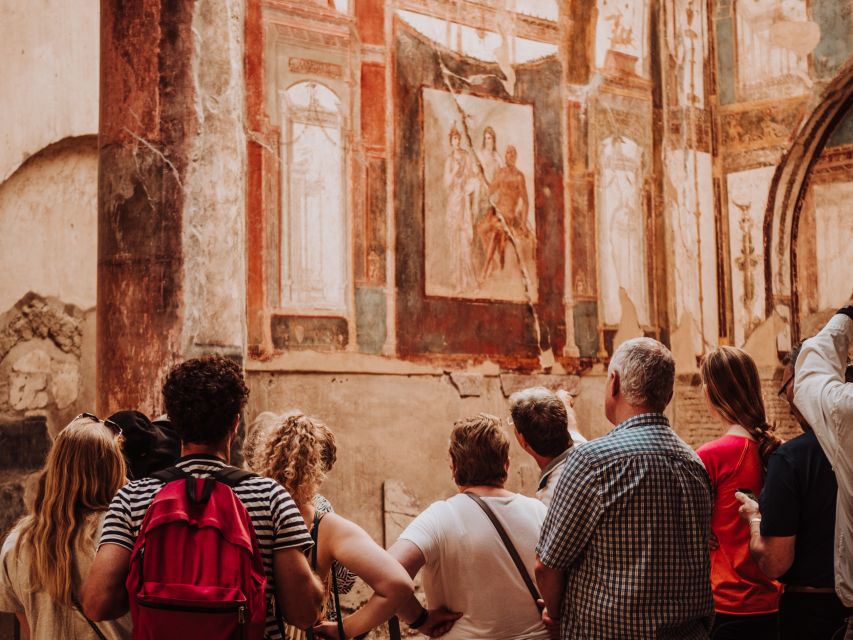
- Herculaneum offers finer preservation: Look for upper floors, painted walls, mosaics, and carbonized wooden objects.
- A group of up to 20: Headsets are provided when the group has more than 10 participants.
- The tour ends in Ercolano: Plan your onward journey from Herculaneum, since transport back to Pompeii is not included.
Why seeing both cities changes the story
Pompeii and Herculaneum were both buried by the eruption of Vesuvius in 79 A.D., but they were preserved in different ways. That difference is the real reason to visit both. Pompeii was covered by about four meters of pumice and ash, while Herculaneum was buried beneath an avalanche of mud roughly 20 meters thick.
Pompeii is the larger, more open site. Its streets, public buildings, homes, shops, and plaster casts help you understand the size and activity of a Roman city. You can picture carts moving through the streets, residents crossing stepping stones, and businesses operating beside busy thoroughfares.
Herculaneum is much smaller, but its preservation is often more striking. The thick mud sealed parts of the town so well that second floors, carbonized wood, intact paintings, and detailed mosaics remain visible. I find Pompeii powerful because of its scale, but Herculaneum can feel more intimate and precise.
That contrast also gives the guide something useful to explain. You are not simply seeing two sets of ruins. You are comparing two different records of the same disaster and getting a clearer idea of how Roman people lived at different social levels.
More Pompeii excavation visits:
- Pompeii: Entry Ticket and Guided Tour with an Archaeologist
★ 4.8 · 19,459 reviews - Pompeii: Small Group Tour with an Archaeologist
★ 4.8 · 12,264 reviews - Pompeii: Skip-the-Line Entrance Ticket with Audio Guide
★ 4.0 · 2,509 reviews
Meeting at Pompeii’s Porta Marina Inferiore
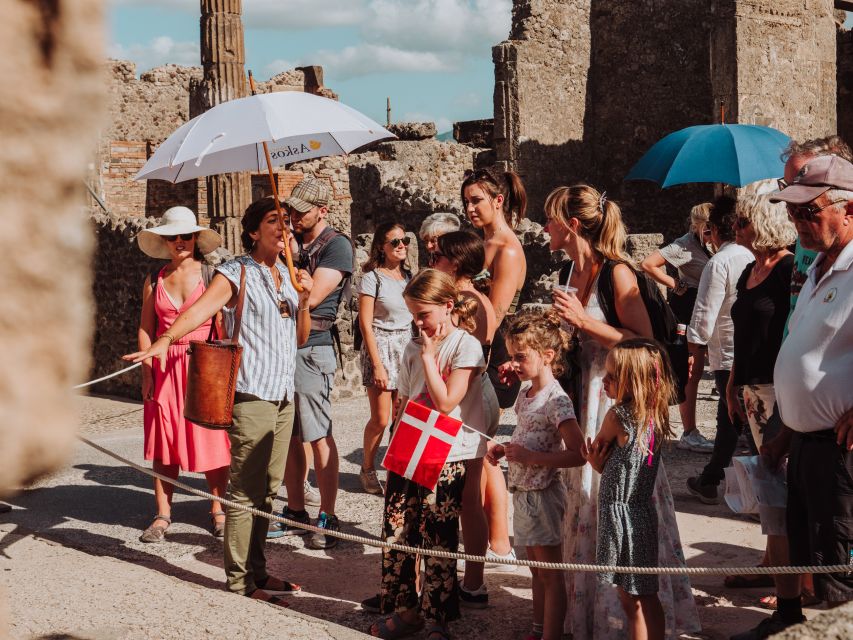
The day begins at Piazza Porta Marina Inferiore, 1, beside the left side of Pompeii’s entrance called Porta Marina Inferiore. Look for the guide holding an Askos Tours sign near the Arte bus stop.
The meeting point is only a few minutes from the Pompei-Villa dei Misteri Circumvesuviana station, but allow time to find the exact spot. Pompeii has several entrances, tour groups, signs, and people offering directions, so it can be easy to head toward the wrong gate. The coordinates provided are 40.7470817565918, 14.484834671020508.
One useful improvement would be a larger, more obvious sign at the meeting area. If you arrive early, stay near the named entrance and look specifically for the Askos Tours sign rather than wandering around the car park.
Bring your passport or identity card. Wear shoes that can handle long walks over uneven ancient paving, and carry water. In summer, a hat and sunglasses are not optional luxuries. A raincoat or poncho is sensible at any time of year because sudden showers can interrupt the day.
Two hours inside Pompeii’s vast ruins
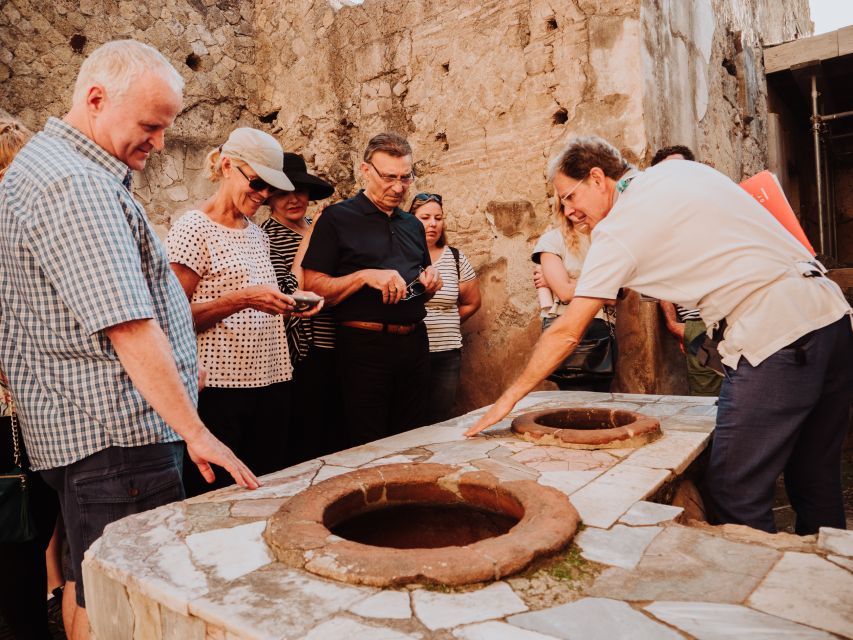
The guided Pompeii visit lasts about two hours. That is long enough to see major sections and hear a coherent explanation, but not long enough to cover every street and building. Pompeii is enormous, so a guide is especially useful here. Without a plan, you can spend a lot of time looking at stones without understanding what you are seeing.
The best guides turn ordinary details into clues about Roman life. A wall inscription can reveal how people communicated. A house plan can show how rooms were arranged. A painted surface or mosaic can tell you about taste, wealth, and the owner’s desire to impress.
Guides including Diego, Paulo, Vincenzo, Antonio, Alfredo, Sergio, and Amedeo have been praised for mixing facts with stories and humor. That style matters at Pompeii, where information can become overwhelming. A good guide gives you a thread to follow instead of throwing dates and names at you.
The plaster casts are one of the most difficult parts of the visit. They preserve the shapes of people caught in the eruption and make the disaster feel painfully immediate. You may find this section emotionally heavy, particularly after spending time imagining the ordinary life of the city.
The site can also be hot and exposed. One guide, Antonio, was praised for taking care of the group during hot weather, while another kept people in shaded areas when possible. Shade cannot be guaranteed, though, so bring your own protection and take water breaks when you need them.
Groups can include around 20 people. For more than 10 participants, headsets are supplied, which helps you hear the guide while standing back from a crowded house or street. This is a small detail, but it makes a real difference in a large archaeological site.
The 30-minute break, and why it feels short
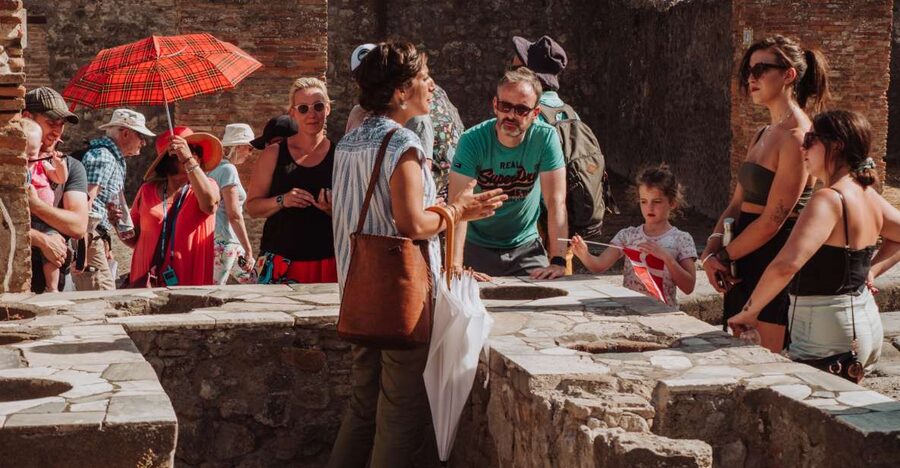
After Pompeii, you have a 30-minute break. This is meant for lunch, a quick drink, a toilet stop, or a look at the souvenir shops outside the ruins.
I would treat this as a practical pause, not a proper meal. Thirty minutes can work if you buy a sandwich and keep moving, but it is not enough for a relaxed sit-down lunch after two hours of walking. Several people found the break too short, especially in hot weather, and nearby restaurants may not have a free table when the group arrives.
Plan ahead. Carry a snack if you need more than a rushed bite, and use the break to refill your water. If a comfortable lunch is important to you, this schedule may feel tight. The tour is designed to fit both archaeological sites into one day, and the short break is the price of that efficiency.
More Herculaneum excavation visits:
- Pompeii and Herculaneum: Guided Tour with an Archaeologist
★ 5.0 · 164 reviews - From Naples: Pompeii and Herculaneum VIP Tour with Lunch
★ 4.4 · 129 reviews - Pompeii & Herculaneum: Skip-the-line & Digital Guide App
★ 4.0 · 35 reviews - Pompeii, Herculaneum, and Vesuvius: Full-Day Tour
★ 3.7 · 21 reviews
The train from Pompeii to Ercolano
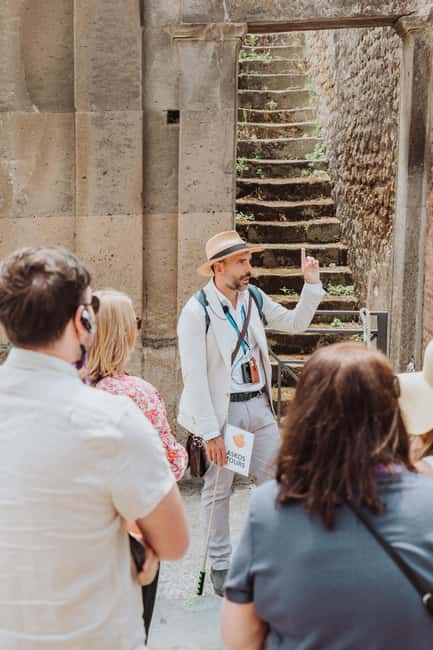
The group then takes the Circumvesuviana train toward Ercolano. The scheduled transfer is about 30 minutes, with the ride itself described as roughly 20 minutes. Local trains can be delayed, and one reported medical emergency caused a longer journey on one occasion.
The guide stays with the group during this transition and may continue explaining the area or sharing local stories. When train problems have occurred, the operator has sometimes used a private minibus instead, but that should be treated as a possible backup rather than a standard feature.
This transfer is one reason the experience does not begin and end at the same place. You start near Pompeii and finish at Parco Archeologico di Ercolano. The train is useful, but it adds a little uncertainty to the timing. If you have a fixed reservation immediately after the tour, leave a generous buffer.
Two hours in Herculaneum’s preserved streets
Herculaneum receives another guided walk of about two hours. The site is smaller than Pompeii, so the visit feels more concentrated. Instead of focusing mainly on the scale of a city, you can study individual houses, decoration, building materials, and signs of everyday life.
The thick mud that covered Herculaneum helped preserve features that disappeared at Pompeii. You might see upper floors, carbonized wooden objects, vivid paintings, and mosaics that still retain strong detail. These surviving elements make it easier to picture the homes as lived-in spaces rather than bare archaeological shells.
Herculaneum also offers a useful look at wealth and comfort in the Roman world. The preserved decoration gives a vivid impression of the opulent lifestyle enjoyed by some residents. Your guide can connect the rooms and artwork to social status, domestic routines, and the wider Roman Empire.
This is where the archaeologist’s training has real value. The guide can explain not just what survives, but also what excavation and preservation involve. You may hear about buildings that remain buried, why some areas are closed, and how archaeologists decide what to protect and display.
The order works well. Pompeii first gives you the broad picture, then Herculaneum supplies close-up detail. By the end, you have seen both an expansive city and a more compact neighborhood with unusually well-preserved interiors.
How much walking and effort should you expect?
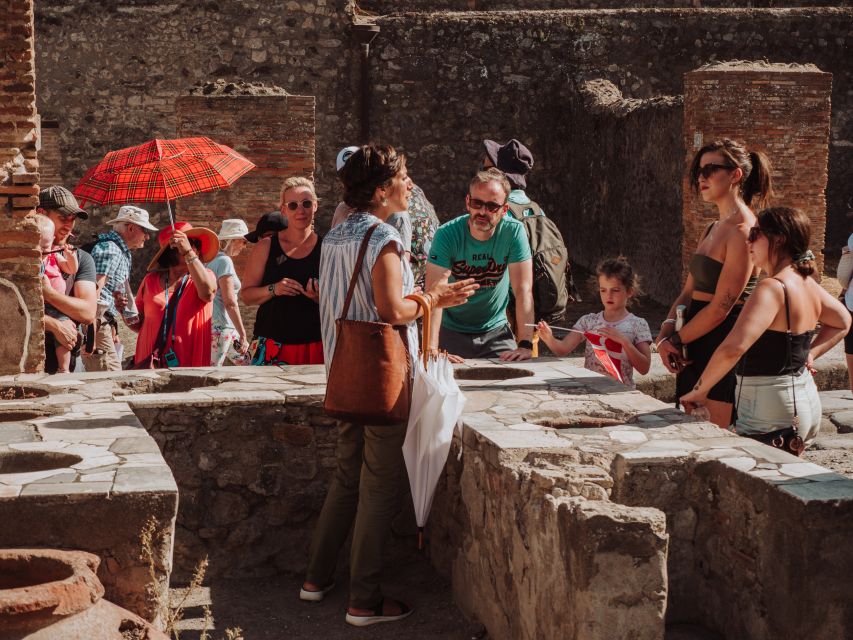
This is an active walking tour, not a quick photo stop. You spend roughly two hours on foot in Pompeii, take a train, then walk for another two hours in Herculaneum. Add the meeting, transfer, and break, and the full experience lasts about 5.5 hours.
The ancient streets are not smooth modern pavements. Comfortable clothes and sturdy walking shoes are essential. Summer heat can make the day much harder, particularly when the group is moving across open areas without shade.
The tour is not suitable for wheelchair users or people with mobility impairments. If uneven surfaces, stairs, extended walking, or heat are difficult for you, a shorter or more tailored visit would be a better choice.
Families with older children may find the guide-led format helpful. The stories, inscriptions, and human details can hold attention better than a silent walk through ruins. One family specifically found the experience engaging for a 10-year-old, though every child will respond differently to a long archaeological visit.
Is an archaeologist guide worth paying for?
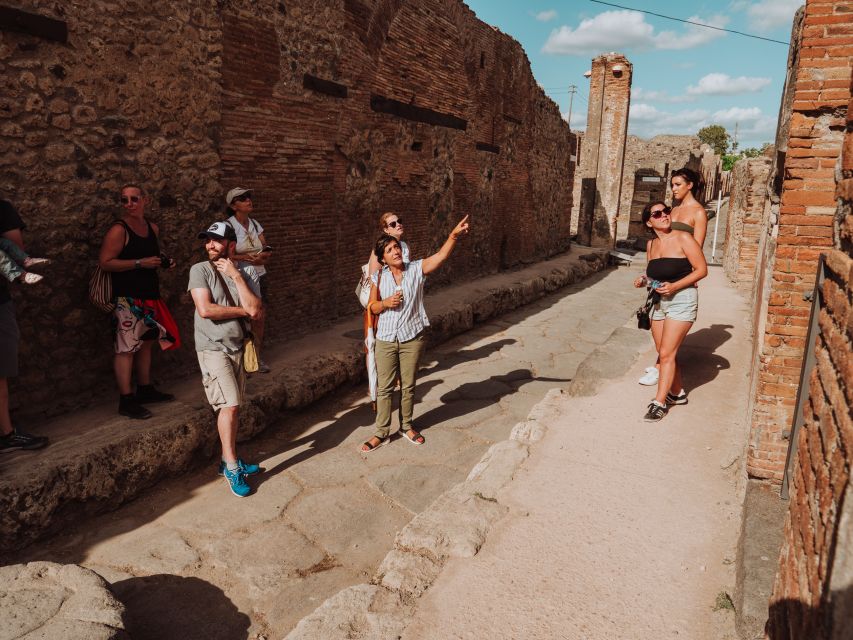
For Pompeii and Herculaneum, I think a guide adds more value than an audio guide or an unplanned walk. The ruins do not always explain themselves. A wall may look plain until someone points out its purpose, a house may seem empty until its layout reveals how Roman families used it, and a mosaic becomes more meaningful when you understand where it belonged.
The strongest guides on this tour have been praised for clear communication, humor, enthusiasm, and answers to questions. Paolo encouraged people to reason about Roman life. Vincenzo used wit to keep the group alert. Diego was praised for making complex material easy to follow, while Alfredo connected the ruins with the eruption and later excavation.
The small group helps, but do not expect a private tour. With up to 20 people, you will still need to stay close and pay attention when the guide moves. Headsets help larger groups hear, and the guide may adjust the route when a major area is crowded.
The value is also practical. Entry tickets for both sites are provided, and the tour skips the ticket line. The public adult admission listed for Herculaneum is 16 euros, with a 2 euro rate for EU citizens aged 18 to 25. Since admission is included, the tour price should be judged against the ticket cost, the guide’s expertise, and the time saved planning the two sites yourself.
Who should book this combined visit?
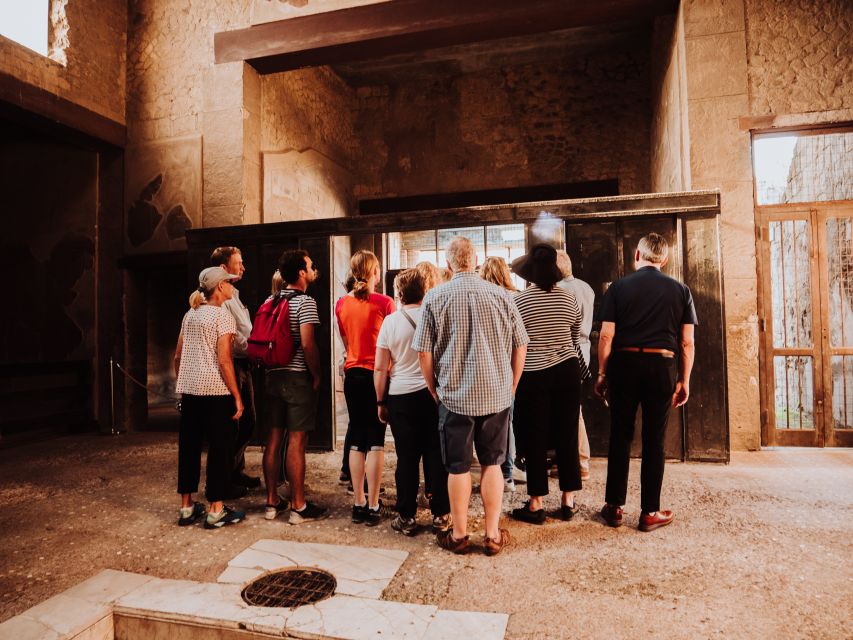
I would choose this tour if you want the key experience of both sites without spending a full day arranging trains, entrances, and a route through Pompeii. It suits first-time visitors, history fans, and anyone who wants the ruins explained rather than simply photographed.
It is also a good fit for a day trip from Rome or Naples, provided you allow extra time around the scheduled five and a half hours. The tour begins at Pompeii and ends in Ercolano, so it can work well if your next stop is in that direction.
I would hesitate if you prefer slow, independent sightseeing. The lunch break is brief, the walking schedule is fixed, and the group must stay together. You may also prefer separate visits if you want several hours at Pompeii alone.
Book with a realistic plan for the weather. Water, a hat, sunglasses, comfortable shoes, and rain protection will make the experience far more pleasant. Take your identity document, and remember that the final departure is from Herculaneum, not Pompeii.
Should you book this Pompeii and Herculaneum tour?
Yes, if your priority is to understand both archaeological sites in one well-organized day. The most highly praised part is the guide, particularly the ability of archaeologists such as Diego, Paolo, Alfredo, Vincenzo, Sergio, and Amedeo to connect ruins with real human lives.
I would book it for the context, included admission, and smart contrast between the two cities. I would not book it expecting a leisurely lunch or a relaxed pace. If you can manage the walking and plan your onward transport from Ercolano, this is a strong choice for seeing Pompeii and Herculaneum together.
FAQ
How long does the Pompeii and Herculaneum tour last?
The experience lasts about 5.5 hours. It includes a two-hour guided visit in Pompeii, a 30-minute break, the train transfer, and a two-hour guided visit in Herculaneum.
Where does the tour begin?
Meet at Piazza Porta Marina Inferiore, 1, on the left side of the Pompeii entrance called Porta Marina Inferiore. The meeting area is near the Arte bus stop.
How can I recognize the guide?
Look for a guide holding an Askos Tours sign.
Does the tour include entry tickets?
Yes. Entry tickets for both Pompeii and Herculaneum are provided, and the activity includes skipping the ticket line.
Is lunch included?
No. The itinerary provides a 30-minute break after Pompeii for lunch, refreshments, a toilet stop, or souvenir shopping.
How do I get from Pompeii to Herculaneum?
The group travels by Circumvesuviana train to Ercolano. The transfer is scheduled for about 30 minutes, with the train ride described as roughly 20 minutes.
Where does the tour finish?
The tour finishes at Parco Archeologico di Ercolano. Transport back to Pompeii is not included.
Is the tour suitable for wheelchair users?
No. The activity is not suitable for wheelchair users or people with mobility impairments.
Newest reviews from Pompei Campania
- From Sorrento: Pompeii & Vesuvius tour small group★ 4.8 · 4 reviews
- Pompeii Private Tour for Kids and Their Families★ 4.8 · 4 reviews
- From Naples_ Pompeii Tour_Skip the line ticket + audioguide★ 4.3 · 4 reviews
- Pompeii, skip-the-line ticket with smartphone audio guide on App★ 3.0 · 4 reviews
- Pompeii Guided Experience – Tour Service Only★ 4.6 · 4 reviews
- From Naples Port:Pompeii+Vesuvius tour★ 4.3 · 4 reviews
- 2-Hour Pompeii Child-Friendly Tour★ 5.0 · 4 reviews
- Naples: Amalfi Coast, Sorrento and Pompeii Day Trip★ 4.4 · 5 reviews
Herculaneum Tours, compared.

Pompeii and Herculaneum Small Group Tour with an Archaeologist
Read our review →
Herculaneum Entry Ticket with Optional Audio Guide
Read our review →
Guided Day Tour of Pompeii and Herculaneum with Light Lunch
Read our review →
Private Day Tour to Vesuvius, Herculaneum & Pompeii with Pick Up
Read our review →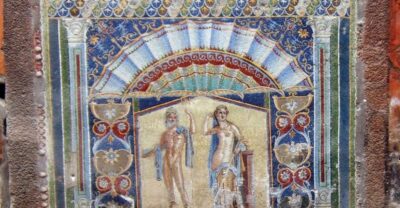
Browse the lists this tour appears in