
Reviewed · WALKING TOURS
Pompeii 3-Hour Walking Tour
Pompeii is most powerful when you stop seeing it as a field of ruins and start reading it as a Roman town caught in one terrible afternoon. This private three-hour tour moves from the city gates to its forum, baths, homes, theatres, brothel, and plaster casts, giving you a clear path through a huge archaeological site.
I like the private format, since you can focus on the questions that interest you instead of following a large crowd. I also like the chance to tour with an archaeologist guide, including Vincenzo, who is described as both highly informed and friendly. The main drawback is the pace: fourteen named stops in three hours means you will cover a lot, but some places may receive only a short explanation.
In This Review
- Key points to know
- Why Pompeii Still Feels Immediate
- Beginning at Porta Marina and the Villa of the Mysteries
- Temples, the Forum, and Pompeii’s Civic Center
- Houses That Show Status and Private Life
- Baths, Bakeries, and a Roman Snack Bar
- The Lupanar and the Less Polished Side of Roman Life
- Theatres, the Amphitheater, and Public Entertainment
- The Plaster Casts and the Human Cost of 79 A.D.
- What Three Hours Really Gives You
- Price, Private Value, and Who Should Book
- Should You Book the Pompeii Walking Tour?
- FAQ
- How long does the Pompeii walking tour last?
- Is the Pompeii admission fee included?
- Is transportation included?
- What languages are available for the live guide?
- What should I bring to the tour?
- Can I cancel the tour?
Key points to know
- The Forum anchors the tour: See Pompeii’s main civic center, Basilica, Temples of Jupiter and Apollo, and nearby public buildings.
- Roman daily life takes center stage: Houses, bakeries, baths, a snack bar, and the Lupanar brothel show how ordinary routines worked.
- The plaster casts are emotionally striking: Human and animal forms preserve the final moments of the eruption.
- A private archaeologist guide leads the way: You can ask questions and request more detail at stops that catch your interest.
- The three-hour route is broad and brisk: It includes major villas, theatres, the amphitheater, and the Villa of the Mysteries.
- Plan for practical restrictions: Bring passport or ID, leave backpacks and pets behind, and prepare for weather.
Why Pompeii Still Feels Immediate
Pompeii was buried by the eruption of Mount Vesuvius in 79 A.D. Ash and volcanic material covered streets, houses, shops, temples, and public buildings. That disaster destroyed a city, but it also protected an extraordinary record of Roman life.
The value of this tour is not simply seeing old walls. Your guide helps connect those walls to the people who used them. A bakery becomes evidence of food production. A thermal bath becomes part of the Roman social day. A private house reveals how status, decoration, and family life worked.
UNESCO places Pompeii and nearby Herculaneum on its World Heritage list because the sites offer a complete and vivid picture of society at one specific moment. That is why a guided visit can be worth the cost. Without context, Pompeii can feel like a giant collection of doorways and broken columns. With a good guide, the city begins to make sense.
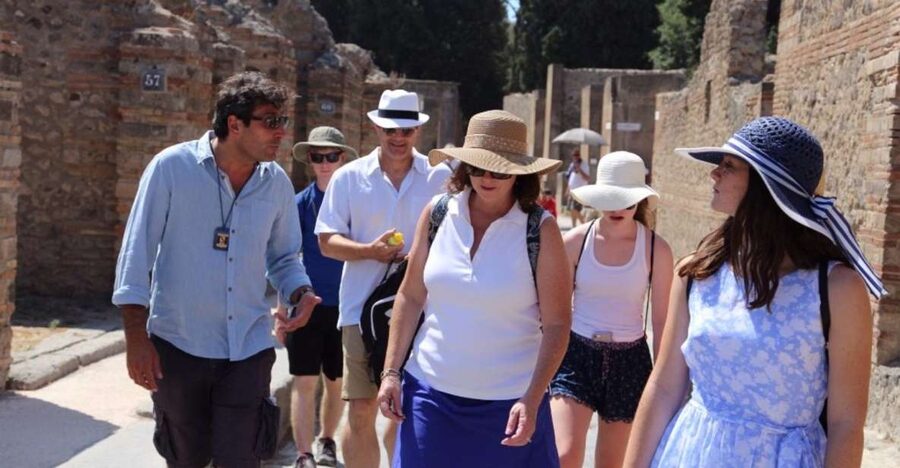
The private arrangement is especially useful here. You can ask why one house is larger than another, how the baths were heated, or what the painted rooms tell you about their owners. If Vincenzo is your assigned guide, you can expect an archaeologist with a friendly, engaging manner, according to the available description.
More Walking Tours in Pompeii
- 2-Hour Private Walking Tour of Pompeii
★ 4.7 · 22 reviews - Pompeii: Guided Walking Tour with Entrance Ticket
★ 4.3 · 1,423 reviews - Discover Pompeii: French Walking Tour of the Buried City
★ 4.8 · 253 reviews
Beginning at Porta Marina and the Villa of the Mysteries
The meeting point is at one of two locations on Via Villa dei Misteri, at numbers 2 or 3, depending on the option you book. The tour then enters the Pompeii Archaeological Site and reaches Porta Marina, one of the city gates.
Porta Marina gives you an immediate sense of Pompeii as a functioning town. This was not an isolated collection of villas. It had entrances, roads, public buildings, commercial spaces, and a steady flow of people. Your guide can help you picture the city as a place of work, worship, politics, bathing, eating, and entertainment.
The Villa of the Mysteries is one of the most distinctive stops. Its name comes from the famous wall paintings associated with mysterious ritual scenes. You should pay close attention here, since painted interiors are among Pompeii’s most valuable remains. The villa also helps show how wealthy Roman homes differed from smaller residences and commercial buildings.
A small caution: Pompeii is extensive, and the route covers many locations. You may not have time to study every room in detail. If the Villa of the Mysteries matters most to you, tell your guide early so you can spend your attention wisely.
Temples, the Forum, and Pompeii’s Civic Center
The Temple of Apollo offers a glimpse of Pompeii’s religious life. Its columns and open setting make it easy to understand how temples related to public spaces. The nearby Forum, or Foro Civile di Pompei, was the city’s main civic square.
The Forum is the place where the tour’s broader story comes together. Here, you can see how religion, government, commerce, and public ceremony shared one central area. The Temple of Jupiter, Temple of Apollo, and Temple of Venus help show the importance of worship, while the Basilica points to law and administration.
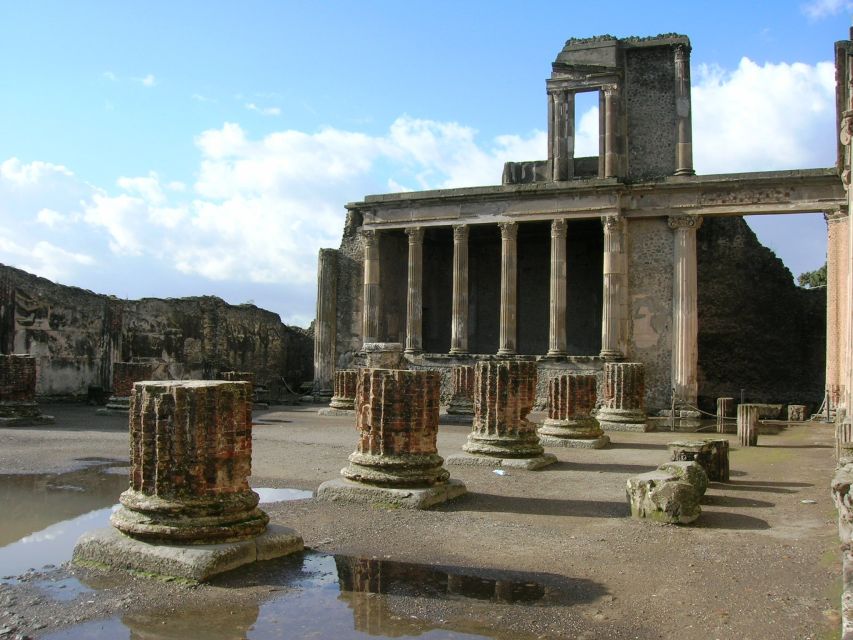
The Basilica served as a courthouse and business center. It was one of the city’s most important public buildings, even though its surviving walls may not look as complete as a modern structure. Your guide’s explanation matters here because the building’s function is not always obvious from the remains alone.
I like this section because it shifts Pompeii from private homes to public power. You see where people gathered, conducted business, and took part in civic life. If you are mainly interested in Roman politics, religion, or architecture, this is likely to be one of the strongest parts of the tour.
The Triangular Forum adds another public space, with a different setting from the main Forum. The route also includes the Temple of Apollo and other major monuments. Since several stops are close together, the guide can compare their purposes without requiring a long transfer across the site.
Houses That Show Status and Private Life
Pompeii’s houses are often more revealing than its grand monuments. The House of Menander, House of the Faun, House of the Tragic Poet, House of the Vettii, and Villa of the Mysteries show different forms of Roman domestic life.
The House of Menander is known for its connection to theatre and elegant domestic decoration. It helps you think about how Roman homeowners used art to present education, taste, and social rank.
The House of the Faun is one of Pompeii’s largest and most famous residences. Its scale offers a sharp contrast with more modest homes. As you move through its rooms and courtyards, the guide can explain how Roman houses were arranged around social visits, household work, and display.
The House of the Tragic Poet adds another layer through its literary and artistic decoration. The House of the Vettii is useful for understanding wealth and private ownership. Together, these residences show that Pompeii was not socially uniform. Some people lived in large, decorated homes, while others worked in smaller spaces or commercial buildings.
A three-hour visit cannot give equal time to every house. That is not necessarily a flaw, but it does mean you should decide what kind of Pompeii you want to understand. Tell your guide if domestic architecture and art matter more to you than theatres or public monuments.
More Pompeii excavation visits:
- Pompeii: Entry Ticket with Optional Audio Guide
★ 4.2 · 12,360 reviews - Pompeii: Archaeological Park Tour with Ticket on request
★ 4.5 · 2,283 reviews - Pompeii Ruins Private Tour with Optional Skip-the-Line Entry
★ 4.9 · 732 reviews - Pompeii: Exclusive Tour with Archaeologist and Entry Tickets
★ 4.9 · 634 reviews
Baths, Bakeries, and a Roman Snack Bar
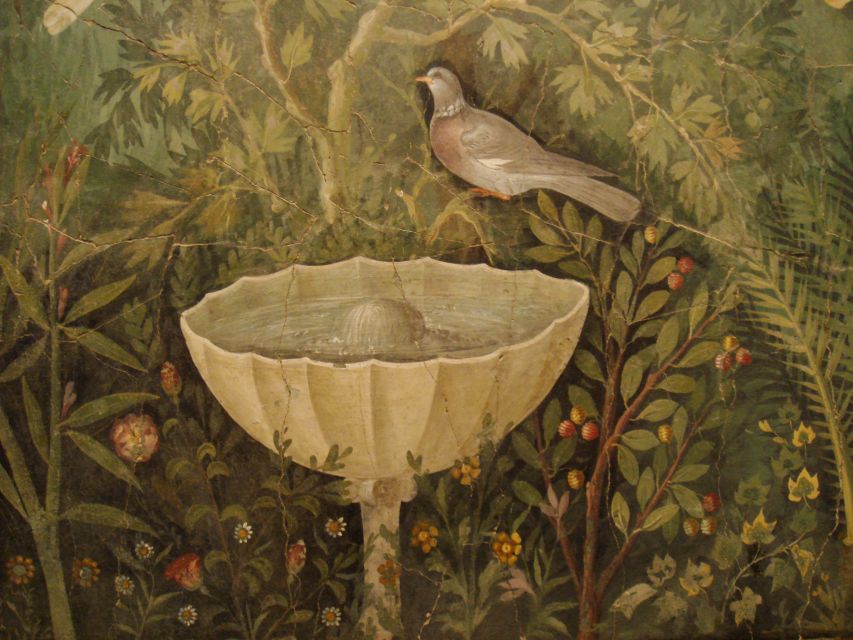
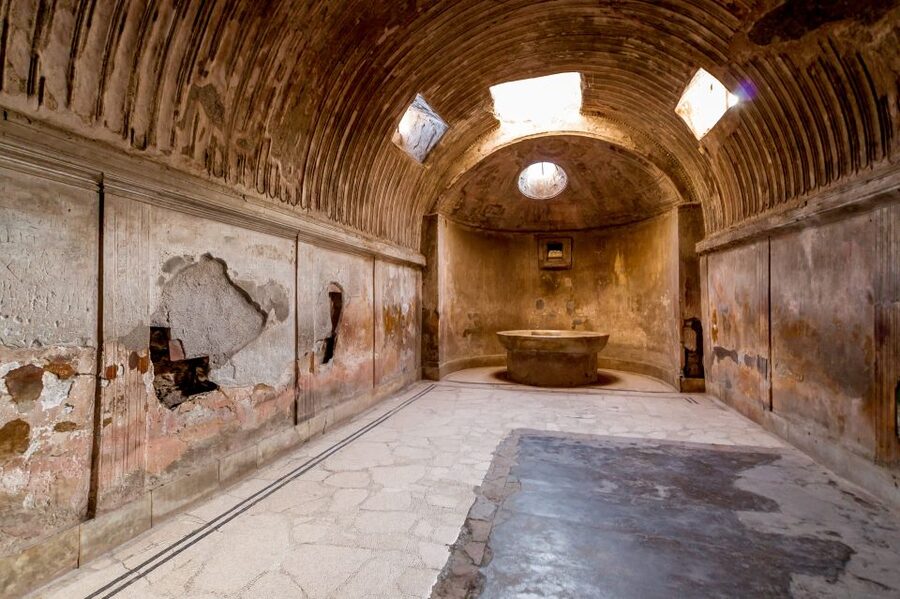
The Sarno Baths and Forum Baths reveal how Romans treated bathing as a social and public activity. These were not simply places to wash. A visit to the baths could involve exercise, conversation, relaxation, and routine contact with other members of the community.
The Forum Baths are especially useful because they sit near the civic center. Their location shows how public services were woven into the city’s daily rhythm. Look for the remains that explain how the bath complex was organized and heated. Your guide can make sense of features that may otherwise look like plain masonry.
The bakery gives you a look at food production. Pompeii’s preserved commercial buildings help you picture how bread was made and sold. The Termopolium Capuano offers another practical glimpse of eating outside the home. A termopolium was a Roman food and drink counter, similar in basic purpose to a small takeaway shop.
These stops are among my favorites because they move beyond emperors and temples. They show the working city: food preparation, public services, and everyday routines. They also make Pompeii feel less like a monument and more like a neighborhood.
The Lupanar and the Less Polished Side of Roman Life

The Lupanar, or old brothel, is one of Pompeii’s most talked-about buildings. Its small rooms and erotic paintings offer evidence of a commercial sex trade in the Roman city.
The stop can be uncomfortable, especially for families or anyone who prefers to focus only on temples and villas. Still, it is part of the site’s social record. A good guide can place it in context without turning the visit into a cheap joke.
This is where a private guide helps. You can ask questions discreetly, move on quickly, or request more historical context. The tour presents Pompeii as it was, not as an edited version of Roman life designed only for polite sightseeing.
Theatres, the Amphitheater, and Public Entertainment
The Large Theatre, or Teatro Grande, shows the place of performance in Pompeii. The nearby Odeion, or small theatre, adds a more intimate performance space. Together, they suggest that entertainment was part of normal urban life, not an occasional luxury.
Theatres also help you understand Pompeii’s population and social organization. Public performances brought people together, while the buildings themselves reveal how Roman audiences were arranged and how architecture shaped the experience.
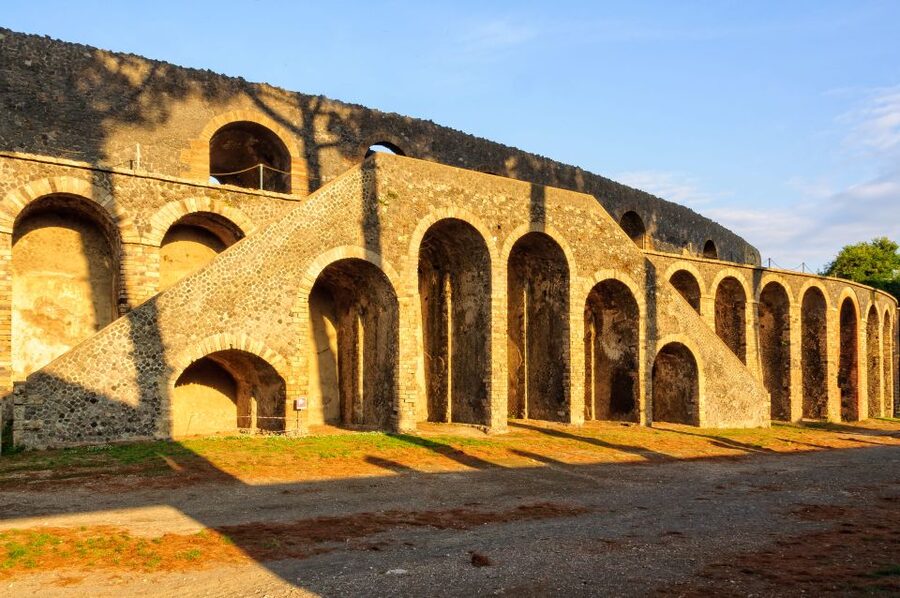
The Amphitheater of Pompeii is another major stop. It was built for large public spectacles and remains one of the clearest reminders that Roman leisure could be highly organized and very intense. The building’s size and form make more sense when your guide explains how it functioned within the city.
This portion of the route is a good fit if you are interested in Roman entertainment, architecture, or public life. The tradeoff is time. With theatres, villas, baths, and the Forum all included, you may not get a long, quiet period at each venue.
The Plaster Casts and the Human Cost of 79 A.D.
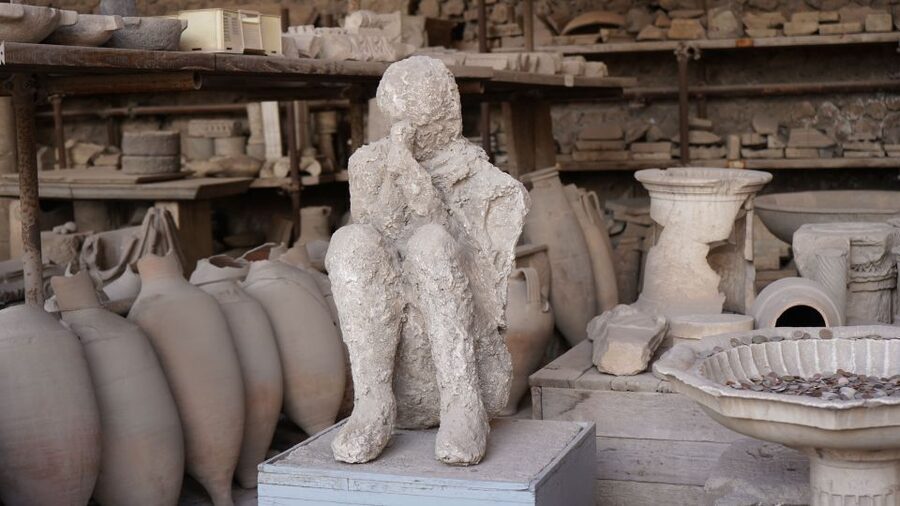
The plaster casts are usually the emotional center of a Pompeii visit. Archaeologists filled cavities left in the hardened ash by bodies that decomposed over time. The resulting casts preserve the shapes and positions of people and animals at the moment of death.
Seeing these forms can change the way you understand the eruption. The city is not just a collection of buildings preserved by chance. It is also a place marked by sudden loss.
Your guide can explain how the casts were made and why they are so important. This is a stop where a few clear sentences may matter more than a long lecture. The evidence is direct and difficult to ignore.
The condition and location of displays can vary, so do not assume every cast will be visible in the same way at every moment. Still, the tour specifically includes the plaster casts, making this a central part of the experience rather than an optional extra.
What Three Hours Really Gives You
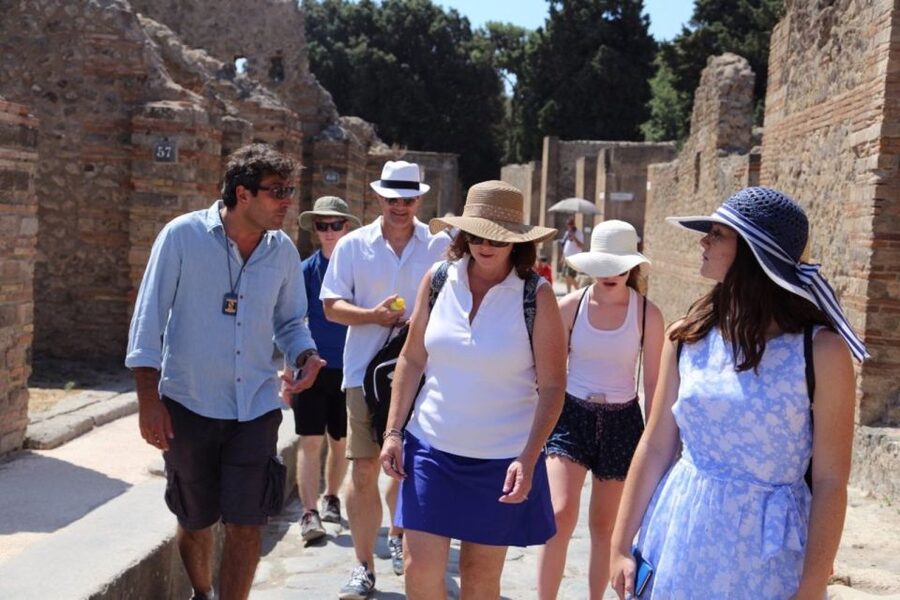
Three hours is long enough for a strong first visit, but not enough to see all of Pompeii. The route includes the archaeological site, Porta Marina, Villa of the Mysteries, Temple of Apollo, Forum, Basilica, House of Menander, Forum Baths, Lupanar, House of the Faun, Large Theatre, House of the Vettii, and Amphitheater.
That is an ambitious list. You should expect steady walking and a brisk progression between highlights. The benefit is breadth. You will see public monuments, private homes, commercial buildings, religious sites, entertainment venues, and human remains in one organized visit.
The drawback is that Pompeii rewards slow looking. If you want to study every painting, inscription, courtyard, or architectural detail, you may need a longer visit beyond this tour. For a first orientation, though, the route gives you a useful framework for returning on your own.
There is no transportation included, so you must reach the meeting point yourself. The tour ends back there. Meals are also not included, which is sensible for a three-hour archaeological walk, but you should plan food and onward transport separately.
Price, Private Value, and Who Should Book
The listed price is $508.15 per group up to one person. Because the price is shown in that format, check the booking details carefully if more than one person will attend. The private guide and Pompeii admission are included, while transportation and meals are not.
That is a substantial price for a three-hour experience. I would consider it good value for a solo visitor who wants expert guidance and a carefully planned route, or for someone with limited time who does not want to work out the site alone.
For a larger party, private guiding can make more financial sense if the booking terms allow the stated group arrangement. You get a guide focused on your interests, rather than a standard explanation aimed at a mixed crowd. The value depends heavily on how much you want interpretation instead of simply entry.
The tour is a strong match for first-time visitors, history fans, families who want questions answered, and people who prefer a private setting. It is less suitable if you want a relaxed, unhurried archaeological study or a full-day exploration.
The live guide service is offered in English, Italian, Spanish, German, Russian, Chinese, Japanese, and Portuguese. Wheelchair access is available, though Pompeii’s ancient surfaces and buildings can still make movement uneven in practical terms. Pets are not allowed, but assistance dogs are permitted.
Bring a passport or ID card. Backpacks and umbrellas are not allowed, so pack lightly. The weather rule is important: the tour runs in rain or shine. Since the instructions also say umbrellas are not permitted, a raincoat is the safer choice.
Should You Book the Pompeii Walking Tour?
Book this tour if you want Pompeii’s major sights explained by an archaeologist and prefer a private group. The Forum, baths, homes, theatres, Lupanar, plaster casts, and amphitheater give you a broad view of Roman public and private life.
Choose it with realistic expectations. Three hours lets you see the essential areas, not every corner. The price is high for one person, and you must arrange your own transportation and food. But if Vincenzo or another strong archaeologist guide leads your visit, the clear explanations and chance to ask personal questions can turn a confusing spread of ruins into a readable ancient city.
FAQ
How long does the Pompeii walking tour last?
The guided tour lasts three hours. Check availability for the starting times offered on your chosen date.
Is the Pompeii admission fee included?
Yes. Pompeii admission fees and private guidance are included.
Is transportation included?
No. Transportation to and from the meeting point is not included. The tour ends back at the meeting point.
What languages are available for the live guide?
Guides are available in Spanish, German, Russian, Chinese, English, Italian, Japanese, and Portuguese.
What should I bring to the tour?
Bring a passport or ID card. Backpacks and umbrellas are not allowed, and the tour operates in all weather conditions. A raincoat is recommended for wet weather.
Can I cancel the tour?
You can cancel up to 24 hours in advance for a full refund. A reserve-now-and-pay-later option is also available.
More 3-Hour Experiences in Pompeii Archaeological Site
- Pompeii Private Tour with an Archaeologist and Skip The Line – 3 hours
★ 5.0 · 564 reviews - Pompeii 3 Hours Walking Tour Led by an Archaeologist
★ 5.0 · 126 reviews - Pompei three hours with an expert guide
★ 5.0 · 82 reviews - Complete Private Guided Three-Hour Tour on the Capri Coast
★ 5.0 · 78 reviews
More Walking Tours in Pompeii Archaeological Site
- Walking Food Tour in Sorrento w/ Limoncello Factory Lemon Grove
★ 4.5 · 821 reviews - Sorrento: Guided Walking Tour & Limoncello Tasting
★ 5.0 · 472 reviews - Herculaneum: 3D Walking Tour with Skip-the-Line Ticket
★ 4.3 · 313 reviews - Capri Walking Tour with local guide
★ 5.0 · 300 reviews
Newest reviews from Pompeii Archaeological Site
- From Naples: Pompeii & Sorrento Shore Excursion with Lunch★ 5.0 · 6 reviews
- From Sorrento: Pompeii and Vesuvius Tour by Express Train★ 4.0 · 12 reviews
- Pompeii: Skip-the-Line Guided Archaeological Discovery Tour★ 4.2 · 13 reviews
- 2-Hour Private Walking Tour of Pompeii★ 4.7 · 22 reviews
- Mount Vesuvius Wine Tasting and Lunch from Pompeii★ 4.3 · 43 reviews
- Pompeii: Skip-the-Line Ticket and Virtual Museum★ 4.5 · 66 reviews
- Pompeii: Skip-the-Line Tour for Kids and Families★ 4.9 · 72 reviews
- Pompeii: Tour for Children★ 4.7 · 106 reviews
Walking Tours, compared.

Walking Food Tour in Sorrento w/ Limoncello Factory Lemon Grove
Read our review →

Discover Pompeii: French Walking Tour of the Buried City
Read our review →

Browse the lists this tour appears in