
Reviewed · SKIP THE LINE
Pompeii: Skip-the-Line Tour for Kids and Families
Pompeii is much easier for children to grasp when it becomes a town rather than a pile of old stones. This two-hour family tour uses games, visual aids, questions, and storytelling to show how people lived, ate, worshipped, worked, and reacted to the eruption of Vesuvius in 79 AD.
I like two things especially: the guide adjusts the pace to the children in front of them, and the route focuses on memorable places such as an ancient restaurant, a theater, fountains, baths, homes, and temples. The separate entrance is another real help. The main drawback is the site itself: Pompeii is hot, uneven, and huge, and this short tour can only show a small part of it.
In This Review
- Key points at a glance
- Why Pompeii works better as a family story
- Meeting at Hotel Vittoria or Coffee Shop Vittoria
- Entering Pompeii without wasting the morning
- The two-hour route through daily Roman life
- Games, visual aids, and small prizes
- How the guides shape the experience
- Heat, cobblestones, and the practical side
- Is two hours enough?
- Who should book this family tour?
- My verdict: pay for the focus if Pompeii is a family priority
- FAQ
- How long does the Pompeii family tour last?
- Where does the tour start?
- Where does the tour finish?
- Which languages are available?
- Does the tour include skip-the-line entry?
- What should children bring for the tour?
- Is identification required for children?
- Can unaccompanied minors join the tour?
- Is the tour suitable for wheelchair users?
Key points at a glance
- Children lead the learning: Guides use trivia, pop-up books, iPad games, visual reconstructions, and friendly competitions instead of a long lecture.
- A practical two-hour route: You see key streets, homes, temples, baths, fountains, restaurants, and theater spaces without asking young children to cross the entire archaeological site.
- Skip-the-line entry: Reserved tickets and a separate entrance can save valuable time, especially when cruise groups arrive.
- Guides who connect with different ages: Guides including Lello, Rafaela, Clelia, Vittoria, Mima, and Roberta have been praised for patience, humor, and adapting to each child.
- Heat matters: Shade stops and comfort breaks help, but you still need good shoes, sun protection, and water.
- Best for families who want meaning, not maximum coverage: This is about understanding Pompeii and remembering it, not checking every street off a map.
Why Pompeii works better as a family story
The power of Pompeii is not only its age. It is the suddenness of the disaster. In one moment, this was a functioning Roman town with shops, homes, public baths, temples, fountains, and places to eat. Then Vesuvius buried it under ash and lava.
Children often understand this more easily when they can connect the ruins to familiar parts of life. A restaurant is easier to picture than an abstract lesson about Roman society. A fountain invites a question about drinking water. A theater gives children a sense of where people gathered for entertainment.
That is the strength of this tour. The guide does not treat Pompeii as a silent museum. Instead, the ruins become clues. You walk across cobbled streets, step into buildings, look at surviving art and architecture, and use the setting to imagine the people who once lived there.
I also like that the experience includes both the disaster and the earlier life of the town. You hear how the eruption happened, how Pompeii was excavated in the 18th century, and why the site later received UNESCO World Heritage status. The historical frame is there, but it supports the walk rather than swallowing it.
More Pompeii excavation visits:
- Pompeii: Entry Ticket with Optional Audio Guide
★ 4.2 · 12,360 reviews - Pompeii: Archaeological Park Tour with Ticket on request
★ 4.5 · 2,283 reviews - Pompeii Ruins Private Tour with Optional Skip-the-Line Entry
★ 4.9 · 732 reviews
Meeting at Hotel Vittoria or Coffee Shop Vittoria
You choose between two starting points connected with Hotel Vittoria and Coffee Shop Vittoria. The exact meeting point depends on the option you book, so check your confirmation closely before setting out.
The same two locations are used for the return at the end. That makes the arrangement simple, especially if you are staying nearby or using the meeting point as a fixed place to regroup.
One useful detail from the family experiences is that guides may be ready before the official start time. Lello, for example, was waiting early and was happy to begin sooner when the family arrived. That is helpful, but I would still arrive at the stated time rather than count on an early start.
The tour is available in English or Italian, and a small-group option is available. Group size matters at Pompeii. A guide can ask children questions and notice when they are tired much more easily with a small party than with a large crowd.
Entering Pompeii without wasting the morning
Reserved entrance tickets and a separate entrance are a major part of the value here. Pompeii can draw large groups, including people arriving from cruise ships, and queues can make a young child lose interest before the first ancient wall appears.
The skip-the-line benefit does not mean every delay disappears. Entry rules and crowd levels can still affect the pace. The first Sunday of each month is a special case: admission is free, but tickets cannot be reserved in advance, so entry is not guaranteed. If your schedule is tight, that is a poor day to depend on advance access.
Once inside, the guide takes over the navigation. You do not need to build a route through a vast archaeological site while also keeping an eye on children. That alone can make the tour worth paying for, even if the family price is higher than entering independently.
The exact price is not provided here, so I cannot call it cheap. I would judge the cost against three things: reserved access, a live guide who can hold a child’s attention, and the time saved from wandering without context. For a family with limited time, those benefits can be more useful than a lower-cost ticket.
The two-hour route through daily Roman life
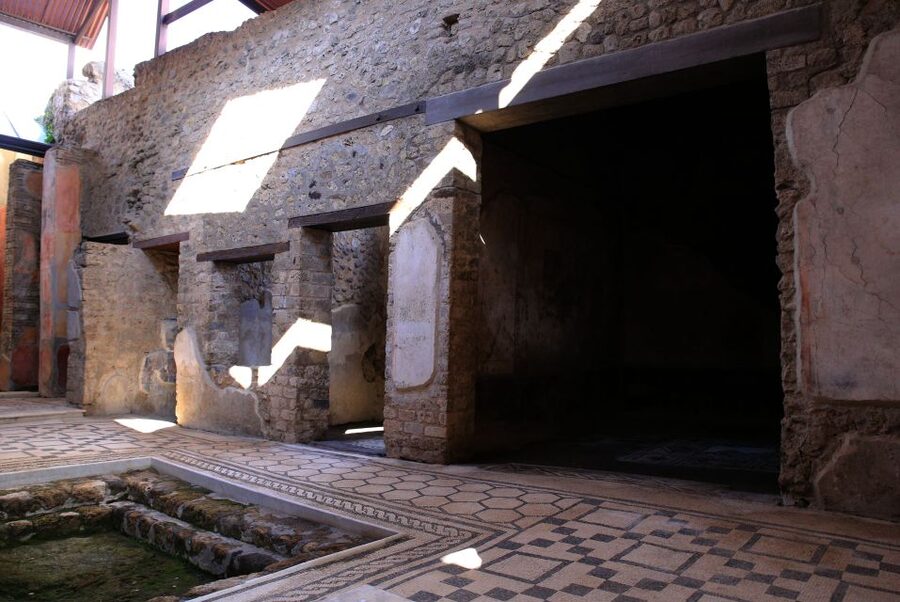
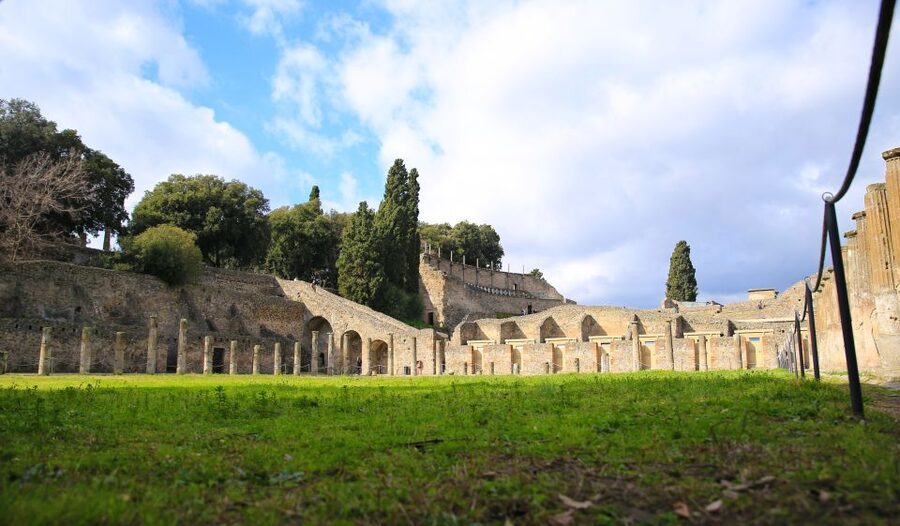
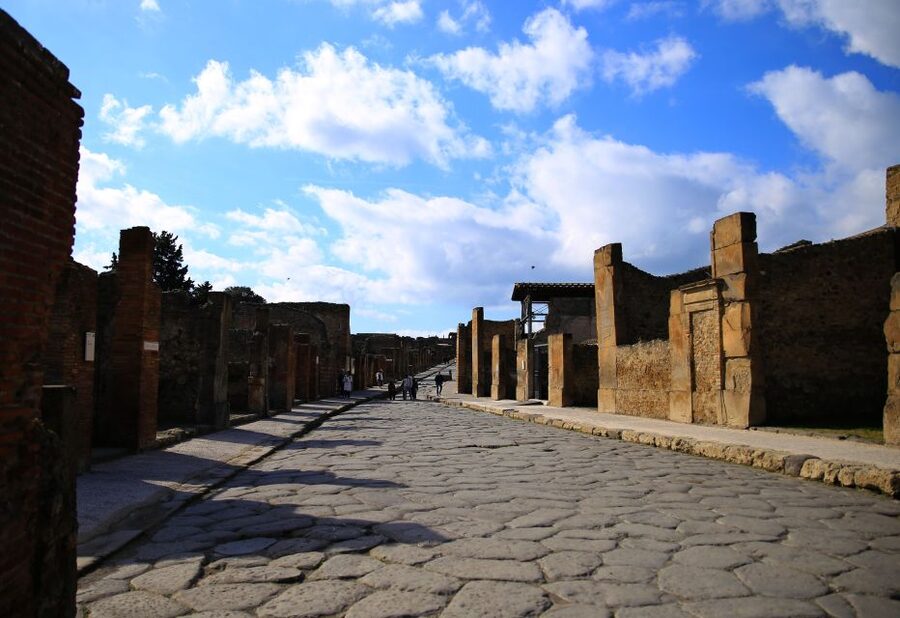
The route is built around Pompeii’s most approachable sights. You walk through the ancient streets and visit the remains of homes, thermal baths, temples, restaurants, fountains, and a theater.
The ancient theater gives the group a clear place to pause and imagine public life. Children can climb the steps with the guide and see how a performance space fits into the town. It is more engaging than hearing about Roman entertainment while standing outside a building.
The original fountains offer another hands-on moment. Children can drink from them, according to the activity details, and connect an old public utility with something they use every day. These small physical encounters often make the site easier to remember.
The ancient restaurants are especially good for families. Crossing the threshold of an early eating place turns Roman food culture into something concrete. The guide can use the setting to explain how an ordinary day might have worked, without reducing Pompeii to a story about emperors and eruptions.
Homes and thermal baths add another layer. They show that Pompeii was not simply a place of public monuments. It was a lived-in town, with private rooms, social spaces, washing facilities, religious buildings, and artwork.
You also see rare examples of preserved art and architecture. The condition of some remains helps children understand why Pompeii matters. It is not only old. It offers unusually direct evidence of an ancient town and its customs.
The limitation is coverage. Pompeii is too large for a complete tour in two hours. You will get a carefully chosen introduction, not every major building. If you already know the site well or want specialist attention to a particular villa or artwork, a longer or more specialized tour may suit you better.
More Pompeii Archaeological Site tours worth comparing
- Pompeii: Skip-the-Line Tickets and Tour with Archaeologist
★ 4.9 · 467 reviews - Pompeii: Skip-the-Line Guided Tour with Expert Archaeologist
★ 4.8 · 196 reviews - Pompeii: Skip-the-Line Ticket and Virtual Museum
★ 4.5 · 66 reviews - Pompeii: Skip-the-Line Guided Archaeological Discovery Tour
★ 4.2 · 13 reviews
Games, visual aids, and small prizes
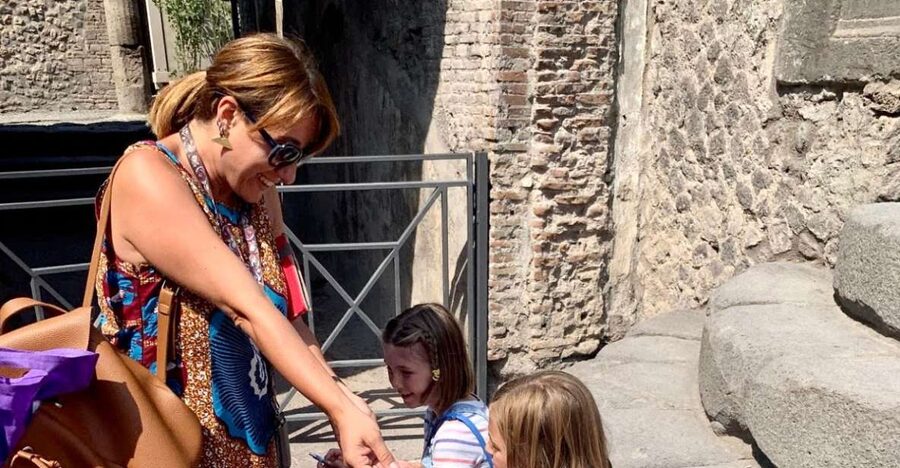
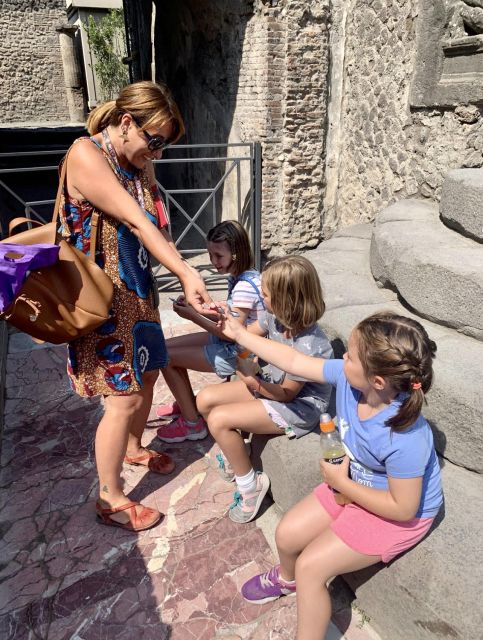
The family focus is not just a label. The activities include pop-up books, iPad games, trivia, and other visual learning tools. Guides may also use friendly competitions and small prizes to keep children involved.
That approach works best when the guide responds to the actual children in the group. Rafaela reportedly used competitions to draw in a 10-year-old boy with ADHD and autism and a seven-year-old girl. Clelia helped a shy eight-year-old ask questions, while another guide kept a very talkative child involved with patience.
I would not promise the same exact game or gift on every departure. The experience depends partly on the guide and the children’s ages. But the format gives the guide several ways to change direction when attention begins to fade.
A particularly nice idea is asking a child to trace the route on a map afterward. One guide suggested this to a six-year-old, who recreated the walk later in the day. That turns the tour into a memory exercise rather than a two-hour burst of information.
Older children are not left out. A 14-year-old and a 10-year-old reportedly stayed engaged for the full tour, and teenagers can take part in questions without being treated like toddlers. The best guides seem to speak to the whole family, not only the youngest child.
How the guides shape the experience
The guide is the main reason to choose this tour instead of a standard group walk. Names associated with especially strong family experiences include Lello, Rafaela, Clelia, Vittoria, Mima, Roberta, Paula, and Claire.
I cannot guarantee which guide you will receive. I can say what you should look for in the format: a person who can explain Roman life plainly, accept interruptions, shift the pace, and use the children’s questions as part of the route.
The strongest guide moments come from flexibility. On a hot day, one guide kept a family in the shade as much as possible. Another included several comfort breaks. A guide working with a toddler stayed patient when the child became difficult, rather than allowing the whole family to feel rushed.
That is important at Pompeii because children do not tire only from walking. They tire from heat, glare, uneven paving, and too much information. A skilled guide knows when to stop explaining and when to let the group simply look.
The tour can also work for a mixed-age family. A two-year-old may mainly enjoy moving through a new place, while older children ask about Roman customs and the eruption. Adults get the same core story, with enough detail to make the ruins meaningful without turning the morning into a university lecture.
Heat, cobblestones, and the practical side
Pompeii is outdoors, and summer heat is a serious consideration. August experiences describe very high temperatures, though guides tried to use shade and plan sensible stops. You should still bring a sun hat, comfortable shoes, and water.
The paving is ancient and uneven. The tour welcomes all ages and fitness levels in general, but it is not suitable for wheelchair users or people with mobility impairments. Families using a stroller should think carefully. One family managed with a stroller and a patient guide, but the parents also noted that it was not ideal.
Do not bring luggage or large bags. Children under 18 must be accompanied by an adult, and unaccompanied minors are not accepted. Bring a passport or identity card for every child. This is required as proof of age when child prices apply, so do not assume a copy or a verbal estimate will be enough.
The pace is a good fit for children with limited stamina, but two hours is still a substantial outdoor walk. I would avoid scheduling a demanding activity immediately afterward, especially in warm weather.
At the end, you return to Hotel Vittoria or Coffee Shop Vittoria. The supplied details also suggest retiring to a nearby restaurant after working up an appetite. Treat that as a useful plan for lunch, not as a guaranteed included part of the tour.
Is two hours enough?
For a first look, yes. Two hours gives you a focused path through the town and enough time to understand how Vesuvius changed it. The shorter format is one reason younger children can finish feeling successful rather than defeated.
For a full archaeological study, no. Pompeii is enormous, and this tour leaves plenty unseen. That is not a flaw if you view it as an introduction. In fact, one family with limited time felt the guide managed to fit in the major sights and still wished to return for more.
I like the balance. A conventional adult tour can try to cover too much and leave children remembering only heat and stones. This experience trades breadth for recall. Your child may remember the fountain, the restaurant, a competition, a temple, or the idea that a real town disappeared beneath the volcano.
Who should book this family tour?
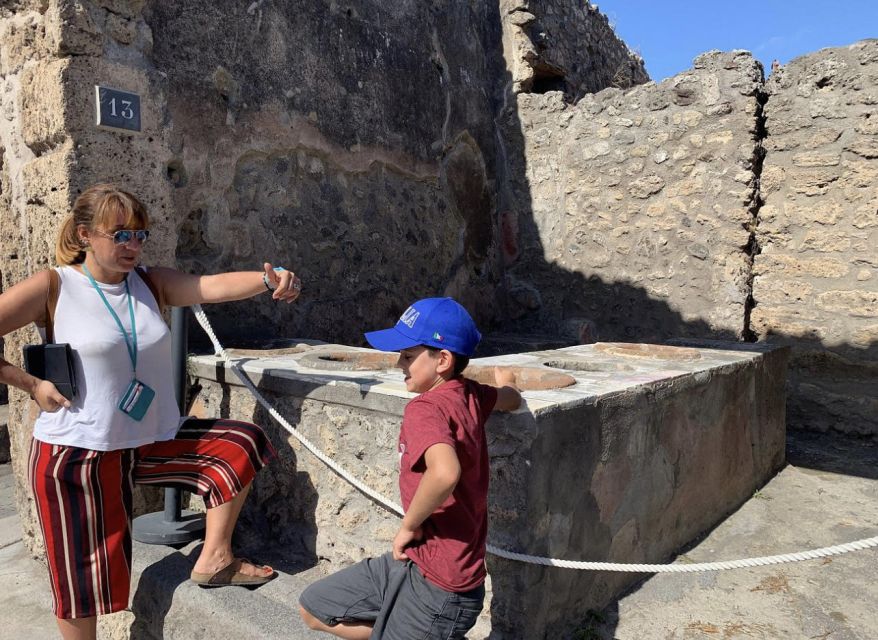
I would choose it for families with children from early primary-school age through the teenage years, particularly if your children have little patience for long lectures. It is also a sensible choice for a first Pompeii visit when you have only a morning or afternoon.
It suits families who want adults to learn too. The storytelling covers the eruption, excavation, Roman customs, art, architecture, and public life, so you are not paying for entertainment at the expense of substance.
It may be less suitable if you need step-free access, want to see a very large portion of the ruins, or prefer to explore alone at a slow, unstructured pace. It is also not the best match for a day when you are carrying large bags or relying on a wheelchair.
The rating is 4.9 from 72 reviews, and the praise is remarkably consistent around the same points: guides who engage children, clear explanations, patience, and a route that avoids exhausting the family. The useful takeaway is not simply that the tour is popular. It is that the guide-child connection matters more here than a long list of monuments.
My verdict: pay for the focus if Pompeii is a family priority
I would book this tour if your goal is to help children understand Pompeii and enjoy the visit at the same time. The reserved entrance, two-hour length, child-centered activities, and flexible guiding solve the main problems families face at the site.
I would skip it only if you are comfortable planning your own route, have plenty of time to explore, or need accessibility that this tour cannot provide. For everyone else, especially families arriving during a busy cruise-ship day, it offers a practical way to turn an overwhelming archaeological site into a story your children may still be telling at dinner.
FAQ
How long does the Pompeii family tour last?
The guided tour lasts two hours.
Where does the tour start?
The available starting locations are Hotel Vittoria and Coffee Shop Vittoria. The exact meeting point depends on the option booked.
Where does the tour finish?
The listed drop-off locations are Hotel Vittoria and Coffee Shop Vittoria.
Which languages are available?
The live guide speaks English or Italian.
Does the tour include skip-the-line entry?
Yes. Reserved entrance tickets and a separate entrance are included to help you avoid the usual lines.
What should children bring for the tour?
Bring comfortable shoes, a sun hat, and a passport or identity card for each child.
Is identification required for children?
Yes. Children should bring a passport or ID card as proof of age when receiving child prices.
Can unaccompanied minors join the tour?
No. Children under 18 must be accompanied by an adult, and unaccompanied minors are not accepted.
Is the tour suitable for wheelchair users?
No. The experience is not suitable for wheelchair users or people with mobility impairments.
Newest reviews from Pompeii Archaeological Site
- From Naples: Pompeii & Sorrento Shore Excursion with Lunch★ 5.0 · 6 reviews
- Pompeii 3-Hour Walking Tour★ 5.0 · 8 reviews
- From Sorrento: Pompeii and Vesuvius Tour by Express Train★ 4.0 · 12 reviews
- Pompeii: Skip-the-Line Guided Archaeological Discovery Tour★ 4.2 · 13 reviews
- 2-Hour Private Walking Tour of Pompeii★ 4.7 · 22 reviews
- Mount Vesuvius Wine Tasting and Lunch from Pompeii★ 4.3 · 43 reviews
- Pompeii: Skip-the-Line Ticket and Virtual Museum★ 4.5 · 66 reviews
- Pompeii: Tour for Children★ 4.7 · 106 reviews
Skip the Line, compared.

Skip-the-Line Entrance Ticket with Audio Guide
Read our review →



Skip-the-Line Entry Ticket with Digital Guide App
Read our review →
Pompeii Ruins Private Tour with Optional Skip-the-Line Entry
Read our review →
Skip-the-Line Pompeii Guided Tour from Sorrento
Read our review →
Skip the Line Guided Tour of Pompeii led by an Archaeologist
Read our review →Browse the lists this tour appears in