
Reviewed · WALKING TOURS
2-Hour Private Walking Tour of Pompeii
Pompeii is most powerful when you stop treating it as a collection of broken walls. On this two-hour private walking tour, your guide helps you picture the ordinary town beneath the ruins: people buying bread, washing at the baths, shopping in the market, watching theater, and crossing streets built for Roman feet.
I like the skip-the-line entry and the small group limit of 10, which leaves more room for questions than a large guide-led crowd. I also like the flexible route. You can see examples of many building types while giving more time to the places that interest you most. The main drawback is the short running time. Pompeii is huge, and two hours gives you a strong introduction, not a full archaeological visit.
In This Review
- Key points to know
- Pompeii in two hours: what this tour really covers
- Meeting at Café Hortus Pompeii
- Walking the basalt roads of an ancient town
- The Forum and Pompeii’s public life
- Bakeries, taverns, and Roman fast food
- The human casts and the human cost of the eruption
- The former red-light district and Roman frescoes
- Choosing among Pompeii’s three theaters
- Villas, baths, shops, and the shape of daily life
- Private tour, small group, and guide languages
- Is $175.22 per person a fair price?
- Who should book this Pompeii walk?
- Should you book the 2-hour Pompeii walking tour?
- FAQ
- How long is the Pompeii walking tour?
- Where does the tour begin and end?
- What does the Pompeii Express ticket include?
- Which languages are available?
- Is the tour wheelchair accessible?
- Can I cancel the booking?
Key points to know
- Original basalt streets: Walk along ancient volcanic-stone roads, with raised stepping blocks that helped pedestrians cross during rain.
- The Forum at the center: See the Temple of Apollo, Capitolium, Temple of the Emperor, Basilica, and market buildings.
- Everyday Roman life: Visit a bakery, tavern-style food counter, shops, baths, and homes rather than seeing only grand monuments.
- Human casts: See casts of Pompeii residents preserved in the positions they held when the eruption overtook them.
- Flexible private format: The guide can shape the route around your interests and physical ability, within the two-hour limit.
- Four guide languages: Tours are offered in English, Spanish, French, and Italian.
Pompeii in two hours: what this tour really covers
Pompeii rewards slow wandering, but most people do not have unlimited time or a clear idea of where to go. The site can feel like a maze of streets, courtyards, temples, kitchens, and half-excavated buildings. A guide gives your visit a thread to follow.
This tour aims to show you at least one example of each main building type. That means the route is less about checking off every famous house and more about understanding how a Roman town worked. You may see religious buildings, public spaces, shops, food businesses, entertainment venues, and private homes in one compact visit.
The guide can adjust the itinerary to your interests and physical ability. If you care about Roman engineering, you can focus on roads, water, buildings, and public works. If daily life interests you more, the bakeries, taverns, baths, and shops will likely be the most revealing stops.
The 2-hour limit matters. You should expect a brisk walk over uneven ancient surfaces, with stops for explanation and questions. You will not see every corner of Pompeii, and you should not book this tour expecting a full-day archaeological survey.
More Walking Tours in Pompeii
- Pompeii 3-Hour Walking Tour
★ 5.0 · 8 reviews - Pompeii: Guided Walking Tour with Entrance Ticket
★ 4.3 · 1,423 reviews - Discover Pompeii: French Walking Tour of the Buried City
★ 4.8 · 253 reviews
Meeting at Café Hortus Pompeii
The meeting point is Café Hortus Pompeii, in front of the entrance at Via Villa dei Misteri 2, Pompeii Archaeological Park. Your tour also ends back at this meeting point.
That simple start and finish can help with planning, especially if you are arranging other activities around Pompeii. Check the available start times when booking, since the tour does not give one fixed departure hour.
You need to provide the full names of everyone in your party. Those names are required for the entrance tickets, so have the information ready when you reserve.
The experience includes Pompeii Express skip-the-line tickets. In practical terms, that means you can avoid the ticket line and use the two hours for the ruins themselves. The entry covers the areas within the city walls included in the Pompeii visit.
The booking also allows cancellation up to 24 hours before the tour for a full refund, and you can reserve now and pay later. Those terms are useful if your Campania plans depend on train schedules, weather, or a changing hotel stay.
Walking the basalt roads of an ancient town
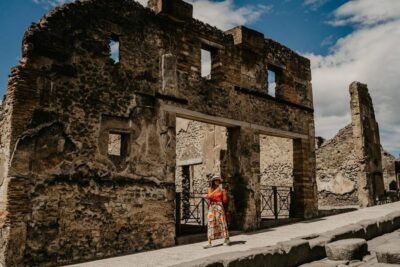
The first streets you encounter give you a quick lesson in how Pompeii worked. The roads are made from volcanic basalt, a dark, tough stone that could handle carts and constant foot traffic.
Look down as you walk. Small white travertine spots were set into the road to reflect torchlight after dark. This is the sort of detail easy to miss when you are moving from one famous ruin to the next, but it makes the ancient city feel practical rather than theatrical.
You will also see large basalt blocks rising from the road. These stepping stones let pedestrians cross without splashing through rainwater and street runoff. Their height and spacing were suited to ancient carts, so you may find yourself watching your feet and choosing each step carefully.
Wear comfortable shoes. The surface is old, uneven, and hard underfoot. Even though the tour lasts only two hours, you will be walking and standing for much of it.
The Forum and Pompeii’s public life
The Forum was Pompeii’s central public space. It brought together religion, trade, administration, and politics, so this is the best place to understand how the town operated as a community.
Your guide is expected to point out several important buildings around this area:
- Temple of Apollo: One of Pompeii’s key religious sites, with a long connection to the city’s public worship.
- Capitolium: A major temple associated with the Roman state religion.
- Temple of the Emperor: A reminder that political power and religious practice were closely linked.
- Basilica: A large public building used for legal and commercial business.
- Macellum: The market area, where food and trade formed part of everyday city life.
The value of seeing these structures together is scale. You are not just looking at separate temples. You are seeing the center of a functioning town, where people came to worship, settle disputes, buy goods, and conduct public business.
The Forum can be visually overwhelming because much of it is open and spread out. A guide helps by telling you where to look and explaining what each building was for. In a two-hour visit, that focus saves time.
More Pompeii excavation visits:
- Pompeii: Entry Ticket with Optional Audio Guide
★ 4.2 · 12,360 reviews - Pompeii: Archaeological Park Tour with Ticket on request
★ 4.5 · 2,283 reviews - Pompeii Ruins Private Tour with Optional Skip-the-Line Entry
★ 4.9 · 732 reviews - Pompeii: Exclusive Tour with Archaeologist and Entry Tickets
★ 4.9 · 634 reviews
Bakeries, taverns, and Roman fast food
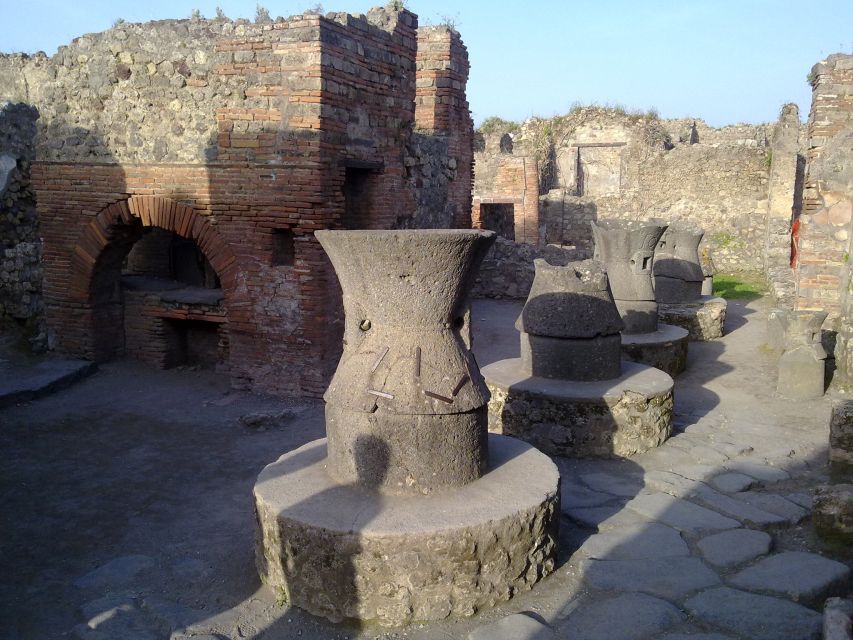
Some of the most memorable stops are not the grand temples. Pompeii’s food businesses show you how ordinary residents ate and worked.
At one of the city’s bakeries, you can see where carbonized loaves of bread were found during excavations. The bread was caught by the volcanic disaster and preserved in a form that connects the ruin to a real kitchen and a real working day.
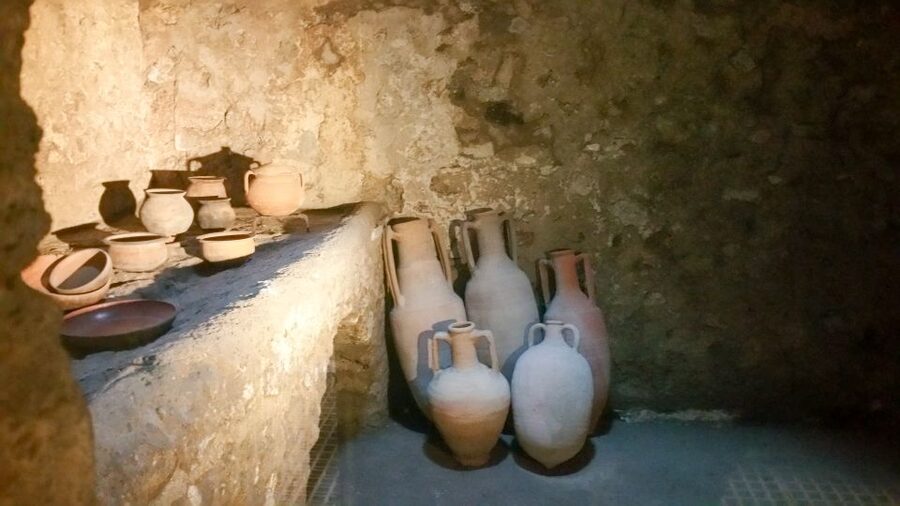
The tour also visits the Roman equivalent of fast food restaurants. These businesses served food and drink from counters built into the street-facing rooms. You can picture a resident stopping for a quick meal instead of returning home to cook.
This part of the tour is especially useful if you want Pompeii to feel like a lived-in town. The Forum explains public power. The bakery and food counter explain lunch.
You may also see shops, taverns, villas, and public baths. Together, these places show the difference between formal public life and the small routines that filled the rest of the day. Pompeii’s appeal comes from that mix. It is not only a city of temples and monuments. It is also a place of errands, meals, work, bathing, and entertainment.
The human casts and the human cost of the eruption
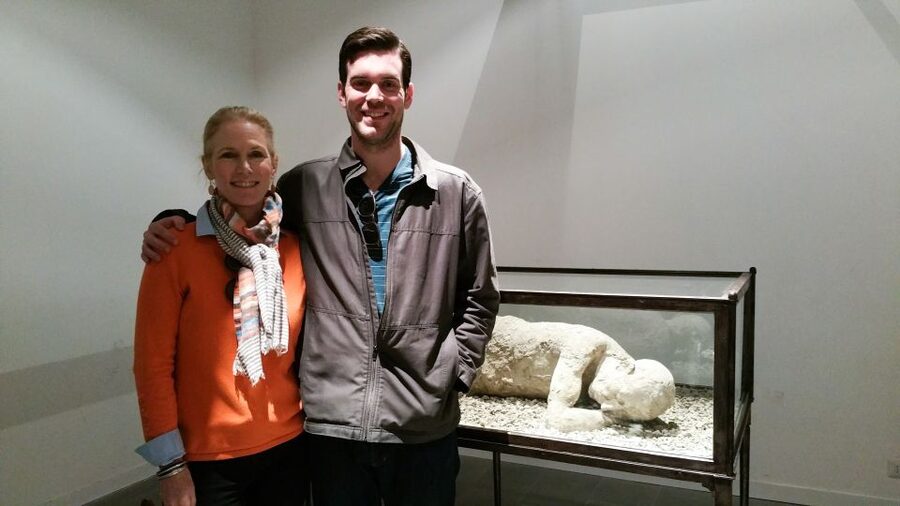
The human casts are among Pompeii’s hardest sights. They preserve the shape and posture of residents caught during the eruption of 79 AD.
Your guide will show a display of casts. The value of seeing them with an interpreter is not simply learning the date of the eruption. You can also understand how an archaeological find becomes evidence of individual lives.
This stop can be emotionally heavy. The casts are not decorative objects, and the visit may be unsettling for children or anyone sensitive to images connected with death. The tour presents them as part of Pompeii’s story, but you should allow yourself time to take in what you are seeing.
Because the route is flexible, you can ask for more context here or move on if this is not the part of Pompeii you want to emphasize. A private format makes that conversation easier than it would be in a rigid large-group schedule.
The former red-light district and Roman frescoes
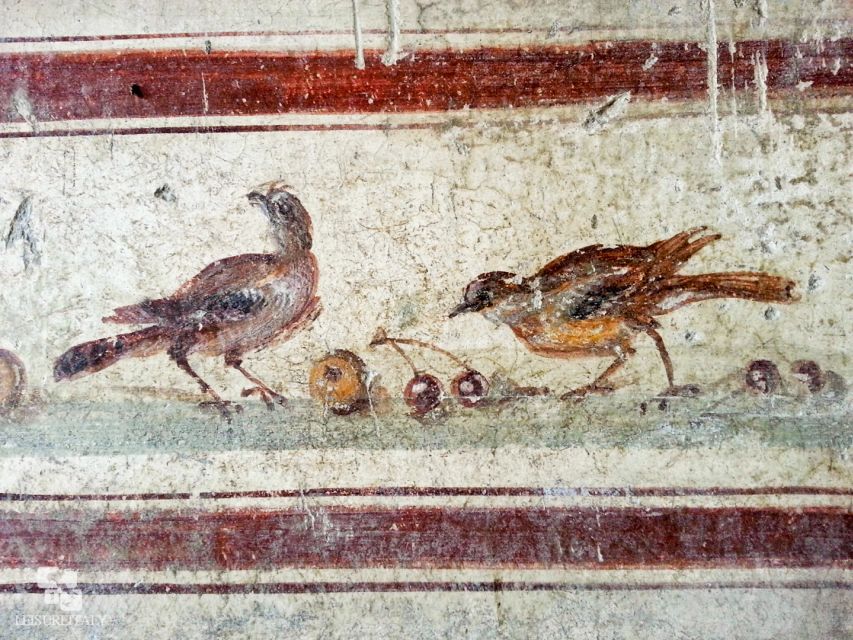
The tour continues to what is described as Pompeii’s former Red Light District. Here you can see Roman frescoes with erotic images.
This stop adds a useful correction to the tidy picture many people carry of ancient Roman life. Pompeii was a working town with public religion and politics, but also with commercial sex, crude humor, and openly displayed erotic art.
The frescoes are direct and not presented as a polite museum collection. If you are visiting with children or prefer to avoid this subject, ask your guide about the route before the tour begins. The itinerary is flexible, but the tour does aim to give a general picture of the ancient town, so this area may be part of the normal route.
The best reason to include it is context. Pompeii’s walls and businesses reflect many parts of Roman society, including subjects that modern visitors may find surprising.
Choosing among Pompeii’s three theaters
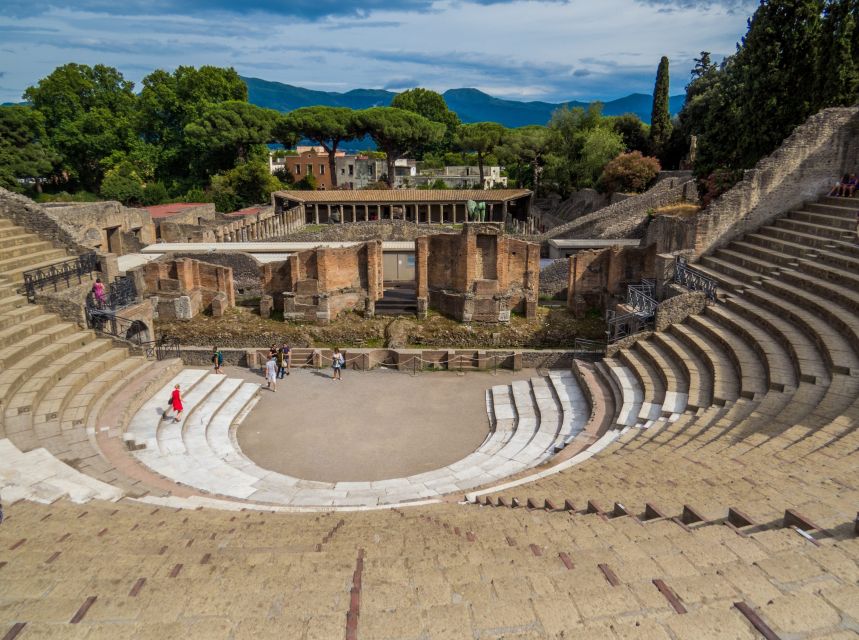
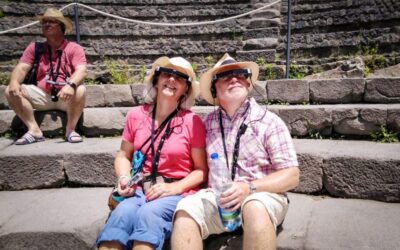
Pompeii had several venues for public entertainment, and this experience visits one of three theaters. The exact theater can vary.
You may see:
- The outdoor arena used for public performances
- The indoor theater used for mime and poetry
- The outdoor theater used for tragedies and comedies
Each option gives a different view of Roman leisure. The outdoor arena suggests large public events. The smaller indoor theater points to performances that depended more on words and actors. The theater for tragedies and comedies connects Pompeii to the dramatic traditions familiar across the Roman world.
Because the tour lasts two hours, visiting one theater is a sensible compromise. You get the idea of public entertainment without spending the whole visit moving between performance spaces.
Ask your guide which theater fits the day’s route and your interests. If you care about architecture, performance, or the social role of public shows, this is a good place to spend a few extra minutes.
Villas, baths, shops, and the shape of daily life
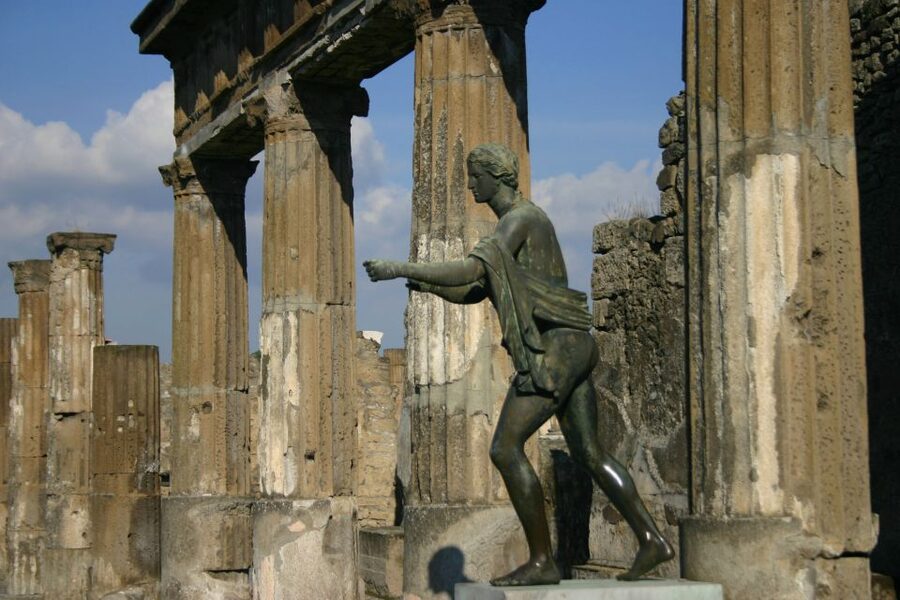
The experience is designed to include at least one site from each main kind of building, so the route can include villas, baths, shops, theaters, markets, and religious structures.
A villa helps explain private life and status. Public baths show how washing, socializing, and civic life overlapped. Shops reveal how commerce worked at street level, while the Forum shows the town’s public face.
The tour does not promise a fixed list of individual villas or every building in the archaeological park. That is important when setting expectations. The guide’s job is to give you a broad picture, not to force you through a long list of rooms with no time for questions.
I like this approach for a first Pompeii visit. You leave with a sense of how the town fit together. If you have already visited Pompeii and want to study a specific house, inscription, or architectural feature, you may need a longer or more specialized visit.
Private tour, small group, and guide languages
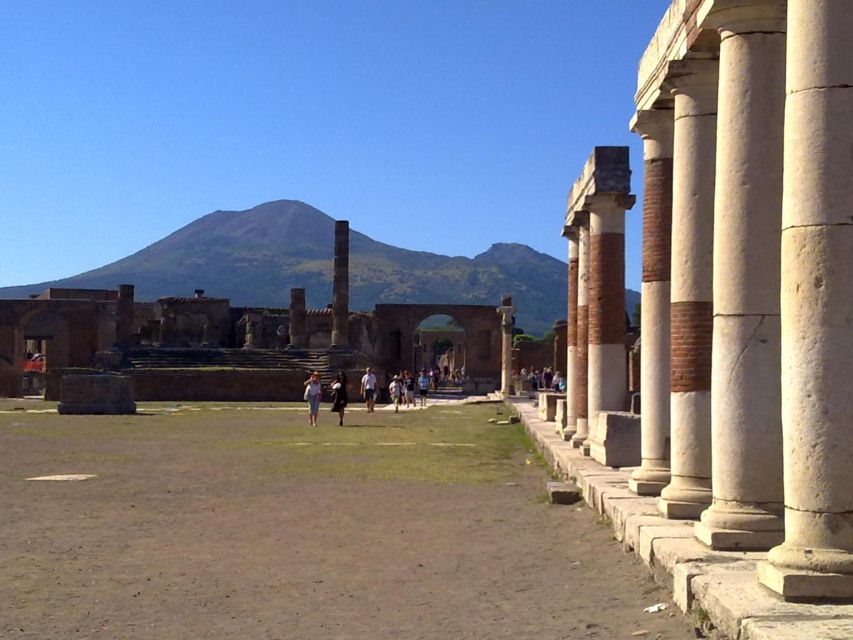
The experience is described as a private sightseeing tour with a small group limited to 10 participants. That combination gives you more personal attention than a large coach-style excursion, while still allowing a shared group format.
You have a live guide in English, Spanish, French, or Italian. Choose the language in which you can comfortably ask detailed questions. Pompeii contains many unfamiliar terms and visual clues, so clear communication matters.
The flexible route is one of the strongest features. You can tell the guide if you want to focus on architecture, food, religion, entertainment, or daily life. You can also explain physical limitations before setting off.
One point needs careful attention: the activity information says it is not suitable for wheelchair users or people with mobility impairments. One booking account describes a guide adapting the tour for a participant who used a wheelchair over slightly longer stretches, with a flexible and helpful approach. That is encouraging, but you should not assume full accessibility. Contact the provider before booking and explain your needs clearly.
Is $175.22 per person a fair price?
At $175.22 per person, this is not a budget way to enter Pompeii. The price makes more sense if you value a personal guide, skip-the-line access, and a route shaped around your group.
The cost includes the private guide and Pompeii Express tickets. You are paying for interpretation and time saved, not just admission. If you arrive with limited time in Campania, avoiding the ticket line and getting a clear route can make the fee easier to justify.
The tour is less attractive if you enjoy reading site signs at your own pace or plan to spend most of the day inside the ruins. In that case, a standard entrance ticket and a self-guided visit may give you more hours for less money.
For a first visit, I see the value in using the two hours to understand what you are looking at. Pompeii is not a compact monument. It is an entire town, and good explanations can prevent the visit from becoming a long walk among anonymous stones.
Who should book this Pompeii walk?
This tour suits you if:
- You are visiting Pompeii for the first time.
- You have only two hours for the archaeological park.
- You want a guide who can explain ordinary Roman life, not just famous monuments.
- You prefer a small group over a large guided crowd.
- You want skip-the-line entry.
- You have particular interests and want a flexible route.
- You are comfortable walking on uneven ancient roads.
It is less suitable if you need guaranteed wheelchair access, have serious mobility limitations, or want to examine many individual houses in detail. It is also not the right choice if you want a completely independent visit with no set time limit.
Pompeii can be hot, exposed, and tiring, although no weather details are supplied for this activity. Comfortable shoes are specifically required, and that advice should be taken seriously.
Should you book the 2-hour Pompeii walking tour?
Book it if you want a focused first look at Pompeii and prefer to understand the ruins with a guide beside you. The strongest parts are the practical details: basalt roads, torch-reflecting travertine, raised crossing stones, bakeries, food counters, baths, and theaters. These details turn the site from a collection of ruins into a Roman town.
Skip it if two hours feels too short for your plans or if accessibility is a firm requirement. Before paying, confirm the route, the language, and the guide’s ability to accommodate your mobility needs.
For most first-time visitors with limited time, the combination of skip-the-line tickets, a small group, and a flexible guide makes this a useful introduction. Just treat it as an orientation to Pompeii, not the final word on one of Italy’s largest archaeological sites.
FAQ
How long is the Pompeii walking tour?
The tour lasts two hours. Check availability for the specific starting times.
Where does the tour begin and end?
Meet your guide at Café Hortus Pompeii, in front of the entrance at Via Villa dei Misteri 2, Pompeii Archaeological Park. The tour ends back at the meeting point.
What does the Pompeii Express ticket include?
The ticket allows you to skip the ticket line and visit all areas within Pompeii’s city walls included with the entry.
Which languages are available?
Live guides are available in English, Spanish, French, and Italian.
Is the tour wheelchair accessible?
The activity is listed as not suitable for wheelchair users or people with mobility impairments. The itinerary can be adjusted for physical ability, and one account describes a guide adapting the route for a wheelchair user, so contact the provider before booking to discuss your needs.
Can I cancel the booking?
You can cancel up to 24 hours in advance for a full refund. The activity also offers reserve now and pay later booking.
More 2-Hour Experiences in Pompeii Archaeological Site
- Pompeii 2-Hour Private Tour
★ 4.9 · 121 reviews - Pompeii 2h Small-Group Tour with Expert Archaeologist
★ 5.0 · 385 reviews - 2 hours Pompeii Tour with Local Historian – Ticket Included
★ 5.0 · 335 reviews - Capri: 2-Hour Boat Tour with Happy Hour
★ 4.8 · 286 reviews
More Walking Tours in Pompeii Archaeological Site
- Walking Food Tour in Sorrento w/ Limoncello Factory Lemon Grove
★ 4.5 · 821 reviews - Sorrento: Guided Walking Tour & Limoncello Tasting
★ 5.0 · 472 reviews - Herculaneum: 3D Walking Tour with Skip-the-Line Ticket
★ 4.3 · 313 reviews - Capri Walking Tour with local guide
★ 5.0 · 300 reviews
Newest reviews from Pompeii Archaeological Site
- From Naples: Pompeii & Sorrento Shore Excursion with Lunch★ 5.0 · 6 reviews
- Pompeii 3-Hour Walking Tour★ 5.0 · 8 reviews
- From Sorrento: Pompeii and Vesuvius Tour by Express Train★ 4.0 · 12 reviews
- Pompeii: Skip-the-Line Guided Archaeological Discovery Tour★ 4.2 · 13 reviews
- Mount Vesuvius Wine Tasting and Lunch from Pompeii★ 4.3 · 43 reviews
- Pompeii: Skip-the-Line Ticket and Virtual Museum★ 4.5 · 66 reviews
- Pompeii: Skip-the-Line Tour for Kids and Families★ 4.9 · 72 reviews
- Pompeii: Tour for Children★ 4.7 · 106 reviews
Walking Tours, compared.

Walking Food Tour in Sorrento w/ Limoncello Factory Lemon Grove
Read our review →

Discover Pompeii: French Walking Tour of the Buried City
Read our review →

Browse the lists this tour appears in