
Reviewed · ARCHAEOLOGIST-LED TOURS
Explore Pompeii with an Archaeologist
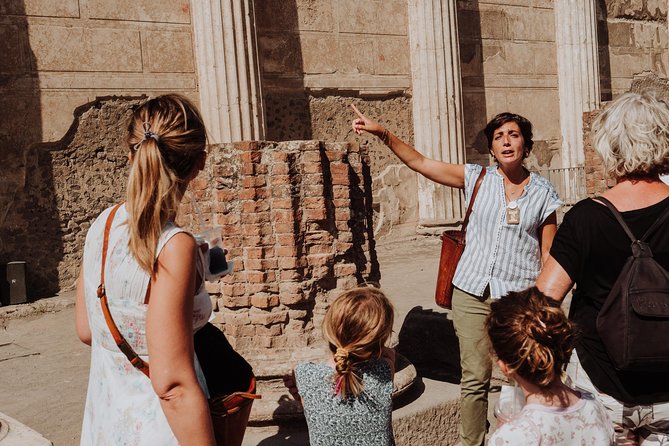
Pompeii is easier to understand when someone helps you read its streets, homes, shops, and public buildings. This two-hour walk with an archaeologist guide takes you from Porta Marina Superiore through the Forum, grand villas, baths, theaters, and the famous Thermopolium.
I like the useful mix of major sights and clear explanations, especially when guides such as Mario, Teresa, Alexandra, Rosanna, and Ilaria bring everyday Roman life into the story. I also like the small-group format, which gives you a fair chance to ask questions instead of trailing behind a guide with dozens of people.
The main drawback is time. Pompeii is enormous, and two hours gives you a well-chosen introduction, not a full visit. Crowds can also gather inside popular houses, and the uneven stone streets, strong sun, and long walking route require sensible shoes, water, and a hat.
In This Review
- Key points to know before you book
- Starting at Porta Marina Superiore
- The Forum and Basilica: Pompeii’s public heart
- The Lupanar and Forum granaries
- House of Menander and House of the Faun
- Stabian Baths and Via dell’Abbondanza
- Thermopolium VI and the taste of daily life
- Teatro Grande and Casa dei Vettii
- What the archaeologist adds
- Is two hours enough?
- Price, group size, and practical value
- Who should book this Pompeii walk?
- FAQ
- How long does the Pompeii tour last?
- Where does the tour meet?
- How will I recognize the guide?
- Where does the tour end?
- Is Pompeii admission included?
- Is transportation included?
- Is the tour offered in English?
- How large can the group be?
- Can I cancel for a refund?
- Should you book Explore Pompeii with an Archaeologist?
Key points to know before you book
- A fast route through Pompeii’s essential sights: You’ll see the Forum, Basilica, Lupanar, House of the Faun, Stabian Baths, Via dell’Abbondanza, theaters, and several major houses.
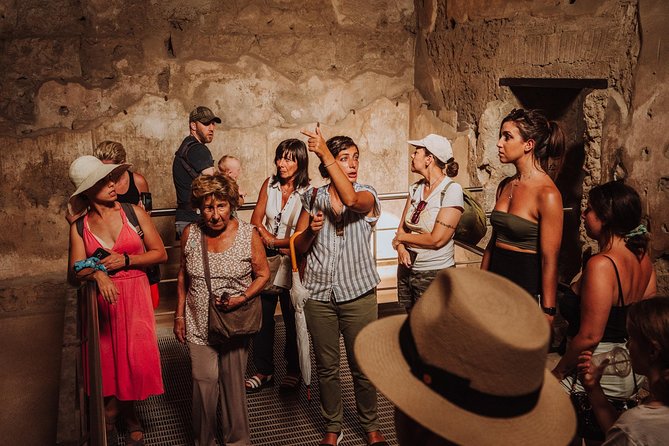
- An archaeologist leads the walk: The guides are expected to explain the site in detail and answer questions, with past tours led by Mario Celentano, Teresa, Alexandra, Rosanna, Ilaria, Diego, Julia, and others.
- Skip-the-line admission is included: This helps you avoid the standard entry queue, though it does not guarantee that you’ll walk straight into every crowded building.
- Small group, but not private: The maximum is 20 people per guide. That is manageable, but a private tour will offer more flexibility and question time.
- Expect a workout: You’ll walk over uneven ancient paving for about two hours, often in exposed sun.
- You can keep exploring afterward: The guided route ends at Piazza Esedra, and you can stay in the archaeological park after the tour to see more on your own.
Starting at Porta Marina Superiore
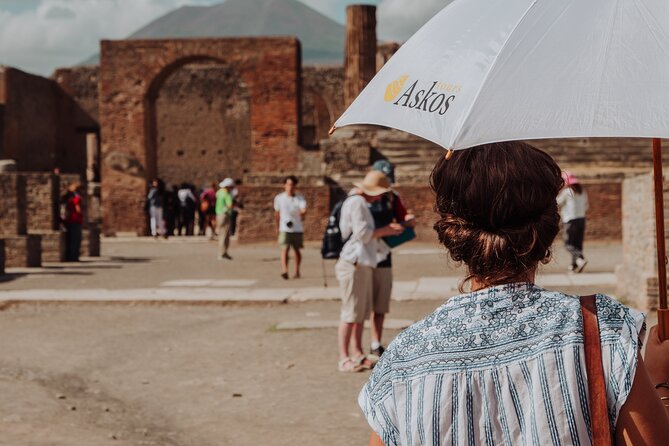
Your meeting point is at Via Villa dei Misteri, 2, near Pompeii’s Porta Marina Superiore entrance. Look for a guide holding an Askos Tours sign. This detail matters because Pompeii has more than one entrance, and turning up at the wrong gate can waste precious minutes.
The admission fee is included, as is dedicated assistance from the tour company. The skip-the-line feature is useful, especially during busy periods, but keep your expectations practical. It is designed to reduce the regular entry wait, not to remove every queue inside the park. Popular rooms and houses can still become crowded.
The tour is offered in English. Groups can reach 20 people, which is smaller than the large coach groups often seen around major Italian sights. For groups of 16 or more, headsets are provided. Those headsets can make a real difference when you are standing in an open square or near other tour groups, though one account found that crowd noise still made hearing difficult at times.
More Pompeii excavation visits:
- Pompeii: Entry Ticket and Guided Tour with an Archaeologist
★ 4.8 · 19,459 reviews - Pompeii: Entry Ticket with Optional Audio Guide
★ 4.2 · 12,360 reviews - Pompeii: Small Group Tour with an Archaeologist
★ 4.8 · 12,264 reviews
The Forum and Basilica: Pompeii’s public heart
The first major stops are the Forum and Basilica. The Forum was Pompeii’s main square, the place where civic, religious, and commercial life came together. It is a good starting point because it gives you the scale of the city and helps explain how the rest of the streets fit around it.
The Basilica served as a courthouse and public meeting place. A guide can help you distinguish it from the nearby temples and administrative buildings, which otherwise can look like a series of impressive but confusing columns and walls.
The ten-minute timing listed for each stop is best understood as an approximate rhythm, not a promise that every location receives exactly ten minutes. Your guide may pause longer at a site if there are questions or if access is slow. Still, this is a brisk route, so listen closely and ask questions when the guide invites them.
The Lupanar and Forum granaries
The Lupanar is Pompeii’s famous brothel, known for its small rooms and painted panels. It is one of the most recognizable stops in the city, but it can also attract a crowd. You may need to wait briefly to enter or move through the rooms.
The nearby granaries of the Forum offer a different kind of story. These buildings show Pompeii as a working city, not just a collection of grand houses. Ancient containers and stored goods help connect the ruins to ordinary food supply and trade, though what is open to view can vary.
I like this pairing because it moves beyond the standard picture of Pompeii as only a place of wealthy villas and volcanic disaster. You get a look at both social life and practical city business.
House of Menander and House of the Faun
The House of Menander is named for a painting of the Greek playwright Menander. It gives you a chance to see how a wealthy Roman home was arranged around interior spaces, courtyards, and decorated rooms.
The House of the Faun is one of Pompeii’s largest and most famous residences. Its name comes from the bronze dancing faun found in the house, and the building is associated with the famous Alexander Mosaic. The guide’s role here is important. Without some explanation, the size of the property and the remains of its decoration can be hard to place in daily life.
These houses are also where time pressure becomes most noticeable. You may see the key rooms and hear the essential story, but you will not study every corner. If you have a special interest in Roman domestic architecture, plan to return after the guided walk.
More tours led by an archaeologist:
- Pompeii Small Group Tour with an Archaeologist
★ 5.0 · 6,593 reviews - Pompeii and Herculaneum Small Group Tour with an Archaeologist
★ 5.0 · 1,350 reviews - Skip the Line Guided Tour of Pompeii led by an Archaeologist
★ 5.0 · 703 reviews - Pompeii: Exclusive Tour with Archaeologist and Entry Tickets
★ 4.9 · 634 reviews
Stabian Baths and Via dell’Abbondanza
The Stabian Baths are among the oldest and most important bath complexes in Pompeii. The rooms help show how bathing worked as a social routine, with different temperatures and spaces for changing, washing, and meeting others.
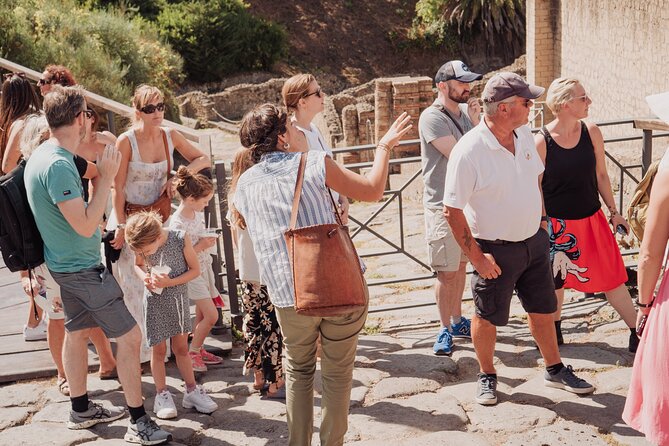
This stop is especially useful for families because the guide can turn bare walls and brickwork into a simple explanation of how a public bath functioned. Several parents have found the guides effective with children, using stories and clear explanations rather than treating the site like a museum lecture.
After the baths, the route reaches Via dell’Abbondanza, Pompeii’s best-known street. You’ll walk over ancient paving and see the ruts made by carts. The street is a strong reminder that Pompeii was a real town, with people moving between homes, shops, public buildings, and food counters.
This is also where you should take the walking conditions seriously. The stones are uneven, and the route can be tiring in summer. Bring a refillable water bottle. Water is available from fountains, and a fan, hat, or umbrella can help on hot days.
Thermopolium VI and the taste of daily life
Thermopolium VI is an ancient food counter. The word refers to a place where hot food and drinks were sold, making this one of the most appealing stops for anyone curious about ordinary Roman life.
The preserved counter, serving vessels, and painted details help you picture Pompeii as a city of workers, shopkeepers, renters, and customers. You are not simply looking at a grand monument. You are seeing where someone might have stopped for a quick meal.
This is one of the tour’s most useful details because it adds human scale. Grand villas explain wealth, while a food shop explains routine. A good guide can make the difference between seeing a decorated counter and understanding how it fitted into the city.
Teatro Grande and Casa dei Vettii
The Teatro Grande was Pompeii’s main theater. Its seating and stage area show how public entertainment worked, while its position on the route gives you a change from houses and streets.
The House of the Vettii is another major residence, known for its decoration and wealthy owners. The house helps explain how private status was displayed through paintings, courtyards, and carefully arranged rooms.
These last stops round out the tour well. You get public entertainment, private luxury, commerce, government, religion, and bathing in one compact route. That range is a major reason the $35.67 price can be good value for a first visit.
Still, you should not confuse a highlights tour with full coverage. Pompeii is too large to see properly in two hours. One useful approach is to treat this walk as your orientation, then continue independently after it ends at Piazza Esedra.
What the archaeologist adds
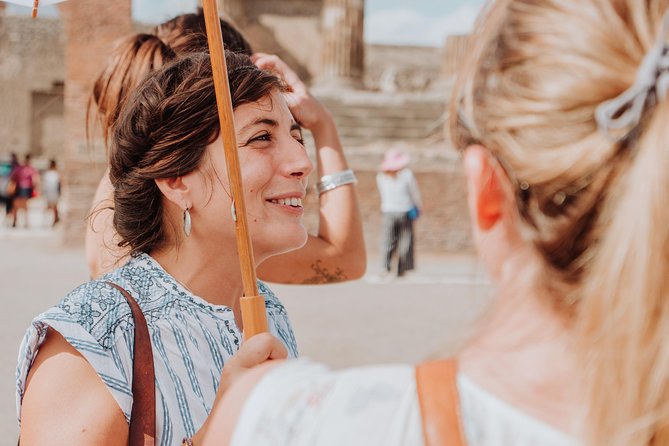
The strongest part of this experience is the guide’s ability to connect fragments. A wall becomes part of a house. A street becomes a route used by carts and pedestrians. A public building becomes a place with a clear civic purpose.
Past guides have included Mario Celentano, Teresa, Alexandra, Rosanna, Ilaria, Diego, Julia, Antonio, Sergio, Jolanta, Rafaela, and others. The best descriptions of the experience repeatedly point to clear explanations, friendly pacing, patience with questions, and a sense of humor. Rosanna, for example, was praised for making difficult material easy to follow, while Mario was noted for checking whether the group wanted a faster or slower pace.
That consistency is encouraging, but guide quality can never be completely uniform. One less favorable account described a slow delivery, limited interaction, and weak answers to questions. Another questioned how much of the tour felt different from a standard history talk. The fair conclusion is that the archaeologist label is valuable when the individual guide uses the training well, but your experience still depends on that day’s guide and group.
Is two hours enough?
Two hours is enough to see a strong set of highlights and gain a basic understanding of Pompeii. It works particularly well if you are visiting from Naples, staying nearby, or fitting Pompeii into a busy day.
You should plan extra time if you want to explore at a relaxed pace. One useful strategy is to let the guide handle the main route, then remain inside the park afterward. You can revisit a house, inspect a street, or look for sections not included in the guided walk.
The tour can also suit families. Guides have handled children well by keeping explanations lively and answering questions. But younger children may tire on the rough paving, and there is little shade across parts of the site.
Price, group size, and practical value
At $35.67 per person, this is reasonably priced for a two-hour guided visit that includes Pompeii admission. You are paying for an English-speaking archaeologist, a planned route, help at the entrance, and the chance to ask questions.
The value is strongest if this is your first visit or if you do not want to spend hours studying a map and guidebook. The value is weaker if you already know Pompeii well, want to move at your own pace, or prefer quiet time in the houses. In those cases, a private tour or an independent visit may suit you better.
A maximum of 20 people keeps the group from becoming unwieldy, though it is not intimate. If your group has 16 or more people, headsets are included. The tour does not include transportation, food, or drinks, so you need to arrange your own way to the entrance and carry water.
Most people can take part, but the uneven surfaces and amount of walking are real considerations. Service animals are allowed. Other dogs must weigh no more than 10 kilograms and measure no more than 40 centimeters in height. They must be leashed, carried inside buildings, and cleaned up after.
Confirmation arrives at booking, and free cancellation is available up to 24 hours before the start time. Cancellations or changes made inside that 24-hour window are not refunded or accepted. If you are arriving by train, allow extra time for delays, since missing the meeting time can affect your day.
Who should book this Pompeii walk?
I would choose this tour if you want a clear introduction without spending a full day inside the ruins. It is a good fit for first-time visitors, families, cruise passengers with limited time, and anyone who prefers an expert to explain what they are seeing.
I would also choose it if you want a route that covers more than the headline sights. The inclusion of the granaries, Thermopolium, Stabian Baths, and Via dell’Abbondanza adds useful everyday detail.
I would think twice if you dislike group tours, need a very slow pace, or want to see excavation areas beyond the standard highlights. The route is fixed, the group can reach 20, and busy rooms may be hard to hear in. If you want long pauses for photography or detailed discussion of archaeology, a private option will give you more control.
FAQ
How long does the Pompeii tour last?
The tour lasts approximately two hours.
Where does the tour meet?
You meet the guide at Porta Marina Superiore, the main entrance to the archaeological site, at Via Villa dei Misteri, 2, 80045 Pompei.
How will I recognize the guide?
The guide will hold a sign with Askos Tours written at the top.
Where does the tour end?
The guided walk ends at Piazza Esedra, 80045 Pompei.
Is Pompeii admission included?
Yes. The Pompeii admission fee and skip-the-line admission ticket are included.
Is transportation included?
No. You must arrange your own transportation to and from Pompeii.
Is the tour offered in English?
Yes. The tour is offered in English.
How large can the group be?
The maximum group size is 20 people per guide. Headsets are provided for groups of 16 or more.
Can I cancel for a refund?
Yes. You can cancel at least 24 hours before the local start time for a full refund. Cancellations and changes made less than 24 hours before the start time are not accepted or refunded.
Should you book Explore Pompeii with an Archaeologist?
Yes, if you want a well-priced, focused introduction to Pompeii rather than an all-day archaeological study. The route covers the city’s public center, wealthy homes, baths, food shops, theaters, and main street, while the guide gives the ruins a readable human story.
Book it early if your dates are firm, since it is commonly reserved about 30 days ahead. Bring water, sturdy shoes, sun protection, and a little patience for crowds. Then stay on after the tour if you can. The two-hour walk will show you how Pompeii works, but the extra time lets you enjoy how much of the city remains to be discovered.
Newest reviews from Pompeii Ruins
- Private Tour Pompeii and Winery★ 5.0 · 4 reviews
- Visit the Pompeii ruins from Salerno with Pizza Lunch★ 5.0 · 4 reviews
- Pompeii Private Tour for Kids and Their Families★ 4.8 · 4 reviews
- From Sorrento: Pompeii & Vesuvius tour small group★ 4.8 · 4 reviews
- Pompeii Sorrento and Positano Tour★ 5.0 · 4 reviews
- From Naples_ Pompeii Tour_Skip the line ticket + audioguide★ 4.3 · 4 reviews
- Pompeii Private Half-Day Tour from: Naples,Sorrento, Amalfi Coast★ 5.0 · 4 reviews
- Pompeii, skip-the-line ticket with smartphone audio guide on App★ 3.0 · 4 reviews
Archaeologist-Led Tours, compared.

Entry Ticket and Guided Tour with an Archaeologist
Read our review →
Pompeii Small Group Tour with an Archaeologist
Read our review →
Pompeii and Herculaneum Small Group Tour with an Archaeologist
Read our review →
Skip the Line Guided Tour of Pompeii led by an Archaeologist
Read our review →
Exclusive Tour with Archaeologist and Entry Tickets
Read our review →
Pompeii Private Tour with an Archaeologist and Skip The Line – 3 hours
Read our review →
Pompeii Skip-the-line Tour with Archaeologist Guide
Read our review →Browse the lists this tour appears in