
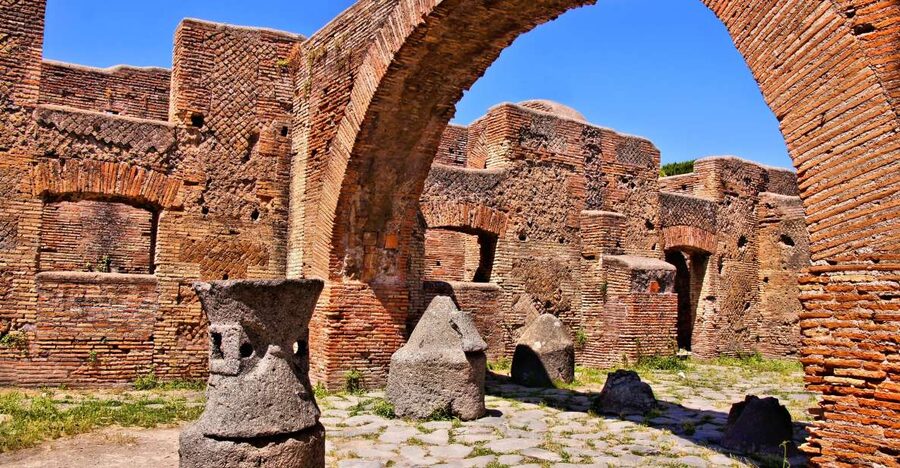
Reviewed · AUDIO TOURS
Pompeii: Skip-the-Line Ticket with Audio Guide and Map
Pompeii is not a small ruin you can breeze through before lunch. Its ancient streets cover about 66 hectares, with houses, temples, shops, baths, theaters, and an amphitheater spread across a wide archaeological site. I like that this experience gives you freedom to set your own route and an audio guide to explain what you are seeing. I also like the practical combination of a ticket, map, and recorded commentary, which lets you explore without being tied to a group.
The main drawback is that the map and audio guide may not always match perfectly. One visitor found some map items missing from the audio guide, and another noted that the site signage can be unclear. The skip-the-line feature may also be less useful during quiet periods, and you may still need to queue for special ticket arrangements such as children’s entry.
In This Review
- Key points at a glance
- Why Pompeii Works Best at Your Own Pace
- Entry, Map, and the First Look at the Ruins
- Walking Pompeii’s Ancient Streets
- Frescoed Houses and Roman Domestic Life
- Baths, Temples, Shops, and Thermopolia
- Theaters, Amphitheater, and Public Spectacle
- The Victim Casts and the Human Cost of the Eruption
- How the Audio Guide and Map Work Together
- Is the $44 Price Good Value?
- Who Should Book This Experience?
- Practical Tips for a Better Day
- Should You Book the Pompeii Audio Guide Ticket?
- FAQ
- How long is the Pompeii ticket valid?
- What is included in the experience?
- Which languages are available for the audio guide?
- Which languages can the host or greeter speak?
- Is food included?
- What should I bring?
- Are large bags allowed?
- Is the experience suitable for people with mobility impairments?
Key points at a glance
- A full day inside a 66-hectare archaeological site: Pompeii is large enough to reward a flexible plan rather than a rushed visit.
- Self-guided sightseeing: You can stop at a frescoed house, temple, shop, or theater for as long as you like.
- Audio commentary in nine languages: English, Chinese, French, Italian, German, Hebrew, Russian, Spanish, and Portuguese are available.
- A useful but imperfect map: It helps you plan, though the route markers and audio entries may not line up every time.
- A hot, demanding walk: Bring water, sunscreen, a hat, and sturdy shoes. Large bags are not allowed.
- Best for independent explorers: This suits you if you prefer your own pace over a fixed group tour.
Why Pompeii Works Best at Your Own Pace
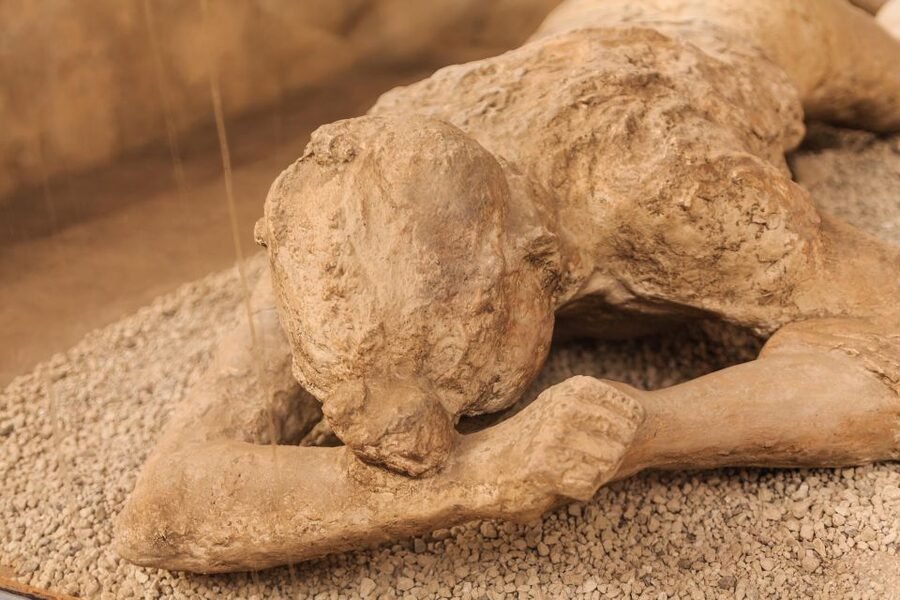
Pompeii rewards curiosity, but its size can catch you off guard. The site covers roughly 66 hectares, so you are not simply walking from one famous monument to the next. You are crossing an ancient city with residential streets, public buildings, businesses, entertainment venues, and religious spaces.
That is why I like the self-guided format. You can spend more time in a richly decorated domus if the frescoes catch your eye, then move on when you are ready. You are not waiting for a group to gather or trying to hear a guide while standing in a crowded street.
The audio guide adds the context that signs may not provide. It helps explain how different buildings fit into daily Roman life, from public baths and temples to shops and thermopolia. These ancient food counters, sometimes described as the coffee and fast-food stops of their day, make Pompeii feel like a real town rather than a collection of empty walls.
You should still accept that this is an independent visit, not a guided tour with a live expert beside you. The host or greeter can speak English, Spanish, French, or Italian, but the main interpretation comes through the recorded guide.
More Pompeii excavation visits:
- Pompeii: Entry Ticket and Guided Tour with an Archaeologist
★ 4.8 · 19,459 reviews - Pompeii: Small Group Tour with an Archaeologist
★ 4.8 · 12,264 reviews - Pompeii: Skip-the-Line Entrance Ticket with Audio Guide
★ 4.0 · 2,509 reviews
Entry, Map, and the First Look at the Ruins

The package includes admission to Pompeii, an updated map, and the audio guide. The ticket is intended to help you avoid the standard ticket line, which can matter at busy times.
That benefit is practical, but do not treat it as a guarantee of instant entry everywhere. At 9 a.m., one person found no regular crowd but still had to wait for children’s tickets. If you are visiting with children, allow extra patience for any separate ticket process.
Once inside, the map becomes your basic tool for finding your way. Pompeii is too large to explore well by simply wandering without a plan, especially if you have only one day. Use it to identify clusters of sights and choose a route that matches your energy.
The map is helpful, but it is not foolproof. Some map items may not have a matching audio entry, and signs around the site can be unclear. I suggest treating the map as a guide to the broad layout rather than a perfect turn-by-turn system.
Walking Pompeii’s Ancient Streets
The streets are the experience. As you walk, you see the city in a way that a museum display cannot match. The remains are arranged in their original urban setting, so houses sit near shops, public buildings, and places of worship.
Look closely at the pavement, doorways, walls, and building fronts. The audio guide can give meaning to details that might otherwise look like piles of stone. A street corner can point to commerce, family life, public services, or local religion.
You may find the walking surface uneven, and the distance between major sights can be substantial. Comfortable shoes are essential. This is not a good choice for people with mobility impairments, and you should think carefully about the physical demands if anyone in your party has trouble with long walks or uneven ground.
The heat is another serious factor. Bring plenty of water, a hat, and sunscreen. Food and drinks are not included, and one visitor found restaurants difficult to locate within the area. Plan your refreshments rather than assuming you can quickly find a meal whenever you need one.
Frescoed Houses and Roman Domestic Life
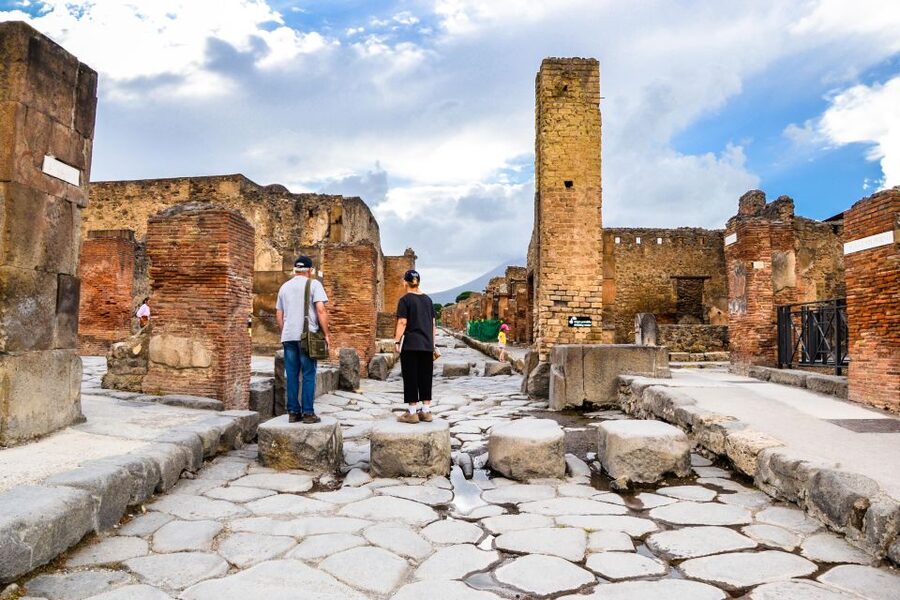
The ancient homes, or domus, are among Pompeii’s most rewarding stops. Their frescoes offer a glimpse of taste, status, and household decoration in the Roman world.
I recommend slowing down here. Instead of checking each house off the map, choose the ones that interest you and spend time looking at the walls, courtyards, rooms, and surviving decorative details. The audio guide can help you understand why the layout matters.
The appeal is not just visual. A home shows how private life fitted into the wider city. After seeing public baths, temples, and theaters, a house brings you back to the daily scale of Pompeii.
Access and opening conditions can vary across a large archaeological site, so do not build your entire day around one specific interior. The map and audio guide help you find the main points, but you should keep your route flexible.
More Pompei Campania tours worth comparing
- Pompeii: Skip-the-line-Ticket and Guided Tour
★ 4.6 · 1,152 reviews - Pompeii: Guided Tour with Skip-the-Line Entry
★ 4.9 · 812 reviews - Pompeii: Skip-the-Line Entry Ticket with Digital Guide App
★ 4.1 · 770 reviews - Pompeii: Tour with Archaeologist Guide & Skip-the-Line Entry
★ 4.5 · 478 reviews
Baths, Temples, Shops, and Thermopolia
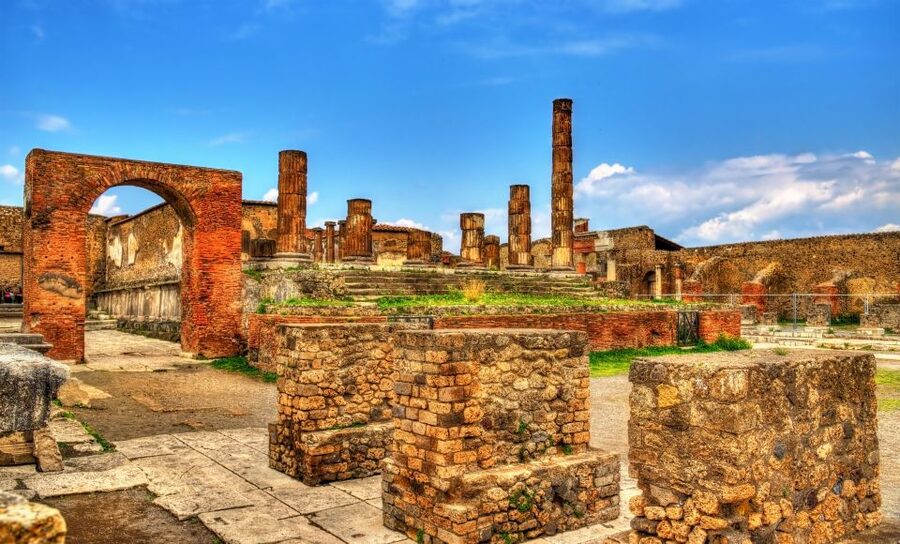
Pompeii becomes easier to picture when you move beyond the grand monuments. The baths show how public life included washing, exercise, and social time. Temples point to the religious structure of the city. Shops and workshops reveal how people bought, sold, and made things.
The thermopolia are especially memorable because they connect ancient Pompeii with something familiar. These were street-side food counters, a Roman version of a quick meal stop. Their presence reminds you that the city was made up of ordinary routines as well as impressive architecture.
This is where the audio guide earns its place. Many buildings have limited information on site, so a recorded explanation can help you understand what a room or counter was used for. It also lets you choose how much detail you want. You can listen carefully at the buildings that interest you and keep moving through less important areas.
The tradeoff is that audio guides require attention and battery life. You also need to manage the device while walking, checking the map, and taking in the ruins. If you are visiting as a family or group, make sure everyone agrees on the pace before you begin.
Theaters, Amphitheater, and Public Spectacle
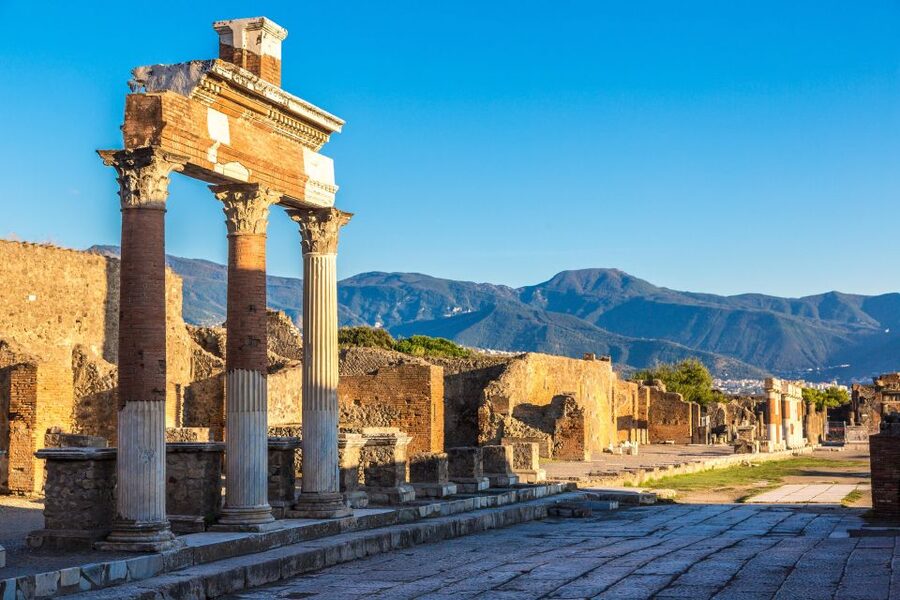
Pompeii’s theaters show the city’s public side. These spaces were built for performance and shared entertainment, giving you a sense of how people gathered beyond the home and marketplace.
The amphitheater is one of the site’s major highlights. It is described as one of the best-preserved Roman amphitheaters, and its scale makes clear how important public spectacle was in Roman culture.
I like placing these large venues between smaller buildings in your route. After exploring narrow streets and domestic rooms, a theater or amphitheater provides a dramatic change in scale. The audio guide can also help connect the architecture with the social life that took place there.
Do not assume that the biggest structure automatically deserves the most time. Pompeii’s strength comes from the contrast between grand public spaces and modest everyday places. A short visit to a shop or thermopolium may tell you as much about city life as a major monument.
The Victim Casts and the Human Cost of the Eruption
The casts of victims are among Pompeii’s most powerful and difficult sights. They are not simply archaeological objects. They bring a human presence to the eruption and remind you that this was a lived-in city, not an abandoned stage set.
Give yourself time to approach these displays thoughtfully. The audio guide may add historical context, but no commentary can make the subject feel light. This is one area where a self-guided visit can be useful because you can pause, move on, or spend longer without a group waiting.
The casts also change the way you see the rest of the city. Frescoed rooms, shops, baths, and streets become parts of a community interrupted by disaster. Pompeii’s power comes from that direct connection between ordinary life and sudden catastrophe.
How the Audio Guide and Map Work Together

The audio guide is offered in English, Chinese, French, Italian, German, Hebrew, Russian, Spanish, and Portuguese. That range makes the experience accessible to many international visitors.
The operating idea is simple: use the map to locate a point, then select the related audio entry. In practice, you may find that some map items do not have a matching audio section. Signs can also be unclear, so you should expect a little trial and error.
I would use the guide selectively rather than trying to listen to every entry. Start with the major houses, baths, temples, theaters, amphitheater, and victim casts. Then add smaller stops if you still have time and energy.
The audio guide received strong praise for being easy to handle, and it is particularly useful if you want to explore alone. One independent visit ran from 10 a.m. to 5 p.m., showing how much time the site can absorb when you set your own route.
Check whether headphones are provided before you go. One person wished headphones had been included, so bringing your own compatible pair may be wise if the equipment requires them. The supplied information confirms the audio guide, but not a headphone policy.
Is the $44 Price Good Value?
At $44 per person, this is not the cheapest way to enter Pompeii. You are paying for more than admission: the package includes skip-the-line access, an audio guide, an updated map, and help from a host or greeter in English, Spanish, French, or Italian.
The value depends on how you like to visit major sites. If you want a live guide explaining every stop, this is not the right product. If you prefer to explore independently but do not want to arrive with no context, the package fills that gap.
The audio guide is the most important part of the value. Pompeii has few explanations at some locations, and the site is too large to understand fully from a quick look at the ruins. The map is also useful for planning a route, even with its occasional mismatches.
The skip-the-line feature matters most on a busy day. During a quiet morning, you may not save much time. If your schedule is tight, the convenience can still be worthwhile, but do not assume it removes every possible wait.
Who Should Book This Experience?
I would choose this for independent adults, couples, families with older children, and anyone who wants control over the day. It works well if you prefer stopping for ten minutes at a fresco and only thirty seconds at a less interesting structure.
It is also a good fit if you are visiting Pompeii in a language covered by the audio guide and want information without hiring a private guide. Spanish, French, Italian, English, German, Portuguese, Russian, Chinese, and Hebrew are supported.
I would think twice if you need step-free access or find long walks difficult. The experience is not suitable for people with mobility impairments. I would also avoid it if your ideal visit depends on a live guide answering questions as you go.
Families should plan carefully. The site is large, hot, and tiring, and food or drinks are not included. Children may also require a separate ticket queue, even when the main entry line is quiet.
Practical Tips for a Better Day
Wear shoes that can handle uneven ancient streets. Sandals with little support are a poor choice for a full day.
Carry water, a hat, and sunscreen. Heat can turn a fascinating visit into a tiring one, especially when you are walking for hours.
Do not bring luggage or large bags. They are not allowed, so make arrangements before arriving at the entrance.
Start with the map and mark a few priorities. I would choose one or two frescoed houses, the baths, a temple area, a thermopolium, the theaters, the amphitheater, and the victim casts. Then use the remaining time for side streets and smaller buildings.
Keep your route flexible. A building may take longer than expected, an unclear sign may slow you down, or a closed area may require a change of plan. Pompeii works better when you leave room for discovery.
The activity is valid for one day, with starting times based on availability. You can also cancel up to 24 hours before the activity for a full refund, and the reserve-now, pay-later option gives you some flexibility while planning.
Should You Book the Pompeii Audio Guide Ticket?
Book it if you want independent access with useful historical explanation. The ticket, map, and multilingual audio guide make a practical bundle for a full day among Pompeii’s streets, houses, baths, shops, theaters, and public spaces.
Skip it if you need a live guide, have limited mobility, or want a quick and tightly organized visit. The site is huge, the signage can be confusing, and the skip-the-line benefit may be modest on a quiet morning.
For most self-guided visitors, the strongest reason to book is the audio commentary. Pompeii is impressive on sight alone, but the explanations help you understand how the city worked. Bring water, wear good shoes, expect a long walk, and use the map as a helpful aid rather than a perfect navigation system.
FAQ
How long is the Pompeii ticket valid?
The ticket is valid for one day. Starting times depend on availability.
What is included in the experience?
The package includes Pompeii entrance admission, an audio guide, and an updated map.
Which languages are available for the audio guide?
The audio guide is available in English, Chinese, French, Italian, German, Hebrew, Russian, Spanish, and Portuguese.
Which languages can the host or greeter speak?
The host or greeter can speak English, Spanish, French, or Italian.
Is food included?
No. Food and drinks are not included.
What should I bring?
Bring comfortable shoes, a hat, sunscreen, and water.
Are large bags allowed?
No. Luggage and large bags are not allowed.
Is the experience suitable for people with mobility impairments?
No. The activity is not suitable for people with mobility impairments.
More Audio Tours in Pompei Campania
- Pompeii, skip-the-line ticket with smartphone audio guide on App
★ 3.0 · 4 reviews - Pompeii: Entry Ticket with Optional Audio Guide
★ 4.2 · 12,360 reviews - Ercolano: Herculaneum Entry Ticket with Optional Audio Guide
★ 4.1 · 581 reviews - Ercolano: Herculaneum Skip-the-Line Ticket & Audio Guide
★ 4.0 · 275 reviews
More Self-Guided Tours in Pompei Campania
- Pompeii: Skip-the-Line Ticket with Audio Guide and Map
★ 4.0 · 117 reviews - From Naples: Vesuvius & Pompeii with Transfer & Audio Guide
★ 4.0 · 58 reviews - Pompeii & Herculaneum: Skip-the-line & Digital Guide App
★ 4.0 · 35 reviews - Pompei: Audio guide of the archeological site
★ 3.4 · 13 reviews
Newest reviews from Pompei Campania
- From Sorrento: Pompeii & Vesuvius tour small group★ 4.8 · 4 reviews
- Pompeii Private Tour for Kids and Their Families★ 4.8 · 4 reviews
- From Naples_ Pompeii Tour_Skip the line ticket + audioguide★ 4.3 · 4 reviews
- Pompeii, skip-the-line ticket with smartphone audio guide on App★ 3.0 · 4 reviews
- Pompeii Guided Experience – Tour Service Only★ 4.6 · 4 reviews
- From Naples Port:Pompeii+Vesuvius tour★ 4.3 · 4 reviews
- 2-Hour Pompeii Child-Friendly Tour★ 5.0 · 4 reviews
- Naples: Amalfi Coast, Sorrento and Pompeii Day Trip★ 4.4 · 5 reviews
Audio Tours, compared.


Skip-the-Line Entrance Ticket with Audio Guide
Read our review →
Herculaneum Entry Ticket with Optional Audio Guide
Read our review →



Browse the lists this tour appears in