Reviewed · GUIDED
Pompeii: Group Tour with an Archeologist Guide
Pompeii is far too large and layered to understand by simply wandering in. This two-hour walk with an archaeologist guide gives you a clear route through the western part of the city, from the Marina Gate to the Forum, baths, theaters, and famous houses. You get the broad story without spending your first hour lost among the ruins.
I like the skip-the-ticket-line entry, especially if you are fitting Pompeii into a busy day from Naples or a cruise port. I also like the guides’ practical style. Guides such as Ernaldo, Alfonso, Laura, Lena, and Giuseppe have been praised for making Roman life clear, answering questions, and keeping children and mixed-age groups involved.
The tradeoff is simple: this is a group tour, and the group can be fairly large. Two hours is enough for a strong introduction, but not enough to see every corner of Pompeii. On hot days, that limited time can be a benefit, though you may wish to stay afterward and explore independently.
In This Review
- Key points at a glance
- Why Pompeii makes a guide worth the price
- Meeting at Tempio Travel beside the Circumvesuviana
- Porta Marina and the western entrance
- The Basilica and Forum: Pompeii’s public heart
- Baths, streets, and the Lupanar
- Theaters and Pompeii’s public entertainment
- Houses, frescoes, and the quieter side of Pompeii
- The Garden of the Fugitives and the plaster casts
- What the archaeologist guide adds
- Timing, heat, rain, and what to bring
- Continuing after the two-hour walk
- Cancellation and the first Sunday warning
- Who should book this Pompeii tour?
- Should you book it?
- FAQ
- How long is the Pompeii guided tour?
- Where does the tour start?
- Where does the tour end?
- Is entrance to Pompeii included?
- Which languages are available?
- Can I bring luggage or a large bag?
- Is the tour suitable for people with mobility impairments?
- Is food or drink included?
- Can I cancel the booking?
Key points at a glance
- Follow the essential western route: See the Marina Gate, Basilica, Forum, baths, Lupanar, theaters, and several celebrated houses.
- Hear the human story: Plaster casts of people who died in the eruption make the disaster personal, not just archaeological.
- Use the headsets wisely: Whisper devices help you follow the guide when the group spreads out.
- Meet beside the train station: Tempio Travel is located at Pompeii’s Circumvesuviana station, making the tour convenient if you arrive by train.
- Plan for the sun: Comfortable shoes, water, and protection from heat matter on Pompeii’s exposed stone streets.
- Stay after the guided walk: The tour ends at the meeting point, but you can continue seeing more of the site on your own.
Why Pompeii makes a guide worth the price
At $50.11 per person, this is not the cheapest way to enter Pompeii. You are paying for the admission ticket, a live guide, and a planned route rather than simply buying access and figuring things out yourself.
For me, the value comes from context. Pompeii presents walls, doorways, paving stones, paintings, and open courtyards, but the meaning is not always obvious. A guide can explain what a building was used for, how the streets worked, and why an apparently plain room matters. Without that help, you can walk past an important site and see only another weathered wall.
The ticket-line advantage adds value when Pompeii is busy. Direct entry saves time, but the real gain is mental: you do not have to begin the visit by studying signs, searching for the right entrance, or deciding which direction to take.
The tour earns its price best if this is your first visit or if you have only one morning or afternoon. If you already know Roman architecture well and enjoy reading maps and archaeological notes alone, the group format may feel less necessary. Pompeii rewards independent exploration, but a guided introduction gives you a useful framework first.
More Pompeii excavation visits:
- Pompeii: Entry Ticket with Optional Audio Guide
★ 4.2 · 12,360 reviews - Pompeii: Archaeological Park Tour with Ticket on request
★ 4.5 · 2,283 reviews - Pompeii Ruins Private Tour with Optional Skip-the-Line Entry
★ 4.9 · 732 reviews
Meeting at Tempio Travel beside the Circumvesuviana
Your starting point is the Tempio Travel office on the first floor of Pompeii’s Circumvesuviana train station. Look for the building with the red logo and allow time to find the office before the scheduled start.
There is one practical point to watch closely: directions connected with the meeting place have also been described as requiring stairs to a second floor. Follow the current instructions on your booking and confirm with the office staff if the floor is unclear. The important part is that you meet at the Tempio Travel office, not independently at the archaeological entrance.
This location works well if you arrive by train. You do not need a separate hotel transfer, since pickup and drop-off are not included. Free parking may be available if the lot is open and spaces remain, but I would not build a full day’s transport plan around that perk.
From the office, the group proceeds toward Porta Marina, or the Marina Gate. The listed itinerary gives this point only a brief stop, but it marks the transition from modern Pompeii into the archaeological site. Your guide handles the entrance process and leads the group through the gate.
Porta Marina and the western entrance
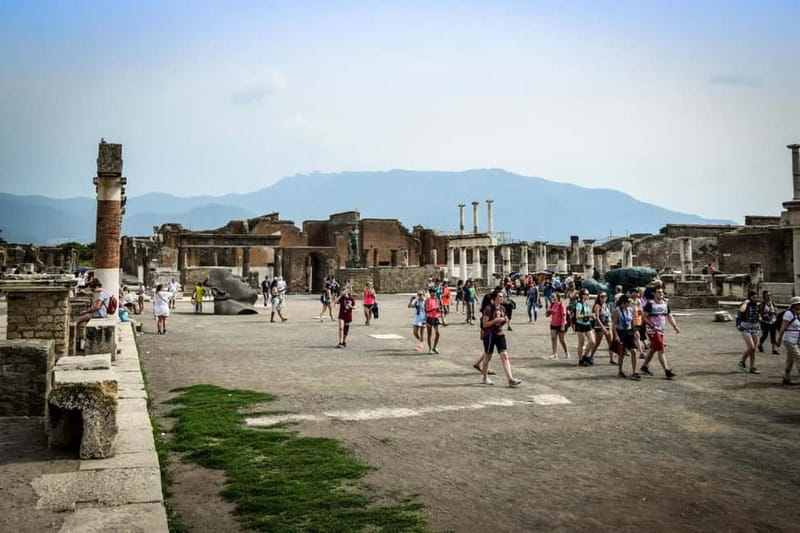
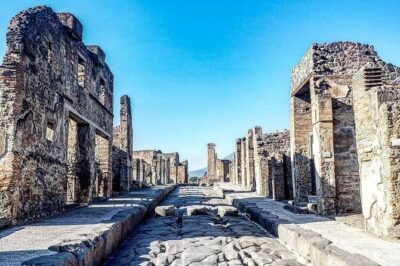
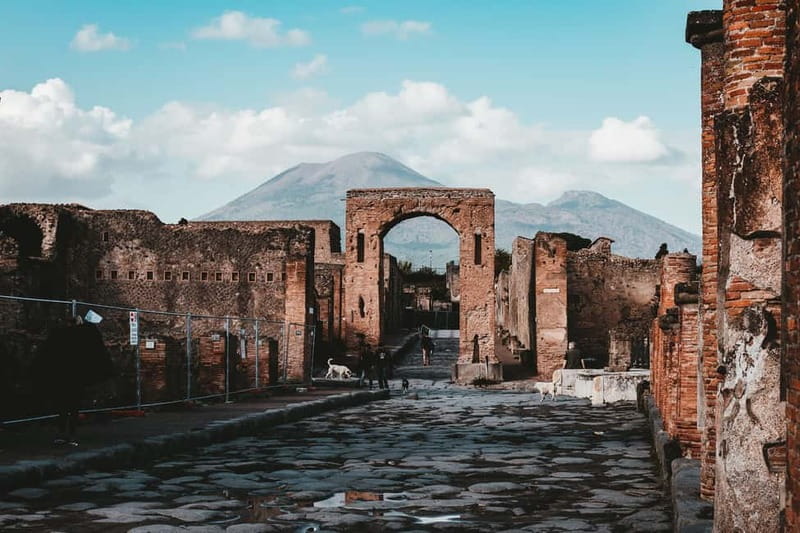
Porta Marina was one of Pompeii’s important entrances, and it sets up the shape of the ancient city. As you pass through, the modern world quickly gives way to broad stone streets, ruined walls, and buildings that once formed a working Roman town.
The western section is a sensible choice for a short tour because it contains many of the site’s major monuments. You are not promised every street or house, but you get a route through the places that help explain public life, private life, entertainment, religion, and the final catastrophe.
Wear shoes with a firm sole. Pompeii’s ancient paving can be uneven, and the visit is conducted on foot. The experience is not suitable for people with mobility impairments, so consider that carefully before booking.
The Basilica and Forum: Pompeii’s public heart
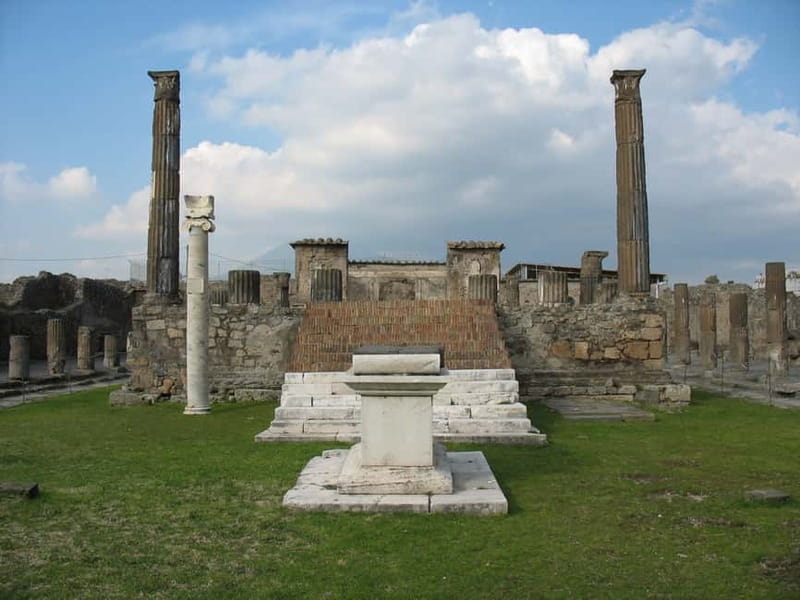
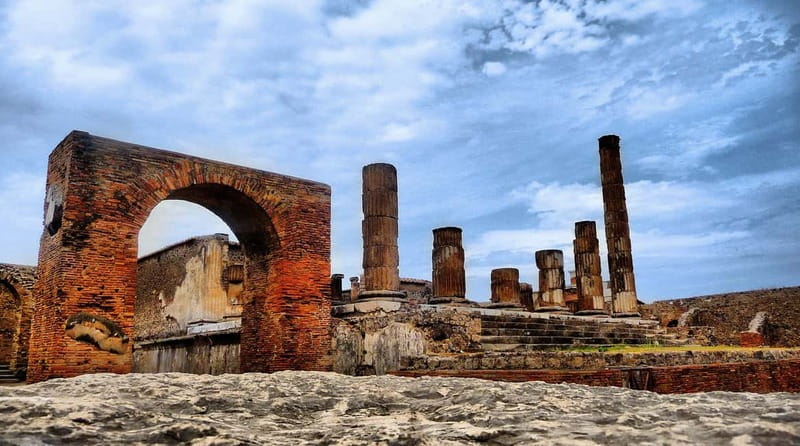
The Basilica and Forum give you the clearest sense of Pompeii as a functioning city rather than a collection of ruins. The Forum was the center of civic, religious, and commercial activity. The Basilica was tied to public business and legal affairs.
A guide helps you read the open spaces. The scale of the Forum, the position of surrounding buildings, and the arrangement of entrances make more sense when someone explains how people moved through the area. This is also where the tour’s Roman-life focus becomes useful. You are not merely looking at columns. You are learning how a town organized its public business.
The Forum can be exposed and sunny. If you join in the afternoon, do not assume the heat will be mild. One family found two hours a good limit in hot weather, and that is a fair way to think about this tour. You get a substantial visit without being committed to a half-day walk in full sun.
More Pompeii Archaeological Site tours worth comparing
- Pompeii: Skip-the-Line Guided Tour with Expert Archaeologist
★ 4.8 · 196 reviews - Pompeii: Skip-the-Line Guided Archaeological Discovery Tour
★ 4.2 · 13 reviews - Pompeii: Entry Ticket and Guided Tour with an Archaeologist
★ 4.8 · 19,459 reviews - Pompeii: Skip-the-Line Entrance Ticket with Audio Guide
★ 4.0 · 2,509 reviews
Baths, streets, and the Lupanar

The route continues through the baths, the main street, and the Lupanar, Pompeii’s famous brothel. These stops show different sides of daily life.
The baths reveal the social importance of public bathing and the practical systems that supported it. The main street gives you a feel for movement through the town, including the hard surfaces and compact urban layout. The Lupanar adds an earthy, memorable detail to the visit, though the subject matter may not suit every young child.
The group format has both good and bad sides here. Headsets help you hear the guide when other groups are nearby or when the walking route stretches out. At the same time, a larger group can make it harder to pause exactly where you want or take a quiet photograph.
Guides have been praised for keeping a good pace and making visitors guess answers before explaining the site. That approach is useful at Pompeii because it turns a long sequence of buildings into a series of questions: Who used this room? Why was this street built this way? What clues reveal the owner’s status?
Theaters and Pompeii’s public entertainment

The theaters provide another view of Roman society. They show that Pompeii was not simply a residential town but a place where people gathered for performance and public events.
Your guide will not have time to give every theater and building an extended study, but this stop rounds out the visit. After seeing the Forum and baths, you can begin to picture Pompeii as a city with work, worship, business, bathing, sex, and entertainment all within one walkable setting.
This is one reason I would not treat the tour as a complete Pompeii visit. It is an organized introduction to the western highlights. If you want a detailed look at every theater, house, garden, and outlying street, plan to remain at the site after the guided portion.
Houses, frescoes, and the quieter side of Pompeii
The named houses add color and intimacy to the tour. You may visit the House of the Tragic Poet, House of the Golden Cupid, Garden of the Fugitives, and other well-known residences included in the route.
The houses are valuable because they bring the city down to a human scale. Public monuments explain how Pompeii worked as a town. A house shows how people displayed status, arranged rooms, decorated walls, and used gardens and courtyards.
The frescoes are among the tour’s strongest visual rewards. Some are delicate, some are vivid, and all require care from the viewer. Your guide can point out what you are seeing and explain why a particular painting or room matters. This is far more useful than rushing through rooms while trying to identify everything from a small sign.
The exact houses accessible on a given day can depend on site conditions and the guide’s route, so think of the named houses as important targets rather than a guarantee that every room will receive equal time. The tour’s purpose is to connect several famous places into a coherent story.
The Garden of the Fugitives and the plaster casts
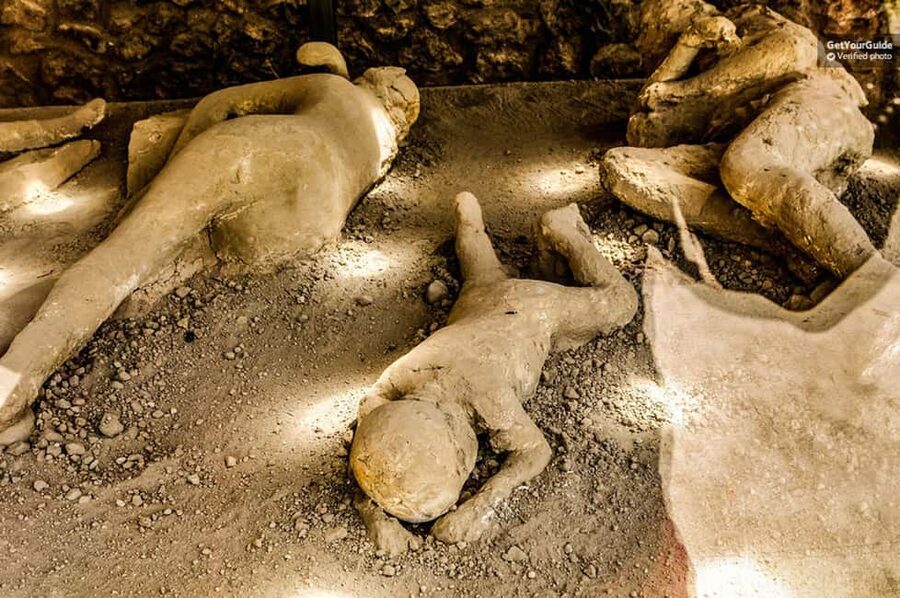
The Garden of the Fugitives is one of Pompeii’s most difficult stops. The plaster casts preserve the shapes of people caught in the eruption of Mount Vesuvius in 79 AD. They turn a distant historical event into a direct encounter with human loss.
I find this part more powerful when the guide gives context without rushing it. The casts are not simply dramatic objects. They help you understand that Pompeii was a living town whose residents had homes, families, work, and ordinary routines before the disaster.
The subject can be upsetting, especially for children. The tour is family-friendly in the sense that guides have successfully kept children aged eight to twelve engaged, but parents should decide how much detail their children are ready to hear.
What the archaeologist guide adds
The strongest part of this experience is the guide. Good guides such as Alfonso have been praised for detailed explanations and thoughtful answers. Ernaldo and Giuseppe have also been singled out for making Roman history engaging, while Laura and Lena have been described as clear, patient, and effective with families.
The language options are English and Italian. You receive a live explanation rather than relying on a written guide, and the headset system helps in a large group.
You should expect different personalities from one departure to another. The guide may be funny, serious, highly detailed, or more concise. The consistent advantage is having someone select the key places and explain what you are looking at. One guide used small stories and questions to keep the group involved, which is often more memorable than a long lecture.
A group can also affect the experience. The guide must keep everyone together, wait at gates, and repeat directions. If you want to stop for extended photographs or examine every inscription, you may find the pace restrictive. The upside is that you are less likely to lose time or miss the site’s main sights.
Timing, heat, rain, and what to bring
The visit lasts two hours, with starting times shown when you check availability. That length works well for a first look, a family visit, or a day when Pompeii is part of a wider Campania itinerary.
Bring comfortable shoes and identification, such as a passport or ID card. Large bags and luggage are not allowed, so arrive without suitcases or bulky day bags. Food and drinks are not included.
Prepare for weather rather than trusting the forecast blindly. Heat can make Pompeii tiring, and one visitor bought a paper umbrella outside the entrance for sun protection. Rain does not necessarily cancel the walk, but you should bring an umbrella or raincoat. If you need to buy one, roadside stalls outside the site may have them, but you should not count on supplies inside.
The tour does not include hotel pickup or drop-off. That keeps the price more focused on the archaeological visit, but you must arrange your own way to Tempio Travel.
Continuing after the two-hour walk
When the guided portion ends, you return to the meeting point. The organized tour is finished, but you may be able to remain in Pompeii and see more on your own. This is an important part of the value.
Use the guide’s route as an orientation rather than treating it as your only chance to see the site. If a house or street catches your attention, note its name and return to it later if access allows. You can also ask the guide for ideas for the rest of the day.
Outside the archaeological site, the modern city of Pompeii offers another nearby stop: the Sanctuary Dedicated to Our Lady of the Holy Rosary. The guide can direct you there, and it is only a few steps from the archaeological area. That gives you a convenient way to add a modern religious landmark after seeing the ancient city.
Cancellation and the first Sunday warning
You can cancel up to 24 hours before the tour for a full refund. The reserve-now, pay-later option also helps if your Campania plans are still shifting.
On the first Sunday of each month, entry to Pompeii is free. However, tickets cannot be reserved ahead of time on that day, and entry is not guaranteed. If seeing Pompeii is a priority, do not assume the free-entry day is the best choice. The included timed access on another day may be worth the cost.
Who should book this Pompeii tour?
I would choose this tour if you are visiting Pompeii for the first time, have limited time, or want the main story explained as you walk. It suits families, train arrivals, and cruise passengers who need a focused two-hour plan.
I would also choose it if ancient sites tend to blur together for you. Pompeii is enormous, and a guide can show you why the Forum, baths, theaters, houses, frescoes, and plaster casts belong to one connected story.
I would hesitate if you dislike group tours, need a fully accessible route, or want several hours of quiet independent study. The group may be large, and two hours will leave more of Pompeii unseen. In that case, you can still use the tour as an introduction, then continue alone if site access and time permit.
Should you book it?
For $50.11, this is a solid introduction to Pompeii, especially when you value direct entry and clear explanations. The best reason to book is not simply saving time at the gate. It is having a guide lead you through the essential western sights and explain what the ruins meant to the people who lived there.
Book it if you want structure, human stories, and a manageable visit. Skip it if you prefer to move at your own pace and already have the background to interpret Pompeii without help. Either way, bring good shoes, protect yourself from the sun or rain, and leave room in your schedule to see more after the two-hour route.
FAQ
How long is the Pompeii guided tour?
The tour lasts two hours. Starting times are shown when you check availability.
Where does the tour start?
You meet at the Tempio Travel office on the first floor of the Circumvesuviana train station in Pompeii. Look for the building with the red logo and follow the current meeting instructions.
Where does the tour end?
The activity ends back at the meeting point.
Is entrance to Pompeii included?
Yes. Skip-the-line entrance tickets are included in the tour price.
Which languages are available?
The live guide is available in English and Italian.
Can I bring luggage or a large bag?
No. Luggage and large bags are not allowed. Bring comfortable shoes and a passport or ID card.
Is the tour suitable for people with mobility impairments?
No. The activity is listed as not suitable for people with mobility impairments.
Is food or drink included?
No. Food and drinks are not included.
Can I cancel the booking?
Yes. You can cancel up to 24 hours in advance for a full refund. You can also reserve now and pay later.
Newest reviews from Pompeii Archaeological Site
- From Naples: Pompeii & Sorrento Shore Excursion with Lunch★ 5.0 · 6 reviews
- Pompeii 3-Hour Walking Tour★ 5.0 · 8 reviews
- From Sorrento: Pompeii and Vesuvius Tour by Express Train★ 4.0 · 12 reviews
- Pompeii: Skip-the-Line Guided Archaeological Discovery Tour★ 4.2 · 13 reviews
- 2-Hour Private Walking Tour of Pompeii★ 4.7 · 22 reviews
- Mount Vesuvius Wine Tasting and Lunch from Pompeii★ 4.3 · 43 reviews
- Pompeii: Skip-the-Line Ticket and Virtual Museum★ 4.5 · 66 reviews
- Pompeii: Skip-the-Line Tour for Kids and Families★ 4.9 · 72 reviews
Guided, compared.

Entry Ticket and Guided Tour with an Archaeologist
Read our review →

Skip-the-Line Entrance Ticket with Audio Guide
Read our review →



Skip-the-Line Entry Ticket with Digital Guide App
Read our review →