
Reviewed · WALKING TOURS
Pompeii: Guided Walking Tour with Entrance Ticket
Pompeii is most powerful when you stop seeing it as a pile of ruins and start reading it as a town. Streets, shops, baths, public buildings, and private homes still show how ordinary Romans lived before Vesuvius buried the city in 79 AD. I especially like the included €20 entrance ticket and the way a guide gives meaning to details you could easily walk past.
I also like the two-hour focus: you get the Forum, Thermal Baths, Lupanare, shops, and key streets without trying to conquer the whole archaeological area in one day. The main drawback is organization at the meeting point. A few groups have waited for a late guide or struggled to find the right person, so arrive early and keep your phone available.
In This Review
- Key points at a glance
- Why a guide changes Pompeii
- Meeting at Hotel Vittoria in Pompeii
- Entering Pompeii with the ticket included
- The Forum, where Pompeii becomes a city
- Thermal Baths and the machinery of daily life
- The Lupanare and Pompeii’s less polished side
- Shops, wine signs, and the Roman street
- What two hours can and cannot cover
- Guide quality and communication
- Price, value, and the practical tradeoff
- Who should book this Pompeii walk?
- Should you book it?
- FAQ
- How much does the Pompeii guided walking tour cost?
- How long does the tour last?
- What time is the meeting?
- Where do I meet the guide?
- Which languages are available?
- Is the entrance ticket included?
- Does the tour skip the ticket line?
- Are headsets provided?
- What should I bring?
- Is the tour suitable for wheelchair users?
- Can I cancel the booking?
Key points at a glance
- See Pompeii’s civic heart: The Forum gives you the clearest sense of how public life worked in the ancient town.
- Read daily life in the ruins: Baths, homes, shops, wine signs, and the Lupanare add human detail to the stonework.
- Use the included entrance ticket: The €20 site admission is covered in the $50 tour price.
- Hear the guide clearly: Headsets are supplied, a real help when the group spreads out.
- Expect a brisk two-hour route: You see a strong selection of Pompeii, but not the entire excavation.
- Plan for a busy meeting area: Meet at 10:50 a.m. in the garden of Hotel Vittoria, outside the CELLINI coral shop.
Why a guide changes Pompeii
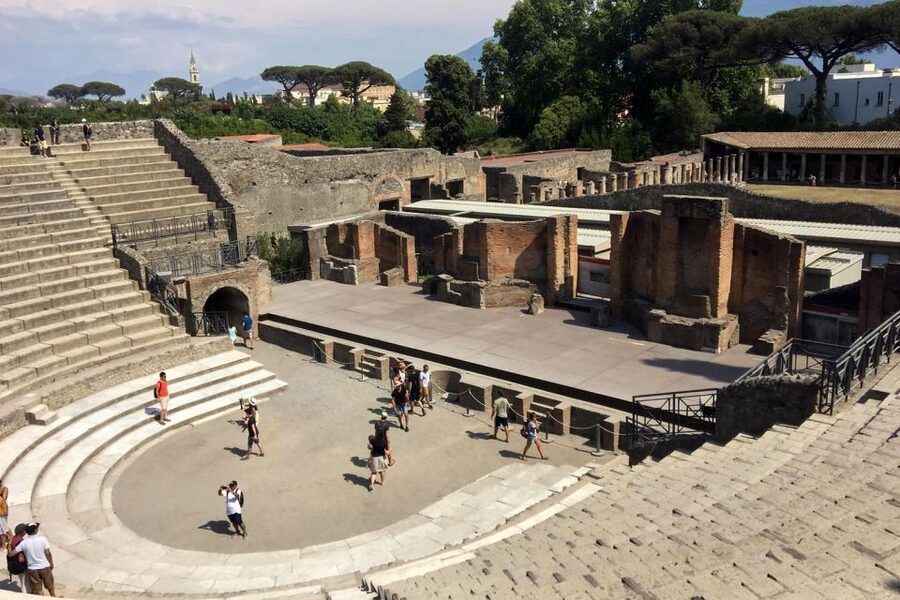
Pompeii is not a tidy archaeological monument. It is a huge, partly excavated Roman town with streets that lead past walls, courtyards, storefronts, temples, baths, and houses. Without context, it can be hard to know what you are looking at or why one broken wall matters.
A good guide turns those fragments into a readable town. You learn how people moved through the streets, where they met, how shops operated, and what public buildings told you about Roman society. The strongest guides, including Elisa, Francesca, Salvatore, Maria, and Miguel, have been described as funny, clear, and good at involving children as well as adults.
That combination matters here. Pompeii is not only about grand monuments. Its appeal comes from ordinary details: a shop sign, a wine reference, a worn street, a bath complex, or the layout of a home. A guide helps you connect those pieces instead of simply taking photographs of old stone.
The tour is offered in English, French, Spanish, and Italian. It may be led by a multilingual guide, so the exact language arrangement is not guaranteed if only one person books in a particular language. Headsets are included and usually make it easier to hear explanations while walking or standing away from the guide.
More Walking Tours in Pompeii
- Discover Pompeii: French Walking Tour of the Buried City
★ 4.8 · 253 reviews - From Salerno: Pompeii Guided Walking Tour
★ 4.5 · 235 reviews - Pompeii 3 Hours Walking Tour Led by an Archaeologist
★ 5.0 · 126 reviews
Meeting at Hotel Vittoria in Pompeii
The stated meeting point is the garden of Hotel Vittoria, just outside the CELLINI coral shop on Via Mare, 80045 Pompei. The scheduled pickup time is 10:50 a.m., and the guide should carry a sign with the booking name.
This sounds simple, but the entrance area can be crowded and confusing. Some people have had trouble locating the group, while others found the company representative by phone or WhatsApp. In one case, staff walked around calling a customer’s last name. That kind of help is useful, but it is better not to rely on a last-minute rescue.
I would arrive at least 15 minutes early. Check the exact meeting instructions before leaving your hotel, keep the confirmation message open, and make sure your phone can receive calls or messages. If you arrive by train, pay close attention to your route and station details. One useful warning is to distinguish Pompeii Scavi from the regular Pompeii station when coming from Naples.
The operator has waited for delayed participants in several cases, including delays caused by traffic, missed trains, and a Circumvesuviana strike. That is encouraging, but it should not be treated as a promise. Pompeii has a fixed opening process, and a large group cannot always hold its place indefinitely.
Entering Pompeii with the ticket included
The tour includes admission to the Pompeii Archaeological Site, listed at €20, along with skip-the-ticket-line access. At a tour price of about $50 per person, the remaining amount pays for the guide, organization, and headsets.
That is reasonable if you want interpretation. Buying the ticket alone is cheaper, but it leaves you to make sense of a large site on your own. If Pompeii is a main reason for your visit, the guide can save time and help you use your limited energy on the most meaningful sections.
Skip-line entry is useful, though it does not mean you walk through every part of the entrance area without any pause. You still need to meet the group, collect or use the required equipment, and pass through the site entrance as a group. The benefit is avoiding the ordinary ticket queue, not avoiding every bit of waiting.
The archaeological area can be hot and exposed. Even pleasant weather may feel intense on the broad stone streets, with little shade in some sections. Wear shoes with good support, bring water, and use weather-appropriate clothing. The tour operates in all weather, so rain can change the feel of the walk quickly.
The Forum, where Pompeii becomes a city
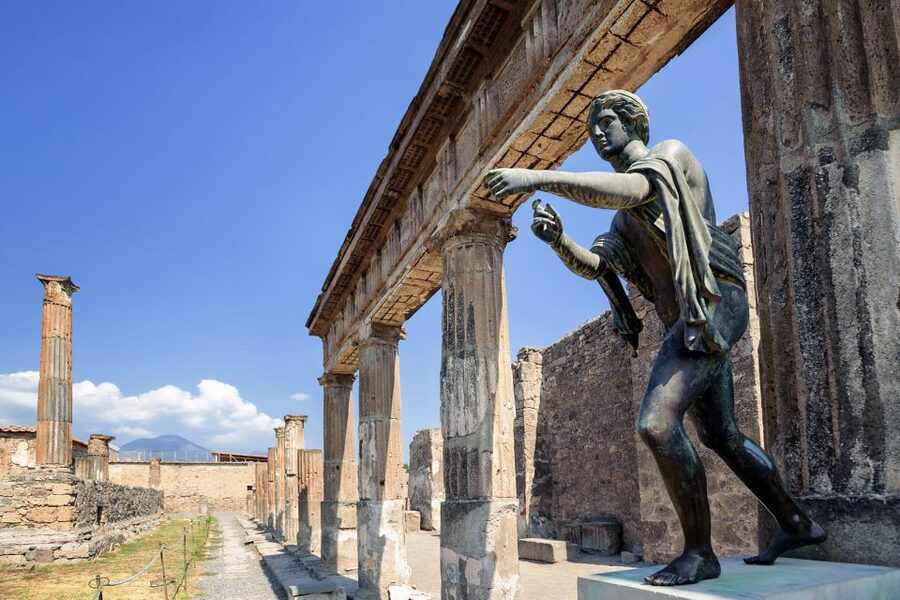
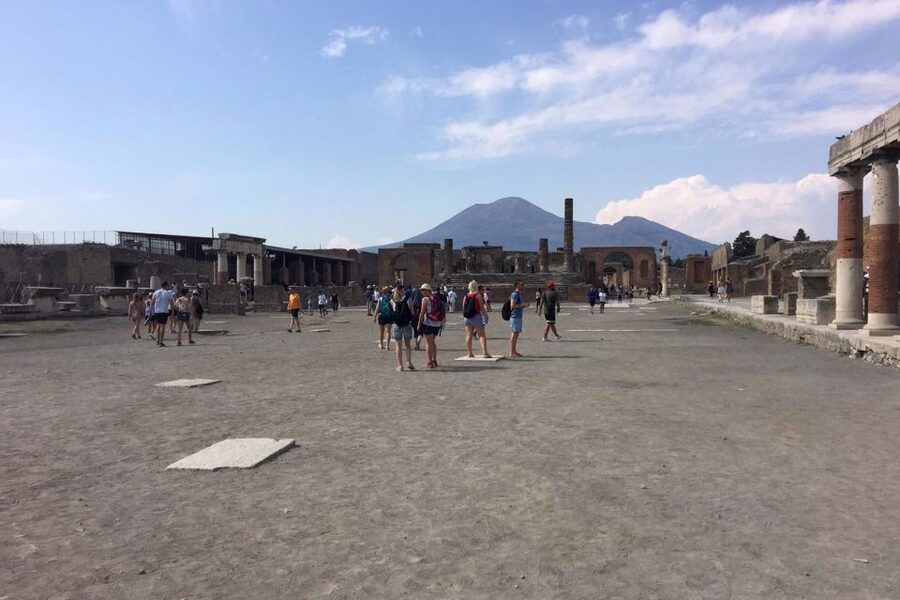
The Forum is one of the essential stops because it gives you a framework for the whole town. This was Pompeii’s main public square, the place to understand civic life, religion, trade, and the arrangement of important public buildings.
A guide can explain why the Forum was positioned as the town’s central meeting place and how the surrounding structures fit together. Instead of seeing disconnected columns and walls, you begin to picture a busy public center with people coming to conduct business, worship, shop, and take part in civic life.
This is also where the scale of Pompeii starts to register. The excavation is large, and the Forum gives you an anchor before the route moves into more intimate spaces. Leave room for photographs, but listen closely to the guide’s explanation of the layout. A few minutes of context here can improve everything that follows.
More Pompeii excavation visits:
- Pompeii: Entry Ticket and Guided Tour with an Archaeologist
★ 4.8 · 19,459 reviews - Pompeii: Entry Ticket with Optional Audio Guide
★ 4.2 · 12,360 reviews - Pompeii: Small Group Tour with an Archaeologist
★ 4.8 · 12,264 reviews - Pompeii Small Group Tour with an Archaeologist
★ 5.0 · 6,593 reviews
Thermal Baths and the machinery of daily life

The Thermal Baths show how much of Roman life revolved around shared public spaces. Baths were not simply places to wash. They were social and practical centers, and their rooms reveal the planning and engineering that supported urban life.
You will see the remains of bathing facilities and hear how Romans used different spaces within the complex. The ruins may not look complete at first glance, but the guide’s explanation helps you understand the purpose of the rooms and the effort required to heat and manage them.
This is one of the stops that benefits most from a live guide. A sign or audio description can give you names, but a person can point out the feature you are looking at and answer questions immediately. The tour does not linger everywhere, so listen first and photograph second if you want to follow the story.
The Lupanare and Pompeii’s less polished side
The Lupanare is one of Pompeii’s most talked-about buildings. It offers a frank look at part of Roman commercial and social life, and the guide explains the site without avoiding its adult subject matter.
That direct approach is useful because the building is easy to reduce to a joke. A good explanation gives it a place within the wider town, alongside homes, shops, baths, religious buildings, and public spaces. Pompeii becomes more believable when you see both respectable public life and the less polished businesses that served it.
Parents should decide in advance if this stop suits their children. Guides have handled mixed-age groups well, but the subject is not hidden or softened. If you want a serious look at how the town functioned, it is an important part of the route.
Shops, wine signs, and the Roman street
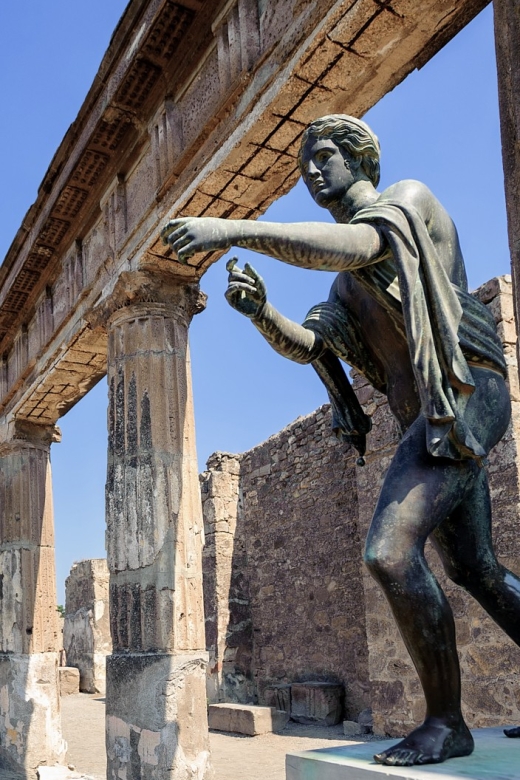
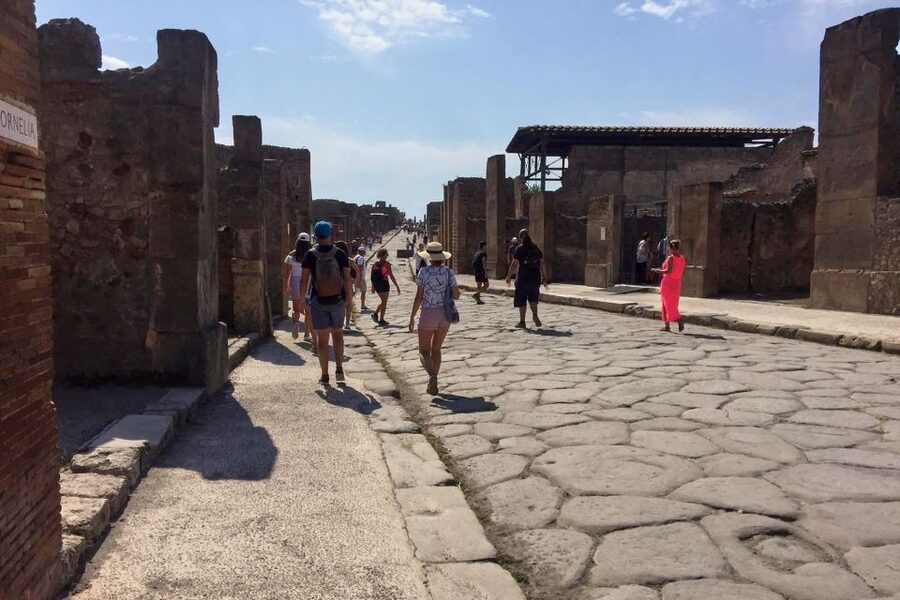
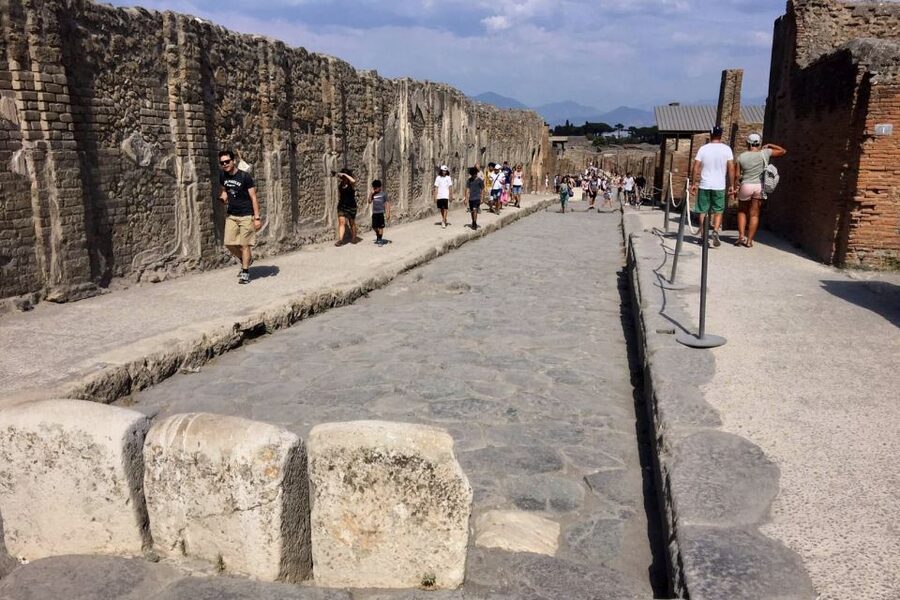
The streets and storefronts may be the most revealing part of the walk. You can see how commercial life was built into the town, with shops opening onto the roads and signs connected to goods such as wine and produce.
These details make Pompeii feel less like a museum and more like a place where people worked, bought food, met friends, and moved through the day. The preserved street plan also helps you understand the town as a functioning community rather than a collection of isolated monuments.
The guide may take you through domestic, public, and commercial areas, depending on the day’s route and site access. That variety is more valuable than seeing only the grandest buildings. It also explains why two hours can pass quickly.
What two hours can and cannot cover

Two hours is a useful introduction, not a complete visit. Pompeii is vast, and even a fast walk can cover only a fraction of the excavated streets and buildings. One guide estimated that seeing everything properly could take far longer than a single tour.
The route is designed to show major highlights while keeping the pace manageable. You should expect to cover the Forum, Thermal Baths, Lupanare, streets, shops, and selected buildings, but not every house or neighborhood.
I like this length for a first visit, especially if you are fitting Pompeii into a larger day in Campania. It gives you a clear story without exhausting you before lunch. If you already know the site well, or want to study individual villas and frescoes, you may find the route too short.
At the end, you can stay and explore on your own in areas not covered by the guide, subject to site access and opening conditions. That makes the tour more useful than a simple in-and-out visit. Use the guided section to learn the layout, then continue independently if you have time and energy.
Guide quality and communication
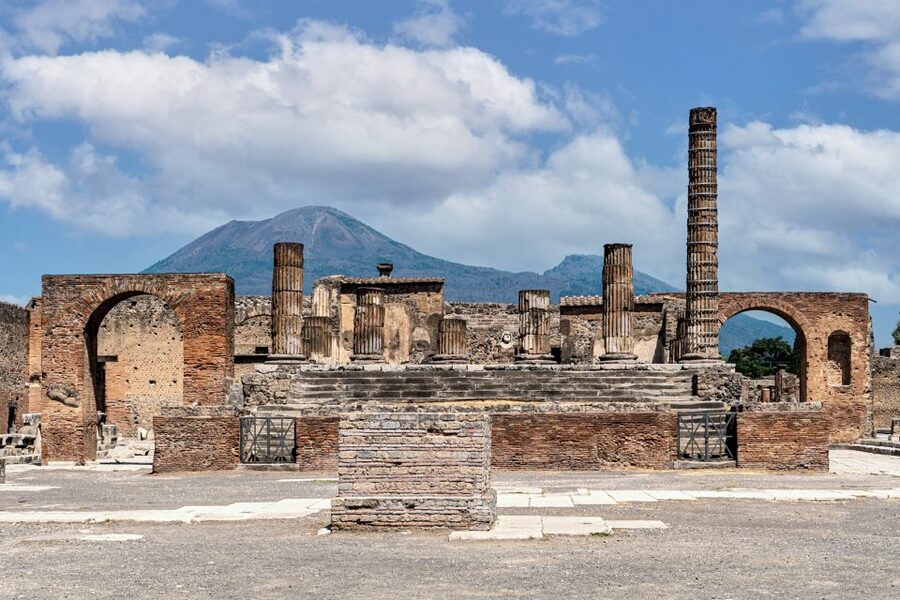
The strongest part of this experience is the guide. Names frequently associated with especially effective tours include Elisa, Francesca, Salvatore, Maria, Miguel, Imma, Mattia, Alex, and Rita. The exact guide depends on the date and language, but the best format is clear: an energetic person who explains the ruins, adds humor, and answers questions.
Several guides have been praised for making the site work for children. Others have used pictures to explain what buildings may once have looked like. That is valuable because much of Pompeii is open to interpretation, and a visual reference can make a damaged structure easier to understand.
Communication can vary by guide. Most English-language experiences have been easy to follow, but one or two visitors found that an accent or speaking style made parts of the commentary difficult. The headsets help, though they are not perfect. One assessment found the supplied earpieces uncomfortable, while others considered them essential.
Group size also affects the experience. A small or well-managed group allows easier questions and a better view when the guide points out details. On a busy day, the group can feel large, and an organizational problem may make it larger than planned. If personal attention is your top priority, this is worth considering.
Price, value, and the practical tradeoff
At $50 per person, the tour is not the least expensive way into Pompeii. The included ticket is worth €20, so you are paying roughly the balance for a professional guide, skip-line arrangements, and audio equipment.
I think the price works well for first-time visitors who want a clear introduction. You are paying to understand the site, not simply to enter it. The value is strongest if you have only a few hours, are nervous about navigating the excavation, or want to learn about Roman culture as you walk.
The value is weaker if you prefer a slow solo visit or already have a detailed guidebook and plenty of time. A two-hour group tour cannot stop at every fresco, house, or street. It is a structured overview, followed by optional independent exploration.
The operator’s flexible cancellation policy also reduces some booking risk: you can cancel up to 24 hours ahead for a full refund, and reserve now while paying later. The tour requires at least two participants to operate. If that minimum is not reached, cancellation after confirmation is possible, with an alternative or full refund offered.
Who should book this Pompeii walk?
I would choose this tour for a first visit, families who want a clear story, and anyone arriving by train who wants an organized route through a confusingly large site. It also suits you if you enjoy history more when someone explains the human details behind the buildings.
It is less suitable for wheelchair users and people with mobility impairments. Pompeii involves uneven ancient streets and a long walking route, and the activity specifically excludes wheelchair users.
You should also skip it if you need a leisurely pace with many breaks or want a specialist archaeological lecture. The guides are praised for clear explanations, humor, and audience interaction, but the tone can be lively rather than academic.
Bring comfortable shoes, water, and clothing suited to the forecast. Take your passport or ID card if you are using a child fare, since children may be asked to prove their age at the ticket office or pay the adult rate.
Should you book it?
Book this tour if you want Pompeii to make sense quickly. The included admission, skip-line entry, headsets, and strong record of engaging guides make $50 a fair price for a two-hour introduction.
I would be cautious only about the meeting point and timing. Arrive early at Hotel Vittoria, confirm the location, and keep your phone on. If you can handle that bit of uncertainty, this is a practical way to see Pompeii’s Forum, baths, Lupanare, shops, and streets while learning what life was like before Vesuvius changed the town forever.
FAQ
How much does the Pompeii guided walking tour cost?
The tour costs $50 per person. The Pompeii Archaeological Site entrance ticket, listed at €20, is included.
How long does the tour last?
The guided walk lasts two hours. You may be able to remain afterward and explore additional areas independently, depending on site access.
What time is the meeting?
The stated meeting time is 10:50 a.m. Check availability when booking, since starting times can vary.
Where do I meet the guide?
Meet in the garden of Hotel Vittoria in Pompeii, outside the CELLINI coral shop on Via Mare, 80045 Pompei. The guide should have a sign with the booking name.
Which languages are available?
Live guides are available in English, French, Spanish, and Italian. The tour may be operated by a multilingual guide.
Is the entrance ticket included?
Yes. Admission to the Pompeii Archaeological Site is included with the tour.
Does the tour skip the ticket line?
Yes. Skip-the-ticket-line entry is included, helping you avoid the regular ticket queue.
Are headsets provided?
Yes. Headsets are included so you can hear the guide more clearly during the walk.
What should I bring?
Bring comfortable shoes, weather-appropriate clothing, and a passport or ID card for children using the child fare.
Is the tour suitable for wheelchair users?
No. The tour is not suitable for wheelchair users or people with mobility impairments.
Can I cancel the booking?
Yes. You can cancel up to 24 hours in advance for a full refund. Reserve now and pay later is also available.
More Walking Tours in Pompeii Ruins
- Pompeii: Highlights Guided Walking Tour
★ 4.6 · 105 reviews - Pompeii: 3D Walking Tour with Entry Ticket
★ 4.3 · 102 reviews - Explore Pompeii: 2-Hour Guided Walking Tour with Included Ticket
★ 4.5 · 77 reviews - Pompeii: walking tour with 3D glasses and with entrance ticket
★ 4.5 · 61 reviews
Newest reviews from Pompeii Ruins
- Private Tour Pompeii and Winery★ 5.0 · 4 reviews
- Visit the Pompeii ruins from Salerno with Pizza Lunch★ 5.0 · 4 reviews
- From Sorrento: Pompeii & Vesuvius tour small group★ 4.8 · 4 reviews
- Pompeii Private Tour for Kids and Their Families★ 4.8 · 4 reviews
- Pompeii Sorrento and Positano Tour★ 5.0 · 4 reviews
- From Naples_ Pompeii Tour_Skip the line ticket + audioguide★ 4.3 · 4 reviews
- Pompeii, skip-the-line ticket with smartphone audio guide on App★ 3.0 · 4 reviews
- Pompeii Private Half-Day Tour from: Naples,Sorrento, Amalfi Coast★ 5.0 · 4 reviews
Walking Tours, compared.

Walking Food Tour in Sorrento w/ Limoncello Factory Lemon Grove
Read our review →

Discover Pompeii: French Walking Tour of the Buried City
Read our review →


Browse the lists this tour appears in