
Reviewed · ARCHAEOLOGIST-LED TOURS
Skip-the-Line Pompeii Tour for Kids with an Archaeologist
Pompeii can flatten a child’s interest fast: mile after mile of old stone, few signs, and a hot sun overhead. This tour solves much of that problem with skip-the-line entry and a guide who turns the ruins into a game. Guides such as Roberta, Loretta, Maria, and Lello have used quizzes, challenges, stories, and even a song in the amphitheater to keep young minds moving.
I like two things here. First, the guide leads you to the key parts of a huge site instead of leaving you to puzzle over a map. Second, the roughly two-hour format is sensible for families, especially in summer. The trade-off is simple: you will not see all of Pompeii, and some families have missed the amphitheater or wished for more time afterward.
In This Review
- Key points at a glance
- Why Pompeii works better with a child-focused guide
- Meeting near Piazza Esedra and getting inside
- Roman houses that make daily life visible
- The Forum, where Pompeii gathered
- Baths, theaters, and the Roman idea of leisure
- Two hours is a useful family limit
- How much value do you get for $119.73?
- Timing, heat, and the physical side of Pompeii
- Who will enjoy this Pompeii tour most?
- Booking details worth knowing
- Should you book it?
- FAQ
- How long does the Pompeii tour last?
- What does the tour include?
- Where does the tour start and end?
- Is hotel pickup included?
- Is the tour suitable for children?
- Can I cancel for a full refund?
Key points at a glance
- Skip the long entrance line: Admission is included, and the guide handles the main entry process.
- Built around children: Expect questions, games, scavenger hunts, and stories rather than a long lecture.
- The main Pompeii sights: The route includes Roman houses, the Forum, thermal baths, theaters, and selected streets.
- Private or small-group format: Your group receives more attention than it would on a large coach excursion.
- A compact visit: Plan on about two hours, with some accounts describing a longer visit depending on the guide and pace.
- Best for children with some stamina: The ground is uneven, the site is broad, and heat can make a long walk tiring.
Why Pompeii works better with a child-focused guide
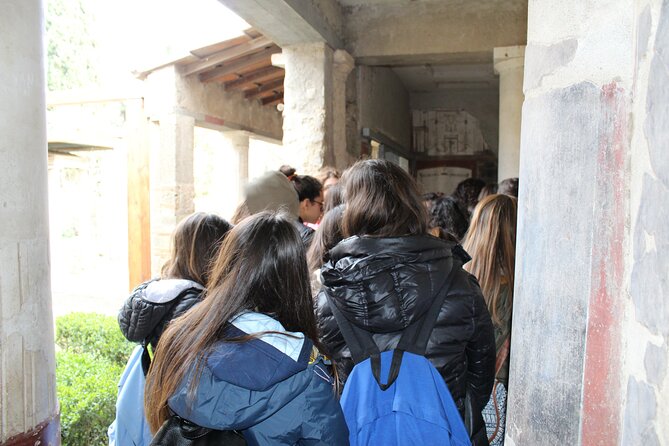
Pompeii is not a single monument. It is a large archaeological park with streets, homes, public buildings, theaters, baths, and open spaces spread across a wide area. Without help, you can see plenty and still miss what made the city meaningful.
A guide gives the stones a reason to matter. Instead of merely pointing to a wall, the guide can explain how a Roman house was arranged, how people used the Forum, and what happened in the years before the city was buried. That context is especially useful for children, who often need a story, a question, or a task before an ancient building feels real.
The strongest part of this experience is the focus on participation. Guides have drawn children into friendly competitions, asked quiz questions, and used scavenger-hunt ideas to make them look closely. One family with children from ages 3 to 13 found that the guide kept changing tactics to hold their attention. Another family said its eight-year-old, initially worn out by weeks of sightseeing, finished the visit calling Pompeii the favorite part of the trip.
That does not mean every child will be captivated every minute. One family found the guide’s style did not suit its son. Children aged 8 and older may get the most from the historical explanations, while younger children can still enjoy the games and movement if they have enough energy.
More Pompeii excavation visits:
- Pompeii: Entry Ticket and Guided Tour with an Archaeologist
★ 4.8 · 19,459 reviews - Pompeii: Entry Ticket with Optional Audio Guide
★ 4.2 · 12,360 reviews - Pompeii: Small Group Tour with an Archaeologist
★ 4.8 · 12,264 reviews
Meeting near Piazza Esedra and getting inside
The meeting point is Hotel Vittoria at Piazza Esedra in Pompeii, near the archaeological park. The tour ends back at the meeting point, and hotel pickup and drop-off are not included, so you need to make your own way there.
The entrance process is one of the practical reasons to book a guided visit. Pompeii can develop long lines, particularly at busy times or on unusual free-admission days. Your admission ticket is included, and the tour promises guaranteed skip-the-line access. That saves time and spares you from trying to work out which queue applies to your ticket.
The exact meeting routine can vary by guide, so arrive with your confirmation ready on your phone. Mobile tickets are accepted. A current passport is required on the day, and children must be accompanied by an adult.
The tour is described as private or small group, with only your party participating for a private booking. That matters when you have children. A guide can pause for a question, redirect a distracted child, or adjust the explanation more easily than someone leading a large crowd.
Roman houses that make daily life visible
The houses are among the most useful stops for children because they show ordinary life rather than only public power. You might see rooms arranged around courtyards, decorative details, and traces of how wealthy Roman families lived.
A good guide does more than name the building. You can expect explanations that help you picture the sounds, smells, routines, and social rules of a working city. Loretta, in particular, has been praised for describing Pompeii as an active place before the disaster, using storytelling to give the empty rooms a human scale.
The value here is the connection between small details and a larger picture. A child may remember a painted wall, a household feature, or an odd street detail long after forgetting a date. Adults also gain more from the visit because the guide points out things that are easy to walk past.
The route cannot cover every house. Pompeii’s size makes a highlights approach necessary, and the guide has to balance the best examples with the attention span of the youngest person in your group.
The Forum, where Pompeii gathered
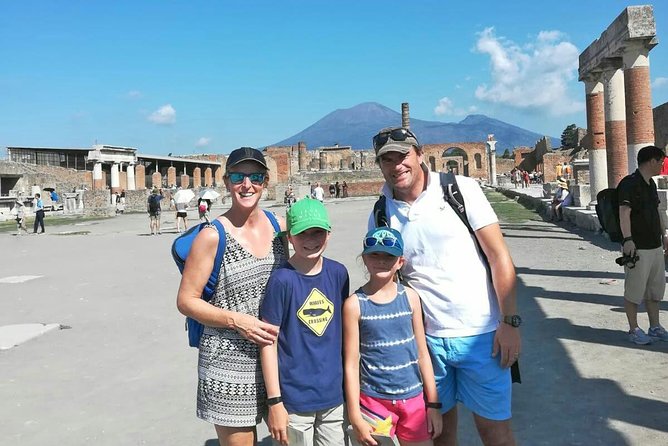
The Forum was the city’s main public square and one of the clearest places to understand Pompeii as a functioning community. Here, your guide can explain how public, political, religious, and commercial life came together.
This is where a child-friendly approach helps most. A dry list of buildings can lose a seven-year-old in seconds. A guide who asks children to identify what a space might have been used for, or who turns the visit into a short challenge, gives them something active to do.
The Forum also gives adults a sense of scale. You begin to understand that Pompeii was not just a collection of isolated ruins. It was a planned city with public areas and daily routines. The guide’s explanations help you connect the Forum to the houses, baths, streets, and theaters seen elsewhere.
Expect the Forum to be one of the busier parts of the park. An early start can help. A family that booked the 9 a.m. visit found that the guide used a less crowded route and moved through the park in reverse. A later 1:30 p.m. start was also praised for allowing a family to travel at a calmer pace after the morning crowd had thinned. Your best time depends on your transport plans and the season.
More tours led by an archaeologist:
- Pompeii Small Group Tour with an Archaeologist
★ 5.0 · 6,593 reviews - Pompeii and Herculaneum Small Group Tour with an Archaeologist
★ 5.0 · 1,350 reviews - Skip the Line Guided Tour of Pompeii led by an Archaeologist
★ 5.0 · 703 reviews - Pompeii: Exclusive Tour with Archaeologist and Entry Tickets
★ 4.9 · 634 reviews
Baths, theaters, and the Roman idea of leisure

The thermal baths show how public facilities shaped Roman life. They were not simply places to wash. The guide can help you understand their social role and the way different parts of the complex fit together.
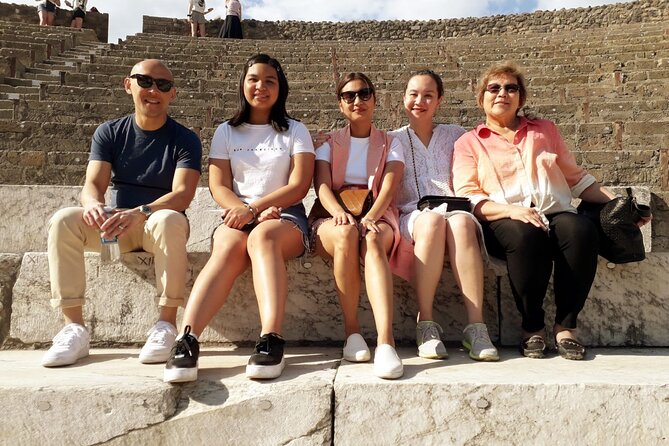
The theaters offer another change of mood. These spaces are easier for children to grasp because their purpose is clear: people gathered to watch performances. The large structures also provide a memorable sense of scale after the smaller rooms of the houses.
One guide, Loretta, was even asked to sing in the amphitheater, a moment that attracted attention from people nearby. That is not something you should assume will happen on every departure, but it shows how a lively guide can use the setting itself to make the visit memorable.
There is an important limit here. The tour focuses on the principal areas, but it may not include every major structure on every route. One family specifically wished it had been taken to the amphitheater. If that building is your priority, ask about it at the start rather than assuming it is guaranteed.
Two hours is a useful family limit
The advertised duration is about two hours. The park visit is also described as lasting about two and a half hours, and one family reported a visit of roughly three hours with its guide. In practice, the pace and guide may affect the total time, so allow flexibility rather than scheduling a tight connection immediately afterward.
For most families, the short format is a strength. Pompeii involves plenty of walking over uneven surfaces, and shade can be limited. In June and August, two focused hours can leave you interested instead of wilted.
The visit is long enough to cover houses, the Forum, baths, theaters, and selected streets. It is not long enough for a full exploration of the park. Think of it as a smart introduction, not an exhaustive archaeological day.
Afterward, you may be able to continue on your own, depending on your schedule and energy. One guide helped a family understand the map so it could explore further, though the family chose to leave and continue to another activity. That is a good way to use the tour: let the guide provide the structure, then decide if you want more ruins.
How much value do you get for $119.73?
At $119.73 per person, this is not the cheapest way into Pompeii. You are paying for more than admission. The price includes the entrance ticket, a professional local guide, and skip-the-line access in a private or small-group setting.
For a family of several people, the cost can add up quickly. The value depends on what you would otherwise do. If you are comfortable studying a map, reading signs, waiting in line, and choosing your own route, self-guided entry costs less. If you want to cover the key sights efficiently and keep children involved, the guide can justify the premium.
I see the strongest value in the time saved and the attention given to children. A large group tour may cost less, but it is less likely to pause for a child’s question or change its approach when attention fades. This experience also reduces the risk of spending your limited Pompeii time in the wrong queue or wandering past important buildings without understanding them.
The price makes most sense for families who care about an organized, personal visit. It is less compelling for adults who want to spend an entire day examining inscriptions, exploring distant corners, or moving at their own pace.
Timing, heat, and the physical side of Pompeii
You need a moderate level of fitness for this tour. The site is large, and you will be walking over ancient streets and uneven ground. Children who are tired, overheated, or unaccustomed to long walks may struggle even if the guide is excellent.
The early 9 a.m. departure has clear advantages. You can enter near opening time, face fewer people in some areas, and make better use of the cooler part of the day. The later 1:30 p.m. option may suit families arriving by train or those who prefer to avoid the biggest morning crowds, but heat can still be a concern.
Wear practical shoes and bring what you need for sun and warmth. The supplied details do not specify equipment or refreshment arrangements, so plan for a walking visit and do not count on hotel transport. Keep your schedule loose if you are connecting to a train, shuttle, or another excursion.
The weather policy is also worth noting. The activity requires good weather. If poor weather causes cancellation, you are offered another date or a full refund.
Who will enjoy this Pompeii tour most?
I would choose this for families with children roughly 6 to 13, especially if the adults want real historical explanation without forcing children through a long lecture. The guide’s use of games has worked with children as young as four, while older children can handle the questions and broader context.
It also suits families arriving by train or making Pompeii part of a busy Italy schedule. The guided route gives you the main picture in a compact visit, and you can stop there or continue independently if you still have energy.
This is less suited to visitors who want every corner of the park. It is also not the right fit if your child dislikes interactive guiding, questions, or being drawn into group activities. The approach is warm and energetic, but not entirely passive.
Adults should not assume a children’s tour will feel shallow. Several guides, including Lello, Maria, Roberta, and Loretta, have been praised for offering serious historical detail while keeping children involved. You get a family format, not a watered-down version of Pompeii.
Booking details worth knowing
The tour is offered in English, and confirmation arrives when you book. It is often reserved well ahead, with bookings averaging about 70 days in advance, so an early reservation is sensible if your dates are fixed.
Group discounts are available, which may improve the value for a larger family or extended party. The tour has free cancellation up to 24 hours before the start time for a full refund. Changes or cancellations inside that window are not accepted for a refund.
Because the experience is private or limited to your own group, you should expect a more personal visit than a standard large-group outing. The exact guide is not guaranteed from the information provided, but the guides praised by name include Roberta, Loretta, Maria, Lello, Lalo, and Laylo.
Should you book it?
Book this tour if your main goal is to help children understand Pompeii without exhausting them. The strongest reasons are the skip-the-line entry, included admission, focused route, and guides who use games and stories instead of relying on children to listen to a long talk.
I would choose the earliest time if you can manage it, particularly in hot weather. If you want the amphitheater or another specific building, ask about it before the tour begins. The two-hour format is a good first visit, but you should not expect to see the whole park.
At $119.73 per person, it is a premium experience. For a family that values saved time and an engaging guide, the cost is sensible. For independent adults with a full day and strong interest in exploring every ruin, buy admission and make your own route instead. For most families with younger children, this is one of the more practical ways to make Pompeii feel like a city rather than a field of stones.
FAQ
How long does the Pompeii tour last?
The tour is advertised as approximately two hours. The park visit is also described as lasting about two and a half hours, and the exact length may vary with the guide and pace.
What does the tour include?
The price includes admission tickets, a local and professional guide, skip-the-line access, and a private or small-group tour.
Where does the tour start and end?
It starts at Hotel Vittoria on Piazza Esedra in Pompei. The activity ends back at the meeting point.
Is hotel pickup included?
No. Hotel pickup and drop-off are not included. You need to reach the meeting point yourself.
Is the tour suitable for children?
Yes. The experience is designed for families and uses questions, games, challenges, and stories to keep children involved. Children must be accompanied by an adult.
Can I cancel for a full refund?
Yes, if you cancel at least 24 hours before the experience start time. Cancellations or changes made less than 24 hours before the start are not refunded. If poor weather causes the activity to be canceled, you are offered another date or a full refund.
More Skip the Line in Pompeii Ruins
- Pompeii: Skip-the-Line Entrance Ticket with Audio Guide
★ 4.0 · 2,509 reviews - Sorrento: Skip-the-Line Pompeii Express Tour by Train
★ 4.8 · 2,038 reviews - Pompeii: Skip-the-line-Ticket and Guided Tour
★ 4.6 · 1,152 reviews - Pompeii: Guided Tour with Skip-the-Line Entry
★ 4.9 · 812 reviews
Newest reviews from Pompeii Ruins
- Private Tour Pompeii and Winery★ 5.0 · 4 reviews
- Visit the Pompeii ruins from Salerno with Pizza Lunch★ 5.0 · 4 reviews
- Pompeii Private Tour for Kids and Their Families★ 4.8 · 4 reviews
- From Sorrento: Pompeii & Vesuvius tour small group★ 4.8 · 4 reviews
- Pompeii Sorrento and Positano Tour★ 5.0 · 4 reviews
- From Naples_ Pompeii Tour_Skip the line ticket + audioguide★ 4.3 · 4 reviews
- Pompeii, skip-the-line ticket with smartphone audio guide on App★ 3.0 · 4 reviews
- Pompeii Private Half-Day Tour from: Naples,Sorrento, Amalfi Coast★ 5.0 · 4 reviews
Archaeologist-Led Tours, compared.

Entry Ticket and Guided Tour with an Archaeologist
Read our review →
Pompeii Small Group Tour with an Archaeologist
Read our review →
Pompeii and Herculaneum Small Group Tour with an Archaeologist
Read our review →
Skip the Line Guided Tour of Pompeii led by an Archaeologist
Read our review →
Exclusive Tour with Archaeologist and Entry Tickets
Read our review →
Pompeii Private Tour with an Archaeologist and Skip The Line – 3 hours
Read our review →
Pompeii Skip-the-line Tour with Archaeologist Guide
Read our review →Browse the lists this tour appears in