
Reviewed · ARCHAEOLOGIST-LED TOURS
Pompeii: Tour with Archaeologist Guide & Skip-the-Line Entry
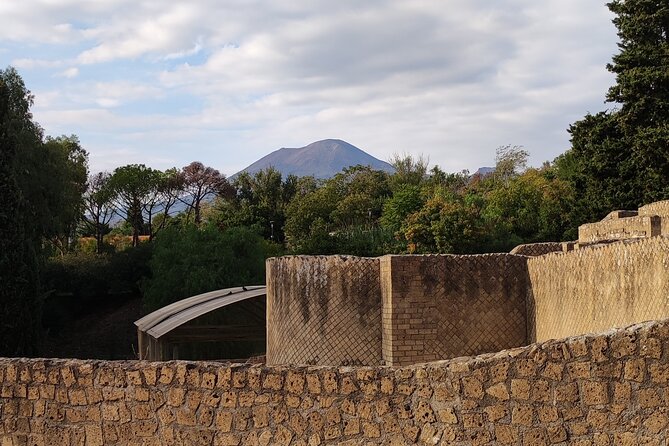
Pompeii is not a museum behind glass. You walk its streets, step into Roman homes, pass ancient baths and shops, and face the plaster casts made from victims of the eruption in 79 AD. This tour gives you a clear two-hour route through the site with an archaeologist guide and skip-the-line entry.
I like two things here: the guide brings structure to a huge archaeological park, and the route covers the essential sights, including the Amphitheater, Via dell’Abbondanza, frescoed houses, baths, Lupanare, Forum, Basilica, and casts. The guide is also described as friendly and able to pack plenty of information about daily Roman life into a short visit.
The main drawback is the fixed two-hour limit. Pompeii is vast, and this tour gives you a strong introduction rather than time to see every corner. With groups of up to 25 people, you may also need to stay close to the guide to hear every explanation.
In This Review
- Key points to know before booking
- Walking into Pompeii through Piazza Esedra
- The Amphitheater and Teatro Grande
- Roman homes, frescoes, and daily life
- Via dell’Abbondanza, Pompeii’s main street experience
- The Stabian Baths and the Lupanare
- The Forum, Basilica, and the city’s final moments
- The 1863 casts and the human side of Pompeii
- What two hours really gives you
- Is $57.84 a fair price?
- Who will get the most from this Pompeii tour?
- Cancellation and timing details
- Should you book this Pompeii tour?
- FAQ
- How long does the Pompeii tour last?
- What sights are included?
- Is admission to Pompeii included?
- Where does the tour start?
- Where does the tour end?
- Can I cancel for a full refund?
Key points to know before booking
- Two hours with an archaeologist guide: You get historical context as you walk, not just an entrance ticket and a map.
- Skip-the-line entry is included: The guide handles admission to the archaeological site.
- Major Pompeii sights in one route: Expect the Amphitheater, Roman homes, Via dell’Abbondanza, Stabian Baths, Lupanare, Forum, Basilica, and casts.
- Meet near Piazza Esedra: The starting point is near Coffee Shop Vittoria, with listed addresses on Via Plinio and Piazza Esedra.
- A compact but active visit: Expect steady walking over an ancient site, with moderate physical fitness recommended.
- Good value for a first visit: At $57.84 per person, the price pays for a guide and site access, but not an all-day exploration.
Walking into Pompeii through Piazza Esedra
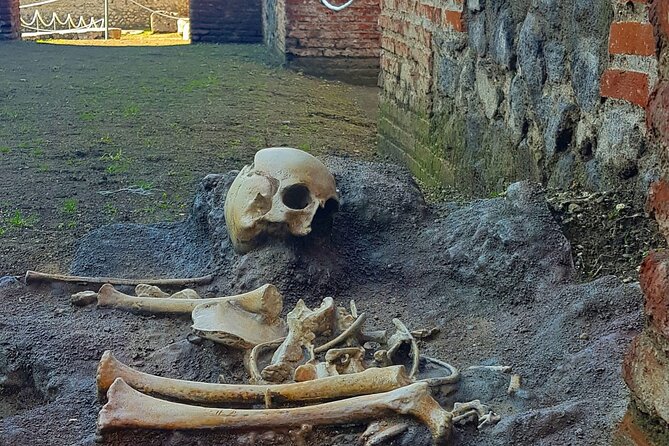
The tour begins at the Piazza Esedra side of Pompeii. The meeting instructions refer to the area near Coffee Shop Vittoria, with the ticket redemption point listed at Tour & Audio Guide, Piazza Esedra 2. The start information also lists Travelcampania at Via Plinio 107, so I would check the exact meeting point carefully before setting out.
That small bit of planning matters. Pompeii has more than one entrance, and arriving at the wrong side can mean an unnecessary walk. Give yourself time to find the guide, especially if you are coming by train, car, or local transport.
Once the group is together, the guide purchases or redeems the entrance tickets. You do not need to spend your visit sorting out admission at the gate. The skip-the-line service is most useful when queues are long, though it does not mean you skip the security process or walk straight into every area without waiting.
The tour ends at the Forum entrance on Via Villa dei Misteri. You can leave with the guide, or stay inside the archaeological park after the guided portion. That second option adds flexibility, even though the two-hour guided route itself is fixed.
More Pompeii excavation visits:
- Pompeii: Entry Ticket and Guided Tour with an Archaeologist
★ 4.8 · 19,459 reviews - Pompeii: Entry Ticket with Optional Audio Guide
★ 4.2 · 12,360 reviews - Pompeii: Small Group Tour with an Archaeologist
★ 4.8 · 12,264 reviews
The Amphitheater and Teatro Grande
The opening section includes Pompeii’s performance spaces, including the Amphitheater and Teatro Grande. These places help you picture public life in the ancient city before you move into the private houses and religious center.
The Amphitheater is especially useful as an early stop because it shows the scale of Roman entertainment. You are not simply looking at a ruin. You are seeing a purpose-built public venue within a city that once had its own rhythm of shows, gatherings, commerce, and politics.
Teatro Grande offers a different view of Pompeii. It points to the city’s theatrical culture and gives the guide a chance to explain how public spaces worked. A short guided visit cannot cover every detail, but these early stops establish that Pompeii was a living city, not merely a place frozen by disaster.
The exact sequence may vary depending on site conditions and the guide’s judgment. The important point is that the route begins with major public buildings before moving through streets and homes.
Roman homes, frescoes, and daily life
The private houses are among the strongest parts of the visit. Pompeii’s domus can reveal more than grand architecture. Their rooms, wall paintings, courtyards, and surviving objects offer clues about status, taste, family life, and household routines.
You will see frescoes and perfectly preserved everyday objects during the walk. These details make the site personal. A Forum can tell you how a city organized public life, but a painted wall or household object helps you think about the people who used the rooms.
The guide’s role is important here. Without context, it is easy to hurry through one house after another, noticing only the colors on the walls. With an archaeologist explaining what you are seeing, the frescoes become evidence of Roman culture and design rather than decoration alone.
The short schedule means you should not expect to linger in every house. If a particular room catches your eye, make a note of it and ask the guide a direct question. You can return to selected areas after the tour if they remain accessible and you have enough time.
Via dell’Abbondanza, Pompeii’s main street experience
Via dell’Abbondanza is one of the most useful parts of the route because it lets you walk through Pompeii at street level. This is where the city feels most like a place of work and movement.
The ancient road connects many of the buildings you visit. As you walk along it, the guide can link homes, public facilities, shops, and civic buildings into a larger picture. The value is not just the road itself. It is the sense of how people moved through their neighborhood.
A two-hour tour benefits from this kind of connecting route. Instead of visiting isolated monuments, you move through the city in a way that helps you understand its layout. You also get a practical sense of the walking involved. Pompeii is not a quick indoor attraction. It is an extensive outdoor archaeological site.
Wear comfortable shoes and be ready for steady walking. The tour information recommends moderate physical fitness, which is a fair warning. The visit is manageable for many people, but it is not a seated activity, and ancient streets can make walking slower than it would be on a modern pavement.
More tours led by an archaeologist:
- Pompeii Small Group Tour with an Archaeologist
★ 5.0 · 6,593 reviews - Pompeii and Herculaneum Small Group Tour with an Archaeologist
★ 5.0 · 1,350 reviews - Skip the Line Guided Tour of Pompeii led by an Archaeologist
★ 5.0 · 703 reviews - Pompeii: Exclusive Tour with Archaeologist and Entry Tickets
★ 4.9 · 634 reviews
The Stabian Baths and the Lupanare
The Stabian Baths show how important public bathing was in Roman urban life. The bath complex gives the guide another way to explain public amenities, social habits, and the difference between private and shared spaces.
The Lupanare, or ancient brothel, is one of Pompeii’s most famous stops. It attracts attention because of its subject matter, but it is also useful for understanding ordinary commercial life in the city. The small rooms and surviving painted images make the stop memorable, though some visitors may find the material frank.
This is one reason a guide helps. You get historical explanation rather than a quick look at a controversial site. The guide can place the Lupanare within Pompeii’s wider social and economic setting without turning the visit into a spectacle.
Because the route includes both the baths and the Lupanare, you see two very different kinds of public and semi-public space. That contrast helps make the tour feel varied, even within a short timeframe.
The Forum, Basilica, and the city’s final moments

The Forum is the natural center of Pompeii’s civic world. It is also where the tour’s different threads come together. After seeing streets, houses, baths, and entertainment spaces, you reach the area where public, religious, and commercial life met.
Nearby, the Basilica adds another layer to the city’s civic organization. The guide can explain the function of these buildings and show you how Pompeii’s public center related to the surrounding streets.
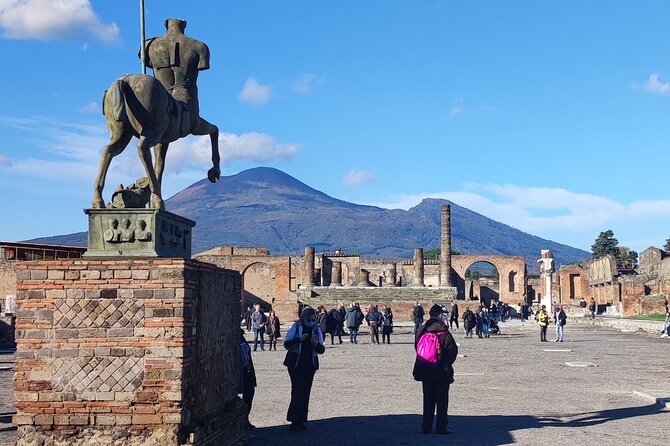
The tour also connects the site to the eruption of Vesuvius in 79 AD. You will hear about the final moments of the city and see how the remains preserve an abrupt interruption of daily life. The strongest interpretation avoids treating Pompeii as a simple disaster story. The buildings and objects first show a functioning Roman community, then reveal how suddenly that life ended.
That balance is one of the reasons to choose a guided visit. You learn about the people and their routines before confronting the casts and the destruction. The emotional effect is stronger when the site has already become a city in your mind.
The 1863 casts and the human side of Pompeii
The tour includes the first casts made in 1863 by architect Giuseppe Fiorelli. These casts are among the most affecting parts of Pompeii, since they preserve the shapes of people caught by the eruption.
The casts can be difficult to view. They are not just archaeological objects. They force you to think about the speed and violence of the disaster, and about the individual lives behind the ancient streets.
Fiorelli’s work also matters from an archaeological point of view. The casts show how excavation methods helped recover details that would otherwise have disappeared. Your guide can connect the casts to the wider process of uncovering Pompeii and interpreting what the ruins reveal.
Expect this stop to change the tone of the walk. The earlier sections focus on architecture, public life, and household details. The casts bring the human cost into view.
What two hours really gives you
Two hours is enough for an organized first look, especially if Pompeii is one stop within a larger Italian trip. You get the main landmarks, a guide’s explanations, and a route that avoids the confusion of wandering through the site without a plan.
It is not enough for a complete visit. Pompeii contains far more streets, houses, public buildings, and objects than any short tour can cover. If you want a slow archaeological study, time for repeated visits, or an extensive look at smaller areas, you will need additional time beyond this experience.
I see the two-hour length as both a strength and a limit. It keeps the tour focused and makes it easier to fit into a busy day. It also means the guide must keep moving, and you may have to choose between listening closely and taking photographs.
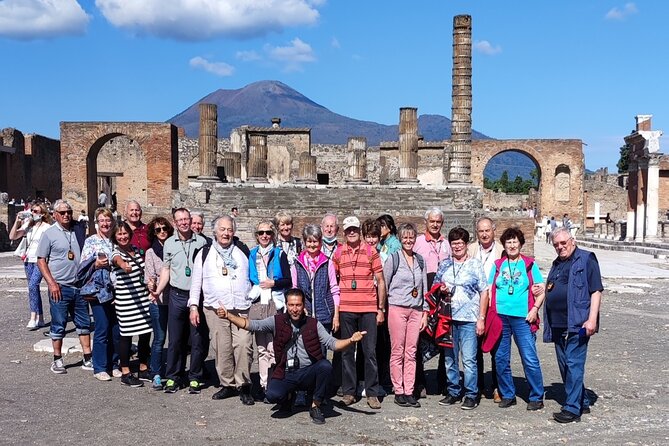
The group can reach 25 people. That is not a private tour, so the experience will depend partly on staying near the guide. A smaller group might offer more time for questions, but this format can work well if you want a lower price and a clear route through the main sights.
Is $57.84 a fair price?
At $57.84 per person, this is not the cheapest way to enter Pompeii. You are paying for more than admission, though. The price includes skip-the-line service and an archaeologist-led walk through the site, which can be worthwhile when you have limited time or want help making sense of the ruins.
The value is strongest for first-time visitors. Pompeii is large, and its remains do not always explain themselves. A guide can show you why a bath complex matters, what makes a house significant, how the Forum fits into the city, and why the casts are important.
The value is weaker if you already know the site well or prefer to explore independently. You may find the two-hour route too short for the cost if your main goal is quiet, unhurried sightseeing.
A simple way to judge it is to ask what you would otherwise do. If you would enter without a plan and spend much of your time trying to identify buildings, the guided format is useful. If you have studied Pompeii and want to set your own pace, admission alone may suit you better.
The current rating is 3.8 out of 5 from five ratings, so the experience is not presented as flawless. Still, the strongest praise centers on the guide’s friendly manner and the amount of information covered in two hours. That is the core reason to book it.
Who will get the most from this Pompeii tour?
I would recommend this tour to you if:
- You are visiting Pompeii for the first time.
- You want the main sights without planning your own route.
- You prefer explanations from an archaeologist rather than an audio guide alone.
- You have only a few hours available.
- You want to understand Roman culture and daily life, not just photograph ruins.
- You appreciate skip-the-line admission and a fixed meeting point.
You may want a longer or more independent visit if you have already seen Pompeii, need frequent rest stops, or want to spend a long time photographing frescoes and architectural details.
The tour is also a practical choice for a day trip from Rome if you are already driving in Italy. The drive can be manageable, but tolls may cost about $40, according to the practical experience included with the tour information. That extra transport cost is separate from the $57.84 tour price, so budget for the full day rather than the ticket alone.
Service animals are allowed, and the site is near public transportation. The activity recommends moderate physical fitness. Those facts make it easier to assess the visit, but they do not remove the need for comfortable footwear and a realistic view of the walking involved.
Cancellation and timing details
You receive confirmation when you book. Free cancellation is available up to 24 hours before the local start time for a full refund.
If you cancel less than 24 hours before the tour, you will not receive a refund. Changes made inside that same 24-hour window are not accepted, so keep your schedule firm once the cutoff approaches.
The tour is booked an average of 34 days in advance. That does not guarantee that every date sells out, but it suggests you should not leave booking until the last moment if your Pompeii visit is tied to a fixed itinerary.
Should you book this Pompeii tour?
Book it if you want a focused introduction to Pompeii, especially on a first visit. The route covers the major public buildings, private homes, frescoes, baths, Lupanare, Forum, Basilica, Via dell’Abbondanza, and Fiorelli’s casts, while an archaeologist gives the ruins a clear human and historical context.
Do not book it expecting a full-day exploration or a private experience. Two hours passes quickly, and a group of up to 25 people may limit personal attention.
For many visitors, the balance is sensible: skip-the-line entry, a friendly guide, and the essential Pompeii route at a midrange price. Arrive at the correct Piazza Esedra meeting point, wear good walking shoes, and keep extra time afterward if you want to explore beyond the guided route.
FAQ
How long does the Pompeii tour last?
The tour lasts approximately two hours.
What sights are included?
The route includes the Amphitheater, Teatro Grande, Roman houses with frescoes, Via dell’Abbondanza, the Stabian Baths, the Lupanare, the Forum, the Basilica, and the first casts made in 1863 by Giuseppe Fiorelli.
Is admission to Pompeii included?
Yes. Admission to the archaeological site is included, and the tour provides skip-the-line entry.
Where does the tour start?
The meeting area is near Piazza Esedra and Coffee Shop Vittoria. The listed ticket redemption point is Tour & Audio Guide at Piazza Esedra 2, Pompeii. Travelcampania at Via Plinio 107 is also listed, so confirm the precise meeting spot before departure.
Where does the tour end?
The listed end point is the Forum of Pompeii at Via Villa dei Misteri 2. You may stay inside the archaeological park after the guided tour if you prefer.
Can I cancel for a full refund?
Yes. You can cancel at least 24 hours before the local start time for a full refund. Cancellations or changes made less than 24 hours before the start are not accepted for a refund.
More Skip the Line in Pompeii Ruins
- Pompeii: Skip-the-Line Entrance Ticket with Audio Guide
★ 4.0 · 2,509 reviews - Sorrento: Skip-the-Line Pompeii Express Tour by Train
★ 4.8 · 2,038 reviews - Pompeii: Skip-the-line-Ticket and Guided Tour
★ 4.6 · 1,152 reviews - Pompeii: Guided Tour with Skip-the-Line Entry
★ 4.9 · 812 reviews
Newest reviews from Pompeii Ruins
- Private Tour Pompeii and Winery★ 5.0 · 4 reviews
- Visit the Pompeii ruins from Salerno with Pizza Lunch★ 5.0 · 4 reviews
- Pompeii Private Tour for Kids and Their Families★ 4.8 · 4 reviews
- From Sorrento: Pompeii & Vesuvius tour small group★ 4.8 · 4 reviews
- Pompeii Sorrento and Positano Tour★ 5.0 · 4 reviews
- From Naples_ Pompeii Tour_Skip the line ticket + audioguide★ 4.3 · 4 reviews
- Pompeii, skip-the-line ticket with smartphone audio guide on App★ 3.0 · 4 reviews
- Pompeii Private Half-Day Tour from: Naples,Sorrento, Amalfi Coast★ 5.0 · 4 reviews
Archaeologist-Led Tours, compared.

Entry Ticket and Guided Tour with an Archaeologist
Read our review →
Pompeii Small Group Tour with an Archaeologist
Read our review →
Pompeii and Herculaneum Small Group Tour with an Archaeologist
Read our review →
Skip the Line Guided Tour of Pompeii led by an Archaeologist
Read our review →
Exclusive Tour with Archaeologist and Entry Tickets
Read our review →
Pompeii Private Tour with an Archaeologist and Skip The Line – 3 hours
Read our review →
Pompeii Skip-the-line Tour with Archaeologist Guide
Read our review →Browse the lists this tour appears in