
Reviewed · SKIP THE LINE
Skip-the-Line Pompeii Guided Tour from Sorrento
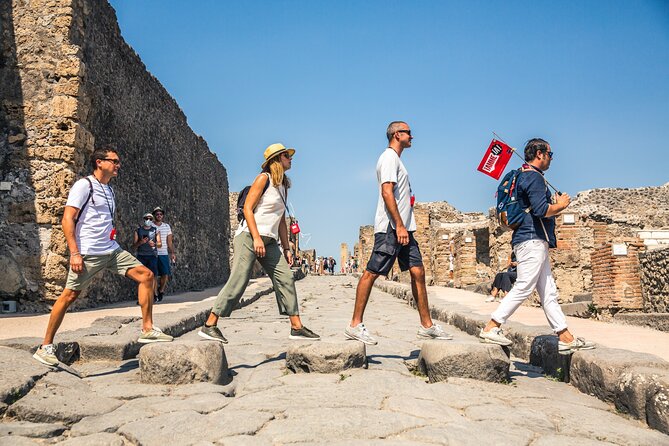
Pompeii is not a tidy museum. It is a huge Roman city of broken paving stones, shop counters, courtyards, baths, theaters, and homes, all spread across a site that can quickly overwhelm you. This five-hour tour from Sorrento gives you a clear route through the most important areas before you lose your bearings.
I like the air-conditioned coach, which takes the sting out of the trip from Sorrento, and the included skip-the-line entry, especially for an early visit. Guides such as Luisa, Lulu, Lucio, Roberta, and Patricia have been praised for turning walls and paving stones into stories about ordinary Roman life.
The tradeoff is time. You get a brisk guided look rather than a full day at Pompeii, and the ancient surfaces are hard going. If you need frequent rests or want to explore every open house at your own pace, this may feel too fast.
In This Review
- Key points to know before booking
- Why a guide makes Pompeii easier to understand
- From Piazza Tasso to Pompeii by coach
- Entering the Archaeological Park of Pompeii
- The Forum and the Temple of Jupiter
- Macellum, Basilica, and the business of daily life
- Via dell’Abbondanza and the Stabian Baths
- The Lupanar, Pompeii’s most talked-about stop
- The House of the Faun and elite Pompeii
- Teatro Grande and the end of the route
- What the $90.70 price really buys
- Walking conditions and who should choose it
- Should you book this Pompeii tour from Sorrento?
- FAQ
- Where does the Pompeii tour depart from in Sorrento?
- Where does the tour end?
- How long does the experience last?
- Is transportation included?
- Is Pompeii admission included?
- Does the tour include skip-the-line access?
- Is the tour offered in English?
- Are food and drinks included?
- Is the tour suitable for people with mobility issues?
Key points to know before booking
- Early morning departures beat the worst heat and crowds, with the 7:30 a.m. option especially useful.
- The coach leaves from central Sorrento, at IAMME IA! Gray Line Amalfi Coast on Piazza Torquato Tasso.
- The guided route covers major Pompeii landmarks, including the Forum, Lupanar, House of the Faun, Stabian Baths, and Teatro Grande.
- The ground is uneven, with ancient stones, steps, and inclines that require steady walking.
- The group can reach 29 people, so headphones are supplied in Pompeii when more than 10 people join.
- The $90.70 price includes transport, guide, entry, and skip-the-line access, but not food or drinks.
Why a guide makes Pompeii easier to understand
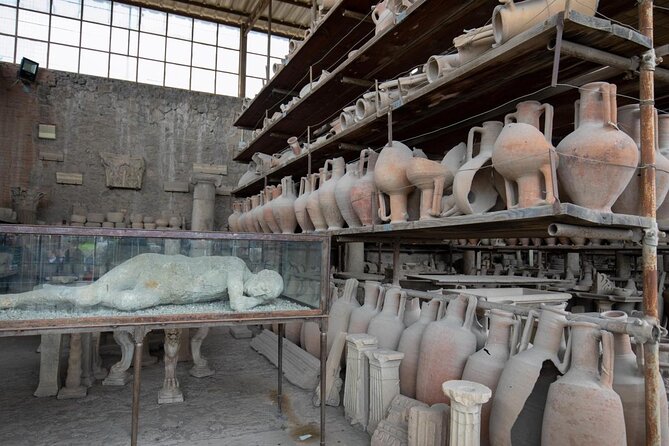
Pompeii can look like a pile of old stone if you do not know what you are seeing. A guide helps you recognize the difference between a public square, a bakery or shop, a bath complex, a private mansion, and a religious building.
The best guides on this route do more than recite dates. Lulu, also called Luisa, has been praised for using humor and stories to keep families engaged. Lucio has been noted for pointing out unusual details while keeping the group moving. Roberta and Patricia have also earned praise for clear explanations and careful attention to questions.
The quality can vary because the local guide in Pompeii may not be the same person who accompanies you from Sorrento. One guide may stop often and explain each feature in detail. Another may walk while talking, which can be hard if you fall behind. Stay near the guide, especially in crowded passages, and tell the escort early if you need a slower pace.
For a first visit, I consider the guided format a good use of time. You see the main sights in roughly two hours inside the park, with someone explaining why they matter. You will not see everything, but you are less likely to leave wondering what you just walked past.
More Pompeii excavation visits:
- Pompeii: Entry Ticket and Guided Tour with an Archaeologist
★ 4.8 · 19,459 reviews - Pompeii: Entry Ticket with Optional Audio Guide
★ 4.2 · 12,360 reviews - Pompeii: Small Group Tour with an Archaeologist
★ 4.8 · 12,264 reviews
From Piazza Tasso to Pompeii by coach
The meeting point is easy to find in the center of Sorrento: IAMME IA! Gray Line Amalfi Coast, Piazza Torquato Tasso 16. The activity ends at the same point, so you do not need to arrange a separate return ride.
The round-trip vehicle is air-conditioned, a welcome feature in Campania, where a sunny day can feel punishing on exposed ruins. Several departures are offered, including morning and afternoon times. I would choose the earliest practical departure. The early start can put you inside Pompeii before the site becomes more crowded, and it leaves more of the day open in Sorrento.
The coach is a practical part of the package, not just a ride tacked onto the ticket. Driving yourself means dealing with traffic, parking, and directions. Public transport can work, but the organized transfer keeps the day simple and returns you to the same central location.
The vehicle may be full, and the maximum group size is 29 people. That is not an intimate private tour. Still, it is small enough to move through the site as one group, and headphones are provided in Pompeii for groups larger than 10 so you can hear the guide more clearly.
Allow a little patience for the road. Sorrento and Pompeii are close in the broad sense, but local traffic can affect the transfer. The company has received praise for punctual pickup and capable drivers, including Giuseppe, Rosario, and Vincenzo. Exact staff members can change, so treat those names as examples, not a promise.
Entering the Archaeological Park of Pompeii
Skip-the-line entry is most useful at the entrance, where waiting outside in the sun can drain your energy before the walking even begins. This tour includes the Pompeii Archaeological Site admission and takes you directly inside through the organized entry arrangement.
The park is enormous. The route described here focuses on major public buildings, a few famous houses, the main commercial street, the baths, and the theater area. Inside time is listed at about two hours, though some accounts describe closer to 90 minutes of actual guiding. That difference matters if you are hoping to roam widely.
Think of this as a well-planned introduction, not a complete survey. You will get the city’s main themes: public life in the Forum, business and food along Via dell’Abbondanza, bathing and social customs at the Stabian Baths, private wealth at the House of the Faun, and entertainment at Teatro Grande.
There are breaks for toilets and a snack at the beginning and end of the visit. Food and drinks are not included, so bring money or your own supplies according to your plans. Do not count on a long sit-down meal during the Pompeii portion.
The Forum and the Temple of Jupiter
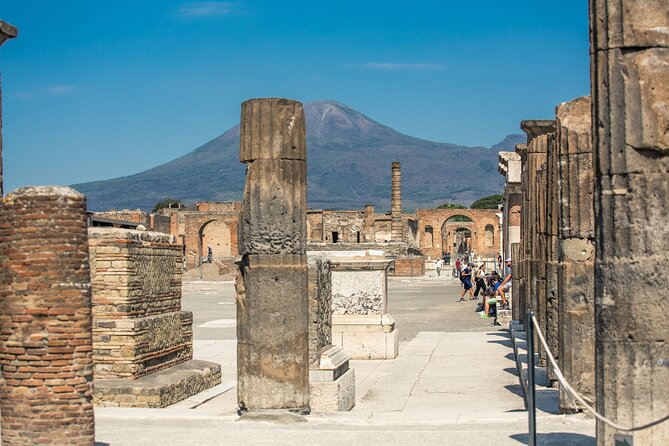
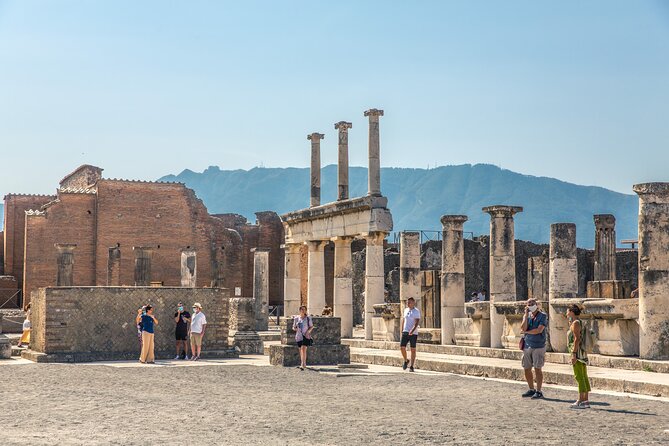
The Civil Forum is the natural starting point for understanding Pompeii. This broad public center gathered administration, justice, trade, markets, and worship in one place. It was the city’s main stage, where public business and religious life met.
From here, the Temple of Jupiter dominates the north end, with Mount Vesuvius behind it. That view gives the site its sharpest sense of place. The volcano is not just a scenic backdrop. Its eruption in 79 A.D. buried the city under ash and pumice, preserving the remains that you are now walking through.
The temple was remodeled after Pompeii became a Roman colony in 80 B.C. It became a Capitolium dedicated to Jupiter, Juno, and Minerva, echoing the major temple in Rome. A guide can help you read the layout and understand how imposing this building would have looked in its setting.
The Forum is also a good place to listen for the guide’s broader explanation of the eruption and the city’s final years. Without that context, the columns and foundations can blur together. With it, you begin to see Pompeii as a functioning city rather than a collection of ruins.
More Sorrento tours worth comparing
- Pompeii: Skip-the-Line Entrance Ticket with Audio Guide
★ 4.0 · 2,509 reviews - Sorrento: Skip-the-Line Pompeii Express Tour by Train
★ 4.8 · 2,038 reviews - Pompeii: Skip-the-line-Ticket and Guided Tour
★ 4.6 · 1,152 reviews - Pompeii: Guided Tour with Skip-the-Line Entry
★ 4.9 · 812 reviews
Macellum, Basilica, and the business of daily life
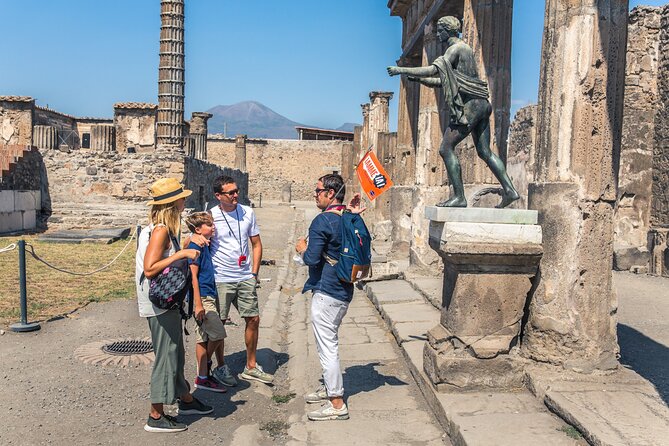
The Macellum was a market complex built around a four-sided portico. It included a raised worship hall and rooms connected with the imperial cult, showing that commerce and loyalty to the emperor could share the same public space.
A large room with a masonry counter may have been used for selling fish. That small detail helps make the ancient city feel practical and familiar. Pompeii was not only temples and grand houses. It was also food, trade, meetings, transactions, and people buying what they needed.
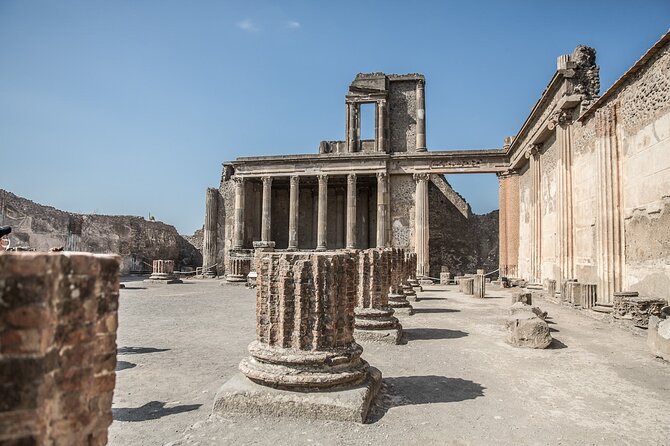
Nearby, the Basilica served business and the administration of justice. At about 1,500 square meters, it was the Forum’s most sumptuous building. The walls may now be incomplete, but the scale gives you a sense of how much effort Pompeii put into public institutions.
I like this part of the route because it moves beyond the familiar tragedy of the eruption. You see the city working. A good guide connects the large buildings to the people who used them, from merchants and officials to worshippers and customers.
Via dell’Abbondanza and the Stabian Baths
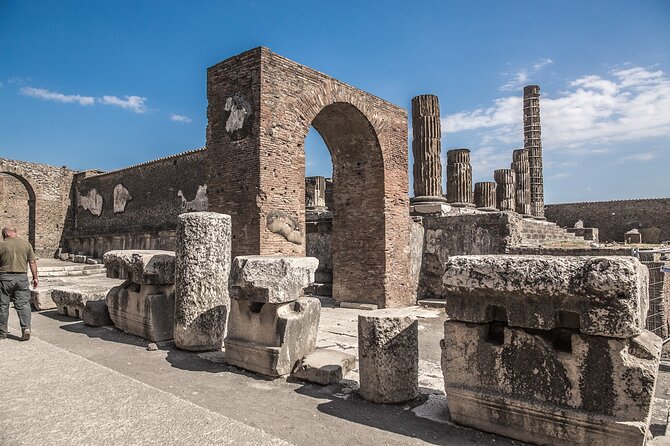
Via dell’Abbondanza was Pompeii’s main east-west street, running from the Forum toward Porta Sarno. In ancient times, it was lined with shops, workshops, cafés, snack bars, and places selling food and drink.
The ten-minute stop listed for this street is short, but it is enough to notice the wheel ruts and the practical shape of ancient storefronts. The paving is uneven, and stepping across the stones takes care. Wear firm shoes with good soles. Sandals that are fine on Sorrento’s promenade may feel foolish here.
The Stabian Baths show how Roman public bathing worked. Men’s and women’s areas had separate entrances, and the men’s section included rooms for changing, cold baths, medium-temperature bathing, and hot bathing. The complex dates to the period after Sulla’s veterans founded the Roman colony in 80 B.C.
An earthquake in 62 A.D. damaged the baths heavily, decades before Vesuvius erupted. That detail adds another layer to Pompeii’s story. The city was already repairing and rebuilding when the volcano ended life there.
The baths are especially useful if you want to understand Roman comfort and engineering. They were social spaces as well as places to wash. Your guide can point out how the rooms related to one another, something that is easy to miss when you walk through without a plan.
The Lupanar, Pompeii’s most talked-about stop
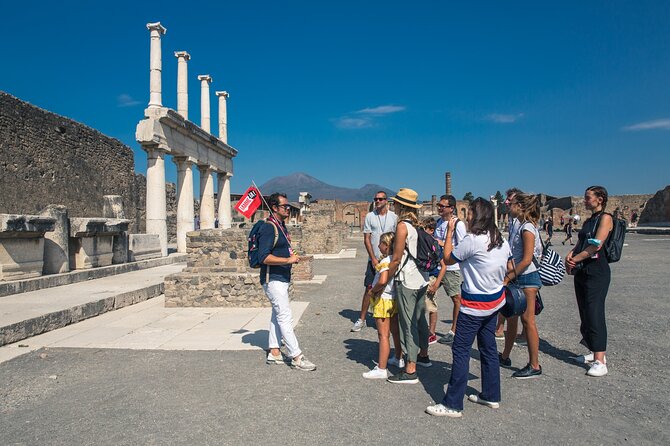
The Lupanar is Pompeii’s official brothel and one of the site’s most famous buildings. It is small, with five rooms on the ground floor, built-in masonry beds, erotic frescoes above the doors, and graffiti left by ancient customers.
The paintings may have acted as a visual guide to the services offered. The graffiti gives a rough, personal glimpse into the language and social life of ordinary Roman people. It is easy to treat the building as a sensational stop, but the details also reveal how historians piece together daily life from modest evidence.
The house was linked to Quintus Poppaeus Sabinus of the Poppei family, related to Poppea Sabina, Nero’s second wife. Your guide may explain that connection while placing the building within the wider social structure of Pompeii.
This stop can be crowded, and the narrow rooms are not a place to linger alone. The tour allows about ten minutes here, so listen closely and move with the group. Families should decide in advance how much explanation suits their children, although the broader tour has worked well for children of different ages.
The House of the Faun and elite Pompeii
The House of the Faun occupies a full city block and ranks among Pompeii’s largest private residences. Its name comes from the bronze statue of a dancing faun found in the main atrium.
The house reflects the wealth of Pompeii’s elite. Two peristyle gardens and detailed floor mosaics show how private homes could be designed for display as well as family life. The most famous artwork associated with the house is the Alexander Mosaic, depicting Alexander the Great fighting Darius III of Persia.
This is one of the places where a guide adds real value. You can see a grand atrium and garden layout, but an explanation helps you understand how architecture, art, and status worked together. The house also provides a useful contrast with the shops and smaller rooms along Via dell’Abbondanza.
Do not assume every artwork or room will be open on every visit. The route includes the House of the Faun, but site access can vary. Enjoy the overall plan and mosaics rather than expecting to inspect every famous detail at close range.
Teatro Grande and the end of the route
The Large Theater uses a natural depression in the hillside to form its auditorium. The seating was divided into five sectors, and performances included tragedies from Greek and Roman traditions.
This is a strong final stop because it shifts the mood from business and private life to public entertainment. Pompeii had a culture of theater, and the building helps show the city as a place where people gathered for shared experiences, not simply a town frozen by disaster.
The theater stop lasts about ten minutes. That is enough for an explanation and photographs, but not for a long independent wander. Afterward, the coach returns you to Sorrento.
What the $90.70 price really buys
At $90.70 per person, this is not the cheapest way to enter Pompeii. You are paying for more than admission: round-trip transport from central Sorrento, an official Pompeii guide, skip-the-line access, and the ease of getting back to the center without arranging your own transport.
The value is strongest if you want a half-day outing with little planning. You avoid parking problems, reduce the chance of taking the wrong train or bus, and get a route through the site’s most important areas. For a first visit, the guide can make the difference between seeing a Roman city and simply walking among old walls.
The value is weaker if you already know Pompeii well or want several hours of solo exploration. The guided portion keeps moving, and one account specifically found there was no free time to return to favorite spots or visit the bookstore.
Group discounts may be available, which could make the cost more appealing for families or larger parties. The tour is offered in English, though the guide may be multilingual. Confirm the language arrangement when booking if clear English commentary is essential for your group.
Walking conditions and who should choose it
Pompeii requires steady walking over rough ground. Expect uneven ancient paving, steps, inclines, and surfaces that can be slippery or awkward in poor weather. The site is not wheelchair accessible, and anyone with mobility concerns should take the warning seriously.
Guides may help with rests and try to keep a slower group member included, but they cannot smooth the roads or change the size of the site. If you have difficulty walking for two hours on uneven stone, an indoor museum may suit you better than this route.
For families, the format can work well. The stories, theaters, bathhouses, and Lupanar give children different ways into the subject, and the coach removes much of the day’s travel hassle. Plan for the early departure if your children can manage it, since cooler conditions and lighter crowds make the visit easier.
Bring comfortable shoes, water, sun protection, and a small snack. The tour does not include food or drinks, and exposed sections of Pompeii offer little relief from the sun. The early morning option is the practical choice in warm weather.
Should you book this Pompeii tour from Sorrento?
Book it if you want Pompeii explained by a guide, prefer organized transport, and are satisfied with a focused two-hour look at the major sights. The central meeting point, air-conditioned coach, skip-the-line entry, and early start make this a sensible choice for a busy Sorrento itinerary.
Choose another option if you need a slow pace, step-free access, or a full day to explore independently. Pompeii rewards extra time, and this tour gives you an introduction rather than every street and house.
Free cancellation is available up to 24 hours before the start time for a full refund. Changes or cancellations made inside that window are not accepted, so check your plans before the cutoff.
FAQ
Where does the Pompeii tour depart from in Sorrento?
It departs from IAMME IA! Gray Line Amalfi Coast at Piazza Torquato Tasso 16, in central Sorrento.
Where does the tour end?
The activity ends back at the meeting point in Sorrento.
How long does the experience last?
The full experience lasts approximately five hours, including the journey between Sorrento and Pompeii.
Is transportation included?
Yes. Round-trip transportation in an air-conditioned vehicle is included.
Is Pompeii admission included?
Yes. Entry to the Pompeii Archaeological Site is included in the price.
Does the tour include skip-the-line access?
Yes. Skip-the-line access is included, allowing the group to head inside without using the standard admission line.
Is the tour offered in English?
Yes. The tour is offered in English, although the guide may be multilingual.
Are food and drinks included?
No. Food and drinks are not included. The schedule allows time for a snack and facilities around the Pompeii visit.
Is the tour suitable for people with mobility issues?
The site has uneven ancient stones, steps, and inclines, and the tour is not wheelchair accessible. Most people can participate, but anyone who struggles with rough walking surfaces should consider a more accessible option.
Newest reviews from Sorrento
- Private Stress-Free Tour from Sorrento: Ischia Island & Tastings★ 5.0 · 4 reviews
- Tour in the ruins of Pozzuoli with an archaeolgist.★ 5.0 · 4 reviews
- Vico Equense: Authentic Cooking Class at a Local’s Home★ 5.0 · 4 reviews
- Private Tour Pompeii and Winery★ 5.0 · 4 reviews
- Lemon Experience with Limoncello demonstration★ 5.0 · 4 reviews
- Path of the Lemons★ 5.0 · 4 reviews
- Positano Private Tour By Night from Sorrento★ 5.0 · 4 reviews
- Walking Secret Food Tours Sorrento with tastings★ 4.5 · 4 reviews
Skip the Line, compared.

Skip-the-Line Entrance Ticket with Audio Guide
Read our review →



Skip-the-Line Entry Ticket with Digital Guide App
Read our review →
Pompeii Ruins Private Tour with Optional Skip-the-Line Entry
Read our review →
Skip the Line Guided Tour of Pompeii led by an Archaeologist
Read our review →
Pompeii Private Tour with an Archaeologist and Skip The Line – 3 hours
Read our review →Browse the lists this tour appears in