
Reviewed · ARCHAEOLOGIST-LED TOURS
Pompeii Private Tour with an Archaeologist and Skip The Line
Pompeii is too large and too layered to understand from a map alone. In two hours, this private tour takes you from the theaters and baths to the Forum, gladiator barracks, brothel, casts, and Casa del Fauno, with an archaeologist explaining what each place meant in daily Roman life.
I like the private format, which lets your guide adjust the pace and focus on your family’s interests. I also like the practical help before arrival, including the official ticket link and meeting instructions. The main drawback is important: site admission is not included, so you pay €19 per adult in addition to the tour price, and you need to arrange the ticket to make the skip-the-line promise useful.
In This Review
- Key points to know before booking
- What the €375 private price really buys
- Meeting at Piazza Esedra
- Beginning with the theaters
- Walking Via dell’Abbondanza
- The Granaries and the casts
- The Stabian Baths and Roman leisure
- The Forum, Basilica, and temples
- The Lupanar and what to expect
- Casa del Fauno and Pompeian wealth
- The private guide makes the difference
- Timing, crowds, and weather
- Who should book this Pompeii tour?
- Should you book it?
- FAQ
- Is Pompeii admission included in the tour price?
- How does skip the line work?
- How long is the Pompeii tour?
- How many people can join the private tour?
- What language is the tour offered in?
- What happens if bad weather cancels the tour?
Key points to know before booking
- Two hours covers Pompeii’s main highlights: You see the Forum, Basilica, temples, baths, theaters, fast-food counters, shops, brothel, gladiator area, casts, and Casa del Fauno.
- The tour is private for your group: Up to 10 people can join, with no unrelated group added.
- An archaeologist leads the visit: Guides connected with the experience include Eliana Sandretti, Luisa, Viktoria, Antonio, Raffaele, and others.
- Buy the entrance ticket separately: Adults pay €19, while children under 18 enter free with identification.
- Skip-the-line requires preparation: You receive a link before the tour so you can buy your ticket online and avoid the ticket-office queue.
- Late-day visits can be appealing: A 5 p.m. departure was praised for lighter crowds and less summer heat, although you should confirm the exact time available when booking.
What the €375 private price really buys
The listed price is $375.05 per group of up to 10 people. That can look steep beside a basic shared walking tour, but the calculation changes if you are a larger family or group. Ten people would bring the guiding cost to about $38 per person before admission. For two people, the price is much harder to justify unless you place a high value on private attention and a tightly planned visit.
The fee pays for an authorized guide and an archaeologist-led experience, not transportation, meals, or Pompeii admission. You also receive assistance before the visit and a link for purchasing the official entrance ticket. That support matters in high season, when arriving without a ticket can cost you precious time.
There is one point you should read carefully. The tour is advertised as skip the line, but the €19 admission ticket is separate. If you buy online before arrival, the guide can help you bypass the ticket-office queue. If you wait to buy on the spot, you may still face a ticket line before entering. The wording has caused confusion, so treat the ticket purchase as part of your preparation, not as an included service.
Children under 18 enter free, but they should bring a passport or other identification because their date of birth may be checked. That can make the total cost more reasonable for a family with children.
More Pompeii excavation visits:
- Pompeii: Entry Ticket and Guided Tour with an Archaeologist
★ 4.8 · 19,459 reviews - Pompeii: Entry Ticket with Optional Audio Guide
★ 4.2 · 12,360 reviews - Pompeii: Small Group Tour with an Archaeologist
★ 4.8 · 12,264 reviews
Meeting at Piazza Esedra
The meeting point is Piazza Esedra, 10, in Pompei. The tour ends back at the same location. The meeting point is near public transportation, and confirmation arrives when you book.
Some guides meet the group with a sign showing the booking name, which can make the first encounter simple in a crowded area. You should still allow time to reach the meeting point and have your tickets ready. The operator sends a link and practical information before the tour, and you can contact the company if you want to purchase the ticket several days in advance rather than waiting for the link sent the day before.
The tour is offered in English. It normally runs in one language, though a multilingual tour can be arranged only on request. If your group needs another language, ask before booking rather than assuming it will be available.
Beginning with the theaters
The itinerary opens with Pompeii’s theaters, starting with the Small Theater, or Odeion. This is a good first stop because it gives you an immediate sense of Roman entertainment and building skill. Your guide explains how the theater was designed for clear acoustics, helping you understand that these ruins were not just decorative stone walls. They were working public spaces built for an audience.
You then visit the Great Theater, the site’s main theater. The stop lasts about 15 minutes. The Great Theater is one of the most important structures in Pompeii, and it helps set the scale of public life in the city. With only two hours, the guide will not linger over every architectural detail, but the private setting gives you a chance to ask about the performances, the structure, and how the theater fit into Pompeii’s civic life.
The nearby Quadriporticus of the theaters leads to the gladiator barracks. Here, you see the apartments and training area linked with gladiators. This stop works well for families and younger visitors because it connects the empty rooms with a clear human story: people lived, trained, and prepared for public combat in this part of the city.
Walking Via dell’Abbondanza
Via dell’Abbondanza is Pompeii’s main street, and crossing it links several of the tour’s most useful stops. Along the way, you see shops, food counters, and other signs of ordinary commerce.
The fast-food counters are especially helpful for picturing daily life. They show that Pompeii was not only a city of temples and wealthy houses. People bought meals, worked in shops, visited public baths, and moved through streets that were built for constant use. Your guide can point out details that are easy to pass without context, including the difference between a grand residence and a working commercial space.
A two-hour route cannot cover every street. Pompeii is vast, and even a full day leaves plenty unseen. The value here is selection. A strong guide chooses sites that explain public life, private wealth, religion, entertainment, and death without sending you aimlessly across the ruins.
More tours led by an archaeologist:
- Pompeii Small Group Tour with an Archaeologist
★ 5.0 · 6,593 reviews - Pompeii and Herculaneum Small Group Tour with an Archaeologist
★ 5.0 · 1,350 reviews - Skip the Line Guided Tour of Pompeii led by an Archaeologist
★ 5.0 · 703 reviews - Pompeii: Exclusive Tour with Archaeologist and Entry Tickets
★ 4.9 · 634 reviews
The Granaries and the casts
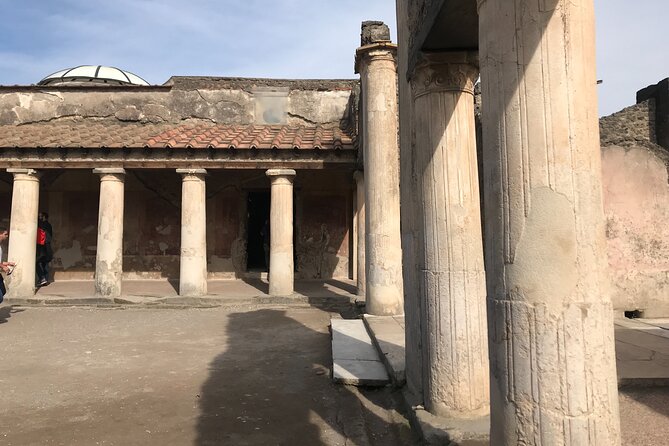
At the Granaries of the Forum, you see casts of people who died in the eruption of 79 AD. You also see an archaeological store of amphorae and work tools. The location combines personal tragedy with evidence of the city’s material life.
The casts can be emotionally difficult. They are not simply dramatic objects for photographs. They make the eruption personal and remind you that Pompeii was a living city whose residents had little time to escape. A good guide helps place the casts in context and keeps the stop respectful.
The amphorae and tools add another layer. They show how archaeologists read a site through objects as well as buildings. You are looking at the remains of storage, trade, labor, and household activity, not just a frozen street scene.
The Stabian Baths and Roman leisure
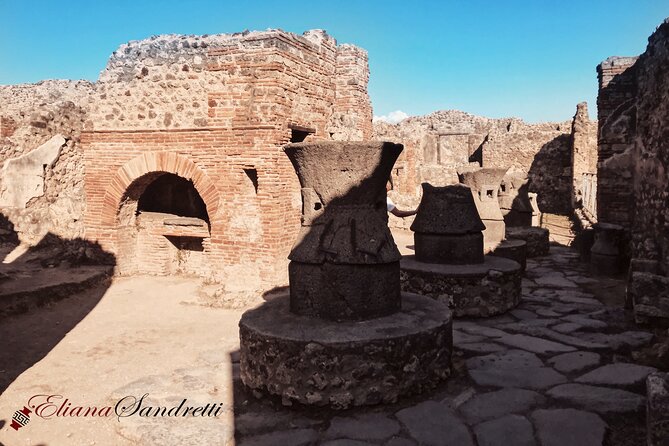
The Stabian Baths are presented as Pompeii’s finest spa complex. The 15-minute stop gives you a look at one of the most social parts of Roman life.
Public baths were places to wash, exercise, talk, and spend time with other people. The baths help correct the common picture of Pompeii as a city made only of villas and temples. Here, the focus shifts to public comfort and routine.
Because the baths are a major stop, you should ask questions if you are interested in Roman engineering or social customs. The guide can adapt the discussion to your group, and that flexibility is one of the better reasons to choose a private tour over a fixed group route.
The Forum, Basilica, and temples
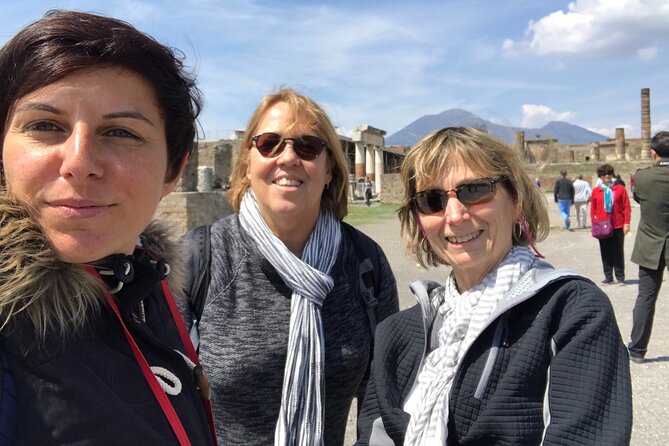
The Forum was Pompeii’s main square, surrounded by markets, temples, and civic buildings. The stop is short, about 10 minutes, so your guide needs to make the space readable quickly.
The Forum can be difficult to grasp at first. Large columns and broken walls do not automatically tell you what happened there. Your guide helps separate religious buildings from civic spaces and explains how the square functioned as the center of public life.
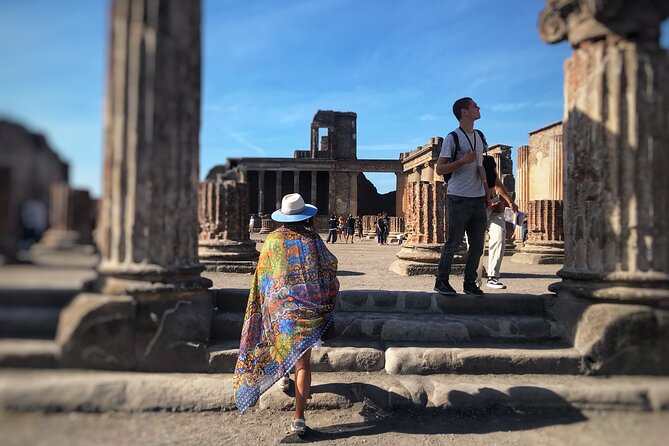
You also visit the Basilica, the ancient court where justice was administered. This is an important contrast with the nearby temples. The Basilica shows the legal and administrative side of the city, while the Forum brings together commerce, religion, and government.
The Temple of Jupiter and Temple of Venus add the religious dimension. The Temple of Jupiter occupied a prominent place in the main square. The Temple of Venus was devoted to the city’s patron divinity. These stops help you see that religion was woven into the city’s public identity rather than kept apart in a separate district.
The Lupanar and what to expect
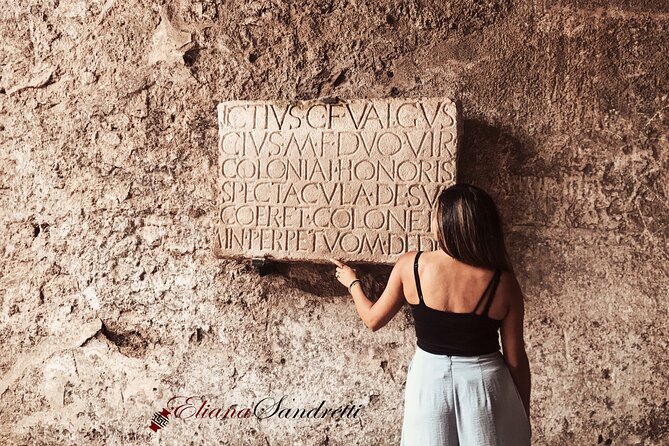
The Lupanar was Pompeii’s brothel, located on the Vicolo del Lupanare. The stop lasts about 15 minutes and is one of the site’s most talked-about locations.
You see the small rooms and erotic imagery associated with the building. It is worth approaching the stop as social history rather than a novelty. The lupanar raises questions about work, class, gender, and the services available in an ancient Roman city.
Parents should decide in advance how they want to handle this section with children. The tour information does not set an age restriction, and most visitors can take part, but the subject matter may not suit every family.
Casa del Fauno and Pompeian wealth
Casa del Fauno is one of Pompeii’s largest and most luxurious residences. The house gives you a sharp contrast with the shops, baths, and public streets seen earlier.
The scale of the residence shows how much space and decoration wealthy families could command. Its name comes from the faun sculpture associated with the house. Your guide can help you read the layout as a home rather than a collection of disconnected rooms, explaining how courtyards, reception areas, decoration, and movement through the house worked together.
This is also a good place to ask about Pompeii’s social divisions. The city’s streets and public buildings served many people, but homes such as Casa del Fauno reveal the resources available to its wealthiest residents.
The private guide makes the difference
The strongest part of this experience is the guide’s ability to shape the route. Guides named in the tour’s feedback include Luisa, Eliana, Raffaele, Viktoria, Antonio, Danilo, Marina, Mattia, Luciana, Francesco, Max, Roberto, and Maria Garzia. You may not receive a particular guide unless the company confirms one, but the repeated strength of the experience is the individual guide’s storytelling and flexibility.
Luisa is associated with routes that avoid heavy crowds while still reaching the main sights. Eliana is praised for archaeological experience and for adjusting the tour around the group’s interests. Viktoria has adapted explanations for children, kept younger family members involved, and sought shady places during hot weather. Luciana has helped older people move at a comfortable pace and used waiting time productively during rain.
These details matter because Pompeii can be tiring. The ground is uneven, the site is exposed, and the distances between major buildings add up. A private guide can slow down, change the order, answer questions, and suggest what to see after the formal two hours.
The experience is not guaranteed to be identical with every guide. One dissatisfied customer found the explanation too casual and wanted the guide to ask more about the group’s background. That is useful advice: at the start, tell your guide what you already know and what you most want to see. If you prefer architecture, archaeology, daily life, or family-friendly stories, say so early.
Timing, crowds, and weather
The standard duration is about two hours. That is enough for the listed highlights, but not enough for a relaxed look at every building. If you want to explore independently afterward, ask your guide for a map and a suggested route. One guide has been praised for marking directions so the group could continue seeing Pompeii after the tour.
Late afternoon may be worth considering in hot months. A 5 p.m. visit in late July was described as cooler and less crowded, with little waiting at the entrance. Conditions vary, so do not treat that time as a guarantee, but it shows why departure time can shape the experience.
The tour requires good weather. If storms cancel the visit, you can choose another date or receive a full refund. For a normal cancellation, you must cancel at least 24 hours before the start time to receive a full refund. Changes made inside that 24-hour window are not accepted.
Who should book this Pompeii tour?
I would consider it for a family, a group of friends, or anyone with only a short time in Pompeii. It is particularly useful if you want the main public buildings and famous private house explained in a clear order instead of wandering with a guidebook.
It also suits repeat visitors. One guide has shown returning visitors areas they missed on an earlier visit, while another has pointed out excavation sections that had recently opened to the public. The exact access depends on what is open during your visit, but local site experience can help you notice more.
I would hesitate if you are a solo visitor on a tight budget, want to spend half a day exploring, or dislike paying separately for admission. You can visit Pompeii without a private guide, and the tour price is a premium. The strongest value comes when several people share the fee or when your time is limited.
Should you book it?
Book this tour if you want Pompeii’s major sights explained by a private archaeologist guide and you value a route adjusted to your group. The Forum, baths, theaters, casts, gladiator barracks, lupanar, and Casa del Fauno make a strong two-hour introduction.
Before you commit, add €19 per adult for admission, buy the ticket online through the official link, and confirm the meeting details. If you do that, the private format and guide support can save time and make a huge archaeological site much easier to understand.
FAQ
Is Pompeii admission included in the tour price?
No. Entrance costs €19 per adult and is paid separately. Children under 18 enter free, but they should bring a passport or other identification so their age can be checked.
How does skip the line work?
The operator sends a link so you can purchase the official entrance ticket online before the visit. This helps you avoid the ticket-office line. If you buy your ticket on the spot, you may need to wait at the ticket office.
How long is the Pompeii tour?
The tour lasts approximately two hours. It covers the main attractions listed in the route, but Pompeii is extensive, so you may want to continue exploring on your own afterward.
How many people can join the private tour?
The private activity is for your group only, with up to 10 people allowed.
What language is the tour offered in?
The tour is offered in English. It normally runs in one language, while multiple-language arrangements are available only on request.
What happens if bad weather cancels the tour?
If poor weather causes cancellation, you can choose another date or receive a full refund. For standard cancellations, cancel at least 24 hours before the start time to receive a full refund.
More Skip the Line in Pompeii Ruins
- Pompeii: Skip-the-Line Entrance Ticket with Audio Guide
★ 4.0 · 2,509 reviews - Sorrento: Skip-the-Line Pompeii Express Tour by Train
★ 4.8 · 2,038 reviews - Pompeii: Skip-the-line-Ticket and Guided Tour
★ 4.6 · 1,152 reviews - Pompeii: Guided Tour with Skip-the-Line Entry
★ 4.9 · 812 reviews
Newest reviews from Pompeii Ruins
- Private Tour Pompeii and Winery★ 5.0 · 4 reviews
- Visit the Pompeii ruins from Salerno with Pizza Lunch★ 5.0 · 4 reviews
- Pompeii Private Tour for Kids and Their Families★ 4.8 · 4 reviews
- From Sorrento: Pompeii & Vesuvius tour small group★ 4.8 · 4 reviews
- Pompeii Sorrento and Positano Tour★ 5.0 · 4 reviews
- From Naples_ Pompeii Tour_Skip the line ticket + audioguide★ 4.3 · 4 reviews
- Pompeii, skip-the-line ticket with smartphone audio guide on App★ 3.0 · 4 reviews
- Pompeii Private Half-Day Tour from: Naples,Sorrento, Amalfi Coast★ 5.0 · 4 reviews
Archaeologist-Led Tours, compared.

Entry Ticket and Guided Tour with an Archaeologist
Read our review →
Pompeii Small Group Tour with an Archaeologist
Read our review →
Pompeii and Herculaneum Small Group Tour with an Archaeologist
Read our review →
Skip the Line Guided Tour of Pompeii led by an Archaeologist
Read our review →
Exclusive Tour with Archaeologist and Entry Tickets
Read our review →
Pompeii Private Tour with an Archaeologist and Skip The Line – 3 hours
Read our review →
Pompeii Skip-the-line Tour with Archaeologist Guide
Read our review →Browse the lists this tour appears in