
Reviewed · ARCHAEOLOGIST-LED TOURS
Pompeii: Exclusive Private Walking Tour with an Archaeologist
Pompeii is far easier to understand with someone who can connect a painted wall, a bathhouse, and a street corner to daily Roman life. This private two-hour walk with an archaeologist takes you through major sights, including the House of Menander, Lupanar, House of the Faun, and Forum, rather than leaving you to decode the enormous site alone.
I like the one-group format, which lets your guide adjust explanations for your family or friends. I also like the focus on archaeologists such as Lello, Clelia, Ines, and Leonardo, whose approach is described as lively, clear, and rich in current archaeological detail. The main drawback is that Pompeii admission is not included, and a few people have had trouble finding the guide at the meeting point.
In This Review
- Key points to know
- Why an archaeologist changes your Pompeii visit
- Meeting your guide near Pompeii’s entrance
- House of Menander and the scale of a Roman home
- Stabian Baths and the social side of Pompeii
- The Lupanar and Pompeii’s bluntest evidence
- House of the Faun and Hellenistic grandeur
- Teatro Grande and the pleasures of public entertainment
- Via dell’Abbondanza, Pompeii’s best-preserved street
- Pompeii’s Forum and the city’s civic center
- What two hours can and cannot cover
- Guide style, humor, and the value of clear explanations
- Who should book this Pompeii tour
- Should you book the private archaeologist tour?
- FAQ
- How long does the Pompeii tour last?
- How many people can join the private tour?
- Is Pompeii entrance included in the tour price?
- Which language is the tour offered in?
- Where does the tour begin and end?
- Is the tour suitable for most people?
- Can I cancel for a full refund?
Key points to know
- Private access for up to 12 people: You get your own English-speaking guide rather than joining a large group.
- Seven important Pompeii sights: The route covers houses, baths, a brothel, theater, main street, and Forum.
- Archaeology over a basic sightseeing script: Guides explain how the ruins fit together and what they reveal about Roman life.
- Two hours is an introduction: You see key areas, then can continue exploring on your own.
- Admission costs extra: Buy your Pompeii entry ticket separately before the tour.
- Meet at Coffee Shop VittoriaVia Mare: Check the final meeting instructions carefully so you and your guide find each other quickly.
Why an archaeologist changes your Pompeii visit
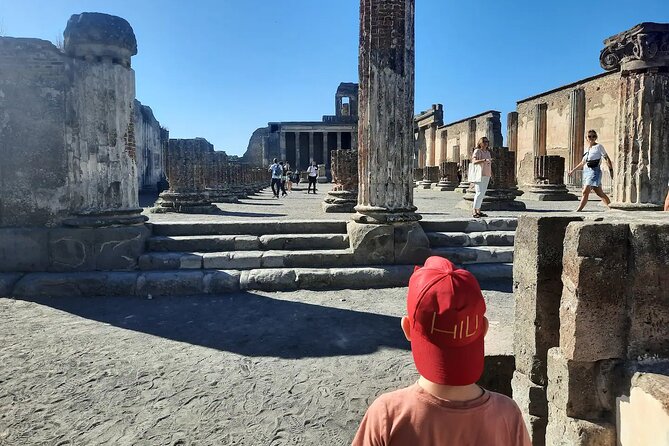
Pompeii is not a tidy monument with one grand entrance and a short path through it. It is a large buried city with streets, homes, shops, public buildings, painted rooms, and layers of history under your feet. Without context, you can spend hours looking at walls and still miss what made each building important.
An archaeologist can turn those remains into a readable story. At the House of Menander, you may learn how a grand Roman home was organized. At the baths, the subject shifts to public life and routine. At the Lupanar, the erotic paintings offer an unusually direct glimpse into Roman sexual culture, though this stop may not suit very young children.
The private format matters here. Your guide can answer questions from your own group, slow down when a building catches your interest, or keep the pace moving if you are traveling with older teenagers. The experience is not designed to cover every corner of Pompeii. It gives you a strong framework for continuing alone.
The guide roster includes Lello, also spelled Lelo in some feedback, along with Clelia, Ines, Leonardo, and Paolo. The strongest descriptions point to guides who use humor, vivid explanations, and up-to-date archaeological information. One account describes Lello as especially good at pointing out small details and then linking them to the larger story of the city.
More Walking Tours in Pompeii
- Pompeii: Guided Walking Tour with Entrance Ticket
★ 4.3 · 1,423 reviews - Discover Pompeii: French Walking Tour of the Buried City
★ 4.8 · 253 reviews - From Salerno: Pompeii Guided Walking Tour
★ 4.5 · 235 reviews
Meeting your guide near Pompeii’s entrance
The tour begins at Coffee Shop VittoriaVia Mare in Pompei. The activity returns to this same meeting point, so the start and finish are simple once you have located it.
I would take the meeting instructions seriously. One person had difficulty finding the guide because the guide did not appear to be at the expected spot and the company name seemed different from the name in the message. That may be an isolated problem, but it is an easy one to prevent: check your confirmation, note the provider name, Hili Travel s.r.l., and arrive with the exact meeting point visible on your phone.
Pompeii is near public transportation, and one family arrived by train from Naples and found the meeting point easy to reach. The tour is offered in English. Confirmation arrives at booking, and the activity is private, so only your group takes part.
The listed price is $421.03 per group of up to 12 people. That is expensive for one or two people, but the calculation changes for a full group. Split among 10 or 12 people, the cost can make sense for a private archaeologist-led visit, especially if you value direct questions and a custom pace. For a couple, it is a premium purchase, and you should weigh that against the shorter duration.
Remember to budget separately for the Pompeii entry ticket. The stops themselves do not carry separate admission charges during the walk, but the archaeological site entrance is not part of the tour price.
House of Menander and the scale of a Roman home
The first listed stop is Casa del Menandro, or the House of Menander. It covers about 1,800 square meters and occupies much of its city block, giving you a clear sense of how much space a wealthy Pompeii household controlled.
The home is important for its architecture, decoration, and contents. A guide can help you read the difference between a practical room and a ceremonial one, and can explain how courtyards, peristyles, and decorated spaces worked together. The building is more than a collection of attractive walls. It shows how status was displayed inside the home.
The planned visit here lasts about 20 minutes. That is enough for a focused explanation, but not enough to inspect every room in detail. If the house captures your attention, ask your guide which features are most useful to remember when you continue through the site on your own.
Stabian Baths and the social side of Pompeii
The Stabian Baths are listed for another 20 minutes. Dating back to about 125 BC, they are described as the oldest and largest of Pompeii’s five public bath complexes.
This stop gives the tour a needed change of scale. The grand houses show private wealth. The baths show shared public life. Romans did not visit bathhouses only to wash. These complexes were places for exercise, conversation, relaxation, and routine social contact.
An archaeologist can make the layout easier to follow, especially when several rooms look like bare stone chambers to the untrained eye. The age of the complex also helps place Pompeii in a longer timeline. The city was not created shortly before the eruption. It had developed and changed for generations.
You spend about 20 minutes here, so expect an overview rather than a technical study of Roman bathing. That is a sensible choice on a two-hour route, since Pompeii has many major buildings competing for your time.
More Pompeii excavation visits:
- Pompeii: Entry Ticket and Guided Tour with an Archaeologist
★ 4.8 · 19,459 reviews - Pompeii: Entry Ticket with Optional Audio Guide
★ 4.2 · 12,360 reviews - Pompeii: Small Group Tour with an Archaeologist
★ 4.8 · 12,264 reviews - Pompeii Small Group Tour with an Archaeologist
★ 5.0 · 6,593 reviews
The Lupanar and Pompeii’s bluntest evidence
The Lupanar is scheduled for 30 minutes, the longest stop on this route. It is a brothel known for its erotic wall paintings.
This is one of Pompeii’s most memorable buildings because the paintings and cramped rooms offer unusually direct evidence of commercial sex in the ancient city. The stop can also raise questions about social class, gender, language, and how modern assumptions shape the way we look at ancient evidence.
Your guide’s explanation matters here. Without context, it is easy to treat the paintings as a quick joke or a shock stop. With careful interpretation, the building becomes part of the wider story of work, commerce, and private behavior in Roman society.
The Lupanar is also a practical consideration for families. The tour is open to most people, but parents should decide if the subject and imagery fit their children. Older teenagers may find it particularly interesting when the guide places it within the broader culture of Pompeii rather than presenting it as a novelty.
House of the Faun and Hellenistic grandeur
Casa del Fauno, the House of the Faun, takes about 20 minutes. Built in the second century BC during the Samnite period, it was a large Hellenistic-style palace framed by peristyles.
The name comes from the faun statue associated with the house. The building’s scale and design make it one of the best places to picture the ambitions of a wealthy owner. Wide courtyards and formal spaces were not simply decorative. They shaped how residents received guests and displayed power.
This is another place where a guide saves you from seeing only ruins. The walls, columns, and open courts can look disconnected after centuries of damage and excavation. A clear explanation helps you picture the original relationships between the spaces.
The House of the Faun also pairs well with the House of Menander. One gives you a sense of a large, highly decorated residence, while the other lets you compare how elite domestic life was arranged. The two stops reinforce each other without being identical.
Teatro Grande and the pleasures of public entertainment
The Teatro Grande is the largest theater in Pompeii, but the planned visit lasts only about 10 minutes. That short stop is enough to look at the shape and setting of the theater and hear how public performance fit into city life.
Do not expect a long lecture here. The route has to keep moving, and the theater is one piece of a much larger city. Still, it gives you a welcome break from house interiors and private courtyards.
The theater also helps make Pompeii feel like a working community instead of an open-air museum. People lived in homes, bathed in public complexes, watched performances, walked busy streets, and gathered in civic spaces. The route keeps returning to that basic point: Pompeii was a city before it became an archaeological site.
Via dell’Abbondanza, Pompeii’s best-preserved street
The tour gives about 10 minutes to Via dell’Abbondanza, described as the best-preserved street in Pompeii. A street can seem less dramatic than a decorated house, but this is where the city’s daily rhythm becomes easiest to imagine.
Look for the relationship between the road and the buildings that line it. Streets connected homes, shops, public spaces, and religious or civic sites. Their surfaces, curbs, doorways, and crossings help you understand how people moved through Pompeii.
The short timing means your guide will likely focus on the most useful details rather than attempt a full walking tour of the road. Listen for practical clues about movement and commerce, then use the street as a reference point after the guided portion ends.
This is also a good place to notice how uneven the ancient pavement can be. The tour is suitable for most people, but Pompeii involves outdoor walking over old stone surfaces. Wear practical shoes and expect a steady walk.
Pompeii’s Forum and the city’s civic center
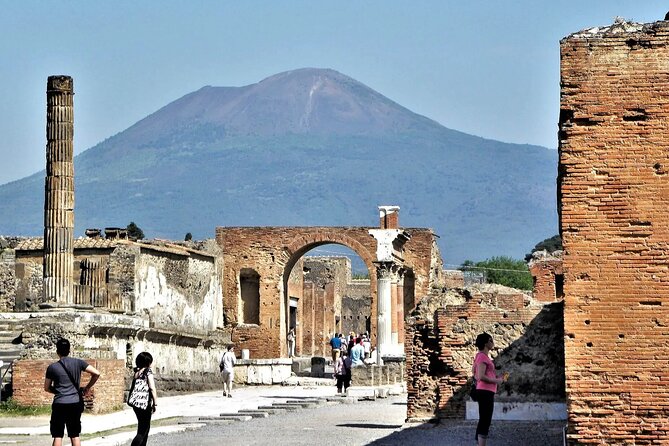
The final listed stop is the Forum, the most important square in Pompeii. It receives about 10 minutes, which makes it a closing snapshot rather than a complete treatment of the city’s political and religious center.
The Forum is where the route’s separate themes come together. Houses showed private wealth. Baths showed public routine. The theater showed entertainment. The street showed movement. The Forum represents civic authority and the public heart of the city.
A good guide can help you understand why the square mattered, even if you spend only a short time there. It is also a useful place to ask what to see next. Several people continued exploring after the formal tour ended, using their guide’s suggestions to visit other parts of Pompeii before closing.
That is one of the best ways to use this experience. Treat the two hours as a guided introduction, not as your entire Pompeii visit. The guide gives you a map in your head. You then spend extra time in the areas that match your interests.
What two hours can and cannot cover
The itinerary adds up to about two hours, with the most time given to the Lupanar and shorter visits to the theater, street, and Forum. This is a brisk route through important highlights.
I like that arrangement for a first visit, especially if you have limited time or are stopping in Pompeii between trains. It keeps the tour from getting bogged down in one building. It also works well for families with older teenagers, who may appreciate varied subjects and a guide who keeps the history moving.
The tradeoff is obvious: Pompeii is too large to understand fully in two hours. You will not see every major house, temple, shop, and neighborhood. If you want a slow archaeological study, plan additional time at the site after the guide leaves.
The private setup helps, but it cannot change the clock. Ask questions, yet keep an eye on the pace. If one stop is especially important to you, mention it early so your guide can shape the visit around your priorities when possible.
Guide style, humor, and the value of clear explanations
The best fit for this tour is someone who wants history explained in plain language, with room for questions and a little humor. The strongest guide descriptions emphasize clear storytelling, warmth, and an ability to make ancient life feel easy to picture.
Lello is noted for combining small observations with the larger story. Clelia is praised for her passion for archaeology and for helping people understand how the ruins fit together. Ines is described as especially useful for selecting the most interesting areas during a short visit. Leonardo is noted for being helpful and kind, while another account credits the archaeologist guide with current information about new findings.
The guide experience may not be identical every time. One account describes Paolo as informative but stern, more like a strict teacher than a relaxed host. That is worth keeping in mind if you want a highly casual style. The tour promises a licensed, English-speaking local guide, but individual personalities will vary.
Who should book this Pompeii tour
I would consider this tour for:
- Families with older children or teenagers who need a clear narrative
- First-time visitors who want the main sights without planning a route
- Couples or friends willing to pay more for a private guide
- People arriving from Naples by train who want a focused visit
- Anyone curious about archaeology, Roman homes, public baths, and ancient daily life
It is less suitable if you want a very cheap entry-only visit, a full-day archaeological survey, or a tour that includes admission in one price. It may also be a poor fit for anyone unable to manage outdoor walking over uneven ancient streets, though the provided information says most people can participate and service animals are allowed.
The activity has a 4.9 rating from 14 reviews, with 93 percent of people recommending it. That is a strong signal, though the sample is small. The praise centers on the guides’ explanations, humor, personal attention, and ability to make Pompeii easier to picture.
You can cancel for a full refund up to 24 hours before the start time. Changes or cancellations inside that period are not accepted for a refund, and the provider may offer another date or a full refund if a minimum number is not reached.
Should you book the private archaeologist tour?
Book it if you want meaningful context in a short visit, especially when you are splitting the cost among several people. The route covers the right mix of private homes, public buildings, entertainment, commerce, and civic space, and the archaeologist-led format can turn scattered ruins into a coherent city.
Before paying, add the separate Pompeii entrance ticket to your budget and confirm the meeting point at Coffee Shop VittoriaVia Mare. If you have more than two hours, plan to keep exploring afterward. Used that way, this tour gives you both a guided foundation and the freedom to follow your own interests.
FAQ
How long does the Pompeii tour last?
The tour lasts approximately two hours.
How many people can join the private tour?
The price covers one private group of up to 12 people. Only your group participates.
Is Pompeii entrance included in the tour price?
No. You must purchase the entry ticket to Pompeii separately.
Which language is the tour offered in?
The tour is offered in English with a licensed, English-speaking local guide.
Where does the tour begin and end?
It begins at Coffee Shop VittoriaVia Mare, 80045 Pompei NA, Italy, and ends back at the same meeting point.
Is the tour suitable for most people?
The provided information says most people can participate. Service animals are allowed, and the site is near public transportation.
Can I cancel for a full refund?
Yes, if you cancel at least 24 hours before the local start time. Cancellations or changes made less than 24 hours before the start are not refunded or accepted.
More Walking Tours in Pompeii Ruins
- Pompeii 3 Hours Walking Tour Led by an Archaeologist
★ 5.0 · 126 reviews - Pompeii: Highlights Guided Walking Tour
★ 4.6 · 105 reviews - Pompeii: 3D Walking Tour with Entry Ticket
★ 4.3 · 102 reviews - Explore Pompeii: 2-Hour Guided Walking Tour with Included Ticket
★ 4.5 · 77 reviews
More Tours Led by an Archaeologist
- Pompeii and Herculaneum Small Group Tour with an Archaeologist
★ 5.0 · 1,350 reviews - Skip the Line Guided Tour of Pompeii led by an Archaeologist
★ 5.0 · 703 reviews - Pompeii: Exclusive Tour with Archaeologist and Entry Tickets
★ 4.9 · 634 reviews - Pompeii Private Tour with an Archaeologist and Skip The Line – 3 hours
★ 5.0 · 564 reviews
Newest reviews from Pompeii Ruins
- Private Tour Pompeii and Winery★ 5.0 · 4 reviews
- Visit the Pompeii ruins from Salerno with Pizza Lunch★ 5.0 · 4 reviews
- From Sorrento: Pompeii & Vesuvius tour small group★ 4.8 · 4 reviews
- Pompeii Private Tour for Kids and Their Families★ 4.8 · 4 reviews
- Pompeii Sorrento and Positano Tour★ 5.0 · 4 reviews
- From Naples_ Pompeii Tour_Skip the line ticket + audioguide★ 4.3 · 4 reviews
- Pompeii, skip-the-line ticket with smartphone audio guide on App★ 3.0 · 4 reviews
- Pompeii Private Half-Day Tour from: Naples,Sorrento, Amalfi Coast★ 5.0 · 4 reviews
Archaeologist-Led Tours, compared.

Entry Ticket and Guided Tour with an Archaeologist
Read our review →
Pompeii Small Group Tour with an Archaeologist
Read our review →
Pompeii and Herculaneum Small Group Tour with an Archaeologist
Read our review →
Skip the Line Guided Tour of Pompeii led by an Archaeologist
Read our review →
Exclusive Tour with Archaeologist and Entry Tickets
Read our review →
Pompeii Private Tour with an Archaeologist and Skip The Line – 3 hours
Read our review →
Pompeii Skip-the-line Tour with Archaeologist Guide
Read our review →Browse the lists this tour appears in