
Reviewed · ARCHAEOLOGIST-LED TOURS
Pompeii 3 Hours Walking Tour Led by an Archaeologist
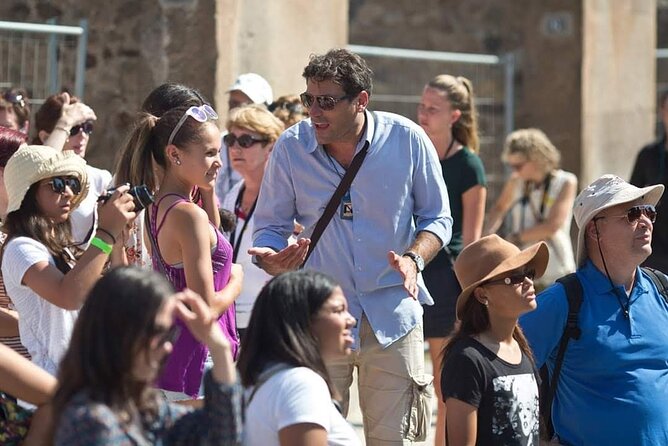
Pompeii comes alive when you stop treating it as a field of ruins and start reading it as a Roman city. This private three-hour walk takes you from the public Forum to bathhouses, theaters, shops, grand homes, and the casts of people caught by Vesuvius. An archaeologist or specialist guide can explain not just what you are seeing, but how the pieces fit together.
I like the private format, since your group can ask questions and set the pace without waiting for a large crowd. I also like the route’s range: you see daily life, politics, entertainment, religion, and domestic architecture rather than only the most famous street.
The main consideration is the price, $256.99 per person. That is a serious outlay, especially for a couple or family, though the value improves if you want expert interpretation and a personal visit instead of wandering through Pompeii on your own.
In This Review
- Key points to know before you book
- Why a private Pompeii tour can be worth the cost
- Meeting at Porta Marina Superiore
- The Basilica and Forum: Pompeii’s public center
- Forum granaries and the casts left by Vesuvius
- House of Menander and the world of the Roman elite
- Stabian Baths: Roman daily life in practical form
- The Lupanar and the less polished side of Pompeii
- House of the Faun and Pompeii’s largest homes
- The Odeon and Teatro Grande
- Timing, pace, and physical comfort
- Price, group size, and overall value
- Who should choose this Pompeii walk
- Should you book the Askos Tours experience?
- FAQ
- How long does the Pompeii walking tour last?
- Is this a private tour?
- What language is the tour offered in?
- Where does the tour meet?
- Are Pompeii admission fees included?
- What should I bring for the visit?
Key points to know before you book
- Three hours with your own group: This is a private walking tour, not a large shared departure.
- A strong cross-section of Pompeii: The route includes the Forum, baths, brothel, major houses, casts, and both theaters.
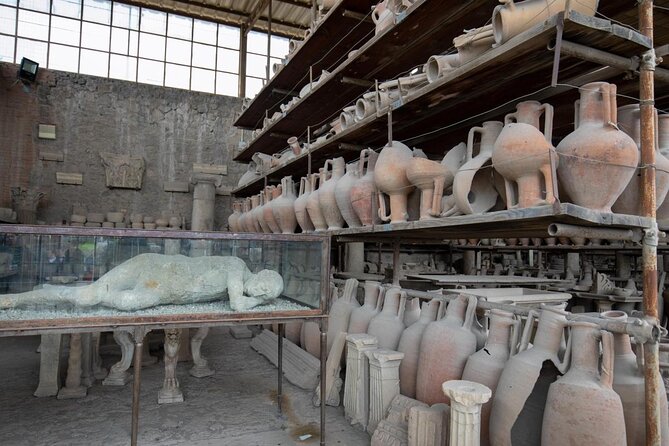
- Specialist guiding: Askos Tours assigns professional guides, with archaeologists and art historians among the guides praised for their teaching.
- A demanding outdoor visit: Pompeii is broad, sunny, and short on shade, so wear a hat and sunscreen.
- Easy meeting point: Meet at Porta Marina Superiore, at Via Villa dei Misteri 1, where the guide carries an Askos Tours sign.
- Useful for rail-based trips: The guide can help with directions to your accommodation or the closest train station after the walk.
Why a private Pompeii tour can be worth the cost
Pompeii is not a compact museum. It is a large ancient city with streets, public buildings, homes, fountains, theaters, and working spaces spread over a wide area. A sign may tell you that a building is a bathhouse or a basilica, but it cannot always explain how that building functioned within Roman society.
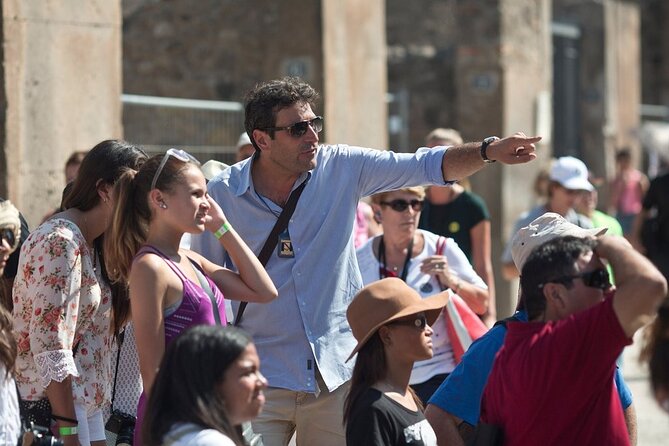
That is where this tour earns its keep. The guide connects the stones to ordinary routines: washing, shopping, conducting business, watching performances, worshipping, dining, and moving through the city. The best guides also point out small architectural details that are easy to pass without help.
The private setup matters. You can ask why a building was arranged in a certain way, pause for an explanation, or tell the guide what interests you most. The experience is offered in English, and the itinerary is described as customizable. That does not mean you will see every corner of Pompeii in three hours, but it does give your guide room to shape the walk around your group.
The guide quality is the strongest thread running through the experience. Daniela Mantice, described as an art historian, was praised for explaining the people, culture, architecture, and chemical effects of the eruption on painted surfaces. Monica was praised for her archaeological teaching and clear explanations, while Antonella received repeated praise for making technical subjects understandable and keeping the group engaged.
Names and assignments can change, so do not book on the assumption that one particular guide will lead your visit. Still, the range of strong guide feedback suggests that Askos Tours places real weight on specialist interpretation.
More Walking Tours in Pompeii
- Pompeii: Guided Walking Tour with Entrance Ticket
★ 4.3 · 1,423 reviews - Discover Pompeii: French Walking Tour of the Buried City
★ 4.8 · 253 reviews - From Salerno: Pompeii Guided Walking Tour
★ 4.5 · 235 reviews
Meeting at Porta Marina Superiore
You meet at the main entrance of the archaeological area, called Porta Marina Superiore, at Via Villa dei Misteri 1 in Pompei. Look for a guide holding a sign with Askos Tours at the top. This is a useful arrangement because Pompeii has more than one entrance, and arriving at the wrong gate could waste valuable tour time.
The tour begins and ends at the same address, although the experience ends inside the ruins. The guide can help you work out how to reach your accommodation or the closest train station afterward. Transportation to and from Pompeii is not included, so you need to arrange that part yourself.
There is also a free luggage store at the meeting point. That can be helpful if you arrive with bags before checking in or are leaving Pompei by train later in the day. Confirm the storage details when you arrive, and avoid carrying anything you do not need through the site.
The Basilica and Forum: Pompeii’s public center
The Basilica is an excellent first stop because it introduces Pompeii as a working city, not simply a residential neighborhood. This open portico sheltered merchants and other public activity. Its surviving columns and broad footprint give you a sense of the importance of business and civic life in the Roman town.
From there, you reach the Forum, Pompeii’s main square. This was the center of public life, where important buildings and civic activity gathered. The open space can look simple at first, but a guide helps you understand how the Forum related to politics, religion, commerce, and movement through the city.
You also walk along one of Pompeii’s main streets. Ancient streets are among the most readable parts of the site because they show how people moved around town. The paving, buildings, and intersections help you picture a city designed for pedestrians, carts, business, and neighborhood life.
This opening section gives you the basic map in your head. That is valuable because the rest of Pompeii can otherwise feel like a series of disconnected houses.
Forum granaries and the casts left by Vesuvius
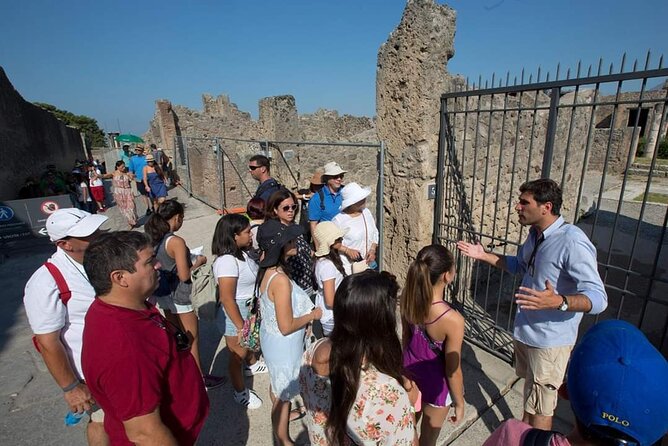
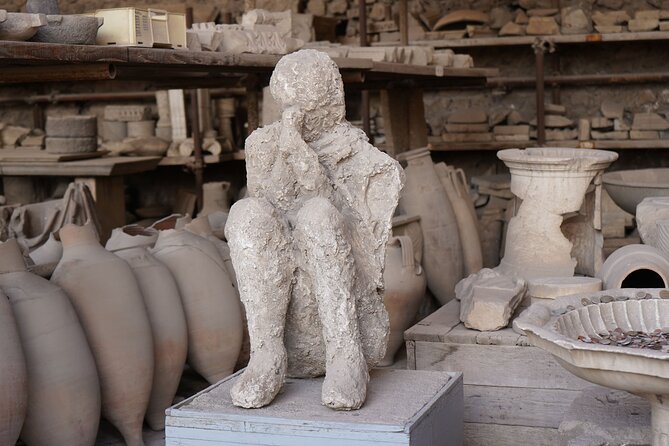
The granaries near the Forum offer one of the tour’s most powerful stops. Here you can see marble tables and baths once used as decorative features at house entrances, along with casts associated with victims of the eruption. The display also includes casts of a dog and a tree.
These casts are emotionally difficult for many people. They are not simply archaeological curiosities. They make the disaster personal and remind you that Pompeii was a lived-in city interrupted by a sudden catastrophe.
Your guide’s explanation matters here. It can help you understand what the casts represent without turning the stop into spectacle. Allow yourself time to look, but remember that this is still an active archaeological site with uneven ground and a long route ahead.
More Pompeii excavation visits:
- Pompeii: Entry Ticket and Guided Tour with an Archaeologist
★ 4.8 · 19,459 reviews - Pompeii: Entry Ticket with Optional Audio Guide
★ 4.2 · 12,360 reviews - Pompeii: Small Group Tour with an Archaeologist
★ 4.8 · 12,264 reviews - Pompeii Small Group Tour with an Archaeologist
★ 5.0 · 6,593 reviews
House of Menander and the world of the Roman elite
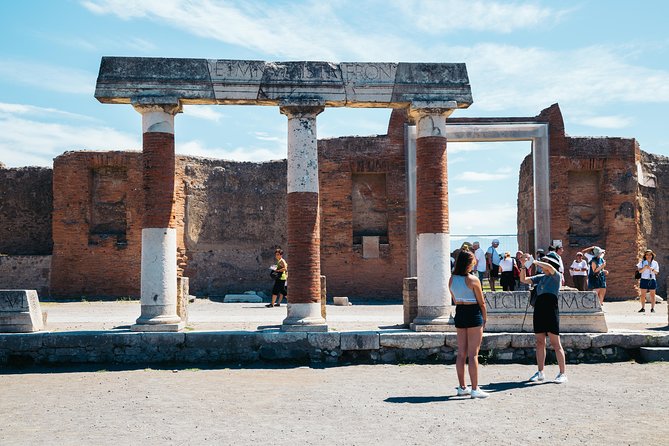
The House of Menander is one of Pompeii’s most important private residences. It is noted for its architecture, decoration, and contents, making it a useful counterpoint to the public Forum.
A large house like this can tell you about wealth, status, household organization, and taste. You will not simply be looking at rooms. You will be considering how a Roman home was arranged to receive people, display social rank, and separate public-facing spaces from more private areas.
This is one place where an art historian or archaeologist can add real value. Painted decoration and architectural details are easy to admire, but a specialist can explain how they fit Roman customs and design choices. If you are especially interested in domestic life, tell your guide early in the walk so the customizable format can work in your favor.
Stabian Baths: Roman daily life in practical form
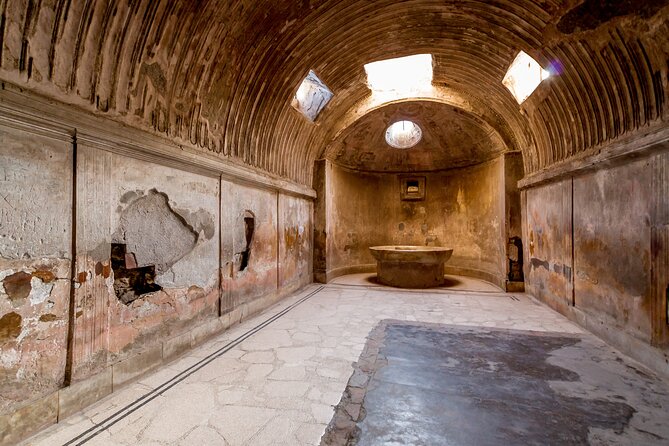
The Stabian Baths occupy a large area between the Brothel lane, the Holconius crossroads, and Via Stabiana. They are considered the oldest thermal complex in Pompeii.
Baths were not only places to wash. They were social and practical centers where people spent time, met others, and followed a familiar sequence of rooms and activities. The Stabian Baths show how much planning and infrastructure went into Roman public life.
This stop is especially useful if you want to understand the city beyond its villas. Pompeii was not just a collection of elegant homes. It had public facilities that served residents across the town, and the baths help you see the scale of that shared urban life.
The site is exposed, so expect sun and heat here. Three hours may sound manageable, but the combination of distance, stone paving, and little shade can wear you down. Bring water, use sunscreen, and wear sturdy, comfortable shoes.
The Lupanar and the less polished side of Pompeii
The Lupanar is Pompeii’s best-known brothel. Its small rooms and surviving decoration offer a glimpse of a part of Roman urban life that many grander monuments leave out.
This stop can be fascinating, but it is not for every group. Families with children should decide in advance how they want to handle the subject, since children must be accompanied by an adult and the building’s purpose is clear. A good guide can place the site in its historical setting rather than treating it as a cheap shock stop.
The Lupanar also shows why guided interpretation helps. Without context, you may notice only cramped rooms and images. With context, you can think about how commerce, sexuality, class, and city life intersected in Pompeii.
House of the Faun and Pompeii’s largest homes
The House of the Faun was one of Pompeii’s largest and most impressive private residences. Its size alone helps you understand the gap between an elite household and the ordinary homes and businesses spread through the city.
As you walk through the property, look at the scale and layout rather than expecting a single preserved room to tell the whole story. A house of this size was designed to impress. Its spaces reveal how Roman domestic architecture could also function as a display of social power.
This is a good point to ask your guide about the difference between a house that was comfortable and one that was meant to project status. Pompeii’s homes are valuable because they preserve the physical setting of Roman life, but the guide’s interpretation helps you read social meaning into the plan.
The Odeon and Teatro Grande
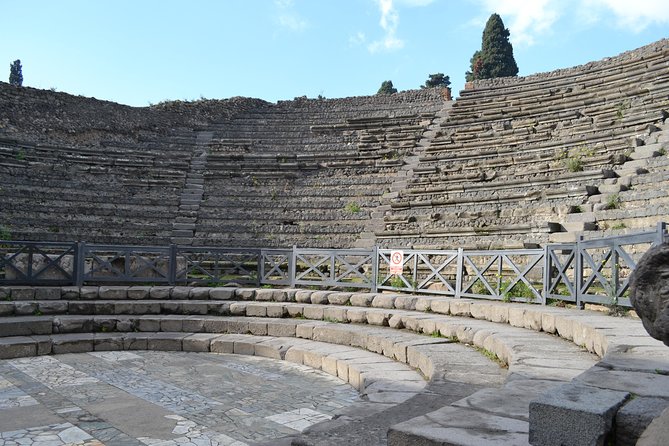
The short stop at the Odeon, also called the Teatro Piccolo, gives you a look at Pompeii’s smaller theater. It is a quick visit, but it adds another piece to the city’s entertainment life.
The Teatro Grande is the major theater and receives more time. It was Pompeii’s most important theater, and its scale makes clear that performances were a serious part of public culture. After seeing streets, baths, houses, and civic buildings, the theater shows you how residents gathered for shared entertainment.
The two theaters work well together. The smaller Odeon and larger Teatro Grande are not identical experiences, and seeing both helps you understand that Pompeii offered different kinds of performances and settings.
The tour ends back at the archaeological site area, with the guide available to offer practical directions. Because the route includes several major buildings rather than a single monument, the final theater stop gives the walk a fitting finish: Pompeii appears as a complete city with work, worship, politics, leisure, and home life.
Timing, pace, and physical comfort
Three hours is long enough to build a clear picture of Pompeii, but not long enough to see the entire archaeological park. The route covers many of the most recognizable places, yet you should not expect a detailed visit to every open house or street.
I would choose a morning or cooler part of the day if you have any flexibility, though the tour operates rain or shine. Pompeii has minimal shade, and the site is exposed. A hat, sunscreen, water, and sensible footwear are more important here than stylish clothing.
Most people can take part, but the walk requires steady movement over an ancient site. Children must have an adult with them. If someone in your party needs frequent breaks, mention that when arranging the private tour so the guide can set a comfortable pace.
Price, group size, and overall value
At $256.99 per person, this is not a budget Pompeii visit. Admission fees and a professional archaeologist guide are included, but transportation is not. Group discounts are available, so the final value may look better for a larger private group than for one or two people.
I would compare this cost with your priorities. If you mainly want to see Pompeii and are happy reading signs, a self-guided visit costs less. If you want a clear route, specialist explanations, and the freedom to ask questions, the private format can justify paying more.
The strongest value comes when you use the guide well. Ask about the houses, the eruption, Roman bathing, public life, or the painted surfaces. The guides praised for this experience are not simply pointing out buildings. They explain how the city worked and respond to questions in a lively, clear way.
Free cancellation is available if you cancel at least 24 hours before the start time. Cancellations within 24 hours are not refunded, and changes within that period are not accepted.
Who should choose this Pompeii walk
I would recommend it for first-time visitors who want structure without a large group. It is also a good match for anyone interested in archaeology, architecture, Roman culture, or the human story behind the ruins.
Families can benefit from the private setup because the guide can adjust explanations and pace, though adults should consider whether the Lupanar suits their children. The tour also works well for couples and small groups who want to focus on specific interests.
I would think twice if you want a slow, all-day exploration of Pompeii. Three hours offers a strong introduction, not full coverage. I would also think twice if $256.99 per person would strain your budget, since the price is based on expert service rather than transportation or luxury extras.
Should you book the Askos Tours experience?
Book this tour if you want Pompeii explained by a specialist and prefer your own group to a crowded shared walk. The route covers the Forum, Basilica, granaries, casts, House of Menander, Stabian Baths, Lupanar, House of the Faun, Odeon, and Teatro Grande, giving you a broad view of Roman city life in one morning or afternoon.
The best reason to choose it is the guide. Ask for an archaeologist or art historian if that is important to you, and understand that named guides such as Daniela, Monica, Antonella, Anna, and Nicoletta may not be available on your date. If you can handle the price and the sun, this is a focused and thoughtful way to meet Pompeii.
FAQ
How long does the Pompeii walking tour last?
The tour lasts approximately three hours.
Is this a private tour?
Yes. Only your group participates in the activity.
What language is the tour offered in?
The tour is offered in English.
Where does the tour meet?
Meet at the Pompeii Archaeological Park entrance called Porta Marina Superiore, at Via Villa dei Misteri 1, 80045 Pompei, Italy. The guide will hold an Askos Tours sign.
Are Pompeii admission fees included?
Yes. Admission ticket fees are included. Transportation to and from the attraction is not included.
What should I bring for the visit?
Pompeii has minimal shade and is exposed to the weather. Bring sunscreen and wear a hat. The tour operates rain or shine.
More Walking Tours in Pompeii Ruins
- Pompeii: Highlights Guided Walking Tour
★ 4.6 · 105 reviews - Pompeii: 3D Walking Tour with Entry Ticket
★ 4.3 · 102 reviews - Explore Pompeii: 2-Hour Guided Walking Tour with Included Ticket
★ 4.5 · 77 reviews - Pompeii: walking tour with 3D glasses and with entrance ticket
★ 4.5 · 61 reviews
More Tours Led by an Archaeologist
- Pompeii and Herculaneum Small Group Tour with an Archaeologist
★ 5.0 · 1,350 reviews - Skip the Line Guided Tour of Pompeii led by an Archaeologist
★ 5.0 · 703 reviews - Pompeii: Exclusive Tour with Archaeologist and Entry Tickets
★ 4.9 · 634 reviews - Pompeii Private Tour with an Archaeologist and Skip The Line – 3 hours
★ 5.0 · 564 reviews
Newest reviews from Pompeii Ruins
- Private Tour Pompeii and Winery★ 5.0 · 4 reviews
- Visit the Pompeii ruins from Salerno with Pizza Lunch★ 5.0 · 4 reviews
- Pompeii Private Tour for Kids and Their Families★ 4.8 · 4 reviews
- From Sorrento: Pompeii & Vesuvius tour small group★ 4.8 · 4 reviews
- Pompeii Sorrento and Positano Tour★ 5.0 · 4 reviews
- From Naples_ Pompeii Tour_Skip the line ticket + audioguide★ 4.3 · 4 reviews
- Pompeii, skip-the-line ticket with smartphone audio guide on App★ 3.0 · 4 reviews
- Pompeii Private Half-Day Tour from: Naples,Sorrento, Amalfi Coast★ 5.0 · 4 reviews
Archaeologist-Led Tours, compared.

Entry Ticket and Guided Tour with an Archaeologist
Read our review →
Pompeii Small Group Tour with an Archaeologist
Read our review →
Pompeii and Herculaneum Small Group Tour with an Archaeologist
Read our review →
Skip the Line Guided Tour of Pompeii led by an Archaeologist
Read our review →
Exclusive Tour with Archaeologist and Entry Tickets
Read our review →
Pompeii Private Tour with an Archaeologist and Skip The Line – 3 hours
Read our review →
Pompeii Skip-the-line Tour with Archaeologist Guide
Read our review →Browse the lists this tour appears in