
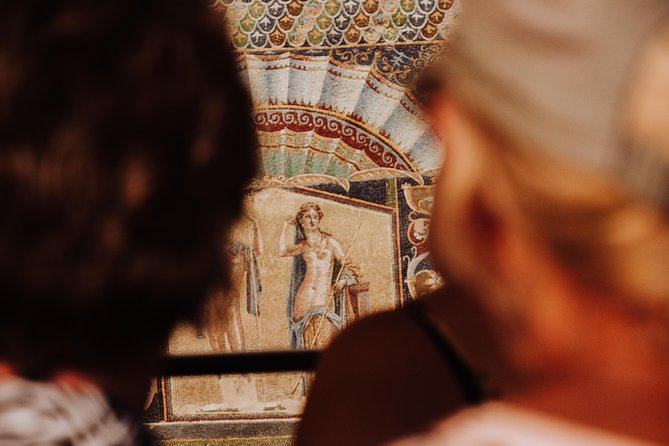
Reviewed · SKIP THE LINE
Pompeii and Herculaneum small group tour – skip the line
Pompeii and Herculaneum tell the same disaster story in very different ways. Pompeii gives you broad streets, theaters, public baths, and a large forum. Herculaneum feels more intimate, with carbonized wood, vivid wall paintings, and homes that still reveal fine domestic details. I like that this two-site tour lets you compare both places in one day, rather than treating Pompeii as the whole story.
I also like the small-group format, with a maximum of 20 people, and the guide’s role throughout both ruins. Guides such as Amadeau, Vince, Sergio, Paulo, Diego, Alfredo, and Michele have been praised for clear explanations, humor, patience, and strong command of the sites. The main caution is the pace: five and a half hours of walking over uneven ancient paving is a lot, especially in summer heat or wet weather.
In This Review
- Key points at a glance
- Why visiting both ruins changes the story
- Meeting at Pompeii’s Porta Marina entrance
- Pompeii’s forum and the business of city life
- Menander, the granary, and Pompeii’s public comforts
- Casa del Fauno and Pompeii’s theaters
- The move to Herculaneum by Circumvesuviana train
- Herculaneum’s villas and surviving wood
- Herculaneum’s baths, black hall, and Samnite house
- The final houses: Bel Cortile and the Grand Portal
- Walking, weather, and the right kind of day
- Who gets the best value from this tour
- Should you book Pompeii and Herculaneum together?
- FAQ
- How long does the tour last?
- What language is the tour offered in?
- Where does the tour begin?
- Where does the tour end?
- Are Pompeii and Herculaneum admission tickets included?
- Is the train from Pompeii to Herculaneum included?
- Is transportation back to my accommodation included?
- Are meals included?
- Is the tour suitable for everyone?
Key points at a glance
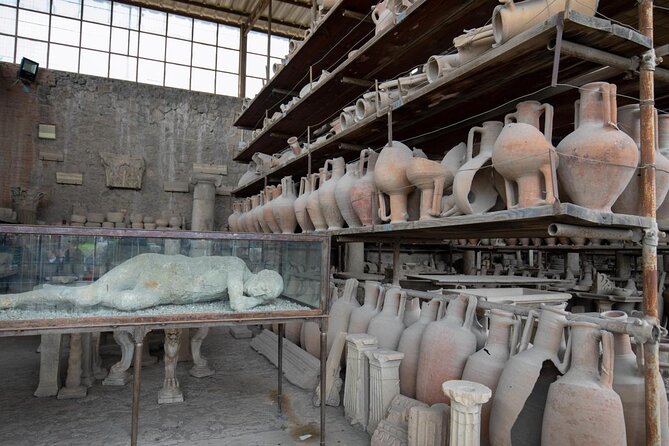
- Two Roman cities in one outing: Pompeii’s open streets and public buildings pair well with Herculaneum’s preserved houses and wooden details.
- Skip-the-line admission: Entry is included for both archaeological parks, saving time at busy periods.
- A guide stays with you: The tour includes guidance for the full visit, not just an introduction at the gate.
- Pompeii to Herculaneum by train: A one-way Circumvesuviana ticket is included, but transport back to your hotel is not.
- A serious walking day: Expect uneven surfaces, sun exposure, and a route that is not stroller friendly.
- Strong guide feedback: Sergio is described as an archaeologist who works on site, while Vince, Diego, Paulo, Alfredo, Michele, and Amadeau are praised for information and good pacing.
Why visiting both ruins changes the story
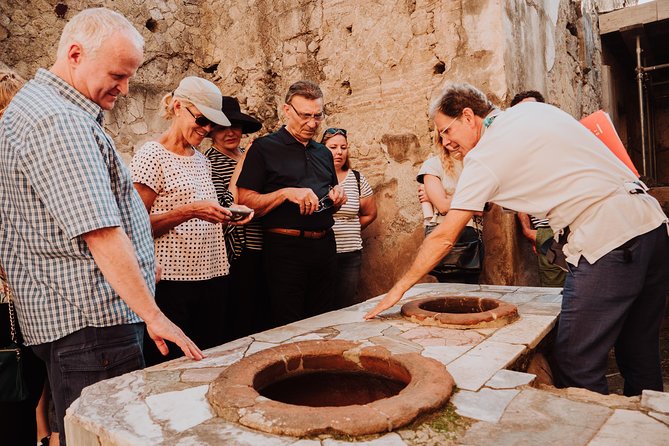
Pompeii is the larger and more famous archaeological park. Its streets let you picture city life at street level: merchants working near the forum, bathers using public facilities, theater crowds gathering, and residents moving between houses and shops.
Herculaneum is smaller, but its preservation can feel more immediate. The eruption buried the town under a different mix of volcanic material, preserving carbonized wood and parts of upper floors. You may find that Pompeii gives you the city plan, while Herculaneum gives you the texture of private life.
That contrast is the best reason to book this tour instead of spending the entire day at Pompeii. You will not see every corner of either park, but you will get a guided look at two places that preserve different pieces of the ancient Roman world.
The price is $119.85 per person. That is not a budget admission ticket, but it covers guided visits to both sites, skip-the-line entry, and the one-way train from Pompeii to Herculaneum. If you would otherwise pay for two entrance tickets and arrange the train yourself, the price becomes easier to justify. You are mainly paying for the guide’s interpretation and the convenience of moving between the sites.
More Skip-the-Line Tickets in Herculaneum
- Sorrento: Pompeii & Herculaneum Tour with Skip-the-Line
★ 4.6 · 125 reviews - Pompeii and Herculaneum Private Tour with Native Guide and Skip the Line Tickets
★ 5.0 · 45 reviews - Pompeii & Herculaneum – Skip the line from Sorrento
★ 4.5 · 44 reviews
Meeting at Pompeii’s Porta Marina entrance
The listed starting point is Piazza Esedra, 4, in Pompei, but the detailed meeting instructions identify the archaeological park entrance called Porta Marina Superiore. The guide should hold an Askos Tours sign. Because the information gives both a general address and a specific gate, I would confirm the exact meeting location before setting out.
That small check matters. Pompeii is large, and arriving at the wrong entrance can cost you valuable time. The tour begins with admission at the archaeological site, so have your mobile ticket ready and look for the guide’s company sign.
The Pompeii portion lasts roughly two and a half hours, depending on the group and the day. The route covers major public buildings, private homes, streets, baths, a brothel, and theaters. The guide’s explanations are especially useful here because many structures look like plain walls until someone points out how they worked.
Pompeii’s forum and the business of city life
The first major stop is the Basilica, an open portico that sheltered merchants and other activities. In Roman towns, buildings like this were tied to public business, law, and commerce. It is a useful early stop because it shifts your attention away from the eruption and toward ordinary city functions.
From there, the route reaches Pompeii’s forum, the ancient main square. This was the city’s public center, and it helps you understand the scale of Pompeii before you move into smaller buildings. Take a moment to look across the open space and picture it as a place for civic business, religion, trade, and public gatherings.
You then walk along one of Pompeii’s main streets. Ancient paving can be irregular, and the route is not a smooth museum walk. Wear shoes with a firm sole, and keep water close. One useful detail from the tour feedback is that you can refill a bottle at an ancient Roman water spring, but do not count on that as your only supply.
Menander, the granary, and Pompeii’s public comforts
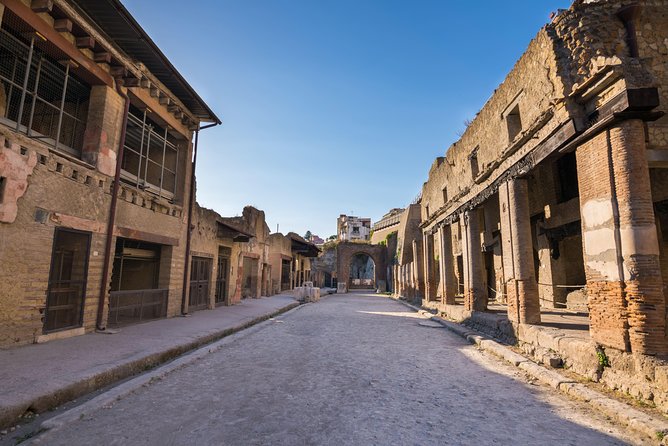
Casa del Menandro is one of Pompeii’s most impressive houses in terms of architecture, decoration, and contents. It gives the guide a chance to explain how wealthy residents arranged their homes and used decoration to signal status.
The Granai del Foro, or forum granary, adds a darker note. Here you can see marble tables and fountain basins that were once connected with houses, along with plaster casts of eruption victims. The casts are not simply archaeological objects. They make the human cost of the disaster difficult to ignore. You may also see casts of a dog and a tree.
The nearby Forum Baths represent the oldest thermal complex in the city. Roman baths were more than places to wash. They were public facilities where people spent time, met others, and followed a daily routine supported by engineering and heated rooms.
The route also passes Pompeii’s famous brothel. This is a short stop, but it often helps explain how historians read a building’s purpose from its layout, paintings, and surviving evidence. The guide can provide context without reducing the site to a novelty.
More Pompeii excavation visits:
- Pompeii: Entry Ticket and Guided Tour with an Archaeologist
★ 4.8 · 19,459 reviews - Pompeii: Entry Ticket with Optional Audio Guide
★ 4.2 · 12,360 reviews - Pompeii: Small Group Tour with an Archaeologist
★ 4.8 · 12,264 reviews - Pompeii Small Group Tour with an Archaeologist
★ 5.0 · 6,593 reviews
Casa del Fauno and Pompeii’s theaters
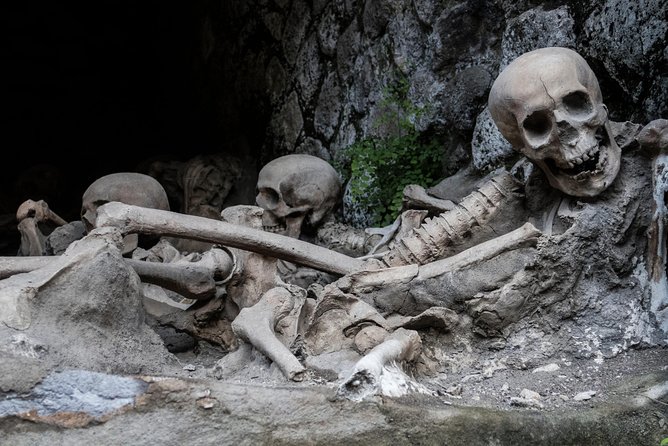
Casa del Fauno was one of Pompeii’s largest and most impressive private residences. The name comes from a statue of a faun, and the house gives you another look at the resources available to an elite Roman family.
The tour then passes the Teatro Piccolo before spending about 15 minutes at the Teatro Grande, Pompeii’s main theater. The theaters are valuable stops because they bring sound, crowds, and performance back into the picture. Pompeii was not a silent collection of ruins. It was a working town with entertainment, public ceremony, and shared spaces.
The Pompeii route is packed. Ten-minute stops sound short, and they are. A good guide makes those minutes count by pointing out a few details rather than trying to recite every fact. Guides praised on this route include Vince, who is described as funny and professional, and Sergio, who is described as an archaeologist working at the site. You should expect plenty of information, but not long periods to explore alone.
The move to Herculaneum by Circumvesuviana train
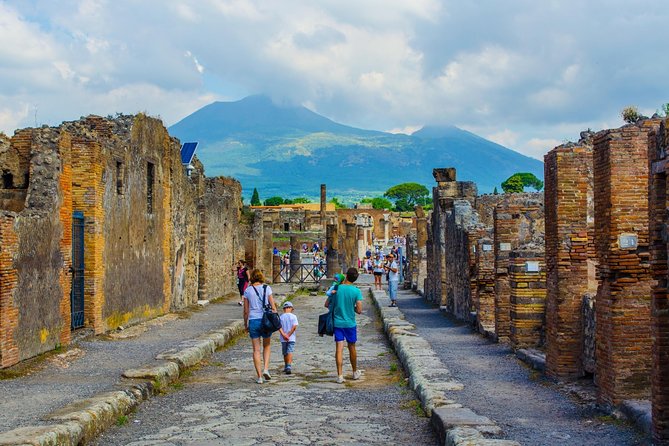
After Pompeii, the tour transfers to Herculaneum by train. The listed journey is about 30 minutes, followed by a walk of roughly 10 minutes. A one-way Circumvesuviana ticket is included.
There may be a quick lunch break if needed. One account describes stopping in an air-conditioned mall between the sites, which can be welcome during hot weather. Meals are not included, so bring money and do not expect a full restaurant stop built into the schedule.
The Herculaneum meeting point is the archaeological park ticket office on Corso Resina. The published end point is the ruins at Corso Resina, 187, Ercolano. Transport back to your accommodation is not included. If you are heading to Sorrento or Naples, check the return train situation on the day. The Herculaneum station is about a 10-minute uphill walk from the site exit, and temporary works or rail strikes can make the return more complicated.
This arrangement is practical, but it also creates a break in the day. One complaint about the experience involved confusion over a promised bus transfer between the sites. The stated plan for this tour is train travel, so I would rely on the included Circumvesuviana ticket and confirm any separate transfer promise before booking.
Herculaneum’s villas and surviving wood
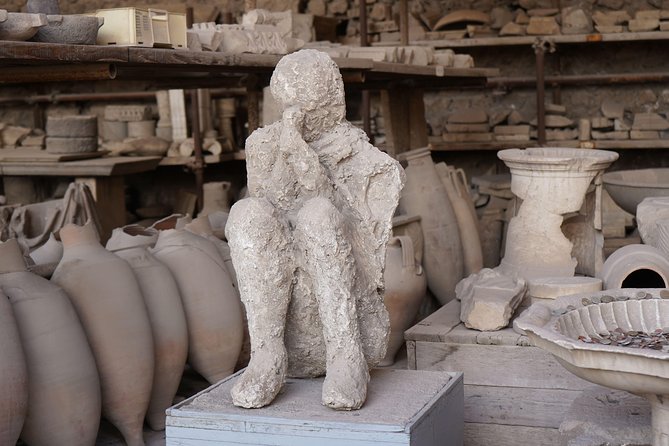
Herculaneum begins with the House of the Deer, named for marble deer statues found in its peristyle. The house is a good introduction to the town’s private architecture, where courtyards and garden areas shaped daily life.
Next comes the terrace of Marcus Nonius Balbus. The itinerary description repeats the House of the Deer explanation at this point, so the guide’s live commentary matters more than the brief written stop label. The terrace is part of the site’s public and commemorative spaces, and it helps connect private homes with the town’s wider civic world.
The College of the Augustales follows. This was associated with the Augustales, a group connected with the imperial cult and civic identity. The stop gives you a useful reminder that Roman religion was woven into public life, politics, and community status.
Casa del Rilievo di Telefo may have belonged to Marcus Nonius Balbus, one of the town’s leading benefactors. It has a private access point to the neighboring Suburban Baths, an unusual feature that shows how some wealthy homes were closely linked to leisure facilities.
Casa del Tramezzo di Legno is important for its elegant wooden partition. At Herculaneum, carbonized wood is one of the great rewards of the visit. A doorway, partition, or beam can make the ancient house feel less abstract than a room with only stone walls.
Herculaneum’s baths, black hall, and Samnite house
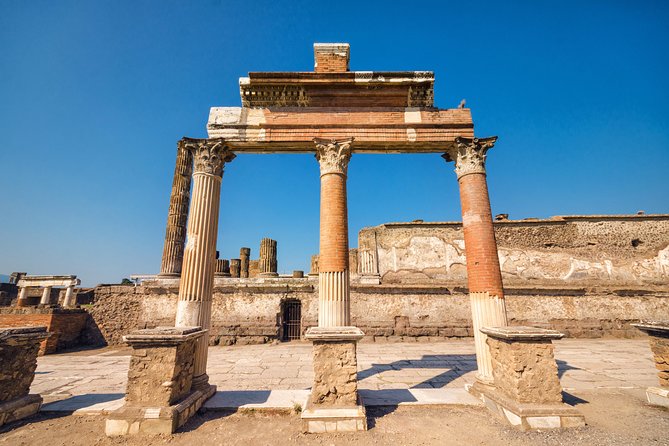
The House of the Skeleton takes its name from human remains found in an upper room in 1831. It may have formed from three smaller buildings joined together. This is another stop where the eruption’s human side comes forward, so it can feel more sobering than the grand villas.
The Central Thermae were built around the start of the first century AD and divided into separate men’s and women’s bathing areas. The arrangement reflects Roman social habits and the town’s investment in public comfort.
Casa del Salone Nero, or the House of the Black Hall, is one of Herculaneum’s more luxurious mansions. Its monumental entrance still retains carbonized doorposts and a lintel. These preserved wooden elements are among the clearest reasons to add Herculaneum to your plans.
Casa Sannitica has an atrium bordered by a gallery with Ionic columns. Its rooms retain fresco decoration, and the layout is linked to Samnite architectural traditions. You do not need to memorize every architectural label to appreciate the basic point: Herculaneum preserves several layers of local identity beneath its Roman setting.
The final houses: Bel Cortile and the Grand Portal
Casa del Bel Cortile is unusual because it uses a courtyard with a stairway and stone balcony instead of the more familiar atrium arrangement. It is a good example of why a guided route helps. Without an explanation, an unconventional plan can look like a damaged house rather than a deliberate design.
The final stop is the House of the Grand Portal, a large home near the center of the archaeological area. Expect columns, frescoes, and charred wooden remains. By this point, you will have seen the most important contrast with Pompeii: Herculaneum often rewards close attention to small domestic details rather than broad public spaces.
The Herculaneum section is described as less crowded and especially interesting. That can make the second half feel calmer, even though your legs may be tired. The tour does not give you a long free period at either site, so this is better for learning the layout and seeing selected highlights than for detailed photography or independent study.
Walking, weather, and the right kind of day
You should treat this as an active half-day, not a relaxed sightseeing outing. The route includes uneven paving and plenty of walking. It is not stroller friendly, and a small child may need to be carried in places.
Heat can change the experience. One guide handled a very hot July outing with humor and useful information, but two and a half hours at each site can still feel demanding under strong sun. Rain is possible too. A guide has been praised for looking after both younger and older members of the group during wet weather, but you should still bring suitable footwear and protection.
Pack water, sunscreen, and a hat when the forecast is warm. Toilets are not always conveniently placed along a long archaeological route, so use one before the tour begins. A small snack is sensible because meals and personal expenses are not included.
The maximum group size is 20. That is smaller than a large coach tour, and it gives you a fair chance to ask questions. It is not a private visit, however. If you want a completely flexible pace, a private guide or separate visits may suit you better.
Who gets the best value from this tour
I would choose this experience if you have one day for the Bay of Naples ruins and want a guide to explain what you are seeing. It suits first-time visitors, history fans, and anyone who wants to compare a large Roman city with a smaller, more carefully preserved town.
It is also a good fit if you prefer a planned route. The included entry and train ticket remove some of the day’s decisions, and the guide keeps the visit moving.
I would hesitate if you dislike group schedules, need frequent rest stops, or want to spend hours inside one house photographing details. Mobility concerns deserve serious thought because of the uneven ground and long walking time. Families with a stroller should leave it behind if possible.
Cancellation is free if you cancel at least 24 hours before the start time. Changes or cancellations made less than 24 hours ahead are not accepted for a refund.
Should you book Pompeii and Herculaneum together?
Book it if you want the main story, strong site coverage, and an English-speaking guide in one organized outing. The combination is more rewarding than Pompeii alone, and Herculaneum may surprise you with its wooden doors, partitions, vivid homes, and quieter feel.
Skip it if you want a slow, self-guided day or if five and a half hours on rough ground sounds tiring. At $119.85, the value depends on using the guide well: ask questions, listen for the links between public buildings and private homes, and confirm the exact Pompeii meeting gate and return transport plan before you go.
FAQ
How long does the tour last?
The experience lasts approximately five hours and 30 minutes.
What language is the tour offered in?
The tour is offered in English.
Where does the tour begin?
The listed start point is Piazza Esedra, 4, in Pompei. Detailed meeting instructions identify Porta Marina Superiore, the main entrance to the Pompeii archaeological site, so confirm the exact location before arrival.
Where does the tour end?
The tour ends at the Archaeological Park of Herculaneum on Corso Resina, 187, Ercolano.
Are Pompeii and Herculaneum admission tickets included?
Skip-the-line admission tickets are included for Pompeii and Herculaneum.
Is the train from Pompeii to Herculaneum included?
Yes. A one-way Circumvesuviana train ticket from Pompeii to Herculaneum is included.
Is transportation back to my accommodation included?
No. Transportation to Pompeii and transportation from Herculaneum to your accommodation are not included.
Are meals included?
No. Meals and personal expenses are not included. A quick lunch break may be possible between the two archaeological sites.
Is the tour suitable for everyone?
Most people can participate, but the tour involves substantial walking over uneven surfaces. It is not stroller friendly, and it may be difficult for people with limited mobility. The maximum group size is 20 people.
More Skip the Line in Pompeii Ruins
- Pompeii: Skip-the-Line Entrance Ticket with Audio Guide
★ 4.0 · 2,509 reviews - Sorrento: Skip-the-Line Pompeii Express Tour by Train
★ 4.8 · 2,038 reviews - Pompeii: Skip-the-line-Ticket and Guided Tour
★ 4.6 · 1,152 reviews - Pompeii: Guided Tour with Skip-the-Line Entry
★ 4.9 · 812 reviews
Newest reviews from Pompeii Ruins
- Private Tour Pompeii and Winery★ 5.0 · 4 reviews
- Visit the Pompeii ruins from Salerno with Pizza Lunch★ 5.0 · 4 reviews
- Pompeii Private Tour for Kids and Their Families★ 4.8 · 4 reviews
- From Sorrento: Pompeii & Vesuvius tour small group★ 4.8 · 4 reviews
- Pompeii Sorrento and Positano Tour★ 5.0 · 4 reviews
- From Naples_ Pompeii Tour_Skip the line ticket + audioguide★ 4.3 · 4 reviews
- Pompeii Private Half-Day Tour from: Naples,Sorrento, Amalfi Coast★ 5.0 · 4 reviews
- Pompeii, skip-the-line ticket with smartphone audio guide on App★ 3.0 · 4 reviews
Skip the Line, compared.

Skip-the-Line Entrance Ticket with Audio Guide
Read our review →



Skip-the-Line Entry Ticket with Digital Guide App
Read our review →
Pompeii Ruins Private Tour with Optional Skip-the-Line Entry
Read our review →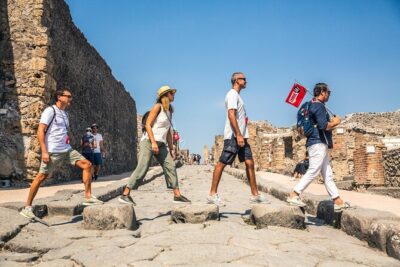
Skip-the-Line Pompeii Guided Tour from Sorrento
Read our review →
Skip the Line Guided Tour of Pompeii led by an Archaeologist
Read our review →Browse the lists this tour appears in