
Reviewed · SKIP THE LINE
Pompeii and Herculaneum Private Tour with Native Guide and Skip the Line Tickets
Pompeii and Herculaneum in one outing gives you two very different views of Roman life. Pompeii offers broad streets, public buildings, and busy commercial routes, while Herculaneum feels more compact and detailed. I especially like the private guide format and the chance to set your own pace. Skip-the-line entry is another real plus at two major archaeological sites.
I also like that the tour ends at Ercolano Scavi rather than returning you to Pompeii, which can fit neatly into a day of independent exploring. The main drawback is practical: transportation between sites, lunch, and hotel pickup are not included, so you must plan that part yourself.
In This Review
- Key points to know before booking
- Why seeing both Pompeii and Herculaneum matters
- Starting at Hotel Vittoria in Pompeii
- Pompeii’s streets, shops, and public life
- Teatro Grande and the sound of ancient entertainment
- The Stabian Baths and Roman daily routines
- Herculaneum’s compact, detailed ruins
- What the private format changes
- Skip-the-line tickets and the value of $431.33
- Timing, walking, and the point-to-point route
- Who will get the most from this experience
- Should you book this Pompeii and Herculaneum tour?
- FAQ
- How long does the Pompeii and Herculaneum tour last?
- Where does the tour begin?
- Where does the tour end?
- Are admission tickets included?
- Does the tour include skip-the-line entry?
- Is transportation included?
- Is lunch included?
- What happens if I need to cancel?
Key points to know before booking
- Two ancient cities in about five hours: You compare Pompeii and Herculaneum on the same guided outing.
- Private attention: Only your group joins the activity, making it easier to ask questions or adjust the pace.
- Skip-the-line admission: Tickets are included, so less time is spent waiting at the entrances.
- Strong guide choices: Italo, Rossana, Giovanna, and Roberta have each been praised for clear explanations and a friendly approach.
- A point-to-point finish: The tour starts in Pompeii and ends at Ercolano Scavi, with no return transfer included.
- Moderate fitness required: Expect substantial walking over archaeological ground during both site visits.
Why seeing both Pompeii and Herculaneum matters
If you have time for only one ancient Vesuvian site, choosing can be difficult. Pompeii is larger and gives you a stronger sense of an entire Roman town. Herculaneum is smaller, but its remains can feel more intimate and sharply detailed.
This tour lets you compare them without giving up one for the other. That is the central value here. You see Pompeii’s main street of commerce, theater, and public baths, then move on to Herculaneum for another view of the same ancient world.
The comparison also helps your guide explain Roman life in a more useful way. Instead of looking at isolated walls, you can connect homes, shops, public spaces, entertainment, and bathing. Giovanna, an archaeologist who has led this experience, is particularly well suited to explaining how ordinary life worked 2,000 years ago.
The timing is tight but sensible. About 2.5 hours are set aside for Pompeii and about 2 hours for Herculaneum, within an experience lasting roughly five hours. You will not see every corner of either site, and that is worth accepting before you book. The goal is a guided highlights visit, not an exhaustive archaeological survey.
More Skip-the-Line Tickets in Herculaneum
- Sorrento: Pompeii & Herculaneum Tour with Skip-the-Line
★ 4.6 · 125 reviews - Pompeii & Herculaneum – Skip the line from Sorrento
★ 4.5 · 44 reviews - Pompeii & Herculaneum Private Skip-the-Line Tour with Ticket
★ 4.9 · 39 reviews
Starting at Hotel Vittoria in Pompeii
The meeting point is Hotel Vittoria, at Piazza Esedra in Pompeii. You are responsible for reaching this point, since hotel pickup is not included. The location is near public transportation, which helps if you are staying elsewhere in the Pompeii area.
The tour begins with your private guide and the included entrance tickets. Since the group is private, you can ask for more detail on subjects that interest you, such as Roman homes, public entertainment, trade, or daily routines. You can also tell the guide if your group needs a slower pace.
A useful planning detail: the experience ends at Ercolano Scavi, not back at the starting point. This is convenient if you plan to continue from Herculaneum, but less convenient if your hotel or car is in Pompeii. Check your onward route before booking and allow time to arrange transportation between Pompeii and Herculaneum.
Pompeii’s streets, shops, and public life
Pompeii receives the larger share of the visit, with about 2.5 hours on site. Your guide takes you through key parts of the archaeological park and puts the remains into context. You are not simply left to wander among ruins with a printed map.
One of the most useful sections is Via dell’Abbondanza, the main commercial street. Walking this route gives you a feel for how Pompeii functioned as a living town. It connects the site’s architecture to movement, trade, and everyday business.
The street also helps you understand Pompeii at human scale. Large monuments can impress, but a commercial road shows how residents moved through the city and where public life took place. Your guide can point out the details that are easy to miss when you walk alone.
Expect uneven surfaces and plenty of walking. A moderate level of fitness is recommended, and comfortable shoes matter. The site is large enough that even a focused highlights route can feel active, especially in warm weather.
Teatro Grande and the sound of ancient entertainment
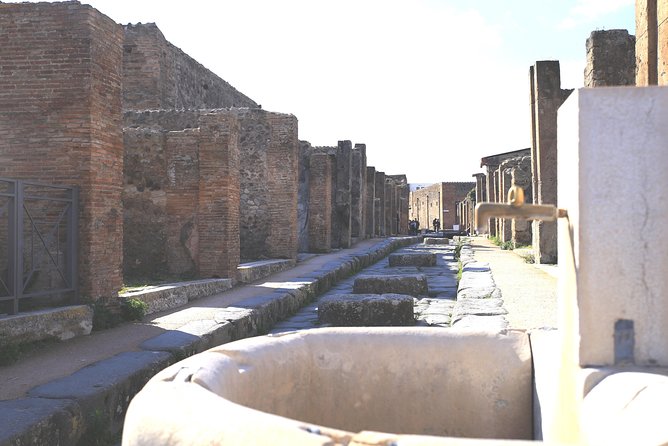
Teatro Grande is one of the named stops in Pompeii. Here, your guide discusses the theater and its acoustic qualities. The point is not only to look at stone seating, but to consider how performances worked in a Roman town.
The theater offers a change of pace from streets and houses. You can think about where people gathered for entertainment and how architecture shaped the experience. The guide’s commentary is important here because the remains alone do not explain how the space was used.
Theater visits also show why a private tour can be helpful for families. Roberta has been praised for making ancient life understandable and for answering questions in a patient way. If children are joining you, tell the guide at the start so the explanations can match the group.
More Pompeii excavation visits:
- Pompeii: Entry Ticket and Guided Tour with an Archaeologist
★ 4.8 · 19,459 reviews - Pompeii: Entry Ticket with Optional Audio Guide
★ 4.2 · 12,360 reviews - Pompeii: Small Group Tour with an Archaeologist
★ 4.8 · 12,264 reviews - Pompeii Small Group Tour with an Archaeologist
★ 5.0 · 6,593 reviews
The Stabian Baths and Roman daily routines
The Stabian Baths, or Terme Stabiane, add another layer to Pompeii. These public baths were part of Roman social life, not just places for washing. Your guide can connect the rooms and remains to the larger role of bathing in the city.
This stop is valuable because it moves the visit beyond the famous disaster. Pompeii was not simply a town frozen in a tragic moment. It was a working community with routines, public spaces, recreation, and social customs.
You should expect the stop to last about 30 minutes as part of the guided visit. That is enough time for an explanation and a close look, but not a long independent exploration of every bathing area. The guide helps you spend that limited time well.
Herculaneum’s compact, detailed ruins
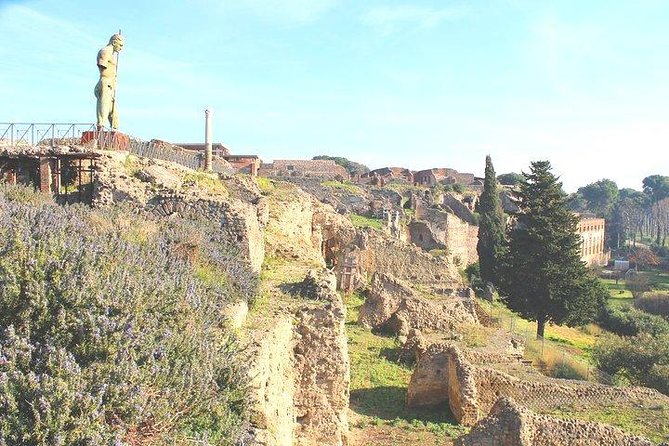
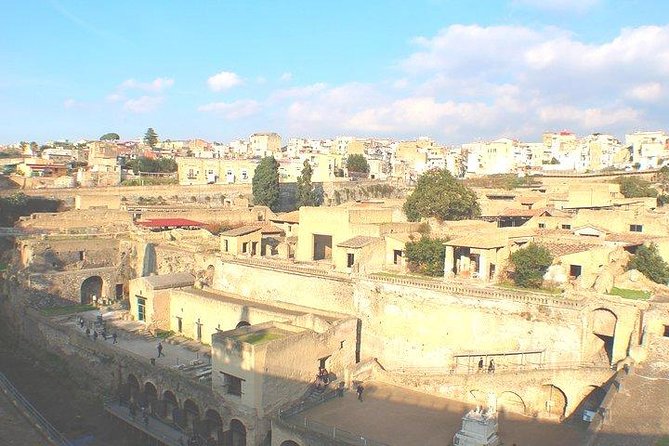
After Pompeii, the tour continues to Parco Archeologico di Ercolano for about two hours. Herculaneum offers a different kind of visit. Its smaller scale can make it easier to grasp the layout of a neighborhood and focus on the surviving details.
This is where the private guide’s storytelling can make a major difference. Giovanna has been praised for bringing both Pompeii and Herculaneum to life through explanations of Roman society. Her archaeological background is a particular asset for visitors who want more than dates and names.
Herculaneum works well as a second stop because you arrive with Pompeii fresh in mind. You can compare the two sites rather than treating them as unrelated ruins. The experience becomes less about collecting famous sights and more about noticing how two communities expressed similar Roman customs in different ways.
The two-hour visit is still a highlights tour. You may find that you want more time, especially if you enjoy architecture or archaeology. That is the tradeoff for fitting both sites into one outing.
What the private format changes
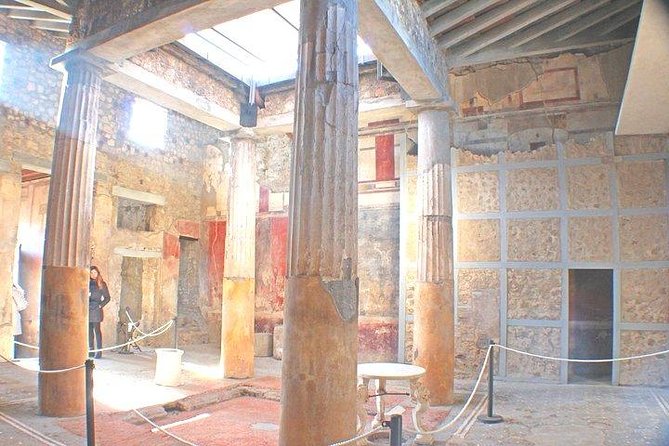
A private tour is not just a smaller version of a group tour. Only your party participates, so the guide can respond to your questions and interests. Italo has been praised for keeping a good pace, while also being friendly and patient with different ages.
That flexibility is useful at sites as large as Pompeii. Some groups want a brisk route focused on the major monuments. Others prefer to pause over Roman homes, public baths, theater, or the practical details of city life.
The tour is offered in English, and several guides have been praised for warmth as well as subject knowledge. Rossana, Italo, Giovanna, and Roberta are names associated with the experience. Guide assignment may vary, so you should not assume you will receive a particular person unless the provider confirms it.
A private format also makes this a better choice for families or mixed-age groups than a fixed group schedule. The tour still requires walking, though. Private does not mean low-effort.
Skip-the-line tickets and the value of $431.33
The price is $431.33 per person, with group discounts available. That is a serious cost, especially for a family, so you should judge it against what is included and what is not.
Admission to both archaeological sites is included, as is skip-the-line entry and a private local guide. The main service you are paying for is interpretation and time management. At Pompeii and Herculaneum, a good guide can save you from spending your limited hours trying to work out what each building once did.
The price does not include hotel pickup, transportation to Pompeii, travel between Pompeii and Herculaneum, transportation after the tour, or lunch. Those exclusions matter. You must budget for the transfers and decide where you want to eat on your own.
For a couple or small group that values personal attention, the price can make sense. A larger party may benefit more from the group discount. If you mainly want entrance tickets and prefer to explore alone, this is likely more than you need.
The booking pattern also suggests planning ahead. The experience is booked an average of 54 days in advance, so last-minute availability may not be reliable. Confirmation is provided at booking, and cancellation is free up to 24 hours before the start time. Changes or cancellations inside that window are not accepted for a refund.
Timing, walking, and the point-to-point route
The listed duration is about five hours. The schedule describes roughly 2.5 hours at Pompeii and 2 hours at Herculaneum, with the named Pompeii highlights folded into that visit. Think of it as a concentrated archaeological day rather than a relaxed all-day excursion.
The start and finish deserve attention. You meet at Hotel Vittoria, Piazza Esedra, in Pompeii, and finish at Ercolano Scavi in Ercolano. Since transport is not included, you need to make your own way to the beginning and arrange your onward plans from the end.
This route may work especially well if you are moving through the area and want to finish near Herculaneum. It may be less convenient if you are based in central Naples and hoped for door-to-door service. The provider does not include hotel transfers, so do not treat this as a fully escorted transportation tour.
Wear shoes suited to uneven archaeological paths and be ready for moderate physical activity. The private guide can help with pace, but cannot remove the walking required by the sites.
Who will get the most from this experience
I would consider this tour for first-time visitors who want both major Vesuvian sites but do not want to manage the archaeology alone. It also suits families, since guides such as Italo and Roberta have been praised for patience with children and for keeping explanations accessible.
It works well for couples and small groups who enjoy asking questions. Rossana has been praised for kindness and a strong grasp of Pompeii, while Giovanna brings an archaeologist’s perspective to both sites.
I would think twice if you want a slow, highly detailed day at Pompeii alone. One visitor chose to spend the full day at Pompeii to appreciate its details, which points to the main limitation here: fitting Herculaneum into the same outing means accepting a shorter Pompeii visit.
Should you book this Pompeii and Herculaneum tour?
Book it if you want a private English-speaking guide, included admission, skip-the-line entry, and a clear comparison of Pompeii with Herculaneum. The strongest reasons are the personal pace, the practical highlights route, and the chance to learn from guides such as Giovanna, Rossana, Italo, or Roberta.
Before paying, make sure the point-to-point route suits your plans. You will need to arrange transportation to the start, between the sites, and after the finish, and you will need to buy lunch separately.
For a private group that values context and convenience inside the archaeological parks, this is a strong choice. For independent visitors on a tight budget, the price and missing transfers may tip the balance toward self-guided entry.
FAQ
How long does the Pompeii and Herculaneum tour last?
The experience lasts approximately five hours. About 2.5 hours are allocated to Pompeii and about two hours to Herculaneum.
Where does the tour begin?
The meeting point is Hotel Vittoria, Piazza Esedra, 80045 Pompei, Italy.
Where does the tour end?
The tour ends at Ercolano Scavi in Ercolano, Italy.
Are admission tickets included?
Yes. Admission tickets for Pompeii and Herculaneum are included.
Does the tour include skip-the-line entry?
Yes. Skip-the-line entry is included for the archaeological sites.
Is transportation included?
No. Hotel pickup and drop-off, transportation to the sites, and transportation between Pompeii and Herculaneum are not included.
Is lunch included?
No. Lunch is not included.
What happens if I need to cancel?
You can cancel up to 24 hours before the experience start time for a full refund. Cancellations and changes made less than 24 hours before the start time are not accepted for a refund.
More Skip the Line in Pompeii Ruins
- Pompeii: Skip-the-Line Entrance Ticket with Audio Guide
★ 4.0 · 2,509 reviews - Sorrento: Skip-the-Line Pompeii Express Tour by Train
★ 4.8 · 2,038 reviews - Pompeii: Skip-the-line-Ticket and Guided Tour
★ 4.6 · 1,152 reviews - Pompeii: Guided Tour with Skip-the-Line Entry
★ 4.9 · 812 reviews
Newest reviews from Pompeii Ruins
- Private Tour Pompeii and Winery★ 5.0 · 4 reviews
- Visit the Pompeii ruins from Salerno with Pizza Lunch★ 5.0 · 4 reviews
- Pompeii Private Tour for Kids and Their Families★ 4.8 · 4 reviews
- From Sorrento: Pompeii & Vesuvius tour small group★ 4.8 · 4 reviews
- Pompeii Sorrento and Positano Tour★ 5.0 · 4 reviews
- From Naples_ Pompeii Tour_Skip the line ticket + audioguide★ 4.3 · 4 reviews
- Pompeii, skip-the-line ticket with smartphone audio guide on App★ 3.0 · 4 reviews
- Pompeii Private Half-Day Tour from: Naples,Sorrento, Amalfi Coast★ 5.0 · 4 reviews
Skip the Line, compared.

Skip-the-Line Entrance Ticket with Audio Guide
Read our review →



Skip-the-Line Entry Ticket with Digital Guide App
Read our review →
Pompeii Ruins Private Tour with Optional Skip-the-Line Entry
Read our review →
Skip-the-Line Pompeii Guided Tour from Sorrento
Read our review →
Skip the Line Guided Tour of Pompeii led by an Archaeologist
Read our review →Browse the lists this tour appears in