
Reviewed · SKIP THE LINE
Pompeii & Herculaneum – Skip the line from Sorrento
Pompeii and Herculaneum tell the same disaster story in very different ways. Pompeii gives you broad streets, public buildings, and a strong sense of city life, while Herculaneum brings you closer to preserved homes, frescoes, shops, baths, and the routines of ordinary Romans. I like that this tour lets you compare both sites in one day instead of choosing between them.
I also like the hotel pickup and return to Sorrento, plus lunch included in the price. Guides such as Tony, Cynthia, Cinzia, Laura, and Martina have been praised for bringing the ruins to life and keeping the day organized. The main drawback is time: two hours at each site only covers the key areas, and the hot, uneven ground can make this a demanding day.
In This Review
- Key points at a glance
- Why seeing both sites changes the story
- Leaving Sorrento along the Bay of Naples
- Pompeii in two hours: the big picture first
- Lunch near Pompeii and what to expect
- Herculaneum’s preserved homes and daily life
- How good are the guides and audio headsets?
- What the $186.23 price includes
- Who should book this day trip?
- Practical advice before you go
- Should you book Pompeii and Herculaneum from Sorrento?
- FAQ
- How long does the Pompeii and Herculaneum tour last?
- What time does the tour start?
- Where does pickup take place?
- Is lunch included?
- How much time do I spend at each archaeological site?
- Is the tour offered in English?
- Is this tour suitable for people with limited mobility?
- Can I cancel for a full refund?
Key points at a glance
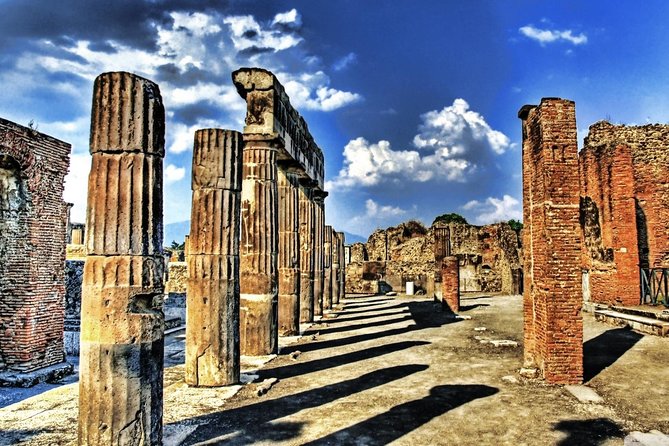
- Two Roman towns in one day: See Pompeii’s large urban layout and Herculaneum’s remarkably preserved buildings.
- About two hours at each site: Enough for the major sights, but not enough for a thorough visit.
- Lunch is included: Expect a simple Italian meal, with some menus including wine, beer, or a soft drink.
- Pickup from Sorrento: Your driver and guide collect you from your accommodation or a nearby meeting point.
- Uneven ground and hot sun: Wear firm walking shoes, carry water, and plan for a full day on your feet.
- English-speaking guidance: An authorized local guide leads the archaeological visits, with headsets used in some groups.
Why seeing both sites changes the story
Pompeii is the famous name, but Herculaneum often becomes the surprise favorite. That is not because it is larger. It is smaller and easier to cover, but its buildings and decorative details can feel more immediate.
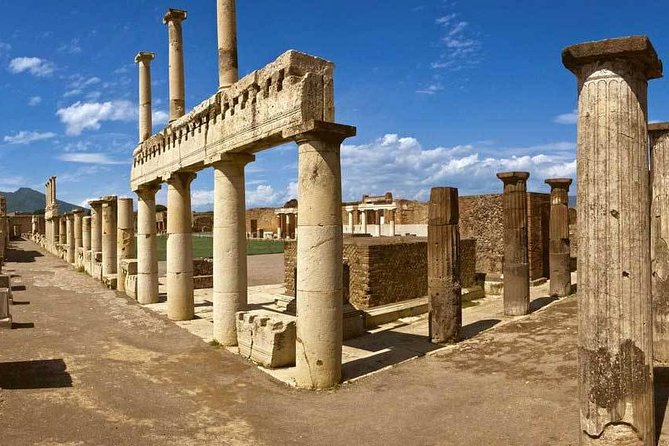
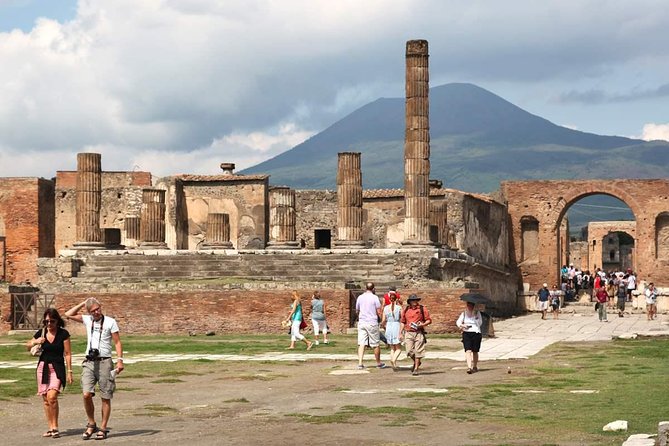
Pompeii was a busy city with wide streets, public monuments, homes, shops, and the Forum at its center. Your guided visit focuses on the Forum, major public buildings, and selected houses. You get the broad outline of Roman city life and see how people moved through a working town.
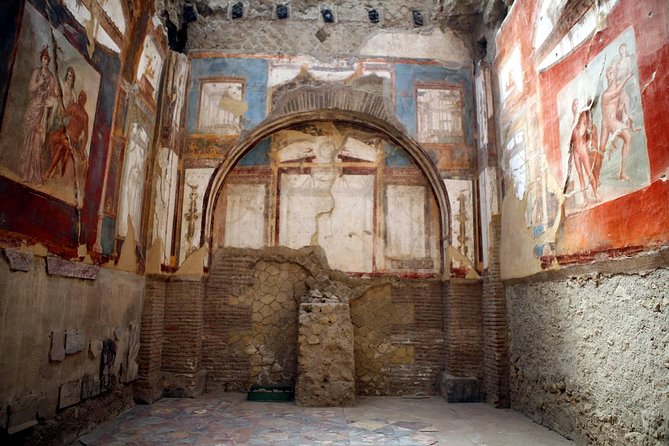
Herculaneum offers a different kind of evidence. The guided route includes intact buildings, frescoes, shops, public gymnasiums, and thermal baths. Here, the story feels more domestic. You can picture people shopping, exercising, bathing, and carrying out ordinary routines before the eruption changed everything.
I find the comparison valuable because the two sites are not simply duplicate ruins. The tour shows you two communities buried by the same volcano, each with a different character and degree of preservation. Both were seaside towns in Roman times, although the coastline has shifted far from the ruins today.
More Skip-the-Line Tickets in Herculaneum
- Herculaneum: 3D Walking Tour with Skip-the-Line Ticket
★ 4.3 · 313 reviews - Ercolano: Herculaneum Skip-the-Line Ticket & Audio Guide
★ 4.0 · 275 reviews - Herculaneum: Skip The Line Entrance ticket + Audioguide
★ 4.3 · 266 reviews
Leaving Sorrento along the Bay of Naples
The day begins at about 8:15 a.m. Pickup is arranged at your accommodation or at the nearest meeting point. If you are staying outside the central pickup area, confirm the exact location carefully. One person paid extra for a taxi after discovering that the nearest meeting point was not close enough for an early start.
The drive follows the Sorrento Coast, with views toward the Bay of Naples on the way to Pompeii. This road section is part of the experience, but it also means the day depends on traffic and road conditions. The route back to Sorrento gives you time to rest after the archaeological visits.
The group can include up to 45 people. That is large enough for a lively outing and small enough to keep moving as one unit, though the feel may vary depending on the vehicle and the day. Some groups have used a comfortable small coach, and the transport is a major help compared with arranging separate trains, taxis, and site entries.
Your driver and guide handle the route, while the local guide leads the visits. Driver quality matters on the winding roads around Sorrento and Naples, so it is worth checking that everyone is seated and settled before the vehicle moves. The overall transport experience has been praised, but one serious complaint described unsafe driving and poor conduct. That appears to be an exception, but it is a fair reminder that the driver is part of your experience too.
Pompeii in two hours: the big picture first
The planned first archaeological stop is Pompeii, with about two hours inside the excavations. An authorized local guide leads you through selected highlights rather than attempting the entire site.
That is the sensible approach for a day combining two locations. Pompeii is huge, and you could spend several days exploring it properly. A short guided route gives you a framework: the Forum, major public monuments, and some homes. You will see enough to understand the city’s scale and layout, but you will not visit every street or building.
The Forum is the key to making sense of Pompeii. It was the center of public life, and it helps explain how religion, politics, trade, and social activity came together in one urban space. From there, the guide can connect the large monuments with details found in the houses and streets.
The strongest part of the visit is the interpretation. Ruins can look like piles of old stone when you do not know what you are seeing. A guide such as Tony, Laura, Antonio, or Cinzia can point out details that would be easy to pass without context. Cynthia has been praised for energy and organization, while Martina has been noted for using questions to keep the group involved.
You should also expect a fair amount of walking on uneven ancient paving. Some areas are slippery, and there is little shade in places. Bring water, use sun protection, and wear shoes with a good grip. Pompeii can be very hot, and a two-hour route under the sun takes more energy than the clock suggests.
Toilets can be scarce or far apart once you are inside. If you have a sensitive stomach or need regular bathroom access, use facilities before entering and plan ahead. This is a small practical detail, but it can make a major difference during a long visit.
Lunch near Pompeii and what to expect
After Pompeii, the group stops at a nearby local restaurant for a Neapolitan meal. Lunch is included, which makes the day easier because you do not have to search for food during a tight schedule.
The meal is generally described as a simple set menu. Some accounts describe a three-course meal, and wine, beer, or a soft drink may be included. Other descriptions mention pasta with marinara sauce as the standard dish. Food quality appears uneven: some people found it much better than expected, while others found the pasta too salty, the salad chicken bland, or the overall meal poor.
That mixed experience is useful to keep in mind. Treat lunch as a convenient pause and a chance to eat with the group, not as a reason to book the tour. A set menu keeps the schedule moving, but it may not suit every taste or dietary preference. The supplied information does not promise a wide range of alternatives, so ask about meal requirements before booking if you need something specific.
The break also divides the day well. After Pompeii, you get a chance to sit down before tackling Herculaneum. You may appreciate that more than you expect, especially in summer.
More Pompeii excavation visits:
- Pompeii: Entry Ticket and Guided Tour with an Archaeologist
★ 4.8 · 19,459 reviews - Pompeii: Entry Ticket with Optional Audio Guide
★ 4.2 · 12,360 reviews - Pompeii: Small Group Tour with an Archaeologist
★ 4.8 · 12,264 reviews - Pompeii Small Group Tour with an Archaeologist
★ 5.0 · 6,593 reviews
Herculaneum’s preserved homes and daily life
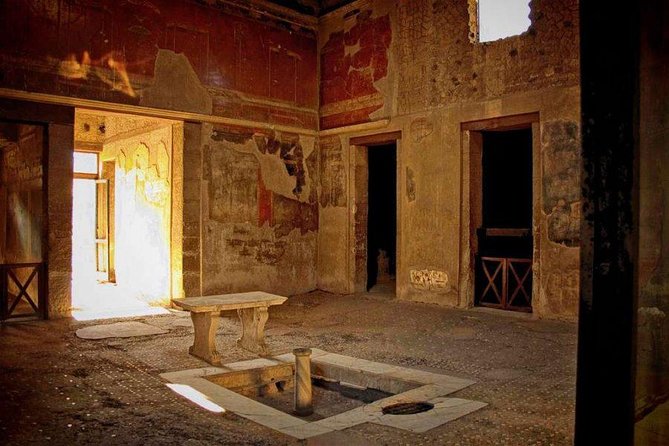
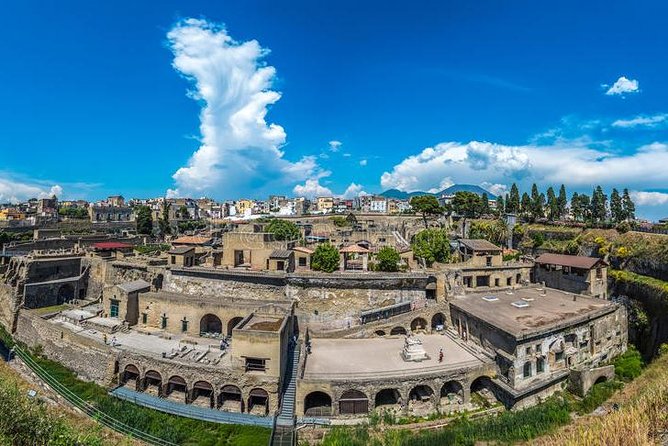
The second archaeological visit lasts about two hours at Herculaneum, also called Ercolano. This is where the tour’s contrast becomes clearest.
Herculaneum was smaller than Pompeii, but many buildings survived in a more complete state. You can see preserved walls, decorative frescoes, shops, public gymnasiums, and thermal baths. The guide focuses on how people used these spaces, so the visit often feels less like looking at monuments and more like reconstructing daily life.
The route includes uneven areas and steps, so Herculaneum is not an easy stroll. You need moderate physical fitness for the full day, and the combination of both sites can be tiring. Still, its more compact layout can make it easier to follow than Pompeii.
A guide is especially useful here because the site can be confusing without a clear route. You may otherwise miss the meaning of a painted wall, a shop opening, or the layout of a bathing complex. Guides have included Ionica, Alex, Ernesto, and Desire, all praised for explaining the setting and keeping the group together.
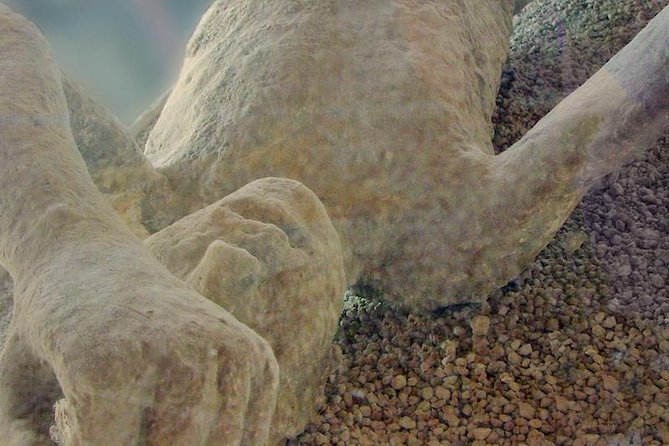
There is one important limitation. The two-hour visit may not include every major section, and at least one route left the group disappointed because it did not reach the area associated with the skeletons. If that section is essential to you, ask before departure whether it is part of the planned route. The guide may need to balance access, walking speed, and the fixed return schedule.
Some groups have started at Herculaneum before Pompeii, although the published itinerary begins with Pompeii. The order can affect your day. Herculaneum first may feel calmer and easier to navigate, while Pompeii first provides a useful introduction to Roman urban planning. Confirm the sequence on the morning of the tour if it matters to you.
How good are the guides and audio headsets?
The guide is the heart of this experience. Several named guides, including Tony, Cynthia, Cinzia, Laura, Martina, Antonio, Alex, and Ernesto, have been singled out for clear explanations, friendly manner, organization, and enthusiasm.
That praise matters because the ruins require interpretation. A guide can show you where a public building fits into city life, explain why a home was arranged as it was, and point out details that do not announce themselves. The best guides also manage time, count the group, and make sure nobody is left behind.
The quality may vary by departure because the guide is assigned rather than selected. One guide was described as informative but not especially engaging, while another gave so much information that some of it felt unnecessary. That is a normal tradeoff on a site as dense as Pompeii. You are paying for a structured overview, not a private lecture tailored to your exact interests.
Headsets are used in some groups so you can hear the guide while taking photos or standing a short distance away. They have been praised as helpful, but the particular one-piece devices used by some groups did not stay on every ear and had patchy reception. If you use hearing aids or have trouble keeping an earpiece in place, tell the guide early and stay close.
What the $186.23 price includes
At $186.23 per person, this is not the cheapest way to visit Pompeii and Herculaneum. The value comes from combining several services in one day: transport from Sorrento, an English-speaking archaeological guide, skip-the-line access, visits to both sites, and lunch.
If you arrange everything yourself, you may spend less, especially if you are comfortable using public transport and studying the ruins independently. But you would need to coordinate two destinations, manage tickets, find food, and keep an eye on the return journey. The guided option is aimed at people who value ease and explanation more than the lowest possible cost.
The price makes the most sense if you have only one free day in Sorrento and want both sites. It is also a good fit if you prefer not to drive in the Naples area or deal with regional transport. You are buying time management as much as admission and transportation.
The value drops if you want long, unhurried visits. Pompeii alone deserves far more than two hours, and Herculaneum has enough detail to reward extra time. Independent visitors with strong archaeological interests may prefer separate days.
Who should book this day trip?
I would choose this tour if you want a clear introduction to both cities and prefer having the day arranged for you. It suits couples, families with older children, and first-time visitors who want context without spending hours planning routes.
It is less suitable for anyone who struggles with steps, uneven paving, heat, or long periods of walking. The activity asks for moderate physical fitness, and the full day can be tiring even when the coach is comfortable.
It may also frustrate serious history fans who want to explore every street, or anyone who dislikes set meals and fixed departure times. You will follow the guide’s route and the group’s schedule.
The tour is generally well received, with a 4.6 rating and 93 percent of participants recommending it. That strong overall result is balanced by complaints about lunch, limited time, headset problems, pickup communication, and one reported driver incident. I would not ignore those concerns, but they do not erase the central strength: one well-organized day can introduce you to two of Italy’s most important archaeological sites.
Practical advice before you go
Wear sturdy shoes. Ancient paving is uneven, and some sections can be slippery. Sandals with thin soles are a poor choice.
Carry water. Both sites can be hot, shade is limited, and there are long stretches between stops. The coach may have bottled water available for purchase, but do not depend on that.
Use the bathroom before entering Pompeii. Facilities may be far apart once you are inside.
Confirm the pickup point and time. The start is early, and the tour may use a nearby meeting point rather than your exact hotel. If you are arriving by cruise ship, pay special attention to email updates. One booking failed when a time change was not received by someone onboard, and rescheduling was not offered.
Allow for schedule changes. The activity requires a minimum number of participants, and if that minimum is not met, you are offered another date or experience, or a full refund. Standard cancellation is free up to 24 hours before the start time. Cancellations or changes made later are not accepted for a refund.
Should you book Pompeii and Herculaneum from Sorrento?
Book it if your priority is seeing both sites in one day with transport, lunch, and an English-speaking guide already arranged. The comparison between Pompeii’s broad civic spaces and Herculaneum’s preserved homes is the real reason to go, and guides such as Tony, Cynthia, Cinzia, Laura, and Martina have helped make the sites understandable and memorable.
Skip it if you want to study Pompeii at length, need flexible meal choices, or dislike walking on rough ground in hot weather. For most first-time visitors with limited time in Sorrento, though, the tour offers a practical way to cover a lot of ancient history without taking on the planning yourself.
FAQ
How long does the Pompeii and Herculaneum tour last?
The experience lasts about eight hours, including transportation, both guided archaeological visits, lunch, and the return to Sorrento.
What time does the tour start?
The scheduled start time is 8:15 a.m.
Where does pickup take place?
Pickup is from your accommodation or the nearest designated meeting point in Sorrento. Confirm the exact location before the tour, especially if you are staying outside the central area.
Is lunch included?
Yes. Lunch at a nearby local restaurant is included in the tour price. The meal is generally a set Italian menu, and some descriptions include wine, beer, or a soft drink.
How much time do I spend at each archaeological site?
The guided visit at Pompeii lasts about two hours, followed by about two hours at Herculaneum.
Is the tour offered in English?
Yes. The tour is offered in English and includes an English-speaking guide.
Is this tour suitable for people with limited mobility?
The activity requires moderate physical fitness. Both sites have uneven surfaces, steps, and areas that may be slippery, so it may not suit anyone who has difficulty walking on rough ground.
Can I cancel for a full refund?
You can cancel for a full refund up to 24 hours before the local start time. Changes or cancellations made less than 24 hours before the experience are not accepted for a refund.
More Skip the Line in Sorrento
- Pompeii: Skip-the-Line Entrance Ticket with Audio Guide
★ 4.0 · 2,509 reviews - Sorrento: Skip-the-Line Pompeii Express Tour by Train
★ 4.8 · 2,038 reviews - Pompeii: Skip-the-line-Ticket and Guided Tour
★ 4.6 · 1,152 reviews - Pompeii: Guided Tour with Skip-the-Line Entry
★ 4.9 · 812 reviews
Newest reviews from Sorrento
- Tour in the ruins of Pozzuoli with an archaeolgist.★ 5.0 · 4 reviews
- Vico Equense: Authentic Cooking Class at a Local’s Home★ 5.0 · 4 reviews
- Private Stress-Free Tour from Sorrento: Ischia Island & Tastings★ 5.0 · 4 reviews
- Lemon Experience with Limoncello demonstration★ 5.0 · 4 reviews
- Path of the Lemons★ 5.0 · 4 reviews
- Private Tour Pompeii and Winery★ 5.0 · 4 reviews
- Positano Private Tour By Night from Sorrento★ 5.0 · 4 reviews
- Walking Secret Food Tours Sorrento with tastings★ 4.5 · 4 reviews
Skip the Line, compared.

Skip-the-Line Entrance Ticket with Audio Guide
Read our review →



Skip-the-Line Entry Ticket with Digital Guide App
Read our review →
Pompeii Ruins Private Tour with Optional Skip-the-Line Entry
Read our review →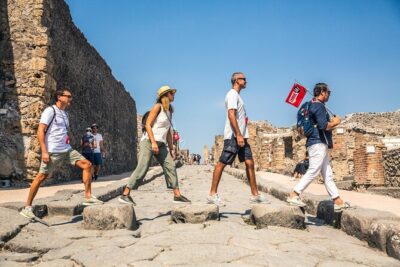
Skip-the-Line Pompeii Guided Tour from Sorrento
Read our review →
Skip the Line Guided Tour of Pompeii led by an Archaeologist
Read our review →Browse the lists this tour appears in