
Reviewed · ARCHAEOLOGIST-LED TOURS
Pompeii 3h Private & Quality Tour with your Archaeologist
Pompeii is much easier to understand when someone can explain what you’re seeing, rather than leaving you to wander among walls and scattered stones. This three-hour private tour with an archaeologist connects the city’s temples, shops, homes, baths, and public buildings into a readable picture of Roman life.
I like the small private format, which lets you set the pace and ask as many questions as you wish. I also like the unusual details built into the route, from charred food in the Great Gymnasium to the coin that helped change the accepted date of the eruption.
The main drawback is cost. At $385.32 per group, the tour becomes good value for a larger party, but it is expensive for one or two people, especially since the €19 admission ticket per person is extra.
In This Review
- Key points to know before booking
- Starting at Porta Marina with Vesuvius overhead
- The antiquarium gives the ruins a human scale
- The Basilica, Forum, market, and temples
- Walking the Greater Decumanus to the baths and Lupanare
- Painted houses and the newly opened Domus of Leda
- Via dell’Abbondanza and the plaster casts at the Fugitives’ Garden
- The Great Gymnasium and its everyday objects
- Finishing at the amphitheater
- Why the archaeologist guide matters
- Price, group size, and overall value
- Who should book this Pompeii tour?
- Practical details worth knowing
- Should you book it?
- FAQ
- Where does the Pompeii tour start?
- Where does the tour end?
- How long does the experience last?
- How many people can join the private tour?
- Is the entrance ticket included?
- How do I get a direct skip-the-line ticket?
- What language is offered?
- Is the tour private?
- Can I cancel for a full refund?
- Are service animals allowed?
Key points to know before booking
- Start at Porta Marina Superiore: Meet at the main entrance on Via Villa dei Misteri, with Vesuvius in view.
- Archaeologist-led touring: Guides including Raffaele, Patrizia, Paolo, Francesco, Riccardo, and Daniela have led visits praised for clear explanations and an easy manner.
- Private group of up to 10: You can ask for specific sights and adjust the pace to suit your party.
- Major sights in three hours: See the Forum, Basilica, temples, baths, Lupanare, painted houses, plaster casts, Great Gymnasium, and amphitheater.
- Admission is separate: The operator sends a link for the direct skip-the-line ticket, priced at €19 per person.
- Best for curious families and first-time visitors: The route mixes famous sights with small details that make the ruins easier to picture.
Starting at Porta Marina with Vesuvius overhead
You meet at the Pompeii Archaeological Park entrance called Porta Marina Superiore, at Via Villa dei Misteri 2. This is a useful starting point because the route begins with one of Pompeii’s most memorable visual pairings: the ancient city below and Mount Vesuvius behind it.
The tour is offered in English and is private for your group. The listed capacity is up to 10 people, so the price works differently depending on your party size. A couple pays a premium for personal attention, while a family or group of friends can divide the cost and get a stronger value per person.
You do not simply arrive and join a general crowd. Before the visit, you receive a web link to purchase the direct skip-the-line admission ticket. The €19 entrance fee is not part of the tour price, so include it in your budget.
That arrangement keeps the guide’s fee and park admission separate, but it also means you need to complete the ticket purchase yourself. Check the instructions carefully before arriving. The meeting point is specific, and the activity ends back there.
More Pompeii excavation visits:
- Pompeii: Entry Ticket and Guided Tour with an Archaeologist
★ 4.8 · 19,459 reviews - Pompeii: Entry Ticket with Optional Audio Guide
★ 4.2 · 12,360 reviews - Pompeii: Small Group Tour with an Archaeologist
★ 4.8 · 12,264 reviews
The antiquarium gives the ruins a human scale
The first stop is the antiquarium, where objects from recent excavations help put faces and dates to a site that can otherwise feel like a vast open-air ruin. The guide points out items such as a coin that helped alter the accepted date of the eruption and a heavy golden arm cuff.
These objects are valuable because they interrupt the usual Pompeii story. You are not looking only at walls preserved by volcanic ash. You are also considering the evidence archaeologists use to revise their understanding of the city and its final days.
This is where an archaeologist guide can make a real difference. The guide can explain why an object matters, how excavation changes earlier ideas, and how a small find can affect the wider story. You also have the chance to ask questions immediately, rather than trying to remember them for later.
The Basilica, Forum, market, and temples
From the antiquarium, the route continues to the Basilica and the Forum, Pompeii’s central public space. The Forum is the right place to begin thinking about how the city worked, since religious, political, and commercial activity gathered around it.
The tour includes the market and the main temples. Your guide’s job here is not just to name each building, but to show how the pieces fit together. You can look across the open square, then connect it to the public offices, places of worship, and trade that surrounded it.
The scale of the Forum can be difficult to grasp on your own. Three hours is not enough to examine every structure in Pompeii, but a focused explanation helps you spend your time on the parts that give the city meaning.
Walking the Greater Decumanus to the baths and Lupanare
The Greater Decumanus takes you along one of Pompeii’s principal streets. This section gives you a better sense of movement through the city, with buildings opening onto the road and public life taking place close to home.
The route includes a look inside the thermal system. Roman baths were not just places to wash. They were social and practical spaces, and the remains help show the systems that supported daily life.
You also visit the Lupanare, Pompeii’s most famous brothel. It is a popular stop, but the guide’s context matters here. Without explanation, you see small rooms and painted decorations. With a clear account of how the building fit into the city, the stop becomes part of a wider picture of commerce, privacy, and public behavior.
The Lupanare may not suit every child, so families should consider the ages and interests in their group. The tour has been used successfully with children as young as eight, and the guide can pitch explanations to adults and children, but parents may still want to discuss the stop in advance.
More tours led by an archaeologist:
- Pompeii Small Group Tour with an Archaeologist
★ 5.0 · 6,593 reviews - Pompeii and Herculaneum Small Group Tour with an Archaeologist
★ 5.0 · 1,350 reviews - Skip the Line Guided Tour of Pompeii led by an Archaeologist
★ 5.0 · 703 reviews - Pompeii: Exclusive Tour with Archaeologist and Entry Tickets
★ 4.9 · 634 reviews
Painted houses and the newly opened Domus of Leda
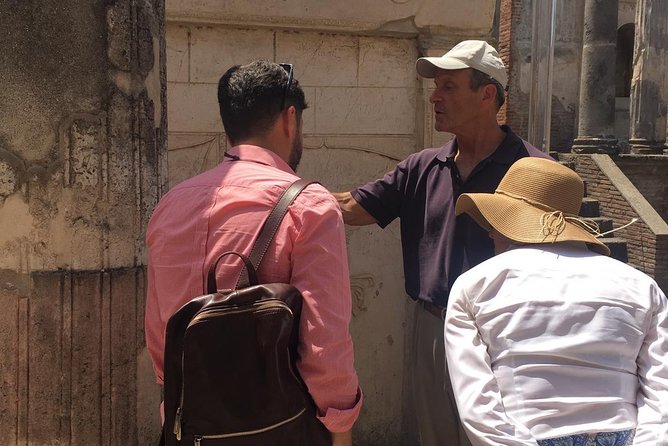
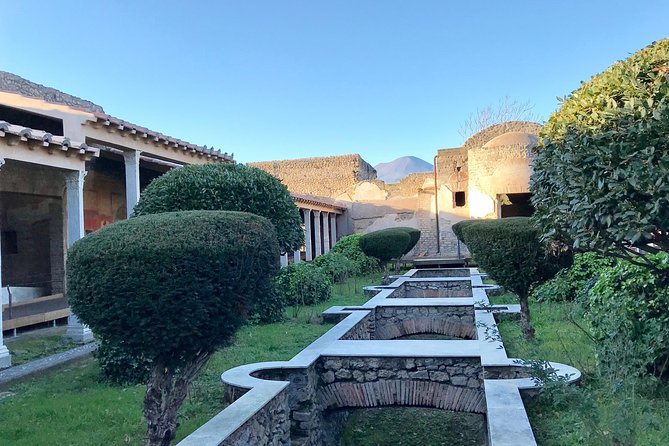
Pompeii’s private houses are among the strongest reasons to book a guide. The domus can look like a series of courtyards and damaged rooms until someone explains how the spaces were arranged and what the wall paintings meant.
The route includes several important houses, including the Domus of Leda and the Swan, described as one of the recently opened homes. You may also see restoration work at the House of the Golden Cupids. The guide can explain both the ancient decoration and the modern work needed to protect it.
The painted interiors are a highlight. The remains retain a surprising amount of detail, and the three-dimensional quality of the wall decoration helps you picture how carefully these homes were designed. This is a good place to slow down and ask questions, since the private houses reward attention more than a quick photograph.
One especially useful feature is the chance to request particular spots. A private format does not guarantee that every requested building will be open on the day, but the guide can adapt the route where possible. That flexibility is valuable at a large site with changing access and ongoing work.
Via dell’Abbondanza and the plaster casts at the Fugitives’ Garden
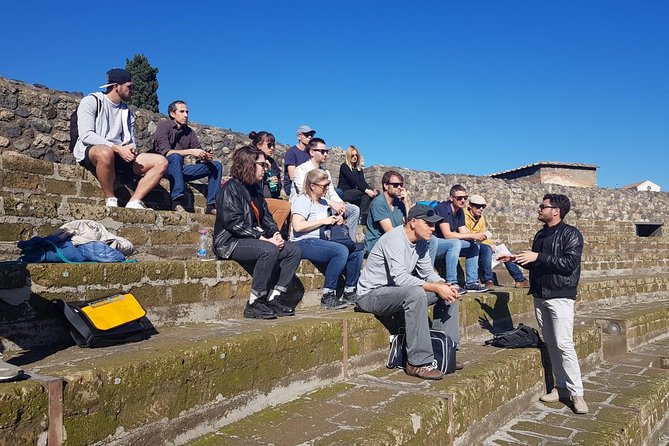
The tour then follows Via dell’Abbondanza, one of Pompeii’s main streets. This gives you another view of daily life, after the grand public buildings and elegant houses. The street itself helps connect the city’s major landmarks to ordinary movement, trade, and neighborhood life.
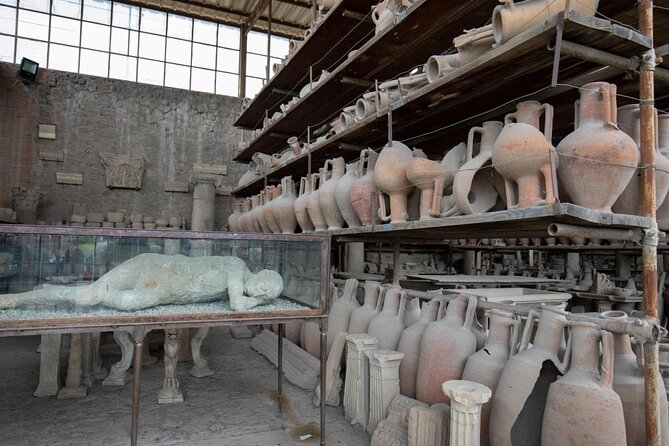
The route reaches the area known as the Fugitives’ Garden. During the eruption, people tried to escape through this part of the city, but died there. The plaster casts preserve the shapes of some of those victims.
This can be the most emotionally difficult section of the visit. The casts are not simply archaeological objects. They are evidence of individual lives interrupted in a disaster, and the guide’s explanation helps you approach the site with respect rather than treating it as a curiosity.
If you are visiting with children, this is another place to judge your own group. The tour is suitable for most participants, but the subject matter is serious. A private guide can adjust the explanation and pace better than a large group can.
The Great Gymnasium and its everyday objects
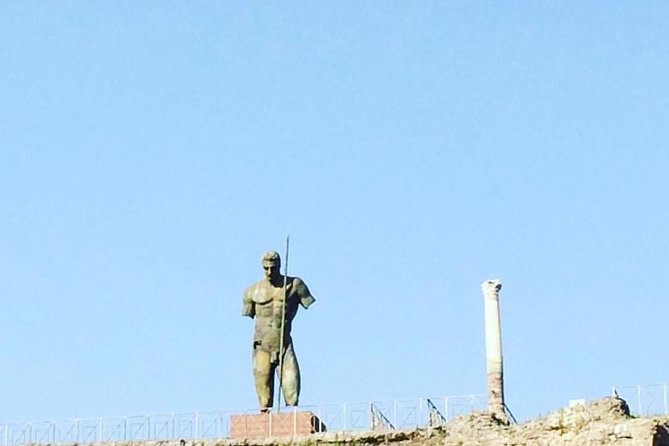
The Great Gymnasium provides a different kind of experience. Along with the large public space, objects from daily life are displayed, including charred food preserved by the eruption.
That detail is easy to remember because it brings Pompeii down to the level of meals, kitchens, and household routines. A temple or forum shows how the city presented itself in public. Burned food shows what people handled in private.
The Great Gymnasium also helps balance the tour. Pompeii is often reduced to grand villas and tragic casts, but the ordinary objects are just as useful for understanding the people who lived there. I would pay close attention here and ask the guide to connect the objects with the homes, shops, and streets you have already seen.
Finishing at the amphitheater
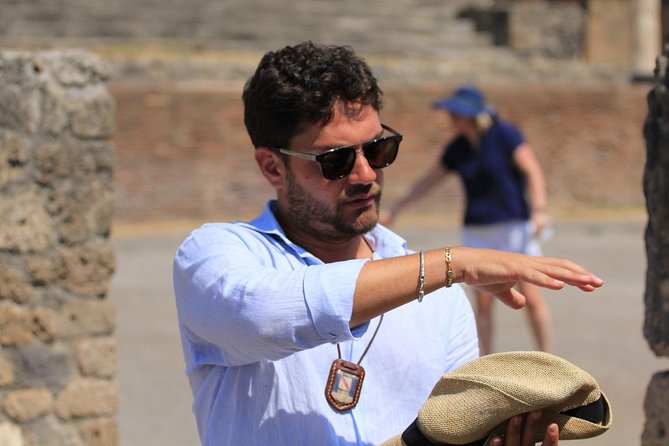
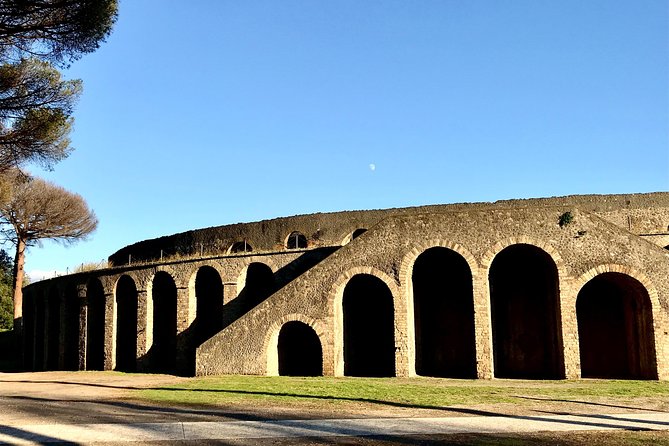
The final stop is the amphitheater, a fitting end to a route that moves from the center of public life to the city’s homes and streets. It gives you one last look at how Pompeii organized entertainment on a large scale.
Ending here also keeps the visit varied. You have seen sacred spaces, civic buildings, private rooms, industrial systems, evidence of disaster, and everyday objects. The amphitheater adds another public setting without requiring the tour to retrace the entire route.
The tour returns to the meeting point after this stop. Since Pompeii is a large archaeological park, three hours will not cover every street or house. That is not a flaw so much as a choice: this route favors a strong introduction to the city’s main themes over a complete survey.
Why the archaeologist guide matters
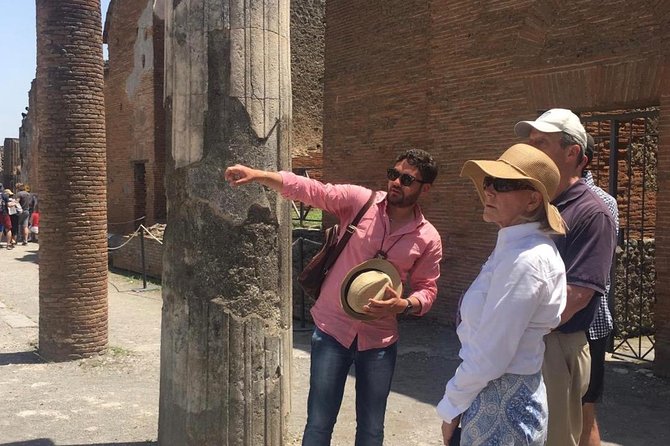
The guide is the central reason to choose this experience instead of walking in alone. The listed guides have different names, but the strongest pattern is clear: explanations are expected to be accurate, understandable, and lively.
Raffaele was especially praised for answering questions in clear English, explaining archaeology in plain terms, and helping visitors picture Pompeii as it once was. His easy attitude also allowed the group to request specific places and adjust the route. He was described as taking good photos and selfies too, a small but useful touch for families or groups of friends.
Patrizia was praised for managing time well and keeping the material fun for a group ranging from an eight-year-old to a 62-year-old. Paolo was noted for holding the attention of both adults and children. Francesco was described as combining strong site knowledge with a pleasant personality, while Riccardo focused on the paintings and the Roman world behind them.
Daniela led a French-language visit in one account, but the experience information here lists English as the offered language. Do not assume another language is available unless the provider confirms it.
Price, group size, and overall value
The price is $385.32 for up to 10 people, with admission extra at €19 per person. For 10 people, the guide cost works out to about $38.53 per person before admission. For four people, it is about $96.33 each before tickets. For two people, the price is much harder to justify unless personal attention and specialist knowledge are your main priorities.
Compared with a large group tour, a private archaeologist-led visit gives you more control. You can ask questions without waiting, request certain houses, and set a manageable pace. That matters at Pompeii, where the amount of information can become tiring and where walking surfaces may make a rushed visit unpleasant.
The price also buys more than simple narration. The guide explains recent finds, restoration work, domestic decoration, public buildings, and the evidence left by the eruption. If Pompeii is a major reason for your trip, that added context may be worth the premium.
The tradeoff is that the ticket fee is separate and the three-hour limit is firm. You will get a focused introduction, not an exhaustive tour of the entire park.
Who should book this Pompeii tour?
I would recommend it most strongly for a family, friend group, or multigenerational party that wants one guide for everyone. The private format is especially useful when one person wants archaeology, another wants architecture, and children need shorter explanations and a flexible pace.
It also suits anyone who has visited Pompeii before but felt lost among the ruins. A previous visit without a guide can leave you impressed by the scale but unsure what you actually saw. This route gives structure to the return visit and includes houses and objects that may not have been open or explained previously.
Older adults may appreciate the manageable pace and the ability to slow down. One guide adjusted the tour for an 81-year-old participant, which suggests that the private setup can work well for groups with different walking speeds.
You should think twice if you want several hours of independent wandering or if you are watching every euro. The tour covers many major sights, but you will follow a planned route and pay separately for admission. It is also not the right choice if you expect to see every corner of Pompeii in one morning.
Practical details worth knowing
Confirmation arrives at booking, and the meeting point is near public transportation. Service animals are allowed, and the experience states that most people can participate.
You should arrange the admission ticket before arriving, using the direct purchase link provided before the tour. The tour itself is in English, and only your group participates.
Free cancellation is available when you cancel at least 24 hours before the start time. Cancellations or changes made inside that 24-hour period are not accepted for a refund, and the cut-off follows local time.
Should you book it?
Book this tour if you want Pompeii explained by an archaeologist rather than simply photographed. The strongest reasons are the private pace, the ability to ask for particular places, and the attention given to details such as the eruption-date coin, painted domus, restoration work, plaster casts, and charred food.
For a large group, the price is reasonable for three hours of specialist guidance. For one or two people, it is a splurge, but a worthwhile one if Pompeii is a central part of your Italy trip and you value clear interpretation over the lowest price.
I would choose it for families, first-time visitors, repeat visitors who want more context, and anyone who prefers a focused route through a huge site. I would skip it only if you want to roam independently or need a budget visit.
FAQ
Where does the Pompeii tour start?
It starts at Scavi di Pompei, the Porta Marina Superiore ticket office, at Via Villa dei Misteri 2, 80045 Pompei, Italy.
Where does the tour end?
The activity ends back at the meeting point.
How long does the experience last?
The guided visit lasts approximately three hours.
How many people can join the private tour?
The private tour is available for a group of up to 10 people.
Is the entrance ticket included?
No. Admission is not included. The ticket costs €19 per person.
How do I get a direct skip-the-line ticket?
Before the tour, the provider sends you a web link to purchase the direct skip-the-line admission ticket.
What language is offered?
The experience is offered in English.
Is the tour private?
Yes. Only your group participates in the activity.
Can I cancel for a full refund?
Yes, if you cancel at least 24 hours before the scheduled start time.
Are service animals allowed?
Yes. Service animals are allowed, and the activity states that most people can participate.
More 3-Hour Experiences in Pompeii Ruins
- Pompeii Private Tour with an Archaeologist and Skip The Line – 3 hours
★ 5.0 · 564 reviews - Pompeii 3 Hours Walking Tour Led by an Archaeologist
★ 5.0 · 126 reviews - Pompei three hours with an expert guide
★ 5.0 · 82 reviews - Visit Pompeii with an expert professional guide (2/3 hours)
★ 5.0 · 35 reviews
Newest reviews from Pompeii Ruins
- Private Tour Pompeii and Winery★ 5.0 · 4 reviews
- Visit the Pompeii ruins from Salerno with Pizza Lunch★ 5.0 · 4 reviews
- Pompeii Private Tour for Kids and Their Families★ 4.8 · 4 reviews
- From Sorrento: Pompeii & Vesuvius tour small group★ 4.8 · 4 reviews
- Pompeii Sorrento and Positano Tour★ 5.0 · 4 reviews
- From Naples_ Pompeii Tour_Skip the line ticket + audioguide★ 4.3 · 4 reviews
- Pompeii Private Half-Day Tour from: Naples,Sorrento, Amalfi Coast★ 5.0 · 4 reviews
- Pompeii, skip-the-line ticket with smartphone audio guide on App★ 3.0 · 4 reviews
Archaeologist-Led Tours, compared.

Entry Ticket and Guided Tour with an Archaeologist
Read our review →
Pompeii Small Group Tour with an Archaeologist
Read our review →
Pompeii and Herculaneum Small Group Tour with an Archaeologist
Read our review →
Skip the Line Guided Tour of Pompeii led by an Archaeologist
Read our review →
Exclusive Tour with Archaeologist and Entry Tickets
Read our review →
Pompeii Private Tour with an Archaeologist and Skip The Line – 3 hours
Read our review →
Pompeii Skip-the-line Tour with Archaeologist Guide
Read our review →Browse the lists this tour appears in