
Reviewed · SKIP THE LINE
Pompeii: 2 Hours Skip the Line Visit with a Licensed Guide
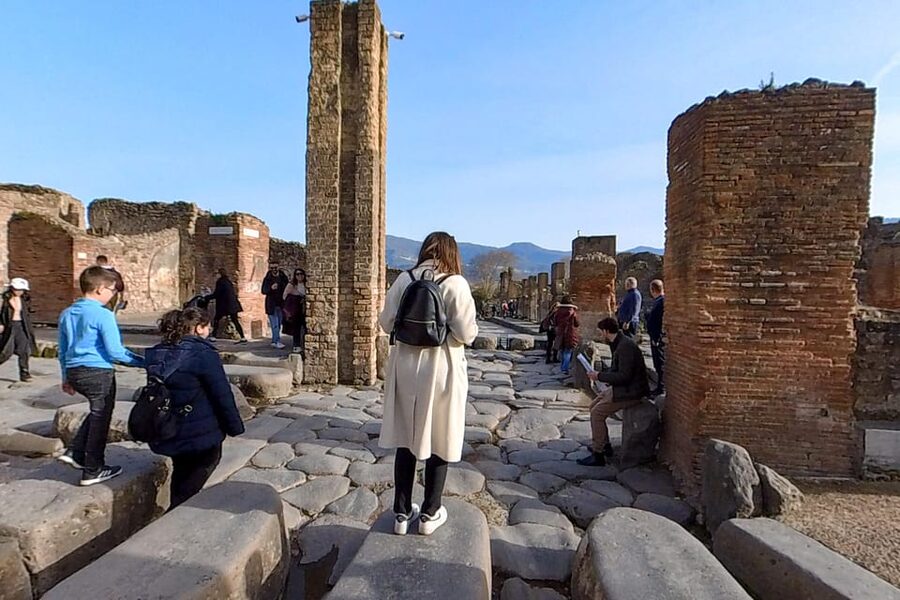
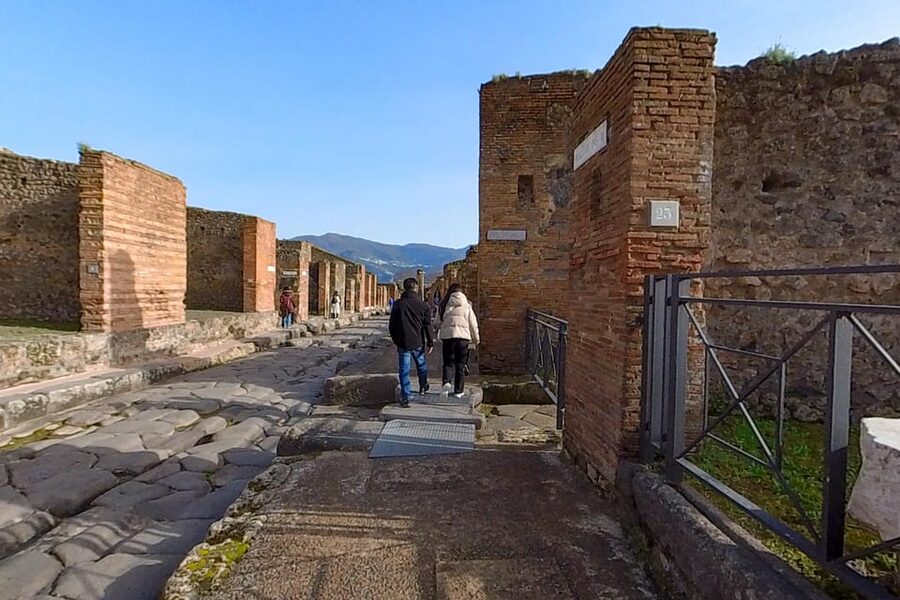
Pompeii is best understood on foot, one street and one weathered doorway at a time. This two-hour tour brings the ruined city into focus through its Forum, homes, workshops, and public baths, rather than leaving you to guess what each broken wall once meant. Guides such as Carlo and Anna have been praised for clear explanations, good humor, and helpful advice.
I like the focused route through everyday Roman life, especially the Thermopolium and Stabian baths. I also like the practical setup: headsets, a licensed guide, helpdesk support, and skip-the-ticket-line access. The main caution is timing. Several bookings finished after only one to one and a half hours, and the group can be fairly large, so confirm exactly what your two-hour booking includes.
In This Review
- Key points at a glance
- Pompeii in two hours: what this tour is really offering
- Meeting at Piazza Esedra near Hotel Vittoria
- The Roman Forum, where Pompeii made decisions
- An ancient house and the details of domestic life
- The Thermopolium, Pompeii’s ancient quick-service counter
- The Lupanare and Pompeii’s less polished history
- The Stabian baths and Roman time off
- Frescoes, workshops, and evidence of ordinary work
- How the eruption shapes the whole visit
- Group size, pace, and the one-hour problem
- Is $58 good value for Pompeii?
- Who should book this guided walk?
- Final verdict: a useful first map of Pompeii
- FAQ
- How long does the Pompeii guided visit last?
- Where do I meet the guide?
- Which languages are available?
- Is Pompeii admission included in the price?
- What places are included in the route?
- What should I bring?
Key points at a glance
- Meet beside Hotel Vittoria: The gathering point is the ticket office near Hotel Vittoria in Piazza Esedra.
- See Pompeii’s working city: The route includes the Forum, an ancient house, artisan workshops, the Thermopolium, and the Lupanare.
- Get a guide’s explanation of the eruption: The tour connects visible ash-preserved buildings with the event that stopped Pompeii in its tracks.
- Use headsets in a busy archaeological site: They help you follow the guide without standing shoulder to shoulder.
- Choose English or Spanish: Live guiding is available in both languages.
- Watch the clock: The advertised duration is two hours, but some bookings have run shorter.
Pompeii in two hours: what this tour is really offering
At $58 per person, this is not simply an admission ticket. You are paying for a guided introduction to a huge archaeological site where the remains can otherwise feel scattered and hard to read.
Pompeii was not preserved as a neat museum. It is a Roman town interrupted by the eruption of Vesuvius, with streets, houses, shops, shrines, public buildings, and painted walls spread across a large area. A guide gives you the basic map in your head. That matters because the site can quickly become a parade of old stones unless someone explains how the rooms fit together.
The tour is designed as a highlights walk. You will not see every corner of Pompeii in two hours, and you should not expect to. Instead, you get a brisk look at political life, commerce, bathing, food, sex work, domestic spaces, and the eruption.
I would treat this as a useful first pass, not a full-day exploration. After the guided portion, you can continue looking around on your own, but you will need to decide how much time remains.
More Pompeii excavation visits:
- Pompeii: Entry Ticket and Guided Tour with an Archaeologist
★ 4.8 · 19,459 reviews - Pompeii: Small Group Tour with an Archaeologist
★ 4.8 · 12,264 reviews - Pompeii: Skip-the-Line Entrance Ticket with Audio Guide
★ 4.0 · 2,509 reviews
Meeting at Piazza Esedra near Hotel Vittoria
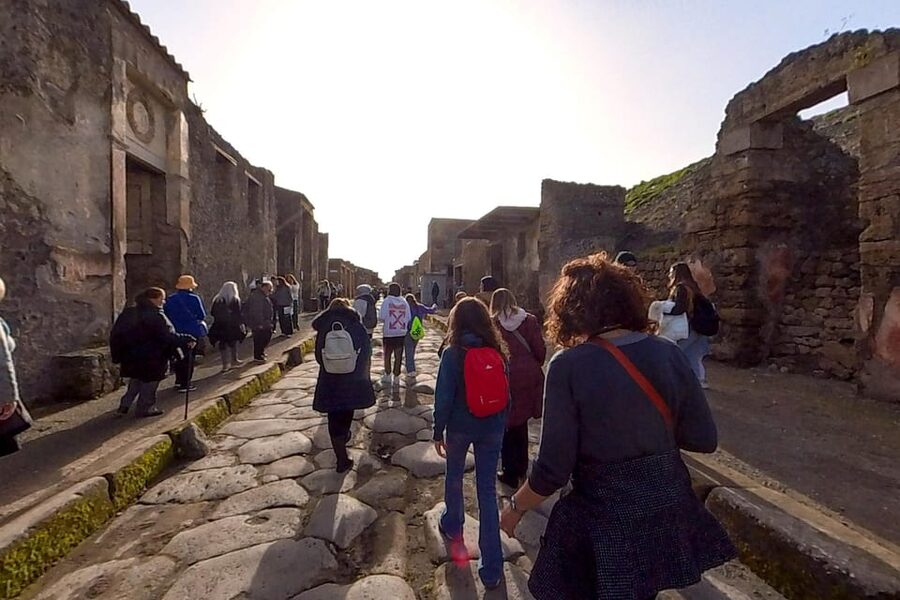
The meeting point is at the ticket office near Hotel Vittoria, in Piazza Esedra. This detail is worth taking seriously. One booking had trouble finding the group because the operator’s sign was less prominent than signs used by other companies.
Give yourself time to locate the correct spot, and keep your booking details ready. A train cancellation caused one group to arrive about 10 minutes late, yet the party was still allowed to join. That is encouraging, but I would not plan on late arrival being accepted every time.
The arrangement is convenient once you find it. You meet close to the archaeological site rather than dealing with a separate city transfer. The tour returns to the Hotel Vittoria area after the visit, according to the planned route.
The Roman Forum, where Pompeii made decisions
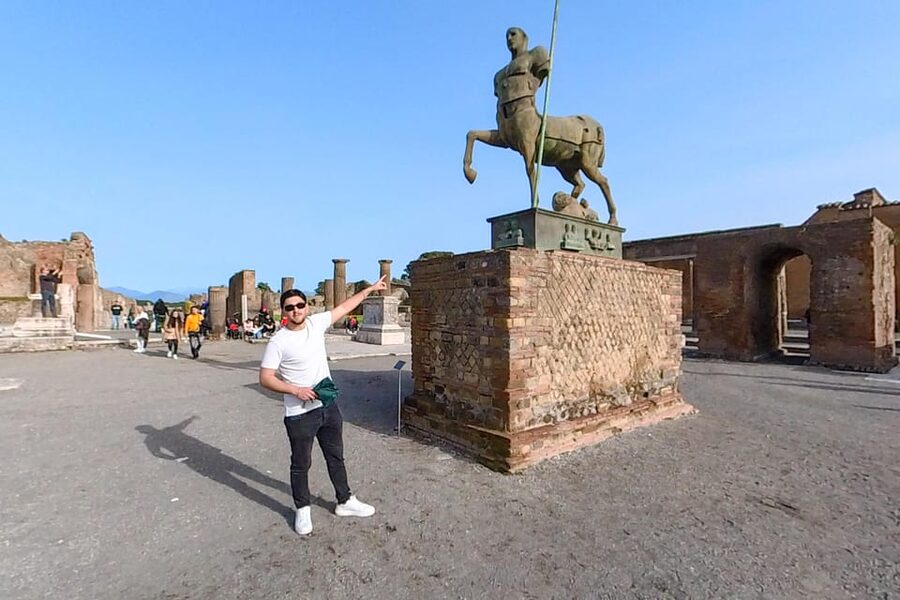
The Forum is the natural anchor for this walk. In Roman cities, this open civic space brought together politics, trade, religion, and public life. Here, your guide can explain how Pompeii worked as a town rather than presenting it as a collection of isolated ruins.
This is one of the places where a guide adds real value. Columns and foundations tell only part of the story. The guide’s job is to connect those remains with the activities that once filled the square, from public business to commerce.
The Forum also gives you a sense of Pompeii’s scale. You are not visiting one villa or a single monument. You are walking through a complete urban center, preserved in fragments by volcanic ash.
A two-hour schedule means the Forum visit will be selective. If this is your first visit, that is sensible. You get a clear orientation before moving into the smaller spaces where daily life becomes easier to picture.
An ancient house and the details of domestic life
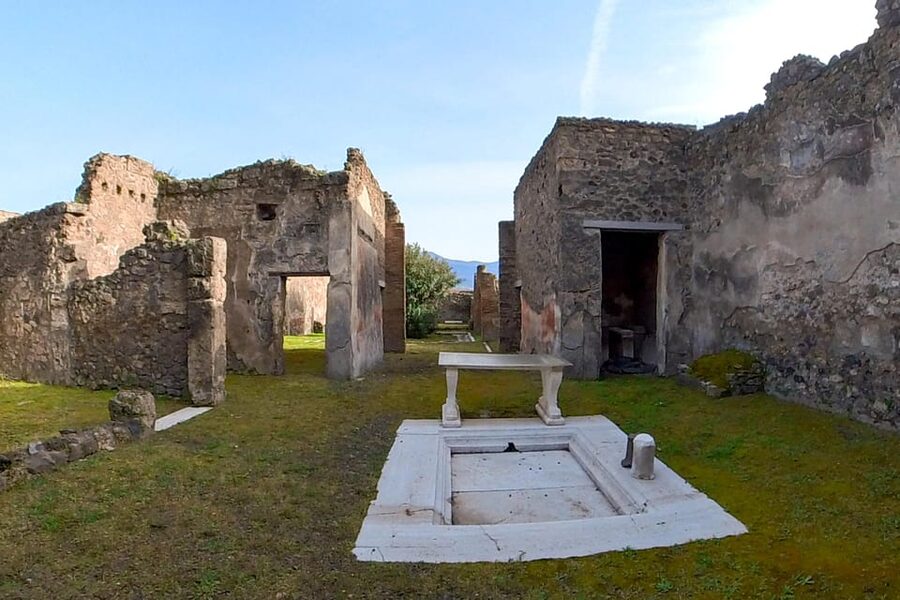
The tour includes a stop at an ancient Roman house. This is a useful change of pace after the public space of the Forum.
Roman homes can reveal how status, family life, decoration, and practical work came together. Pompeii is especially memorable for its surviving wall paintings and visible room layouts. The tour description points to frescoes showing stories of daily life, giving your guide material to explain how decoration shaped the home.
Do not expect every room to be open on every visit. Archaeological sites change access based on preservation and management. Still, the house stop helps you see Pompeii as a lived-in town, not only as a disaster site.
I like this part of the route because it shifts the focus from famous public buildings to ordinary routines. You begin to notice doorways, courtyards, painted walls, and work areas as clues to the people who once used them.
More Pompei Campania tours worth comparing
- Pompeii: Skip-the-line-Ticket and Guided Tour
★ 4.6 · 1,152 reviews - Pompeii: Guided Tour with Skip-the-Line Entry
★ 4.9 · 812 reviews - Pompeii: Skip-the-Line Entry Ticket with Digital Guide App
★ 4.1 · 770 reviews - Pompeii: Tour with Archaeologist Guide & Skip-the-Line Entry
★ 4.5 · 478 reviews
The Thermopolium, Pompeii’s ancient quick-service counter
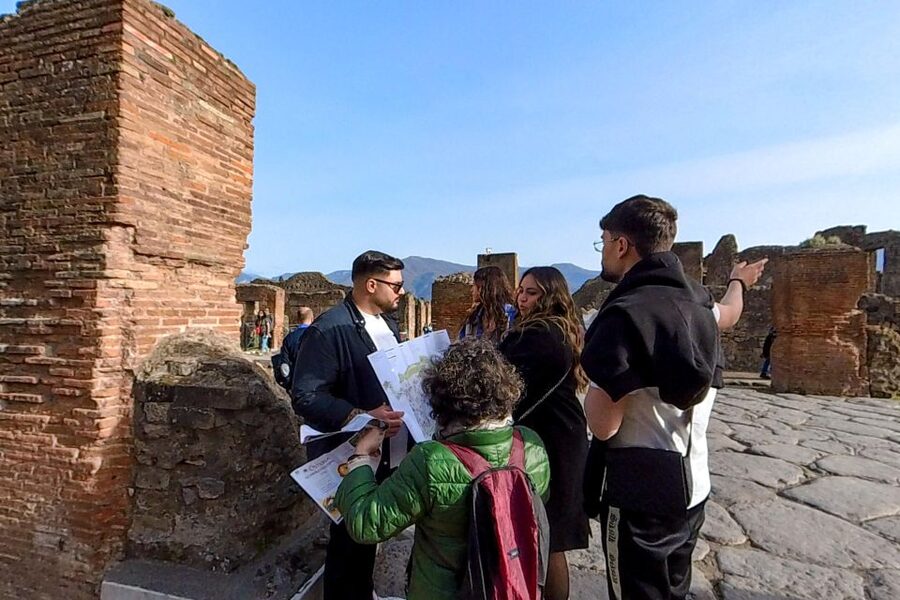
The Thermopolium is one of the most approachable stops because its purpose is easy to grasp. It was a place where Pompeiians could obtain a quick meal, rather like an ancient takeaway counter.
The preserved serving area gives the guide a chance to discuss food, commerce, and the rhythm of city life. This is not just a pretty ruin. It shows that Pompeii had small businesses serving people who lived and worked nearby.
For many visitors, this becomes one of the tour’s most memorable moments because it connects the ancient city with something familiar. You can imagine a worker stopping for food, a shopkeeper serving customers, and a neighborhood depending on local businesses.
The visit is guided rather than centered on a long stop for independent study. If you want detailed time at each shop, you may find the pace quick.
The Lupanare and Pompeii’s less polished history
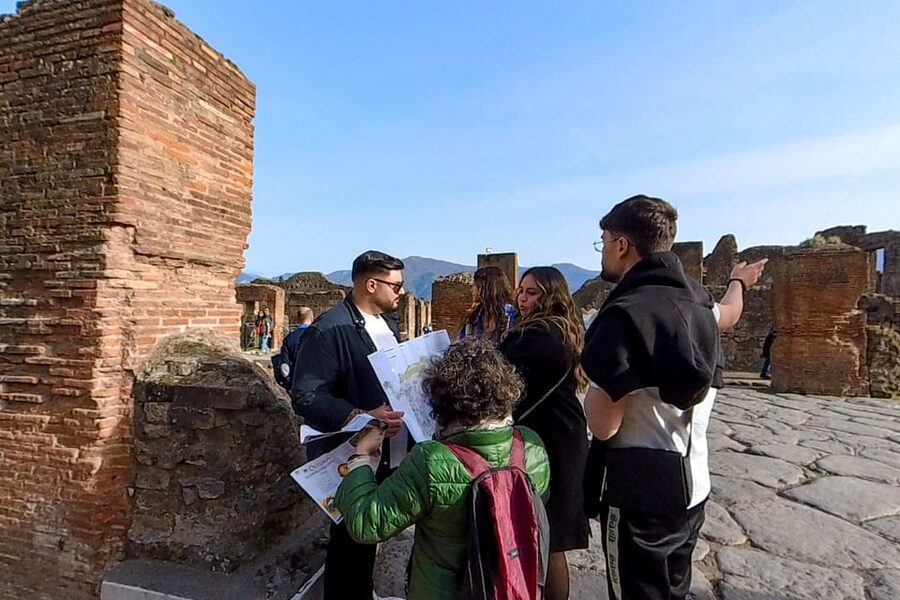
The Lupanare, Pompeii’s brothel, is included in the route. It is one of the site’s most famous buildings, but it should be approached as part of the city’s social and commercial life, not as a sensational detour.
The guide can explain the building’s function and place it within Roman society. The small rooms and surviving decoration help show how different kinds of business operated in Pompeii. This is also a reminder that the ancient city contained the full range of human behavior, from public government to private transactions.
The Lupanare can be busy, and the space is not large. A group tour may mean looking from a short distance or waiting briefly for room to move. Headsets help you hear the explanation, but they do not make a crowded room feel spacious.
Still, I would keep this stop on the must-see list for a first visit. It adds social context that a tour focused only on temples and grand buildings would miss.
The Stabian baths and Roman time off
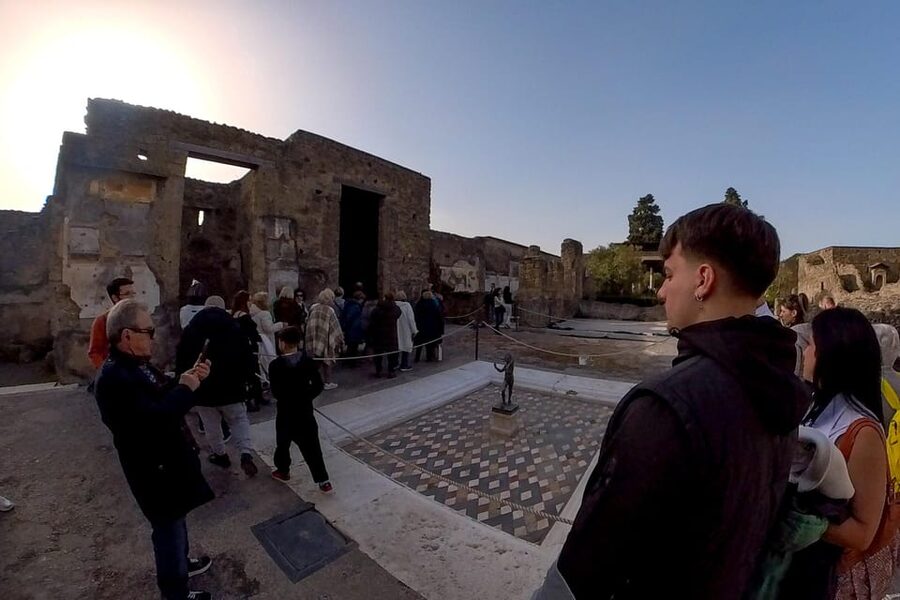
The Stabian baths show how public bathing worked as both leisure and social life. These were not simply places to wash. They were hubs where people could relax, meet others, and spend time away from work.
This stop broadens the picture of Pompeii. The Forum shows public affairs, the Thermopolium shows quick meals, and the baths show recreation. Together, they make the town feel more complete.
Your guide can point out how the bath complex supported Roman routines and why such buildings mattered in an urban community. The remains also give you a chance to consider the engineering behind public facilities, although the exact amount of technical detail depends on the guide and the time available.
The Stabian baths are a good example of why a two-hour guided route works best as an introduction. You receive the essential idea, then can return later to examine the complex more closely if you have enough independent time.
Frescoes, workshops, and evidence of ordinary work
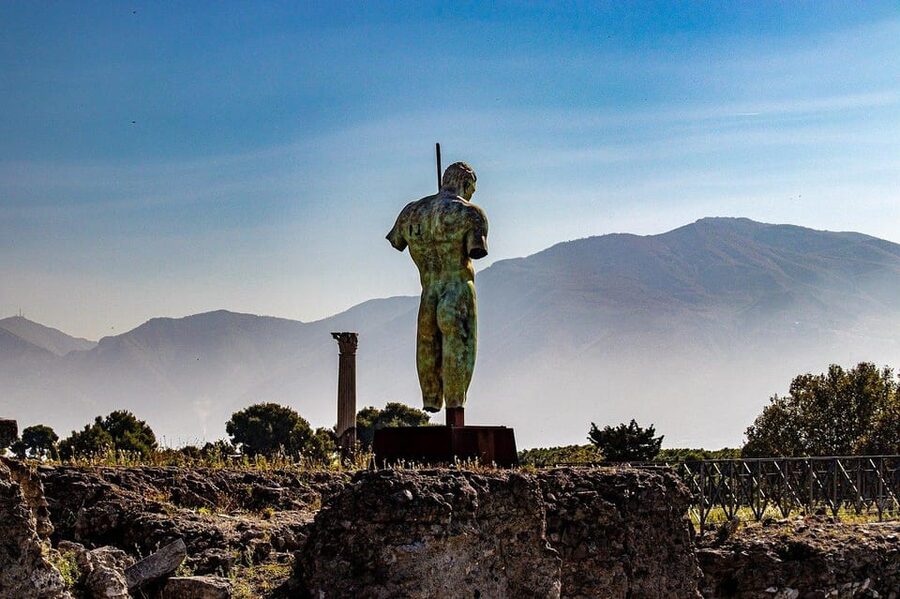
The route also refers to artisan workshops and frescoes depicting daily life. These details are easy to pass without help. A doorway may look like another doorway, while a work area may seem like a pile of stone.
A good guide makes you stop and ask what happened there. Workshops reveal Pompeii as a working town, not just a place of grand houses. Frescoes add another layer, showing how people decorated their surroundings and used images to tell stories.
This is where the guide’s quality matters most. The strongest feedback about this tour centers on the explanations, humor, and practical help offered by the guides. Carlo was singled out for being helpful and clear, while Anna was described as friendly and useful even during a badly delayed start.
The experience is conducted in English or Spanish. Headsets are included, which should make the commentary easier to follow when the group is moving through open streets or busy buildings.
How the eruption shapes the whole visit
Pompeii’s buildings are compelling on their own, but the eruption of Vesuvius gives the visit its force. The city was buried beneath ash and later reconstructed through archaeological excavation. You are seeing a place that was interrupted, preserved, and slowly brought back into view.
The guide links the physical remains with the eruption and explains how Pompeii was frozen in time. That context helps you understand why houses, shops, frescoes, and public spaces remain visible in ways that are unusual for an ancient city.
The tour does not promise a specialist lecture on volcanology. Its purpose is to show how the eruption affected the town and why the archaeological evidence is so valuable. For a first visit, that balance works well.
Take your passport or ID card with you. The booking information also says that discounted or free admission may be available for eligible visitors. There is some mixed wording about the ticket: the tour details list Pompeii entry tickets among the inclusions, while the practical information says tickets can be purchased through the operator after booking to guarantee access. I would clarify the final price and ticket arrangement before paying.
Group size, pace, and the one-hour problem
The biggest practical concern is duration. The experience is sold as a two-hour guided visit, but one booking began an hour late because of a scheduling misunderstanding and ended up with only one hour of touring. Another ended after about an hour and a half because the rest of the group continued to a different tour.
That is not a minor issue at Pompeii. The site is large, and every lost 30 minutes means fewer streets, houses, and public buildings. If your schedule is tight, ask the operator to confirm the start time and expected guided duration before the day of the visit.
Group size can also affect the experience. One booking described the group as fairly large and suggested choosing a smaller group if the budget allows. A large group is usually cheaper than a private or small-group option, but it can slow movement and make close views harder.
On the positive side, headsets and an experienced guide reduce some of the problems created by a larger party. You can hear the commentary while standing back from a crowded doorway. The guide’s ability to keep the group moving still matters.
Is $58 good value for Pompeii?
At $58 per person, the price makes sense if you want a guide to shape your first look at Pompeii and you value the skip-the-ticket-line arrangement. The licensed guide is the main reason to choose this experience over entering alone.
The value drops if your visit is shortened or if ticket costs are added unexpectedly. Since the supplied information is not perfectly consistent about whether admission is included in the advertised price, confirm that point in writing.
I would also compare the price with the size of the group. A large group at $58 can feel less attractive than a smaller guided option at a modest premium, especially if you care about questions and slower viewing. On the other hand, the tour can save you from spending your first hour trying to work out the site’s layout.
The free cancellation policy allows cancellation up to 24 hours before the start for a full refund, and you can reserve now and pay later. Those terms help if your Campania plans are still shifting.
Who should book this guided walk?
I would recommend it to you if:
- This is your first visit to Pompeii.
- You want the main sights explained in English or Spanish.
- You prefer a short introduction rather than a full-day archaeological visit.
- You value skip-the-line access and help at the meeting point.
- You want context for shops, baths, homes, and the eruption.
- You are comfortable with a brisk pace and possibly a larger group.
I would hesitate if you want a guaranteed two-hour guided experience with plenty of time for questions. I would also think twice if you already know Pompeii well and prefer to wander through side streets at your own speed.
After the tour, use any remaining time for independent exploring if access allows. The guided route gives you the framework, but Pompeii rewards slow observation. A painted fragment, workshop entrance, or quiet street can matter as much as the headline sights.
Final verdict: a useful first map of Pompeii
This tour has a strong core: a licensed guide, a sensible selection of Pompeii’s public and private spaces, headsets, and a route that covers more than the usual grand monuments. The best guides, including Carlo and Anna, appear to bring humor, clear explanations, and practical help to the walk.
The weak point is operational consistency. A two-hour Pompeii visit should deliver two full hours, and the reports of late starts and shortened tours are serious enough to warrant a confirmation before booking. The ticket wording also deserves clarification.
Book it if you want an organized introduction and the convenience of a guided highlights route. Skip it, or seek a smaller option, if your priority is a slower pace, detailed archaeological discussion, or complete control over your time.
FAQ
How long does the Pompeii guided visit last?
The advertised duration is two hours. Some bookings have experienced shorter guided visits, including one hour and one and a half hours, so confirm the expected duration before the tour.
Where do I meet the guide?
Meet at the ticket office near Hotel Vittoria in Piazza Esedra.
Which languages are available?
The live tour guide is available in English and Spanish.
Is Pompeii admission included in the price?
The tour details list entry tickets among the inclusions, while the practical information says Pompeii tickets can be purchased through the operator after reservation. Confirm the ticket arrangement and total cost before booking.
What places are included in the route?
The route includes the Pompeii Archaeological Site, the Roman Forum, an ancient Roman house, the Thermopolium, the Lupanare, the Stabian baths, artisan workshops, and frescoes depicting daily life.
What should I bring?
Bring your passport or ID card. Headsets, a licensed guide, helpdesk support, and Pompeii entry arrangements are listed with the activity.
More 2-Hour Experiences in Pompei Campania
- Pompeii: 2-Hour Guided Tour with an Archaeologist
★ 4.9 · 151 reviews - Pompeii: 2H group guided tour with a certified guide
★ 3.4 · 8 reviews - Pompeii in 2h and 30mnt: walk with local guide
★ 3.0 · 6 reviews - Pompeii : 2h small group tour with an archeologist
★ 4.8 · 5 reviews
Newest reviews from Pompei Campania
- From Sorrento: Pompeii & Vesuvius tour small group★ 4.8 · 4 reviews
- Pompeii Private Tour for Kids and Their Families★ 4.8 · 4 reviews
- From Naples_ Pompeii Tour_Skip the line ticket + audioguide★ 4.3 · 4 reviews
- Pompeii, skip-the-line ticket with smartphone audio guide on App★ 3.0 · 4 reviews
- Pompeii Guided Experience – Tour Service Only★ 4.6 · 4 reviews
- From Naples Port:Pompeii+Vesuvius tour★ 4.3 · 4 reviews
- 2-Hour Pompeii Child-Friendly Tour★ 5.0 · 4 reviews
- Naples: Amalfi Coast, Sorrento and Pompeii Day Trip★ 4.4 · 5 reviews
Skip the Line, compared.

Skip-the-Line Entrance Ticket with Audio Guide
Read our review →



Skip-the-Line Entry Ticket with Digital Guide App
Read our review →
Pompeii Ruins Private Tour with Optional Skip-the-Line Entry
Read our review →
Skip-the-Line Pompeii Guided Tour from Sorrento
Read our review →
Skip the Line Guided Tour of Pompeii led by an Archaeologist
Read our review →Browse the lists this tour appears in