
Reviewed · ARCHAEOLOGIST-LED TOURS
2 Hours Private Walking Tour in Pompeii with an Archaeologist
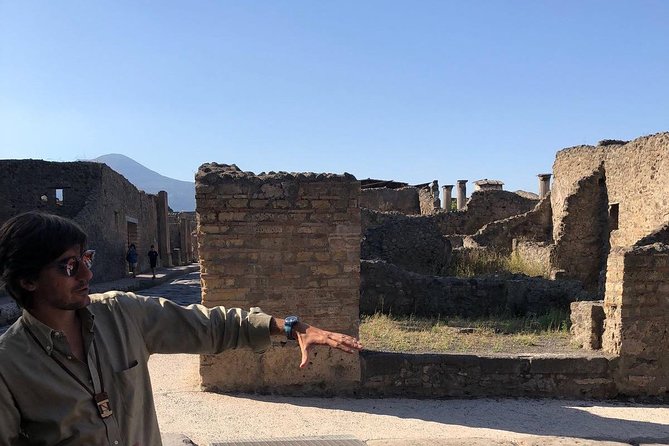
Pompeii makes far more sense when someone can connect its grand public buildings with ordinary Roman life. On this private two-hour walk, an archaeologist guides you from theatres and baths to a bakery, fast-food counter, fabric market, and homes, showing how one city worked day to day.
I like the small-group format, which lets your party of up to eight focus on its own questions. I also like the mix of famous sights and less-touristed areas, plus the chance to work with guides such as Yana, whose warm, personal approach earned special praise.
The main drawback is cost. At $336.43 per group, this is good value for a full party, but expensive for one or two people, especially since Pompeii admission costs an extra €20 per person. The tour is also non-refundable unless poor weather forces cancellation.
In This Review
- Key points at a glance
- Why an archaeologist changes Pompeii
- Starting at Piazza Esedra in Pompeii
- The Forum, theatres, and sacred area
- Thermal baths and the practical Roman city
- A Roman fast-food counter and Pompeii’s working life
- Roman homes and the private side of the city
- What two hours can realistically cover
- Price, admission, and group value
- Who will get the most from this walk
- Booking details worth knowing
- Should you book this Pompeii tour?
- FAQ
- How long is the tour?
- Where does the tour begin?
- Where does the tour end?
- Is Pompeii admission included?
- How much does the private tour cost?
- Is this a private activity?
- Who leads the tour?
- What language is offered?
- Are different tour times available?
- What happens if poor weather cancels the tour?
Key points at a glance
- A private archaeologist-led walk: Only your group takes part, with a licensed guide who holds a degree in Archaeology.
- Public and private Pompeii together: See the Forum, theatres, baths, and sacred area, then move into homes, a bakery, a fabric market, and a Thermopolium.
- A useful two-hour route: The tour focuses on important areas without asking you to commit to a much longer outing.
- Good value for larger groups: The flat price covers up to eight people, though admission is separate for everyone.
- Several start times: You can choose a departure that fits your day in Pompeii.
- Simple meeting point: The walk begins and ends at Piazza Esedra, 10/13, near public transportation.
Why an archaeologist changes Pompeii
Pompeii can look like a giant field of old walls if you walk through it without context. A guide with archaeological training helps you read the remains as parts of a functioning town: where people gathered, bought food, washed, worshipped, worked, and lived.
That is the real strength of this experience. You are not limited to a quick look at the Forum or a famous house. The route links public life and private life, so the large civic spaces have a practical connection to the smaller buildings nearby.
The guide is licensed and holds a degree in Archaeology. Yana is identified as one of the guides, and the personal attention is part of the appeal. A five-star rating from 15 reviews and a 100 percent recommendation record give the tour a strong early track record, though the sample is still fairly small.
More Walking Tours in Pompeii
- Pompeii: Guided Walking Tour with Entrance Ticket
★ 4.3 · 1,423 reviews - Discover Pompeii: French Walking Tour of the Buried City
★ 4.8 · 253 reviews - From Salerno: Pompeii Guided Walking Tour
★ 4.5 · 235 reviews
Starting at Piazza Esedra in Pompeii
You meet at Piazza Esedra, 10/13, in Pompei. The activity ends back at the same meeting point, which keeps the day easy to plan if you are using public transportation or have other plans in Pompeii afterward.
The mobile ticket makes the booking simple to carry. Confirmation arrives within 48 hours, subject to availability, so you should avoid treating the reservation as final until that confirmation comes through.
Several start times are offered. That matters in Pompeii, where the time of day can shape your comfort and attention. A morning start may fit neatly before lunch, while a later option can work better if you are arriving from another stop. The available choice lets you fit the walk into your schedule rather than building the whole day around one fixed departure.
The Forum, theatres, and sacred area
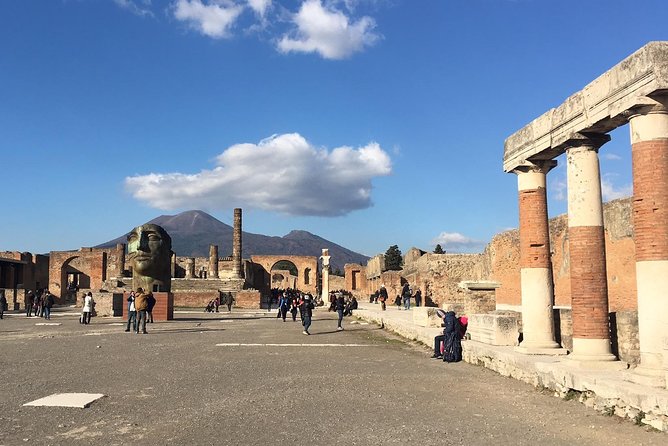
The public heart of Pompeii is the Forum, the city’s main square. This is where the scale of ancient civic life becomes clear. Instead of seeing a collection of unrelated ruins, you can use the Forum as the organizing point for understanding how public business, religion, and social life met in one place.
The tour also includes the theatres. These buildings show another side of city life, with public entertainment taking place alongside political and religious activity. Your archaeologist can help explain how the theatres fit into the wider town rather than treating them as isolated photo stops.
The sacred area adds another piece to the picture. Religious buildings were not distant from everyday life in Pompeii. They formed part of the city’s public identity, and seeing them with the Forum and theatres gives you a clearer sense of how the town was arranged.
Two hours is enough for a focused introduction to these major spaces, but it is not enough to inspect every corner of the archaeological park. That is not necessarily a weakness. A shorter route can be a smart choice if you want an expert framework before exploring more on your own.
Thermal baths and the practical Roman city
The thermal baths are among the most useful stops for understanding ordinary routines. Roman baths were not simply places to wash. They were part of public life, and their presence helps show how the city supported daily habits beyond work and worship.
You will see the baths as part of the public side of Pompeii, then move toward buildings tied to trade and household life. That change in scale is important. The route shows that Pompeii was not only a place of monuments. It was also a working city with services, shops, food businesses, and homes.
The guide’s archaeological background is especially useful here because the remains can be hard to interpret at a glance. The value lies in learning what a space was used for and how it related to nearby buildings, rather than simply hearing a list of dates and names.
More Pompeii excavation visits:
- Pompeii: Entry Ticket and Guided Tour with an Archaeologist
★ 4.8 · 19,459 reviews - Pompeii: Entry Ticket with Optional Audio Guide
★ 4.2 · 12,360 reviews - Pompeii: Small Group Tour with an Archaeologist
★ 4.8 · 12,264 reviews - Pompeii Small Group Tour with an Archaeologist
★ 5.0 · 6,593 reviews
A Roman fast-food counter and Pompeii’s working life
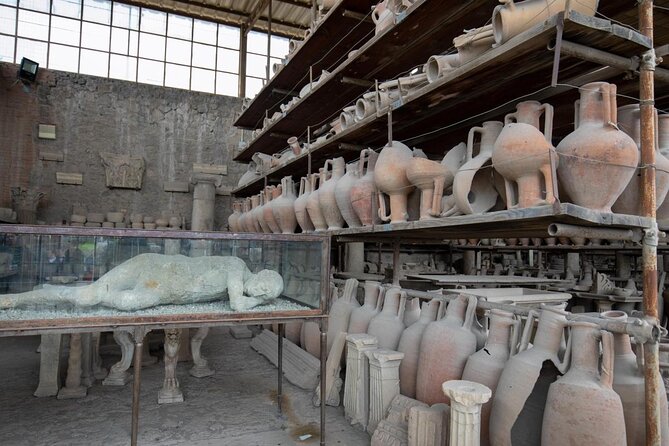
The Thermopolium is one of the most memorable stops because it brings ancient street food into view. This Roman fast-food business offers a direct link to eating habits and commercial life. It is a small, human detail that can make the entire city feel more understandable.
The bakery adds another practical layer. Bread production was a basic part of urban life, and a bakery shows the work behind a daily staple. You can compare it with the Thermopolium and begin to see a local economy built around food preparation, selling, and consumption.
The fabric market points to a different trade. Together, the market, bakery, and food counter broaden your view of Pompeii. You are not only looking at temples and formal buildings. You are looking at a place where people bought necessities, ran businesses, and earned a living.
These stops are also useful for younger visitors and anyone who finds grand ruins hard to connect with. A food counter or bakery needs little explanation to feel relevant. The basic questions are familiar: What was sold here? Who used it? How did the business fit into the street?
Roman homes and the private side of the city
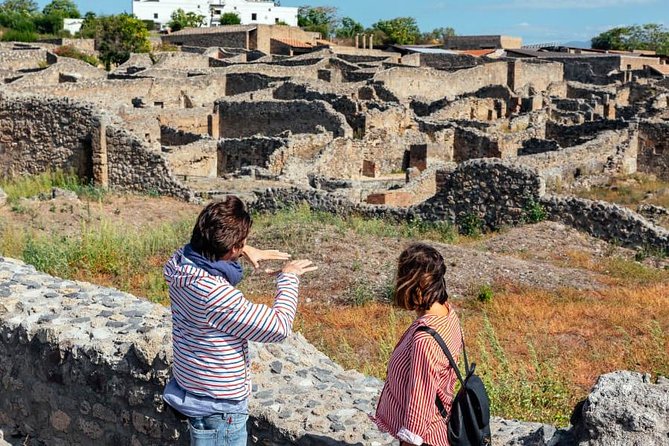
The tour also enters the world of private buildings and houses. Homes give you a closer look at domestic life, though the experience should not be confused with a full tour of every residential area in Pompeii.
What makes this part valuable is the contrast with the Forum and theatres. Public buildings tell you how the city presented itself. Houses and work spaces offer clues about how people organized daily life behind the public face.
The route is designed to include areas outside the main tourist paths. That can make the walk feel less like a checklist of famous ruins. Still, the exact hidden or less-visited spaces can vary, and the supplied details do not identify specific houses or restricted rooms, so you should see this as a chance for added discovery rather than a promise of particular secret sites.
What two hours can realistically cover
Two hours is a useful middle ground. You get a guided introduction to the most important public and private areas without spending half a day following a long archaeological lecture.
The tradeoff is pace. Pompeii is large, and the tour cannot cover the entire park in this time. You may leave with a strong understanding of the city’s main functions, but you should not expect every famous house, street, or museum collection to be included.
I would choose this length if you want a clear first look, have limited time, or plan to combine Pompeii with other activities. If you want a slow examination of many buildings, you may find two hours too short. The private format helps because the guide can shape explanations around your interests instead of delivering the same speech to a large crowd.
Price, admission, and group value
The listed price is $336.43 for up to eight people. Pompeii admission is not included and costs €20 per person. That means a full group pays the same guide fee while dividing it among eight people, making the arrangement much better value for a family or group of friends.
For two people, the guide fee is a larger expense per person. You are paying for privacy, an archaeologist-led experience, and the ability to keep the tour focused on your own group. That may be worthwhile if you care about detailed explanation and do not want to join a larger party, but it is not the cheapest way to enter Pompeii.
The entrance fee is a separate cost you need to include in your budget. Since the tour price does not cover admission, plan for €20 per person in addition to the private guide charge.
Who will get the most from this walk
This tour suits you best if you want an expert introduction and prefer questions to a fixed large-group script. Families, couples, and friend groups can all benefit from having one guide focused only on them.
It is also a good match if you want more than the headline monuments. The Thermopolium, bakery, fabric market, and houses help connect Pompeii with food, work, shopping, and home life.
You may want a different format if you are looking for a full-day archaeological study, a very low-cost visit, or a tour built around a specific famous house that is not named in the available details. The two-hour format has a clear focus, but it cannot promise every corner of Pompeii.
Most people can participate, and service animals are allowed. The experience operates near public transportation. It requires good weather, and if poor weather cancels the tour, you are offered another date or a full refund.
Booking details worth knowing
Confirmation is sent within 48 hours, subject to availability. The activity is offered in English and uses a mobile ticket.
The cancellation terms are strict: the experience is non-refundable and cannot be changed for any reason. If you cancel or request an amendment, you will not receive your payment back. Check your schedule carefully before booking, and remember that the weather exception applies when the provider cancels because conditions are poor.
The tour begins and ends at Piazza Esedra, 10/13, 80045 Pompei. Since the starting and ending point are the same, it is easier to coordinate with transportation or another Pompeii plan.
Should you book this Pompeii tour?
Book it if you want a private, archaeologist-led introduction that mixes the Forum and theatres with everyday places such as a bakery and Thermopolium. It is especially sensible for a group of up to eight, when the flat guide fee becomes easier to share.
Think twice if you are visiting alone, watching every euro, or hoping to see the entire archaeological park. The extra €20 admission per person and strict cancellation terms matter.
For most small groups that value explanation and personal attention, this is a focused way to make Pompeii readable in two hours. You will see the city not just as ruins, but as a place where people worshipped, worked, ate, shopped, and lived.
FAQ
How long is the tour?
The walking tour lasts approximately two hours.
Where does the tour begin?
It begins at Piazza Esedra, 10/13, 80045 Pompei, Italy.
Where does the tour end?
The activity ends back at the meeting point at Piazza Esedra.
Is Pompeii admission included?
No. Admission to Pompeii Archaeological Park is not included and costs €20 per person.
How much does the private tour cost?
The listed price is $336.43 per group, for up to eight people.
Is this a private activity?
Yes. Only your group participates in the tour.
Who leads the tour?
A licensed guide with a degree in Archaeology leads the experience. Yana is one of the guides associated with the tour.
What language is offered?
The tour is offered in English.
Are different tour times available?
Yes. You can choose from several tour times, subject to availability.
What happens if poor weather cancels the tour?
If the experience is canceled because of poor weather, you will be offered a different date or a full refund.
More Walking Tours in Pompeii Ruins
- Pompeii 3 Hours Walking Tour Led by an Archaeologist
★ 5.0 · 126 reviews - Pompeii: Highlights Guided Walking Tour
★ 4.6 · 105 reviews - Pompeii: 3D Walking Tour with Entry Ticket
★ 4.3 · 102 reviews - Explore Pompeii: 2-Hour Guided Walking Tour with Included Ticket
★ 4.5 · 77 reviews
More Tours Led by an Archaeologist
- Pompeii and Herculaneum Small Group Tour with an Archaeologist
★ 5.0 · 1,350 reviews - Skip the Line Guided Tour of Pompeii led by an Archaeologist
★ 5.0 · 703 reviews - Pompeii: Exclusive Tour with Archaeologist and Entry Tickets
★ 4.9 · 634 reviews - Pompeii Private Tour with an Archaeologist and Skip The Line – 3 hours
★ 5.0 · 564 reviews
Newest reviews from Pompeii Ruins
- Private Tour Pompeii and Winery★ 5.0 · 4 reviews
- Visit the Pompeii ruins from Salerno with Pizza Lunch★ 5.0 · 4 reviews
- Pompeii Private Tour for Kids and Their Families★ 4.8 · 4 reviews
- From Sorrento: Pompeii & Vesuvius tour small group★ 4.8 · 4 reviews
- Pompeii Sorrento and Positano Tour★ 5.0 · 4 reviews
- From Naples_ Pompeii Tour_Skip the line ticket + audioguide★ 4.3 · 4 reviews
- Pompeii, skip-the-line ticket with smartphone audio guide on App★ 3.0 · 4 reviews
- Pompeii Private Half-Day Tour from: Naples,Sorrento, Amalfi Coast★ 5.0 · 4 reviews
Archaeologist-Led Tours, compared.

Entry Ticket and Guided Tour with an Archaeologist
Read our review →
Pompeii Small Group Tour with an Archaeologist
Read our review →
Pompeii and Herculaneum Small Group Tour with an Archaeologist
Read our review →
Skip the Line Guided Tour of Pompeii led by an Archaeologist
Read our review →
Exclusive Tour with Archaeologist and Entry Tickets
Read our review →
Pompeii Private Tour with an Archaeologist and Skip The Line – 3 hours
Read our review →
Pompeii Skip-the-line Tour with Archaeologist Guide
Read our review →Browse the lists this tour appears in