
Reviewed · ARCHAEOLOGIST-LED TOURS
2 Hours Pompeii Group Tour with Archaeologist Guide and Skip the Line
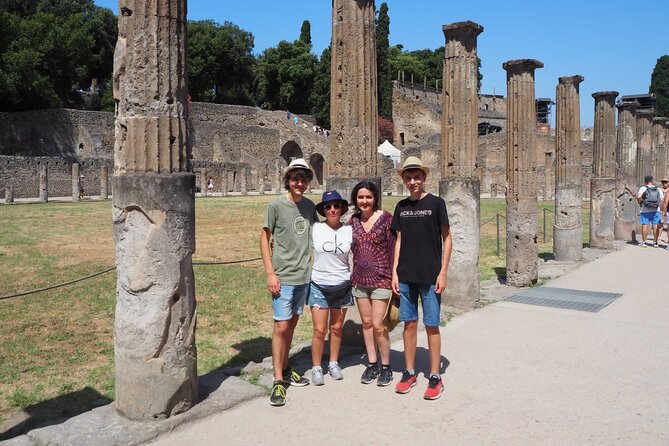
Pompeii is much too large for a quick look on your own. This two-hour archaeological tour tackles the city’s main sights at a brisk but useful pace, from the Forum and theaters to a laundry, bath complex, luxury house, and famous brothel. The guide supplies the missing piece: why these broken walls and worn streets mattered to daily Roman life.
I like the skip-the-ticket-office queue, especially when the entrance area is crowded, and I like the advertised maximum of 15 people. Guides such as Mariagrazia, Eliana, Luisa, and Luciana have been praised for clear explanations, warmth, and the ability to adjust when children or older family members need help. The catch is price: at $132.03 per person, you still pay the €18 adult entrance fee separately, so this is a premium short tour.
In This Review
- Key points at a glance
- Meeting at Piazza Esedra and getting inside
- Gladiators, laundry, and the working city
- The Forum and the Temple of Jupiter
- Pompeii’s theaters, from music to drama
- Casa del Menandro and Roman luxury
- The Lupanar and Pompeii’s frank side
- Baths, streets, and the physical feel of Pompeii
- Plaster casts, 3D Pompeii, and the final temples
- What the guides add to the ruins
- Is $132.03 a fair price for two hours?
- Who should book this Pompeii tour?
- Final verdict: a useful first look at a huge site
- FAQ
- How long does the Pompeii tour last?
- Where does the tour begin?
- Where does the tour end?
- Is the entrance ticket included?
- What does skip the line mean on this tour?
- What language is the tour offered in?
- How many people can join the group?
- Which Pompeii sights are included?
- Is transportation included?
- Can I cancel for a full refund?
Key points at a glance
- A fast route through Pompeii’s main sights: The plan includes the Forum, theaters, baths, temples, shops, a luxury house, and the Lupanar.
- An archaeological guide, not just an escort: The guide explains Roman washing, theater life, religion, commerce, housing, and public bathing.
- Skip the ticket-office line: You still need to buy and pay for the entrance ticket, but the guide helps you avoid the long purchase queue.
- A small advertised group: The stated maximum is 15 people, a sensible size for hearing explanations in busy ruins.
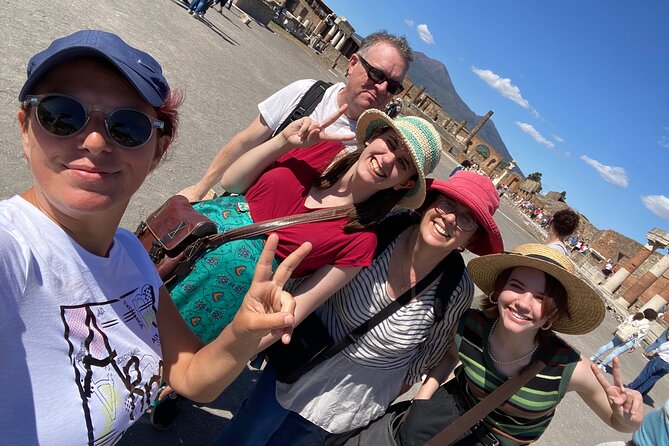
- Strong family appeal: Luisa was especially praised for patience with four young children, while another guide helped a family when a parent became ill.
- A packed two hours: You cover a lot, but you will not have time to linger at every building or explore Pompeii at your own pace.
Meeting at Piazza Esedra and getting inside
The meeting point is outside the main entrance of Ristorante Suisse at Piazza Esedra, 10/13, in Pompei. The tour ends back at the same meeting point, which makes the plan simple if you are using Pompeii as a stop between other activities.
The guide handles the process of buying tickets on site, allowing you to skip the long line at the ticket office. This does not mean admission is free. The adult ticket costs €18, while minors enter free with an identity card. That distinction matters when you compare the tour price with a self-guided visit.
The $132.03 cost covers the guide and the queue assistance, not the entrance ticket, meals, drinks, or transportation. At first glance, that is a lot for two hours. I would consider it worthwhile mainly if Pompeii is a major reason for your visit, you want context rather than a quick walk among ruins, or you are traveling with family members who may not get much from an audio guide or guidebook.
The stated group limit is 15 people. That is small enough for questions and usually easier to manage than a large coach-style group. Still, two hours is short for Pompeii, so arrive ready to walk and listen rather than expecting a slow, detailed study of every house.
More Pompeii excavation visits:
- Pompeii: Entry Ticket and Guided Tour with an Archaeologist
★ 4.8 · 19,459 reviews - Pompeii: Entry Ticket with Optional Audio Guide
★ 4.2 · 12,360 reviews - Pompeii: Small Group Tour with an Archaeologist
★ 4.8 · 12,264 reviews
Gladiators, laundry, and the working city
The first stop is the Vicolo di Gladiatori, identified as the gladiators’ barracks. It is one of the more evocative places on the route because it connects Pompeii with the training and fighting culture of the Roman world.
You receive about 10 minutes here. That is enough for a clear explanation and a few photographs, but not enough for a long discussion of gladiatorial life. The value lies in seeing the space in place, rather than meeting gladiators only as a subject in a museum display.
Next comes the Fullonica di Stephanus, Pompeii’s best-known laundry. The guide explains how Romans washed clothing and roughened fabrics, as well as the materials involved. This is one of the tour’s most useful stops because it shifts attention from emperors and temples to ordinary work.
I particularly like this part of the route. A laundry shows how a city functioned day to day. It also helps you read Pompeii as a living town, with trades, services, customers, and practical problems, rather than as a collection of grand ruins.
The Forum and the Temple of Jupiter
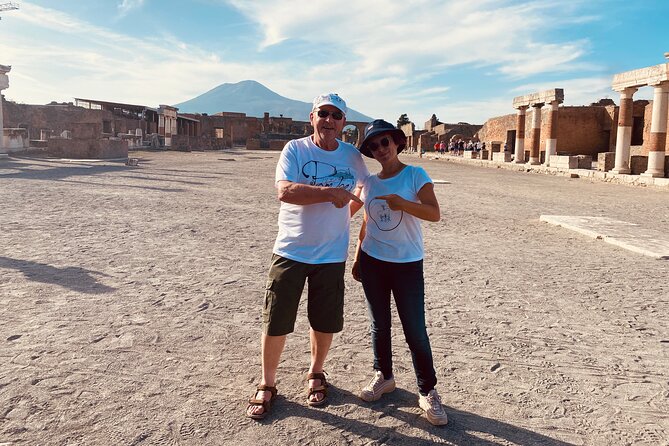
The Temple of Jupiter sits beside Pompeii’s large Forum, the center of public, commercial, and religious activity. The Forum is where the city’s major business and ceremonies came together, so this stop gives you the broadest sense of Pompeii as a civic place.
The temple takes about five minutes on the schedule. That may sound brief, but the surrounding Forum gives the guide a large setting in which to explain how public life worked. You can expect the focus to be on the temple’s role and its place within the central square, not a long architectural lecture.
The route also passes the Temple of Venus, partly destroyed during the Second World War. Its condition adds another layer to Pompeii’s story. The city was damaged not only by the ancient eruption but also by modern events, weather, excavation, and the ongoing challenge of caring for exposed ruins.
A city market near the Forum is also included. This is where large purchases of goods for resale in shops took place. Along with the main shopping street and another Pompeian street, the market helps you picture the movement of food, supplies, shopkeepers, and customers through the city.
Pompeii’s theaters, from music to drama
The Odeon, or Teatro Piccolo, was used for musical events. Instruments were found inside and are now kept in the Antiquarium, while the theater itself retains original parts that you can see.
The scheduled visit lasts around 15 minutes. That is enough time to understand the building’s purpose and notice how different a smaller performance space feels from Pompeii’s main theater. The Odeon is a good reminder that entertainment was not limited to large public spectacles.
The Teatro Grande was Pompeii’s largest theater. Dramas and comedies were performed here, and the building was fully renovated with support from the Gens Holconia, one of Pompeii’s important families.
You have about 10 minutes at the larger theater. I would pay attention to the scale and seating arrangement, then let the guide connect the building to public life and wealthy local families. If you are interested in ancient performance, this is one of the strongest parts of the tour. If you want long free time for photographs, the short schedule may feel restrictive.
More tours led by an archaeologist:
- Pompeii Small Group Tour with an Archaeologist
★ 5.0 · 6,593 reviews - Pompeii and Herculaneum Small Group Tour with an Archaeologist
★ 5.0 · 1,350 reviews - Skip the Line Guided Tour of Pompeii led by an Archaeologist
★ 5.0 · 703 reviews - Pompeii: Exclusive Tour with Archaeologist and Entry Tickets
★ 4.9 · 634 reviews
Casa del Menandro and Roman luxury
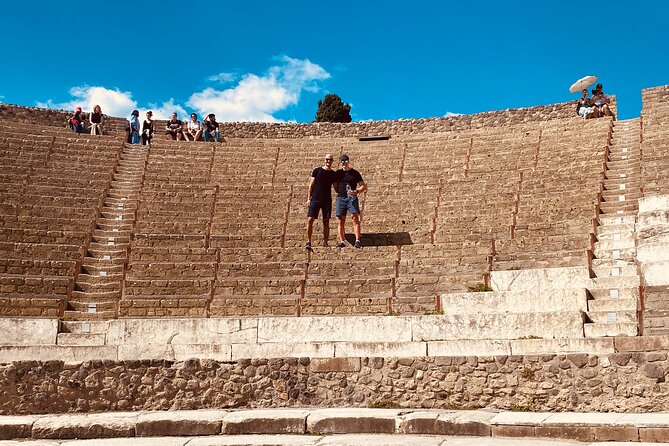
Casa del Menandro offers a look at the homes of wealthy Romans. The route allows about 15 minutes here, with attention to frescoes, decoration, sculpture, and the design of a luxury house.
This is an important contrast with the laundry and market. Pompeii contained both working spaces and richly decorated homes, and the tour moves between them quickly. You begin to see how wealth shaped private life, social status, and the use of domestic space.
I like having a house on a short Pompeii route because a Forum alone can make the city seem too formal and monumental. A home gives you a closer look at how Roman residents used rooms, decorated their surroundings, and displayed their position.
The drawback is that 15 minutes does not allow a leisurely examination of every fresco or sculpture. You will get the guide’s main points and an overview, then move on. If Casa del Menandro is your top interest, consider returning after the tour, if your admission and schedule allow.
The Lupanar and Pompeii’s frank side
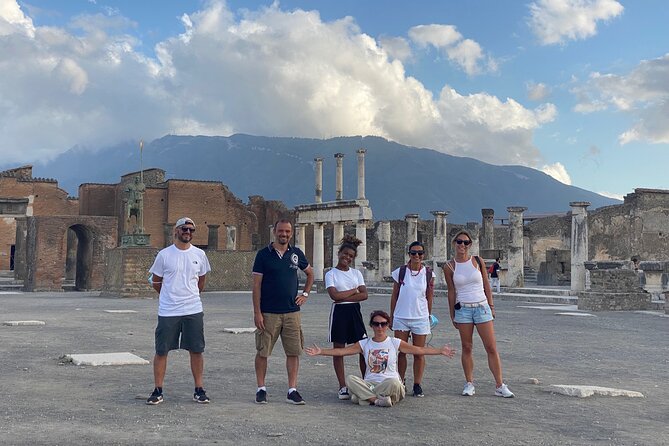
The Lupanar is one of Pompeii’s most famous buildings. It is a brothel with original frescoes depicting sexual scenes, including images associated with the kamasutra. The visit lasts about 15 minutes.
This can be a crowded and emotionally mixed stop. Some people find the paintings fascinating as evidence of Roman attitudes and commercial life. Others may find the subject matter uncomfortable, especially with children. The guide’s job here is useful: context can keep the stop from becoming a quick look at provocative pictures without understanding the setting.
Because the Lupanar is famous, it may be one of the places where the group must keep moving. Listen closely and ask questions when there is room. If you are traveling with children, decide in advance how you want to handle this stop. The tour is not presented as adults-only, and one guide, Luisa, received praise for working well with four young children, but the Lupanar’s imagery is still direct.
Baths, streets, and the physical feel of Pompeii
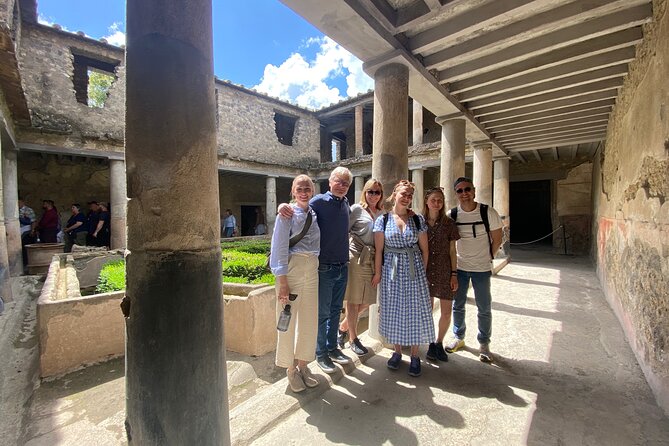
The Stabian Baths are the first baths built in Pompeii. The complex still contains casts and frescoes, and the tour allows about 15 minutes.
The baths help explain how Romans combined washing, exercise, social time, and public life. They also make the ancient city feel more practical. After seeing temples and theaters, you get a place built around everyday routines and shared facilities.
The route includes a street full of shops, described as Pompeii’s main street, plus another street within the site. These sections matter because the paving, storefronts, and street layout show how people moved around town. A guide can point out what you might miss when walking alone, especially when your attention is pulled toward the larger buildings.
This is also where Pompeii’s surface matters. Expect a walking tour over ancient streets and through open archaeological areas. The supplied information says most people can participate and that the site is near public transportation, but it does not provide a detailed accessibility assessment. If you have specific mobility needs, contact the provider before booking.
Plaster casts, 3D Pompeii, and the final temples
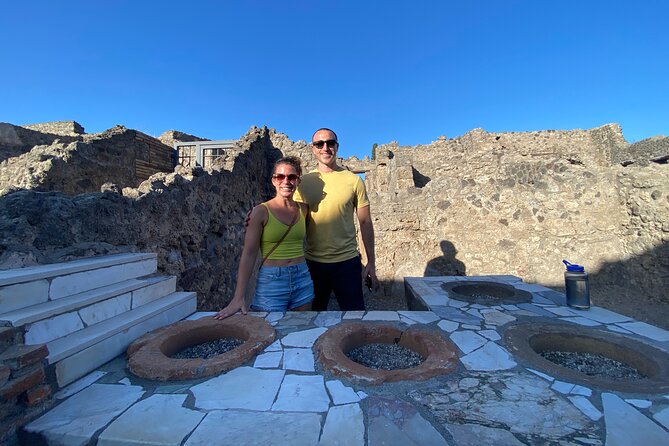
The Pompei 3D stop concerns the bodies of Pompeii and lasts about five minutes. The casts are among the site’s most powerful reminders of the eruption. They shift the focus from architecture to individual human lives caught in the disaster.
Five minutes is brief, so do not expect a long museum-style presentation. Even so, this stop can change the tone of the tour. After houses, markets, entertainment, and public buildings, you are brought back to the event that preserved the city and caused its destruction.
The route also includes the Temple of Apollo, one of Pompeii’s prominent religious sites. Together with the Temple of Jupiter and Temple of Venus, it shows that religion was woven into the city’s public spaces and daily activity.
These final stops round out the tour rather than offering one single grand finale. You see commerce, religion, entertainment, housing, work, bathing, and death. That range is the main strength of the itinerary.
What the guides add to the ruins
The best part of this experience is the human explanation. Mariagrazia has been praised for using both light and somber stories to help you picture life before the eruption. She is also described as able to answer questions and explain details beyond what fits into the scheduled time.
Eliana is an archaeologist working in Pompeii, and her background gives the tour a strong connection to both the ancient city and the modern work of caring for the site. She has also been praised for arranging a route that avoided some large crowds while still covering many sights.
Luciana was described as informative and fun, a useful combination during a packed walk. Luisa was singled out for patience, kindness, and handling four young children well. One family also received unusually thoughtful assistance from Eliana when a father became ill before the tour. The tour was shortened in that case, but she helped arrange medical attention and a taxi, then still gave the family a useful overview.
These details point to an important question: do you want a fixed script, or a guide who can respond to your group? The experience appears best suited to people who value explanation, questions, and a bit of flexibility. Guide assignment is not guaranteed, so you should not book solely to secure a particular person.
Is $132.03 a fair price for two hours?
The answer depends on how you plan to use Pompeii. The price is high once you add the €18 adult admission, and it does not include transport, food, or drinks. If you are comfortable reading signs, using a guidebook, and finding your own way, a self-guided visit costs much less.
The tour earns its price through three things: saving time at the ticket office, providing an authorized archaeological guide, and building a route through many of Pompeii’s major categories of sights. You are not paying only for entry. You are paying for interpretation and for a plan that keeps you moving through a huge site.
I would choose this tour if Pompeii is your first visit, your time is limited, or your group includes children who need stories to stay interested. I would hesitate if you have a full day and prefer to pause often, study details, or revisit favorite buildings. Two hours gives you an excellent introduction, not a complete examination of Pompeii.
The tour is offered in English and includes a mobile ticket. Confirmation arrives at booking. Service animals are allowed, and the activity is near public transportation. The experience requires good weather and a minimum number of participants. If poor weather or low enrollment cancels it, you are offered another date or a full refund.
Free cancellation is available up to 24 hours before the local start time. Cancellations or changes made less than 24 hours ahead are not refunded or accepted.
Who should book this Pompeii tour?
I would recommend it to first-time visitors who want a clear route and strong historical context without spending an entire day on site. Families may also find it helpful, especially since the guides have shown patience with children and have handled heat or illness with care.
It also suits anyone who finds ancient ruins hard to read. A laundry, theater, market, or house can look like a pile of walls until someone explains its purpose. Here, the guide’s focus on Roman life gives each stop a reason to matter.
I would not make it my first choice for a dedicated archaeology enthusiast who wants long, quiet periods at individual buildings. The schedule is packed, the group may need to keep moving, and entrance is not included in the headline price.
Final verdict: a useful first look at a huge site
This is a strong orientation tour, especially for a first visit to Pompeii. You see the gladiators’ barracks, laundry, Forum, temples, theaters, Casa del Menandro, Lupanar, baths, market, shops, and plaster casts in two hours, with an archaeological guide to connect them.
Book it if you value expert storytelling and want to make your limited time count. Skip it if you want the lowest possible cost or a slow, independent day. The fairest way to judge the price is to treat the tour as a guided introduction, then stay longer on your own only if your ticket and schedule permit. For many people, that combination gives Pompeii both structure and room to breathe.
FAQ
How long does the Pompeii tour last?
The tour lasts approximately two hours.
Where does the tour begin?
It begins at the main entrance of Ristorante Suisse, Piazza Esedra, 10/13, Pompei, Italy.
Where does the tour end?
The activity ends back at the meeting point.
Is the entrance ticket included?
No. Adults pay €18 for admission. Minors enter free but must bring an identity card.
What does skip the line mean on this tour?
The guide helps you skip the long queue to buy tickets at the ticket office. You still need to pay the entrance fee.
What language is the tour offered in?
The tour is offered in English.
How many people can join the group?
The advertised maximum is 15 participants.
Which Pompeii sights are included?
The route includes the gladiators’ barracks, Fullonica di Stephanus, Temple of Jupiter, Odeon, Teatro Grande, Casa del Menandro, Lupanar, Temple of Venus, Basilica, main shopping street, Stabian Baths, Pompei 3D, city market, and Temple of Apollo.
Is transportation included?
No. Transportation, food, and beverages are not included.
Can I cancel for a full refund?
Yes, if you cancel at least 24 hours before the experience start time. Cancellations made less than 24 hours ahead are not refunded.
More 2-Hour Experiences in Pompeii Ruins
- Pompeii 2h Small-Group Tour with Expert Archaeologist
★ 5.0 · 385 reviews - 2 hours Pompeii Tour with Local Historian – Ticket Included
★ 5.0 · 335 reviews - Pompeii: 2 Hour Private Tour with an Archeologist Guide
★ 5.0 · 214 reviews - Pompeii 2-hour Private Tour with an Archaeologist-Ticket included
★ 5.0 · 181 reviews
More Skip the Line in Pompeii Ruins
- Pompeii: Skip-the-Line Entrance Ticket with Audio Guide
★ 4.0 · 2,509 reviews - Sorrento: Skip-the-Line Pompeii Express Tour by Train
★ 4.8 · 2,038 reviews - Pompeii: Skip-the-line-Ticket and Guided Tour
★ 4.6 · 1,152 reviews - Pompeii: Guided Tour with Skip-the-Line Entry
★ 4.9 · 812 reviews
Newest reviews from Pompeii Ruins
- Private Tour Pompeii and Winery★ 5.0 · 4 reviews
- Visit the Pompeii ruins from Salerno with Pizza Lunch★ 5.0 · 4 reviews
- From Sorrento: Pompeii & Vesuvius tour small group★ 4.8 · 4 reviews
- Pompeii Private Tour for Kids and Their Families★ 4.8 · 4 reviews
- Pompeii Sorrento and Positano Tour★ 5.0 · 4 reviews
- From Naples_ Pompeii Tour_Skip the line ticket + audioguide★ 4.3 · 4 reviews
- Pompeii, skip-the-line ticket with smartphone audio guide on App★ 3.0 · 4 reviews
- Pompeii Private Half-Day Tour from: Naples,Sorrento, Amalfi Coast★ 5.0 · 4 reviews
Archaeologist-Led Tours, compared.

Entry Ticket and Guided Tour with an Archaeologist
Read our review →
Pompeii Small Group Tour with an Archaeologist
Read our review →
Pompeii and Herculaneum Small Group Tour with an Archaeologist
Read our review →
Skip the Line Guided Tour of Pompeii led by an Archaeologist
Read our review →
Exclusive Tour with Archaeologist and Entry Tickets
Read our review →
Pompeii Private Tour with an Archaeologist and Skip The Line – 3 hours
Read our review →
Pompeii Skip-the-line Tour with Archaeologist Guide
Read our review →Browse the lists this tour appears in