
Reviewed · SKIP THE LINE
Pompeii Skip the Line Ticket + Guide Book with itineraries
Pompeii is best seen with time to wander, and this self-guided visit gives you the freedom to choose your own pace inside one of Italy’s largest archaeological sites. The updated map and timed routes help turn a huge, sometimes confusing ruin into a manageable day out.
I like the flexibility to enter between 9 am and 5 pm, and I like that the guidebook stays with you as a souvenir. The main drawback is the skip-the-line promise: you may still queue for security, and some visitors have waited for staff to collect the actual tickets before reaching the entrance.
In This Review
- Key points at a glance
- What this Pompeii ticket really gives you
- Meeting at Via Roma 123 and entering at Piazza Anfiteatro
- A two-hour route for Pompeii’s essential sights
- A four-hour route for a fuller first visit
- A six-hour route for people who want Pompeii in depth
- Frescoed houses, baths, temples, and working streets
- The amphitheater and casts of the victims
- Is the $41 price good value?
- Best time to visit and how to pace yourself
- Who should book this independent visit?
- Should you book the Pompeii ticket?
- FAQ
- How long is the Pompeii experience valid?
- What are the entrance hours?
- Where do I meet the staff?
- Is a personal guide included?
- How many people receive a guidebook?
- What languages are available?
- Can I cancel the booking?
Key points at a glance
- Choose your own visit length: Follow a two, four, or six-hour route instead of trying to see every street.
- Enter at Piazza Anfiteatro: Show your voucher at the staff information point at Via Roma 123 before walking to the archaeological park entrance.
- Expect security checks: Skip-the-ticket-line access does not necessarily remove the bag scan queue.
- See Pompeii’s everyday life: The route can lead you to homes, baths, temples, shops, snack bars, theaters, brothels, and the amphitheater.
- One guidebook serves two people: The book is available in 13 languages and comes with an updated map.
- Plan for a hot, physical day: Bring water, a sun hat, comfortable clothes, and sturdy walking shoes.
What this Pompeii ticket really gives you
This is not a guided tour with a historian walking beside you. It is an independent visit built around three useful tools: your entrance ticket, a printed guidebook, and an updated map.
That difference matters. I would choose this option if you enjoy stopping where you like, taking photographs, reading at your own speed, and changing plans when a particular house or street catches your attention. You are not tied to a group or a fixed speaking schedule.
The guidebook gives you background on Pompeii and suggests routes lasting two, four, or six hours. That is helpful because the archaeological park is large, and a casual wander can easily turn into a long walk without a clear idea of what remains ahead.
You should also know what is not included. There is no personal guide, food, drink, or transfer. You make your own way to Pompeii, collect or confirm your entrance arrangements, and then explore independently.
More Pompeii excavation visits:
- Pompeii: Entry Ticket and Guided Tour with an Archaeologist
★ 4.8 · 19,459 reviews - Pompeii: Small Group Tour with an Archaeologist
★ 4.8 · 12,264 reviews - Pompeii: Skip-the-Line Entrance Ticket with Audio Guide
★ 4.0 · 2,509 reviews
Meeting at Via Roma 123 and entering at Piazza Anfiteatro
Your first stop is the staff information point at Via Roma 123 in Pompeii. Show your voucher there, and the staff will direct you toward the archaeological park entrance at Piazza Anfiteatro.
Allow some patience at this stage. The practical process may not feel as quick as the words skip the line suggest. A security queue for bags can remain, and one visitor reported waiting about 20 minutes while staff obtained the tickets. Another found that the queue to buy a ticket on the spot was short that day.
Once past security, barcode scanning and the turnstiles can be quick. The experience may therefore save time at the ticket window without guaranteeing an instant walk through the entrance. If you arrive during a busy period, that distinction is worth keeping in mind.
I would arrive with your voucher ready on your phone, your identification available, and your group together. The stated entry window runs from 9 am until 5 pm, but you should check the available starting time when booking. Since the ticket is valid for one day, you have room to choose a morning or afternoon visit.
A two-hour route for Pompeii’s essential sights

The two-hour plan suits you if Pompeii is one stop in a packed Campania day, or if you want the clearest introduction without exhausting yourself.
Use the map to focus on the central highlights rather than walking every lane. Your guidebook can point you toward decorated houses, public buildings, places of worship, shops, and the most important surviving structures. You will get a taste of both public life and private life, which is more useful than seeing a long list of ruins without context.
The compact route is also a sensible choice in strong sun. Pompeii has open streets and exposed areas, and comfortable footwear and water are essential. Two hours can feel short, but it gives you a defined goal and leaves energy for the rest of your day.
The tradeoff is obvious: you will skip many quieter corners. You may also find that the most interesting house or fresco is not on your immediate path. If this is your only visit to Pompeii, I would choose four hours when possible.
A four-hour route for a fuller first visit
For many people, four hours is the best balance. You have enough time to see major streets and buildings, pause for the guidebook’s explanations, and make a few unplanned discoveries.
This route can include Pompeii’s frescoed houses, baths, temples, shops, and thermopolia. A thermopolium was an ancient counter-service food shop, a useful reminder that Pompeii was not only a city of grand villas and temples. Everyday commerce is part of what makes the site feel understandable.
The public buildings add another layer. The theaters show how entertainment fitted into Roman city life, while the amphitheater gives you one of the best-preserved Roman arenas in the world. The guidebook helps connect these places to the wider story of the city rather than leaving you with isolated walls.
You can also take time with the casts of victims of the eruption. They are among Pompeii’s most affecting sights, but they can be emotionally difficult. The guidebook gives you a way to approach them with some historical context and at your own pace.
Four hours still requires choices. Pompeii is not a compact museum where every room is a few steps from the next. Keep an eye on the map, drink water, and do not spend your entire visit in the first few buildings.
More Pompei Campania tours worth comparing
- Pompeii: Skip-the-line-Ticket and Guided Tour
★ 4.6 · 1,152 reviews - Pompeii: Guided Tour with Skip-the-Line Entry
★ 4.9 · 812 reviews - Pompeii: Skip-the-Line Entry Ticket with Digital Guide App
★ 4.1 · 770 reviews - Pompeii: Tour with Archaeologist Guide & Skip-the-Line Entry
★ 4.5 · 478 reviews
A six-hour route for people who want Pompeii in depth
The six-hour route is for you if Pompeii is a main purpose of your day and you prefer a slower visit. You can cover more streets, spend longer inside houses, and allow time for the site’s less famous details.
This longer plan is especially useful if you like Roman social history. You can compare private homes with public baths, religious buildings with commercial spaces, and grand theaters with ordinary shops. The thermopolia, brothels, and working streets help show how people lived, ate, worshipped, and spent money.
The extra time also protects you from rushing. Pompeii rewards pauses. A painted wall, a shop counter, or a worn stone road can be easy to miss when you are hurrying toward the next famous building.
Still, six hours on ancient paving is a serious physical commitment. Bring water, wear shoes with good support, and use the map to plan breaks. There is no personal guide managing your pace, so you must decide when to rest and when to move on.
If you want to use the whole day, check the closing and entry details carefully. The stated access window is from 9 am to 5 pm, and a one-day ticket does not mean you can arrive at any hour without checking availability.
Frescoed houses, baths, temples, and working streets
Pompeii’s power comes from its variety. A visit built only around the amphitheater would miss the details that make the ancient city so readable.
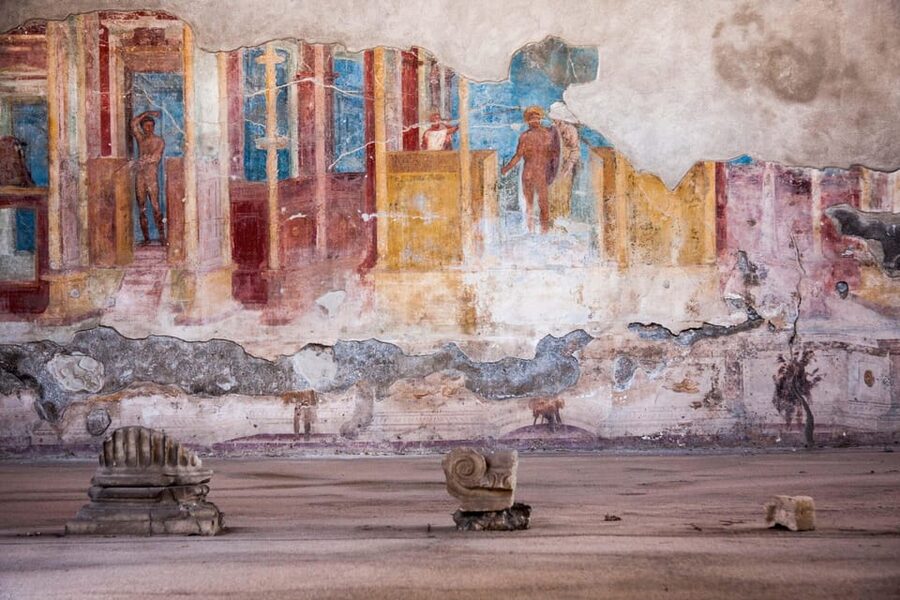
The frescoed houses offer glimpses of decoration, status, and domestic life. You can use the guidebook to understand how rooms fit together and why a painted wall matters, rather than simply photographing it and moving on.
The baths show the civic side of Roman life. They were not just places to wash. They formed part of the city’s public routine, and their surviving rooms help you picture the scale of daily activity.
Temples provide a different view, tied to worship and public identity. Shops and thermopolia bring you back to ordinary transactions. A counter, doorway, or row of rooms may tell you more about daily life than a grand monument does.
The brothels are another part of Pompeii’s social record. They can be a memorable stop, but you may want to read the guidebook before entering so the space has some context.
The amphitheater and casts of the victims
The Roman amphitheater is one of the major reasons to choose a longer route. It is a large, clear example of how entertainment shaped Roman cities, and it gives you a strong sense of Pompeii’s public scale.
The casts of victims create a sharp change in mood. They are not simply archaeological objects. They bring the eruption’s human cost close, and you may prefer to approach them slowly rather than treating them as another quick stop.
The guidebook is useful here because you can read before or after seeing the casts. Since you are not part of a moving group, you can take a quiet moment and then continue when ready.
Is the $41 price good value?
At $41 per person, this option sits above a bare entrance ticket, but you are paying for convenience and orientation as well as admission.
The value is strongest if you want a ready-made plan. The two, four, and six-hour routes save you from spending your first hour wondering which direction to take. The map is particularly useful because the site is large, and one visitor wished facilities such as toilets and cafes had been marked more clearly. Check the map carefully, but do not assume it will answer every practical question.
The guidebook also has lasting value. It is provided for every two bookings, not one per person, and it is translated into 13 languages. If you are traveling as a pair, sharing one book is easy. Two solo visitors booking separately may need to plan around that arrangement.
The value is weaker if your only goal is to avoid every queue. Security screening can still involve waiting, and ticket collection may take time. One person found little time saved because the ordinary ticket line was short on that particular afternoon.
I would compare this price with your priorities. If you want a flexible, self-guided day and appreciate a printed map, it is a reasonable convenience package. If you expect a guide, transport, guaranteed front-of-every-line entry, or detailed personal explanations, this is not the right product.
Best time to visit and how to pace yourself
The afternoon can work well, especially if your schedule is tight. One visitor entered around 2 pm and found the site noticeably quieter after 4:30 pm. That does not guarantee low crowds every day, but it suggests that a late visit can have a calmer final stretch.
Arriving later also creates a risk: a six-hour route will not fit comfortably if you enter close to closing time. For the two-hour route, a late start may be more practical, provided you confirm the day’s hours.
Morning gives you more room for a long route and may suit you better in hot weather. Whatever time you choose, keep your route realistic. Pompeii can look close on a map while taking longer on foot than expected.
I would divide the visit into sections. Start with the route’s main sights, then leave room for side streets and houses. Stop to drink water before you feel tired, not after. Comfortable clothes, a sun hat, and water are listed essentials for good reason.
Who should book this independent visit?
I would recommend it most strongly to independent sightseers who:
- Want to avoid a fixed group schedule
- Prefer reading and exploring at their own pace
- Need a two-hour visit or a longer six-hour plan
- Are comfortable navigating with a map
- Want a souvenir guidebook in one of 13 languages
- Already have transport to Pompeii arranged
Families and couples may appreciate the freedom to pause or move on without holding up a group. It can also suit repeat visitors who do not need a full spoken tour.
I would think twice if you want a specialist to explain every building, if you dislike navigating large archaeological sites, or if queue avoidance is your main reason for booking. The included book provides structure, but it cannot answer questions in the moment.
The activity is offered with English, Italian, Spanish, and French support at the meeting arrangements. The guidebook itself is translated into 13 languages, which gives you more reading choices than the staff language list suggests.
The youth reduced price for ages 18 to 24 applies only to European Union citizens. Bring a passport or identity card, as requested in the practical information.
Should you book the Pompeii ticket?
Book this if you want Pompeii on your own terms, with a useful map and a choice of two, four, or six hours. The strongest part is the freedom: you can linger over a fresco, skip a crowded building, or finish late in the afternoon without following a guide’s timetable.
Do not book it expecting a fully escorted tour or a guaranteed shortcut through every entrance procedure. Security queues may remain, and the ticket collection process can reduce the time saved.
For most first-time visitors, I would choose the four-hour route. It gives you room for the amphitheater, public buildings, homes, shops, and the more human sights without demanding the stamina of a full six-hour walk. Choose two hours for a tight schedule, and six hours only if Pompeii is the central event of your day.
The activity currently carries a 4.1 rating from six ratings, with strong praise for the freedom to explore independently and sharp criticism of the skip-line process. That mixed picture matches the practical reality: the ruins are spectacular, but the ticket service is best treated as a convenience, not a promise of zero waiting.
FAQ
How long is the Pompeii experience valid?
The ticket is valid for one day. Available starting times should be checked when you make the reservation.
What are the entrance hours?
You can enter from 9 am until 5 pm, according to the activity information.
Where do I meet the staff?
Meet staff at the information point at Via Roma 123 in Pompeii. The archaeological park entrance connected with the reservation is Piazza Anfiteatro.
Is a personal guide included?
No. This is an independent visit with a guidebook and map. A personal guide is not included.
How many people receive a guidebook?
One guidebook is provided for every two bookings.
What languages are available?
Staff support is available in English, Italian, Spanish, and French. The guidebook is translated into 13 languages.
Can I cancel the booking?
You can cancel up to 24 hours in advance for a full refund. A reserve-now-and-pay-later option is also available.
Newest reviews from Pompei Campania
- From Sorrento: Pompeii & Vesuvius tour small group★ 4.8 · 4 reviews
- Pompeii Private Tour for Kids and Their Families★ 4.8 · 4 reviews
- From Naples_ Pompeii Tour_Skip the line ticket + audioguide★ 4.3 · 4 reviews
- Pompeii, skip-the-line ticket with smartphone audio guide on App★ 3.0 · 4 reviews
- Pompeii Guided Experience – Tour Service Only★ 4.6 · 4 reviews
- From Naples Port:Pompeii+Vesuvius tour★ 4.3 · 4 reviews
- 2-Hour Pompeii Child-Friendly Tour★ 5.0 · 4 reviews
- Naples: Amalfi Coast, Sorrento and Pompeii Day Trip★ 4.4 · 5 reviews
Skip the Line, compared.

Skip-the-Line Entrance Ticket with Audio Guide
Read our review →



Skip-the-Line Entry Ticket with Digital Guide App
Read our review →
Pompeii Ruins Private Tour with Optional Skip-the-Line Entry
Read our review →
Skip-the-Line Pompeii Guided Tour from Sorrento
Read our review →
Skip the Line Guided Tour of Pompeii led by an Archaeologist
Read our review →Browse the lists this tour appears in