
Reviewed · SKIP THE LINE
Pompeii: Skip-the-Line Guided Tour
Pompeii is easiest to understand when someone helps you read the stones. This two-hour guided walk takes you from the Forum and thermal baths to the Lupanar and House of the Faun, turning a huge field of ruins into a picture of Roman daily life. You also get skip-the-line entry, a real help on a hot or crowded day.
I like the clear route through the city and the chance to keep exploring after the guide leaves. I also like the guides’ personal touch: Carlo, Antonio, Lilia, Francesco, and others have been praised for humor, local insight, and good pacing. The main drawback is time. Pompeii is vast, so two hours gives you the essential sights, not every corner.
In This Review
- Key points to know before you book
- Starting at Coffee Shop Vittoria
- Reading Pompeii through its streets
- The Forum, where public life gathered
- Plaster casts and the human cost of the eruption
- Thermal baths and the routines of Roman life
- The Lupanar and the less polished side of Pompeii
- The Amphitheater and 30 minutes to look around
- The House of the Faun and Pompeii’s wealthy residents
- What the two-hour format really gives you
- Price, group size, and overall value
- Practical advice for a more comfortable visit
- Who should book this Pompeii tour?
- Should you book it?
- FAQ
- How long does the Pompeii guided tour last?
- What is included in the price?
- Where does the tour start?
- Is the tour conducted in English?
- What should I bring?
- Is the tour suitable for wheelchair users or strollers?
Key points to know before you book
- Skip-the-line entry saves time: You enter through a separate access point instead of waiting in the regular ticket queue.
- The Forum anchors the tour: This was Pompeii’s public center, and it gives you a useful starting point for understanding the city.
- The guide connects ruins to ordinary life: Baths, houses, shops, temples, and the Lupanar reveal more than grand monuments alone.
- The House of the Faun adds detail: Its size and decoration show how wealthy Roman households lived.
- You can stay after the guided walk: The visit to the Amphitheater and House of the Faun includes free time, and you can continue around Pompeii independently.
- Expect uneven ground and strong sun: Comfortable shoes, a hat, and sunscreen are not optional extras here.
Starting at Coffee Shop Vittoria
Your meeting point is in front of Coffee Shop Vittoria in Pompeii. Look for a guide holding a City Wonders sign. The meeting spot is intended to be easy to find, but arrive with enough time to orient yourself, especially if you are coming from Pompeii station or another part of town.
The guide leads the group to the archaeological site and handles the included entrance. Skip-the-line access does not mean you walk past every security check, but it does mean you use a separate entrance rather than joining the standard ticket line. That can make a noticeable difference during busy periods.
The tour is offered in English. Groups have sometimes been smaller than 20, though one booking had more than 20 people. That matters at Pompeii because voices can vanish quickly among open courtyards and tall walls. Some groups receive working audio equipment, and one guide used earphones effectively. Still, equipment quality can vary, so stand close to the guide when possible and ask for help if the sound cuts out.
More Pompeii excavation visits:
- Pompeii: Entry Ticket and Guided Tour with an Archaeologist
★ 4.8 · 19,459 reviews - Pompeii: Small Group Tour with an Archaeologist
★ 4.8 · 12,264 reviews - Pompeii: Skip-the-Line Entrance Ticket with Audio Guide
★ 4.0 · 2,509 reviews
Reading Pompeii through its streets
Pompeii was preserved after the eruption of Mount Vesuvius in 79 AD covered the city in volcanic material. The result is not a polished museum. It is a walk through streets, courtyards, homes, public buildings, and places of worship, with much of the city still exposed to the weather.
That setting is the point. You are not simply looking at isolated objects behind glass. You can see how streets connected public and private spaces, how homes opened around central courtyards, and how daily routines took place in buildings that still occupy their original plots.
A guide helps you notice details that are easy to miss on your own. Roman life appears in practical features such as baths, household layouts, public gathering places, and commercial areas. The best commentary does not stop at dates. It explains who used a space, what it was for, and how that use fitted into Roman society.
The guides on this tour have been praised for speaking clearly, keeping a reasonable pace, and making room for questions. Names such as Helena, Lilly, Bernadette, Innes, Mauro, Giovanni, and Francesco appear among the guides associated with especially well-received tours. You cannot choose a specific guide when booking, but the pattern is clear: the experience depends heavily on the person leading your group.
The Forum, where public life gathered
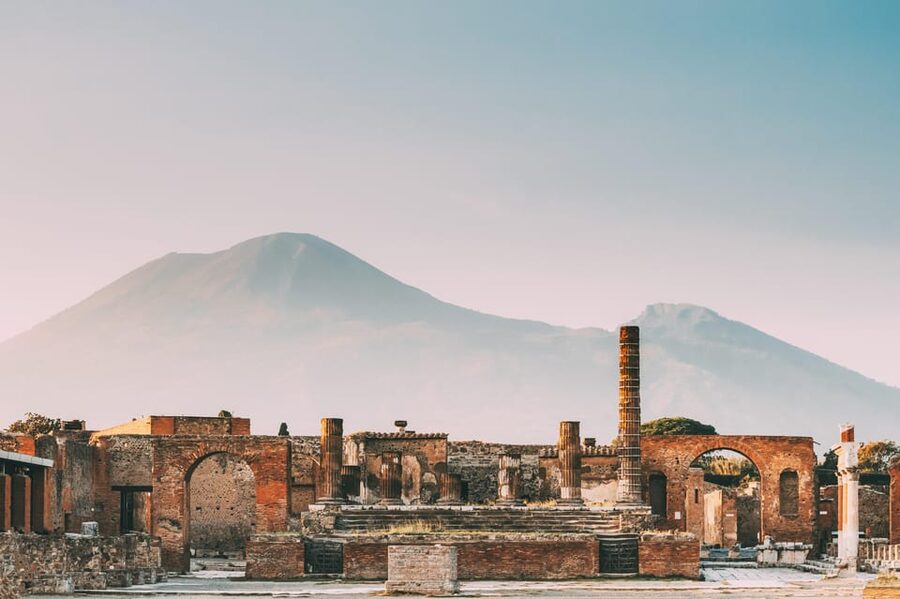
The Forum is one of the most important stops because it gives you the broadest sense of Pompeii as a functioning city. This open public space was linked to civic, religious, and commercial life. From here, the scale of the settlement begins to make sense.
Do not rush this stop. Look across the open area, then compare it with the surrounding temples and civic buildings. Your guide can explain how public spaces shaped Roman life and why the Forum mattered to people who came to conduct business, attend civic events, worship, or simply see and be seen.
The Forum also makes a good reference point for the rest of the visit. Once you understand the difference between public and private areas, a wealthy home or a bathhouse becomes easier to read. Without that context, Pompeii can feel like a long sequence of walls and paving stones.
The open setting has a cost. There is little shade in some parts of the site, and warm weather can make the walk tiring. One especially useful route adjustment took the group away from crowded areas and toward a path with more manageable conditions. Your exact route may vary, but a good guide should adjust the pace and order of stops when possible.
Plaster casts and the human cost of the eruption
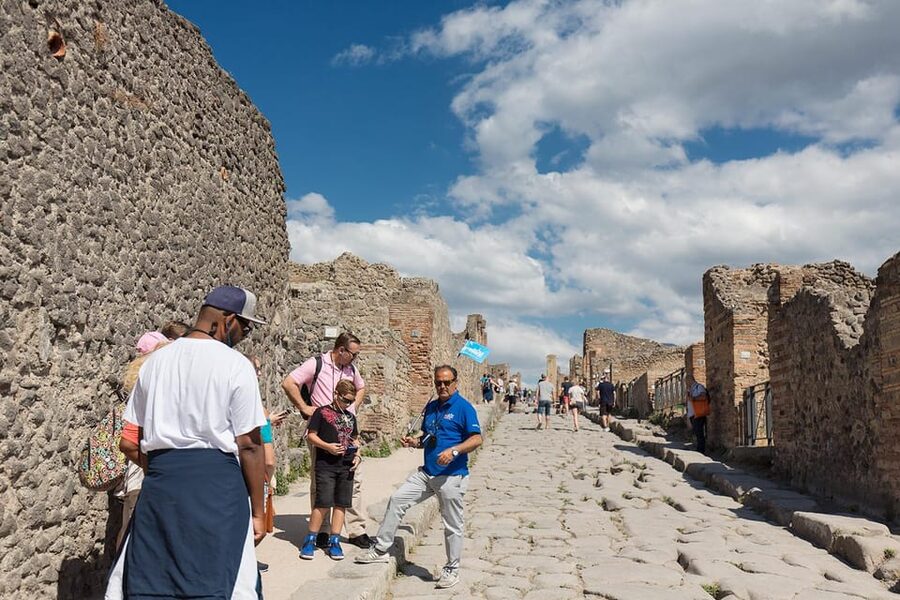
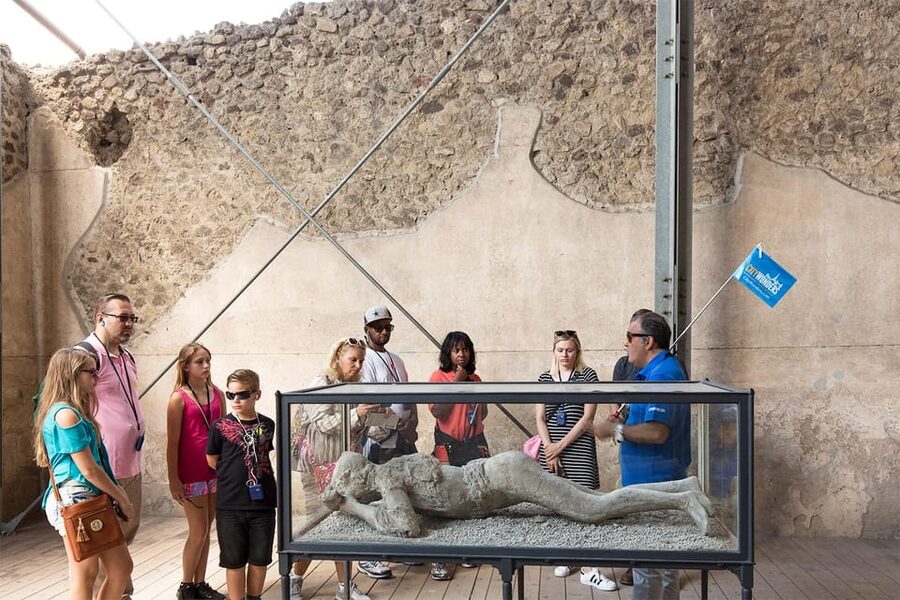
The plaster casts are among Pompeii’s most haunting sights. They preserve the forms of people who died during the eruption, giving the disaster a human scale that architecture alone cannot provide.
This stop deserves a measured explanation. The casts are not merely dramatic objects for photographs. They help you understand that Pompeii was a lived-in city filled with people who had little warning or no safe way out. Your guide can place them within the wider story of the eruption and explain why these remains were preserved.
The emotional effect is strong, and the quality of the explanation matters. A sensitive guide will give you time to look without turning the moment into a spectacle. If you are visiting with children, be ready to explain what you are seeing in simple terms.
More Pompei Campania tours worth comparing
- Pompeii: Skip-the-line-Ticket and Guided Tour
★ 4.6 · 1,152 reviews - Pompeii: Guided Tour with Skip-the-Line Entry
★ 4.9 · 812 reviews - Pompeii: Skip-the-Line Entry Ticket with Digital Guide App
★ 4.1 · 770 reviews - Pompeii: Tour with Archaeologist Guide & Skip-the-Line Entry
★ 4.5 · 478 reviews
Thermal baths and the routines of Roman life
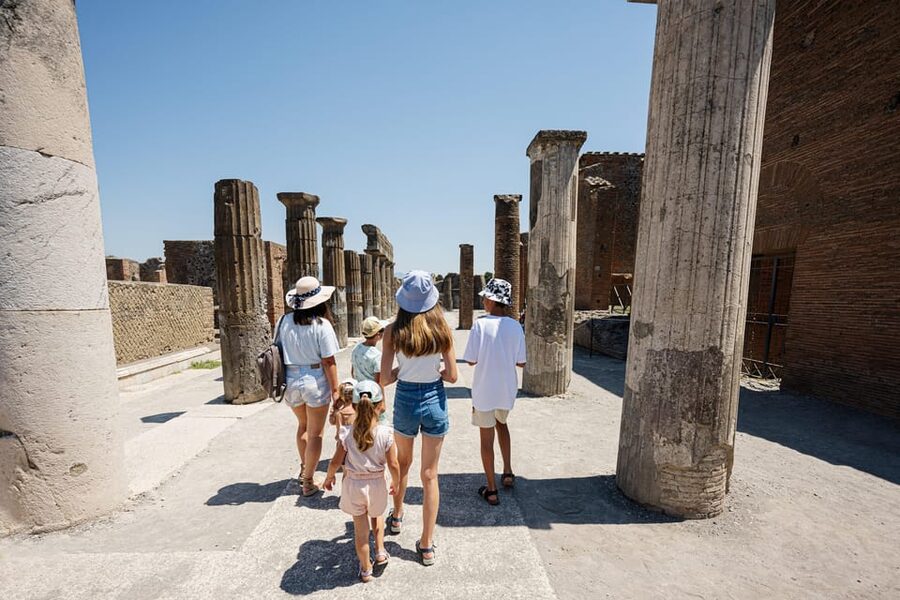
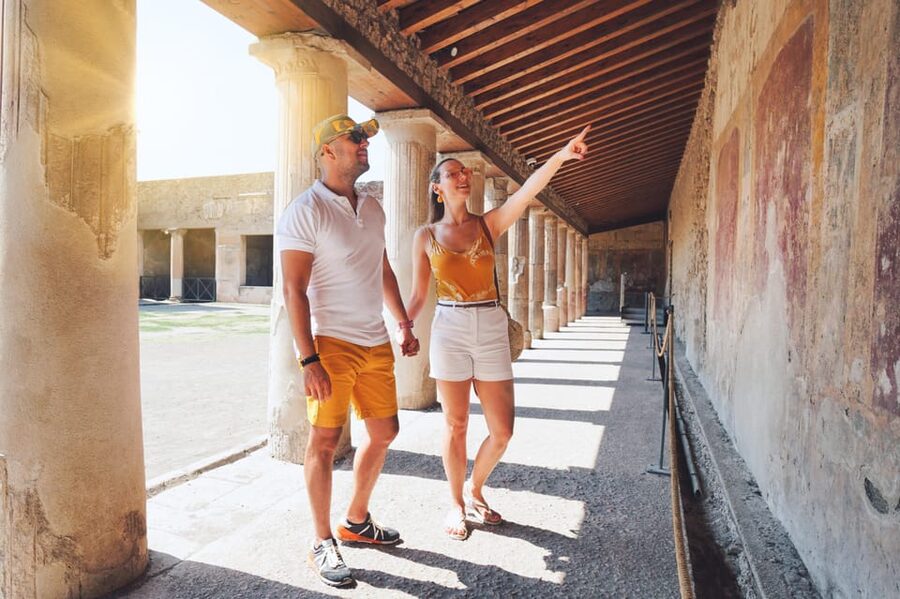
The thermal baths show how much social life happened outside the home. Romans used bath complexes not only to wash but also to meet, talk, and spend part of the day. The buildings also reveal Roman engineering, with carefully planned rooms and systems for managing heat and water.
I find this part of the tour especially useful because it moves away from the familiar image of emperors and armies. The baths point to ordinary routines and shared public habits. You begin to see Roman society through the places people used every day.
The guide’s role is important here. A bare room can look plain until someone explains its purpose and connects it to the wider layout. Clear commentary, supported by an audio device when it works well, lets you listen while standing back from the group.
The Lupanar and the less polished side of Pompeii
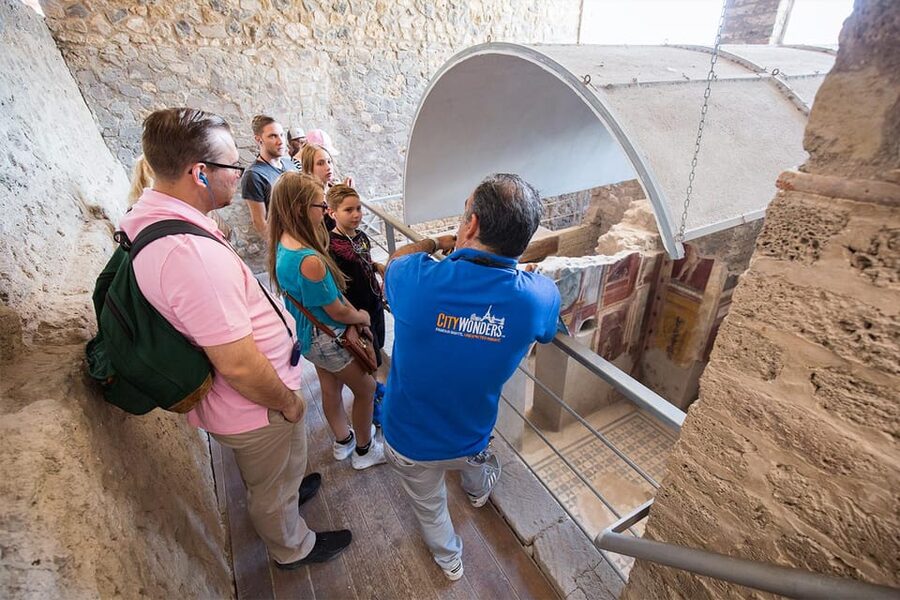
The Lupanar offers a glimpse into a side of Roman society that is often left out of grand accounts of the ancient world. The building is associated with prostitution, and its small rooms and surviving decorations provide clues about the services offered there.
The stop can draw a crowd, so your guide may need to manage the group carefully. You might have only a short time to look inside, especially when other tours are moving through. This is one reason the guided route is useful: the guide helps you focus on what is significant instead of waiting without context.
The Lupanar also reminds you that Pompeii was not a frozen postcard of noble villas. It was a working city with social divisions, commerce, entertainment, religion, and private behavior all packed together. That mixture makes the site feel more human.
The Amphitheater and 30 minutes to look around
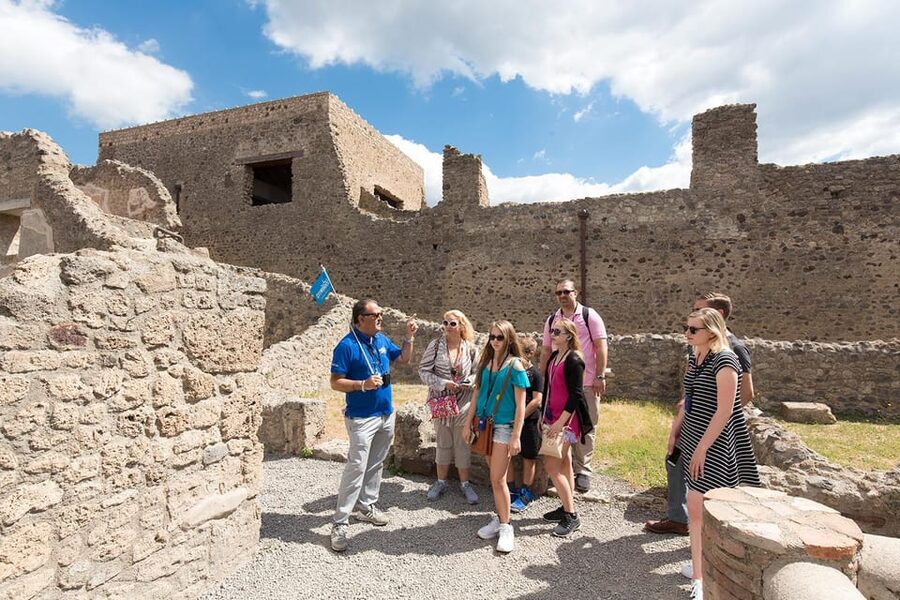
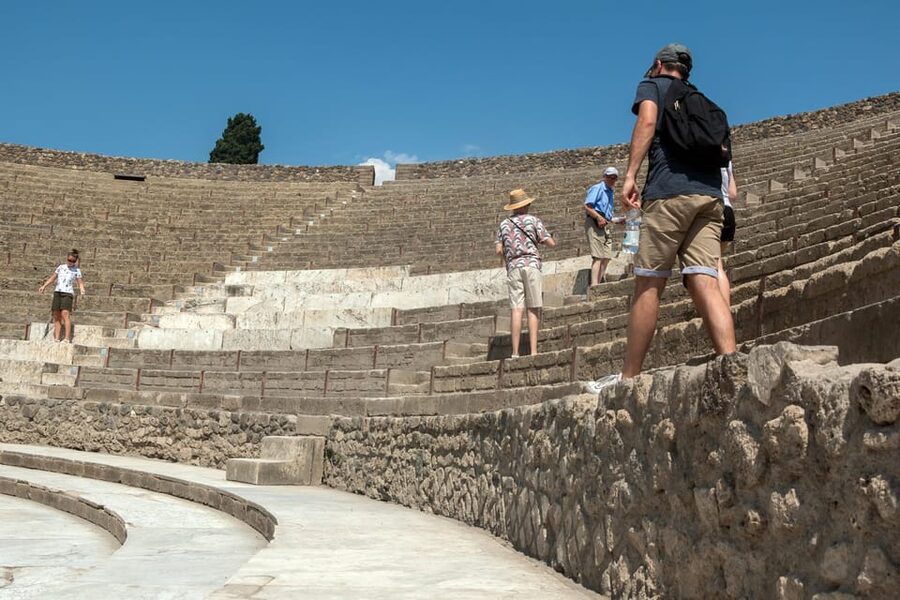
The Amphitheater is scheduled as a visit with free time. It gives you a chance to see one of Pompeii’s major public entertainment spaces and to step away from the guide’s commentary for a while.
Use this time to take in the shape of the building and imagine how large public events fit into city life. The Amphitheater is also a useful change of pace after the denser streets and houses. If your group moves on before you are ready, listen carefully to the guide’s instructions about where and when to regroup.
The free time is valuable, but the schedule needs attention. The advertised duration is two hours, while the route also lists 30 minutes at the Amphitheater and 30 minutes at the House of the Faun. In practice, think of two hours as the guided core, with some stops and independent viewing extending your visit. Several people have spent another two or three hours walking around after the guided portion ended.
The House of the Faun and Pompeii’s wealthy residents
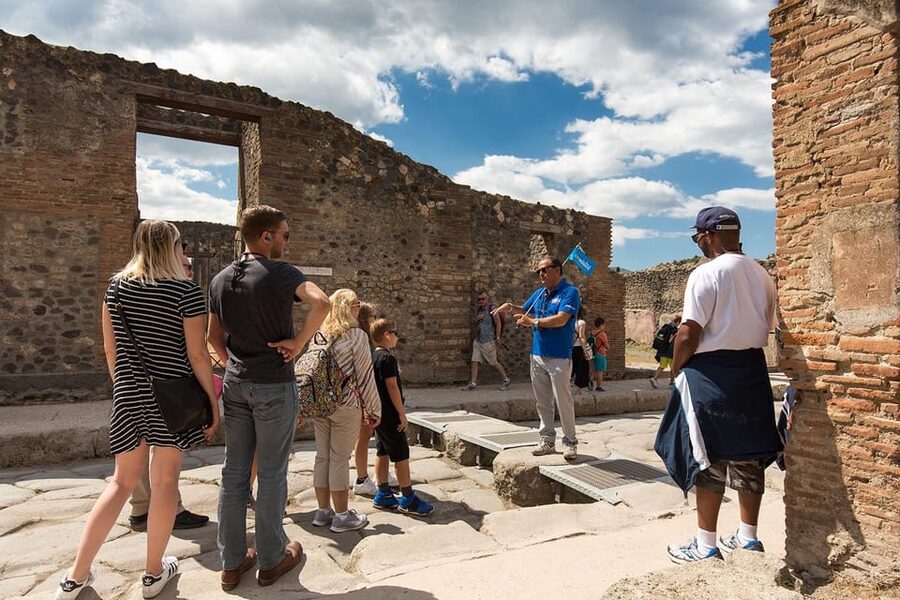
The House of the Faun is one of the tour’s major highlights. Its size helps you understand the gap between an ordinary Pompeian home and a large residence built for wealth, display, and entertaining.
Your guide explains the building’s story and points out the details that make it important. The name comes from a faun statue, and the house is known for its scale and decoration. You do not need to memorize every architectural term. Focus on how the rooms connect and what that layout says about status and private life.
The House of the Faun is also listed as a free-time stop. This is a good place to linger after the formal explanation, take photographs where permitted, and look again at features that went by quickly during the group walk.
One limitation is that access to individual buildings can change at Pompeii. The supplied route includes the House of the Faun, but conditions inside ancient structures may vary. Follow the guide’s directions and expect the precise order or amount of time at each room to shift.
What the two-hour format really gives you
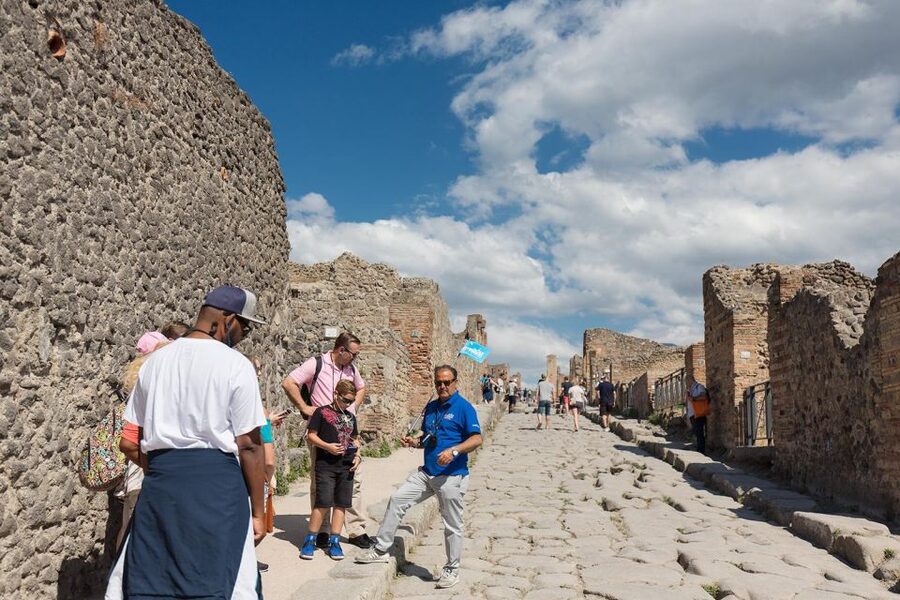
Two hours is enough for a strong first reading of Pompeii. You see major public spaces, a wealthy house, the baths, the Lupanar, the Amphitheater, and the plaster casts, while the guide explains how these pieces fit together.
It is not enough for a full survey. Pompeii is too large, and some streets or houses will remain outside the route. That is not a flaw if you plan for it. I would treat the guided walk as your orientation, then use the provided map and remaining time to choose a few extra areas.
A guide can also help you avoid a common problem: spending too long at the first impressive building and then racing through the rest. The best guides described by name, including Innes and Lilia, kept a steady pace, explained where the group had been, and suggested what to see afterward. That simple guidance can make the difference between a satisfying visit and a tiring wander.
Price, group size, and overall value
The price is $39 per person, including the English-speaking guide and skip-the-line entrance. One guide-led visit can cost more than a basic entry ticket, but here the extra money pays for orientation, explanation, and time saved at the entrance.
One booking noted that the regular Pompeii ticket would normally cost €22, though ticket prices can change. At this price, the tour offers solid value if you want the main story without arranging a private guide. It is especially useful for a first visit, when the size of the ruins can otherwise feel overwhelming.
The value is less clear if you already know Pompeii well or prefer to read every sign at your own speed. In that case, you may want a longer self-guided visit. You can still do that after this tour, but you are paying for a guided introduction first.
Group size is worth checking when you book. Many groups appear to be modest in size, and audio devices can make a larger group workable. One booking involved more than 20 people, however, and larger groups can make narrow streets, courtyards, and popular buildings less personal.
Practical advice for a more comfortable visit
Wear shoes with firm soles. Pompeii’s ancient paving and uneven surfaces are not kind to flimsy footwear, and you will spend much of the time standing or walking.
Bring a sun hat and sunscreen. The site has exposed areas, and heat can build quickly. Carry water if you can do so within the site’s bag rules, but avoid large bags and luggage. Baby strollers and large bags are not allowed on this group tour.
The activity is not suitable for wheelchair users or people with mobility impairments. The provider also cannot accommodate guests who need special assistance, and strollers or baby carriages are not accepted. If any member of your party needs an accessible route or support, this is not the right tour.
Children under 18 might be asked for an identification card at the entrance, so bring one for each younger participant. The tour is conducted in English, and the guide may use listening devices. If hearing the commentary clearly is important to you, stay near the guide and speak up quickly if the device does not work.
You can cancel up to 24 hours before the activity for a full refund, and you can reserve now and pay later. Those terms are useful if your Campania plans are still shifting.
Who should book this Pompeii tour?
Book it if you want a focused introduction, prefer human explanations to site signs, and want to avoid the main entrance line. It suits first-time visitors, history fans, and anyone who wants to understand Roman homes and public life rather than simply photograph old walls.
It is also a good choice if you plan to spend extra time at Pompeii afterward. The guided route gives you a framework, then you can explore at your own speed. The included map and the guide’s suggestions can help you choose where to go next.
Think twice if you need step-free access, want a private experience, or hope to see nearly the entire archaeological site in one session. Two hours moves at a useful pace, but it cannot cover everything. You should also accept that the precise route, group size, audio equipment, and guide will affect the feel of the day.
Should you book it?
For $39, this is a practical way to see Pompeii’s main sights with a guide and skip the standard entry queue. I especially like the mix of public spaces, homes, baths, and more difficult human stories. The strongest guides bring the ruins to life with humor, clear English, local feeling, and time for questions.
Book it if you want structure and context, then plan to stay another two hours if the weather and your energy allow. Skip it only if you need accessibility, want complete independence, or already have a detailed plan for exploring the site on your own.
FAQ
How long does the Pompeii guided tour last?
The advertised duration is two hours. The route also includes time at the Amphitheater and House of the Faun, and you can continue exploring Pompeii independently after the guided portion.
What is included in the price?
The $39 price includes an English-speaking guide and skip-the-line entry to the Pompeii Archaeological Site.
Where does the tour start?
Meet your guide in front of Coffee Shop Vittoria. The guide will be holding a City Wonders sign.
Is the tour conducted in English?
Yes. The live tour guide speaks English, and listening devices may be provided for the group.
What should I bring?
Bring comfortable shoes, a sun hat, and sunscreen. Children under 18 might need to show an identification card at the site entrance, so bring one for them.
Is the tour suitable for wheelchair users or strollers?
No. The activity is not suitable for wheelchair users or people with mobility impairments. Strollers, baby carriages, luggage, and large bags are not allowed on the group tour.
Newest reviews from Pompei Campania
- From Sorrento: Pompeii & Vesuvius tour small group★ 4.8 · 4 reviews
- Pompeii Private Tour for Kids and Their Families★ 4.8 · 4 reviews
- From Naples_ Pompeii Tour_Skip the line ticket + audioguide★ 4.3 · 4 reviews
- Pompeii, skip-the-line ticket with smartphone audio guide on App★ 3.0 · 4 reviews
- Pompeii Guided Experience – Tour Service Only★ 4.6 · 4 reviews
- From Naples Port:Pompeii+Vesuvius tour★ 4.3 · 4 reviews
- 2-Hour Pompeii Child-Friendly Tour★ 5.0 · 4 reviews
- Naples: Amalfi Coast, Sorrento and Pompeii Day Trip★ 4.4 · 5 reviews
Skip the Line, compared.

Skip-the-Line Entrance Ticket with Audio Guide
Read our review →



Skip-the-Line Entry Ticket with Digital Guide App
Read our review →
Pompeii Ruins Private Tour with Optional Skip-the-Line Entry
Read our review →
Skip-the-Line Pompeii Guided Tour from Sorrento
Read our review →
Skip the Line Guided Tour of Pompeii led by an Archaeologist
Read our review →Browse the lists this tour appears in