
Reviewed · ARCHAEOLOGIST-LED TOURS
Best of Pompeii & Herculaneum: Private Tour with an Archaeologist
Pompeii and Herculaneum tell the same disaster story in very different ways. Pompeii gives you grand public spaces, theaters, baths, the Forum, and the famous Lupanare. Herculaneum brings you closer to ordinary home life, with shops, bakeries, a thermopolium, frescoes, mosaics, and stucco decoration still in place.
I like the private format, which lets your guide focus on your questions instead of following a fixed group script. I also like the clear contrast between the two sites, plus the chance to get useful advice from guides such as Giada, who has been praised for her humor and local restaurant tips.
The main drawback is cost. The tour runs $720.91 for up to eight people, and that does not include the two entrance fees or optional transport. You also need good weather, and the booking is non-refundable unless poor weather forces the operator to cancel.
In This Review
- Key points at a glance
- Why seeing both sites makes sense
- Pompeii: the Forum, theaters, baths, and the Lupanare
- Herculaneum: smaller streets, stronger domestic detail
- What a private archaeologist adds
- Price, transport, and the real cost
- Timing, walking, and practical comfort
- Who will get the most from this tour
- Should you book this Pompeii and Herculaneum tour?
- FAQ
- Where does the tour begin?
- Where does the tour end?
- How long does the experience last?
- How much time is spent at Pompeii?
- How much time is spent at Herculaneum?
- Are entrance fees included?
- Is transportation included?
Key points at a glance
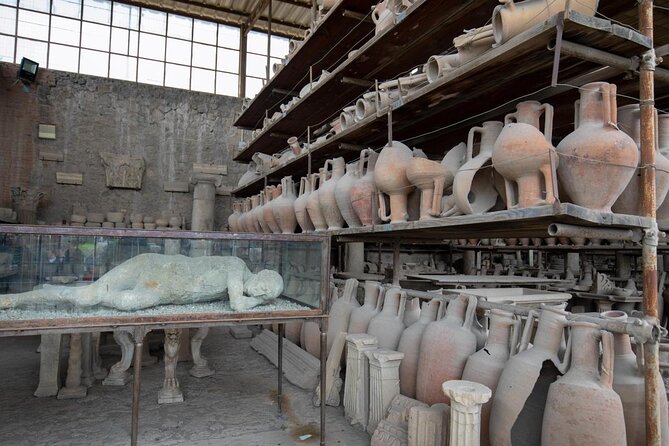
- Two ancient cities in one half-day: See Pompeii’s public buildings and Herculaneum’s private homes in about four to five hours.
- A private archaeologist guide: Your group alone takes part, with an English-speaking local expert leading the visit.
- Pompeii’s public face: Explore the Forum, theaters, thermal baths, surrounding buildings, and the Lupanare.
- Herculaneum’s domestic detail: Look for bakeries, a thermopolium, shops, mosaics, frescoes, and stucco work.
- Extra costs matter: Pompeii and Herculaneum admission is €40 per person, while private transport costs from €350.
- A strong guide can shape the day: Roberto has been praised for explaining both the eruption and Roman daily life, while Giada is known for a friendly, funny approach.
Why seeing both sites makes sense
If you have time for only one ancient Vesuvian city, the choice can be difficult. Pompeii is larger and gives you the big civic picture. Herculaneum is smaller, but its preserved houses and shops often make Roman life feel more immediate.
This tour solves that problem by giving you a planned look at both. You spend about two hours in Pompeii, then around ninety minutes in Herculaneum. That is enough for a guided introduction to each site, but not enough to inspect every street or building at a leisurely pace.
I like this pairing because the sites do not simply repeat one another. At Pompeii, you see how a Roman city functioned in public. At Herculaneum, you turn toward kitchens, shops, decoration, and private living spaces. A good archaeologist can connect those pieces and explain how the city worked beyond the famous eruption.
The tour is offered in English and is private for your group, with a maximum of eight people. That size is especially useful at archaeological sites, where a large crowd can make it hard to hear or ask questions.
More Pompeii excavation visits:
- Pompeii: Entry Ticket and Guided Tour with an Archaeologist
★ 4.8 · 19,459 reviews - Pompeii: Entry Ticket with Optional Audio Guide
★ 4.2 · 12,360 reviews - Pompeii: Small Group Tour with an Archaeologist
★ 4.8 · 12,264 reviews
Pompeii: the Forum, theaters, baths, and the Lupanare
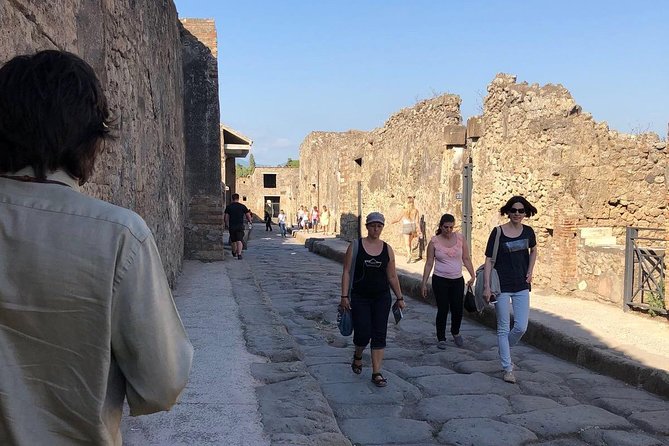
The Pompeii portion lasts about two hours. That sounds generous until you remember how much ground the archaeological park covers. Your guide focuses on selected public buildings rather than trying to march you through every visible ruin.
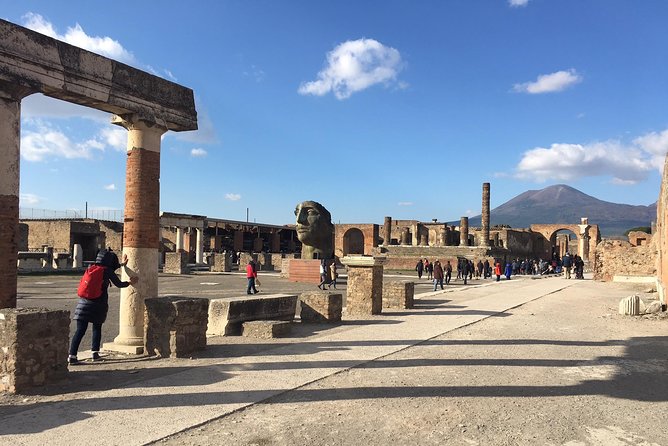
The Forum is the essential starting point. This was the civic heart of Pompeii, surrounded by important public and religious buildings. Even without studying every structure, you can use the space to understand the city’s layout and the difference between public life and private life.
The theaters add another angle. They show that entertainment was part of the city’s daily rhythm, not a side note reserved for the wealthy. Your archaeologist can explain how these spaces fit into Roman society and how public buildings served different parts of the community.
The thermal baths offer a useful correction to the idea that bathing was simply about washing. Roman bath complexes were social and civic spaces, and they help explain how people spent time together. The tour includes the baths along with the Forum and theaters, giving you a solid look at Pompeii as a working city.
Then comes the Lupanare, Pompeii’s famous brothel. It is one of the site’s best-known stops, but it is also easy to reduce it to a quick joke and move on. A good guide gives it context within Roman commercial and social life, which makes the building more interesting than its reputation alone suggests.
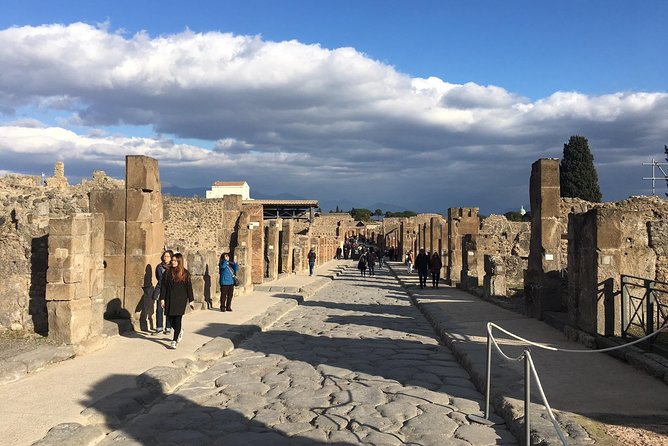
The Pompeii visit is not just a parade of ruins. The useful question is how people moved through the city, worked, met, bathed, watched performances, and used public buildings. The strongest part of the guiding here should be the connection between the stones and the people who used them.
Admission is not included. The stated cost is €40 per person for both Pompeii and Herculaneum. Keep that in your budget before comparing the tour price with other options.
Herculaneum: smaller streets, stronger domestic detail
At Herculaneum, you spend about an hour and a half looking at private houses and shops. This is where the tour changes character. Pompeii gives you civic scale, while Herculaneum focuses more closely on homes, businesses, decoration, and household life.
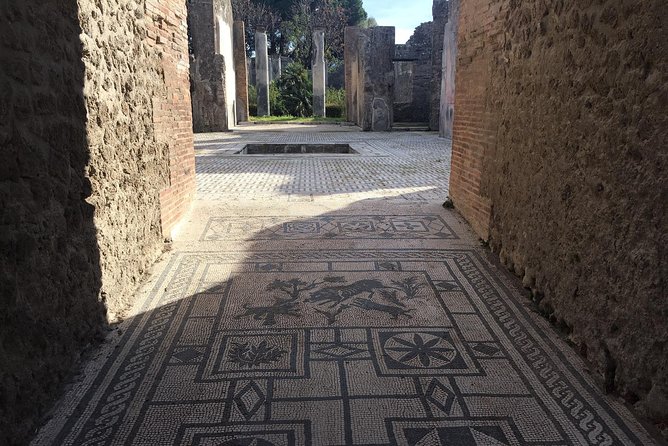
The preserved decoration is a major reason to include Herculaneum. You can expect to see beautiful frescoes, mosaics, and stucco details in the houses. These features help you picture how Romans decorated their interiors, rather than leaving you with bare walls and vague impressions.
The shops are just as useful. A bakery and a thermopolium are included in the visit. The thermopolium, a place selling prepared food and drink, offers a direct look at the commercial side of everyday eating. A bakery helps you think about how food was produced and sold, not just consumed.
Herculaneum’s smaller scale can make these details easier to appreciate. You are not only looking at monumental architecture. You are looking at the spaces where people lived, bought food, worked, and displayed their taste.
The ninety-minute visit is also the tour’s main limitation at Herculaneum. If you become absorbed in the houses, the time can pass quickly. You will get a focused introduction, not a complete examination of the archaeological park.
That is why your guide matters here. Roberto has been praised for fielding questions about both the eruption and the daily lives of the people who lived in these cities. That combination is important. You want the disaster explained, but you also want the residents treated as real people with homes, jobs, meals, and routines.
What a private archaeologist adds
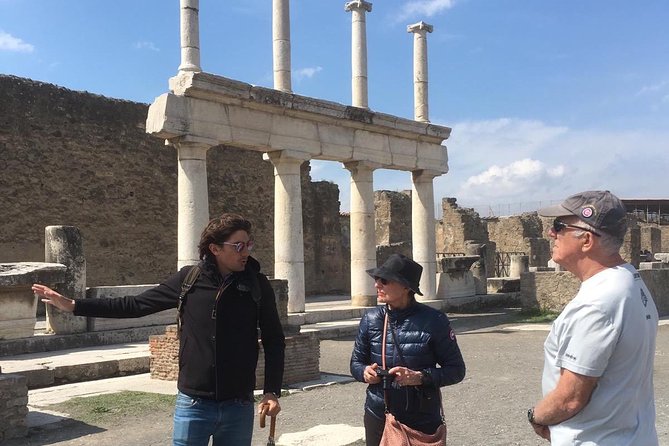
The guide is the central reason to choose this experience instead of simply visiting with an audio guide or reading the signs. The stated service includes a local expert archaeologist as your private guide, and only your group participates.
That private setup gives you room to shape the visit. If your group cares about architecture, religion, food, household decoration, or the eruption, you can ask questions in that direction. You are not waiting for a large group to catch up or listening to questions that do not interest you.
The guide’s role is also to make sense of incomplete remains. Archaeological sites can be visually impressive but confusing. A Forum may look like a collection of columns. A shop may look like a room with counters. Context turns those fragments into places with a purpose.
The available guide feedback points to two useful styles. Roberto is praised for thorough answers about the eruption and ordinary Roman life. Giada is described as funny, kind, and highly informed, and she has also recommended a good pizza place. You are not guaranteed either guide, but those comments show the sort of personal touch this private format can provide.
For families or mixed-interest groups, this flexibility is valuable. One person can ask about Roman food while another asks about architecture. For history fans, the archaeologist’s training may make the extra cost easier to justify.
Still, a private guide cannot change the basic time limit. Four to five hours is a compact visit to two major sites. You should arrive ready to listen, ask focused questions, and accept that some corners will remain unexplored.
More Herculaneum excavation visits:
- Pompeii and Herculaneum Small Group Tour with an Archaeologist
★ 5.0 · 1,350 reviews - Pompeii: Small-Group Tour of Pompeii and Herculaneum
★ 4.8 · 867 reviews - Guided Day Tour of Pompeii and Herculaneum with Light Lunch
★ 4.5 · 311 reviews - Private Day Tour to Vesuvius, Herculaneum & Pompeii with Pick Up
★ 5.0 · 279 reviews
Price, transport, and the real cost
The listed price is $720.91 per group of up to eight people. On a full group, that can be reasonable for a private professional guide, especially if you value a personal pace and shared attention. For two or three people, the per-person cost becomes much higher.
Entrance fees are separate. Budget €40 per person for entry to both archaeological parks. This is a significant addition, so do not treat the headline group price as the full cost of the outing.
Private transportation is optional and starts at €350 with a professional driver. Without that option, you are responsible for reaching the starting point and managing the transfer between the two sites. The tour begins at Piazza Esedra in Pompeii and ends at the Archaeological Park of Herculaneum on Corso Resina.
That start and end arrangement is worth noticing. You do not finish where you began, which can be useful if you are continuing toward Herculaneum or arranging your day around that area. It is less convenient if you need to return to Pompeii immediately.
The tour is near public transportation, but the supplied details do not specify the exact route or transfer method. If you do not book the private driver, confirm your transport plan before the day begins. A little planning will keep the archaeological visit from turning into a rushed transfer exercise.
An optional light lunch break costs from €20 per person. This is not included, so decide in advance if you want to keep the tour moving or pause for food.
Timing, walking, and practical comfort
The full experience lasts approximately four to five hours. Pompeii takes about two hours, Herculaneum about one and a half hours, and the remaining time covers the transition and normal tour pacing.
The two parks require time on your feet. The details provided do not state the exact walking distance or surface conditions, so wear comfortable shoes and plan for an active half-day. You should also allow enough time to follow a guide through large outdoor archaeological areas without trying to squeeze another major attraction into the same schedule.
The experience requires good weather. If poor weather causes the operator to cancel, you are offered another date or a full refund. That protection applies to a weather cancellation, not to a change of mind.
Booking confirmation arrives within 48 hours, subject to availability. The experience is offered with a mobile ticket, and service animals are allowed. Most people can participate, and the private format means you do not have to adapt your pace to strangers.
Because the booking is non-refundable and cannot be changed for any reason, check your date, group size, meeting point, and transport plan carefully before paying. This is particularly important for a tour often booked well in advance, with bookings averaging about 132 days ahead.
Who will get the most from this tour
I would recommend this experience to anyone who wants both sites but does not want to spend hours building a detailed plan. It suits first-time visitors who want a clear introduction, couples who prefer a private pace, and families who need the guide’s attention to remain focused.
It is also a good match for people who enjoy asking questions. The private setting is wasted if you simply follow along silently, since one of its main benefits is the chance to explore your own interests.
History fans should like the mix of public and private life. Pompeii covers theaters, baths, the Forum, and the Lupanare. Herculaneum adds houses, food shops, frescoes, mosaics, and stucco. Together, they give you more than an eruption story.
I would be more cautious if you want a slow, exhaustive archaeological study. The schedule is tight, and both entrance fees and transport add to the cost. Independent visitors who already know the sites may prefer more time on their own.
The tour also suits groups of up to eight particularly well. Split across eight people, the guide price is easier to absorb. A small group of two should compare the cost with other private options before booking.
Should you book this Pompeii and Herculaneum tour?
Book it if you value a private archaeologist, want to compare two very different sites in one outing, and prefer clear historical context over wandering alone. The strongest reasons are the expert-led explanations, the focus on both public buildings and domestic life, and the chance to ask questions throughout the visit.
Think twice if the $720.91 group price, €40 admission per person, and possible €350 transport fee stretch your budget. Also avoid booking until your date and plans are firm, since the experience is non-refundable and cannot be amended.
For a full group of up to eight, this can be a sensible way to share the cost of a private guide. For a smaller party, you are paying for the convenience, personal attention, and time saved in planning. If those matter to you, the price may be fair. If not, a self-guided visit could offer more hours at a lower total cost.
FAQ
Where does the tour begin?
The tour begins at Piazza Esedra, 10/13, 80045 Pompei, Italy.
Where does the tour end?
The tour ends at the Archaeological Park of Herculaneum, Corso Resina, 187, 80056 Ercolano, Italy.
How long does the experience last?
The tour lasts approximately four to five hours.
How much time is spent at Pompeii?
The Pompeii visit lasts about two hours and includes public buildings such as the theaters, thermal baths, Forum, nearby structures, and the Lupanare.
How much time is spent at Herculaneum?
The Herculaneum visit lasts about one hour and thirty minutes and includes private houses, shops, a bakery, and a thermopolium decorated with frescoes, mosaics, and stucco.
Are entrance fees included?
No. Entrance to Pompeii and Herculaneum costs €40 per person and is paid separately.
Is transportation included?
No. Private transportation with a professional driver is optional and costs from €350. The tour is near public transportation.
More Tours Led by an Archaeologist
- Pompeii Small Group Tour with an Archaeologist
★ 5.0 · 6,593 reviews - Skip the Line Guided Tour of Pompeii led by an Archaeologist
★ 5.0 · 703 reviews - Pompeii: Exclusive Tour with Archaeologist and Entry Tickets
★ 4.9 · 634 reviews - Pompeii Private Tour with an Archaeologist and Skip The Line – 3 hours
★ 5.0 · 564 reviews
Newest reviews from Pompeii Ruins
- Private Tour Pompeii and Winery★ 5.0 · 4 reviews
- Visit the Pompeii ruins from Salerno with Pizza Lunch★ 5.0 · 4 reviews
- Pompeii Private Tour for Kids and Their Families★ 4.8 · 4 reviews
- From Sorrento: Pompeii & Vesuvius tour small group★ 4.8 · 4 reviews
- Pompeii Sorrento and Positano Tour★ 5.0 · 4 reviews
- From Naples_ Pompeii Tour_Skip the line ticket + audioguide★ 4.3 · 4 reviews
- Pompeii, skip-the-line ticket with smartphone audio guide on App★ 3.0 · 4 reviews
- Pompeii Private Half-Day Tour from: Naples,Sorrento, Amalfi Coast★ 5.0 · 4 reviews
Archaeologist-Led Tours, compared.

Entry Ticket and Guided Tour with an Archaeologist
Read our review →
Pompeii Small Group Tour with an Archaeologist
Read our review →
Pompeii and Herculaneum Small Group Tour with an Archaeologist
Read our review →
Skip the Line Guided Tour of Pompeii led by an Archaeologist
Read our review →
Exclusive Tour with Archaeologist and Entry Tickets
Read our review →
Pompeii Private Tour with an Archaeologist and Skip The Line – 3 hours
Read our review →
Pompeii Skip-the-line Tour with Archaeologist Guide
Read our review →Browse the lists this tour appears in