

Reviewed · ARCHAEOLOGIST-LED TOURS
VIP Pompeii Tour including Newly Opened Houses With Archaeologist
Pompeii’s newly restored aristocratic houses are the star here. With a private guide, you can see the Domus of Venus, the House of Octavius Quartius, and other rotating villas while also making sense of the city’s streets, theaters, baths, and Forum. The result is far more focused than wandering Pompeii with a map.
I like the skip-the-line entry and the freedom to shape the route around your interests. I also like the small private setting, which lets guides such as Giada, Italo, Fiorenza, Rosanna, and Antonio spend time on questions and adjust the pace. The main caution is price: at $359.22 per person, this is a serious splurge, and the advertised four-hour length does not always match the five-hour descriptions given for some departures.
In This Review
- Key points to know before booking
- Why the private format works so well at Pompeii
- Meeting near Porta Marina and getting inside
- The Forum: Pompeii’s public heart
- Teatro Grande and Teatro Piccolo
- The Stabian Baths and everyday Roman life
- House of Menander and the private side of Pompeii
- The newly opened villas and rotating access
- Domus of Venus
- House of Octavius Quartius
- House of the Fruit Trees
- House of Iulia Felix
- What makes the guides effective
- Four hours or five, and how much walking?
- Is $359.22 per person a fair price?
- Best fit, and who may want another option
- Final call: should you book it?
- FAQ
- Where does the Pompeii tour begin?
- How long does the experience last?
- Are the newly opened houses guaranteed to be open?
- What is included in the price?
- Is hotel transportation included?
- What should I bring?
Key points to know before booking
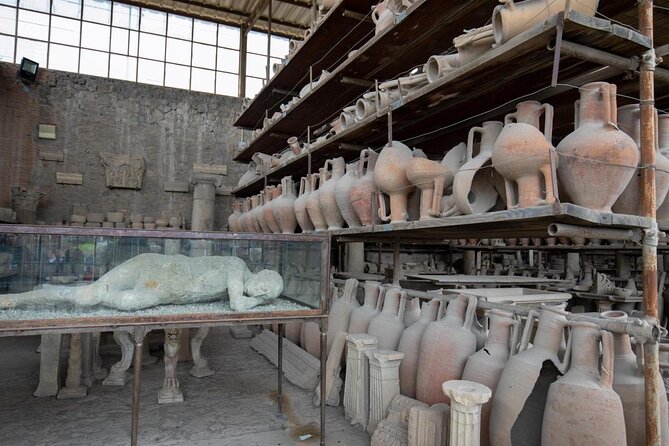
- Newly opened houses rotate: The Domus of Venus, House of Octavius Quartius, House of the Fruit Trees, and House of Iulia Felix may not all be open on the same day.
- Private attention changes the experience: Your guide can slow down for frescoes, answer questions, and avoid wasting time on aimless walking.
- The route covers Pompeii’s essential core: Expect the Forum, Teatro Grande, Teatro Piccolo, Stabian Baths, House of Menander, and major villas.
- The tour involves serious walking: Bring comfortable shoes, a hat, and a full water bottle. Shade is limited.
- Skip-the-line tickets are included: You meet near the Pompeii entrance and go inside with your admission arranged.
- The guide assignment varies: Many guides are praised for history, humor, and storytelling, but an archaeologist may not be guaranteed on every departure.
Why the private format works so well at Pompeii
Pompeii is not a single monument. It is a full Roman city spread across a large archaeological park, with streets, houses, temples, shops, public baths, theaters, gardens, and political buildings. Without context, the site can become a long walk past broken walls.
A private guide gives each building a purpose. You learn how people moved through the city, where they gathered, how homes were arranged, and what details reveal social rank. A painted wall is no longer just decoration when your guide explains how Roman homeowners used mythological scenes, garden imagery, and careful room placement to impress visitors.
The private setup also matters physically. You can ask to spend more time on a mosaic or move faster through a less interesting section. Several guides, including Giada and Fiorenza, are praised for adapting their explanations to the group. That is especially useful with children, who can lose interest if every stop turns into a long lecture.
You also avoid the basic problem of following a large group through narrow ancient streets. A private guide can keep the pace moving and help you reach popular buildings without waiting for a big crowd to clear. The skip-the-line ticket is helpful at the entrance, but it does not mean every house inside will be empty or open.
More Pompeii excavation visits:
- Pompeii: Entry Ticket and Guided Tour with an Archaeologist
★ 4.8 · 19,459 reviews - Pompeii: Entry Ticket with Optional Audio Guide
★ 4.2 · 12,360 reviews - Pompeii: Small Group Tour with an Archaeologist
★ 4.8 · 12,264 reviews
Meeting near Porta Marina and getting inside
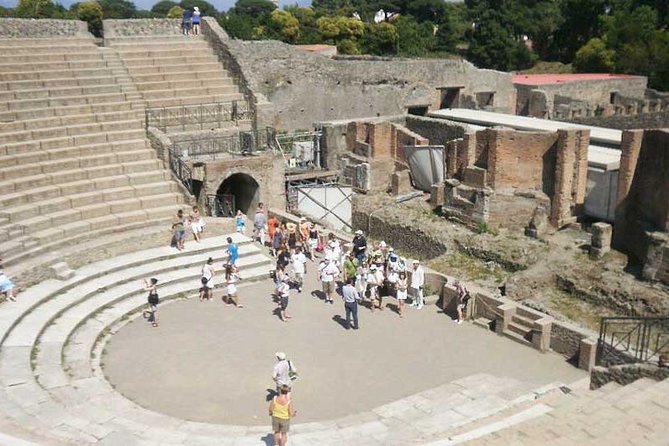
The usual meeting point is Coffee Shop Vittoria on Via Mare, near the Pompeii entrance at Piazza Porta Marina. You make your own way there unless you arrange hotel or port pickup for an added charge.
That meeting point is practical if you are already in Pompeii or arriving by public transportation. Give yourself enough time to find the café and identify your guide. The tour details describe flexible departure times, so confirm your selected start time and meeting instructions carefully.
A current valid passport is required on the day of the tour. That is easy to overlook on a day trip, especially if you are carrying only a small bag. Keep it accessible, along with your booking confirmation.
Once you meet your guide, the skip-the-line admission lets you head into the archaeological park without joining the longest ticket queue. Your tour ends back near the starting area after roughly four to five hours, depending on the selected version and the pace of your group.
The Forum: Pompeii’s public heart
The walk begins through Pompeii’s main streets and ends at the Forum, the city’s central public square. This is where the private guide can first give you a clear picture of daily Roman life.
The Forum was not simply an open plaza. It was the place for public business, religious activity, civic decisions, and social display. From here, you can begin to understand how the rest of the city fitted together.
I like this early stop because it gives structure to everything that follows. After hearing how the Forum worked, you can look at private houses and shops with a better sense of their place in the city. You also hear how Pompeii developed over time, with some ruins dating back as early as the seventh century BC.
The eruption of nearby Mount Vesuvius in AD 79 is part of the story, but the tour is not only about destruction. A good guide connects the eruption to ordinary routines: bathing, shopping, attending performances, visiting friends, and moving through the city’s paved streets.
Teatro Grande and Teatro Piccolo
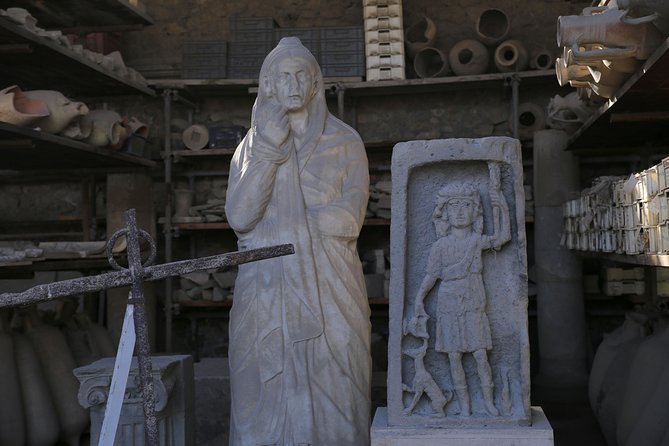
The Teatro Grande offers a change of scale. It was Pompeii’s main theater, and your guide uses it to explain Roman entertainment and public life.
The theater is memorable because it shows how a city could gather large numbers of people for performances. You get a sense of how architecture guided movement, seating, and visibility. The stop is listed at about 30 minutes, which gives you enough time for an explanation and photographs without turning the visit into a long pause.
Next comes the smaller Teatro Piccolo, also called the Odeon. This theater is known for its excellent acoustics. The guide may demonstrate the effect with a voice or short sound, as one particularly enthusiastic guide did by singing in the arena. That kind of demonstration makes the building easier to understand than a dry explanation of its design.
The two theaters work well together. The Teatro Grande shows public entertainment on a broad scale, while the Odeon feels more intimate and refined. If you enjoy architecture, the acoustics and layout are among the more memorable details on the route.
More tours led by an archaeologist:
- Pompeii Small Group Tour with an Archaeologist
★ 5.0 · 6,593 reviews - Pompeii and Herculaneum Small Group Tour with an Archaeologist
★ 5.0 · 1,350 reviews - Skip the Line Guided Tour of Pompeii led by an Archaeologist
★ 5.0 · 703 reviews - Pompeii: Exclusive Tour with Archaeologist and Entry Tickets
★ 4.9 · 634 reviews
The Stabian Baths and everyday Roman life
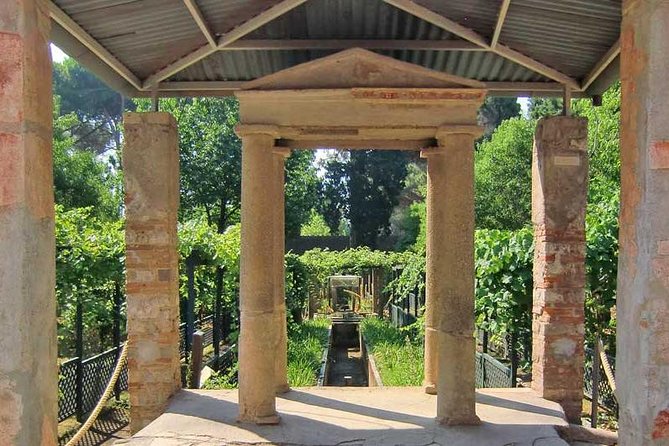
The Stabian Baths are one of the best places to picture ordinary city life. Roman baths were not just for washing. They were social spaces where people met, exercised, relaxed, and maintained routines that had little to do with the emergency that later buried the city.
Your guide can point out the different parts of the complex and explain how bathing worked. The surviving walls and rooms are also a reminder that Pompeii was a functioning city, not an isolated collection of grand villas.
This is where a private tour earns its keep. You can ask practical questions about who used the baths, how the rooms were organized, and what the architecture tells us about Roman customs. A large group often has to move on as soon as the guide finishes the prepared explanation.
The archaeological park has limited shade, and the surface can be uneven. The baths come after several other walking stops, so sturdy shoes are more useful than fashionable ones. Bring water from the start. There are fountains in the grounds, but you should not count on buying a drink at every point along the route.
House of Menander and the private side of Pompeii
The House of Menander gives you a closer look at an affluent Roman residence. Its name comes from the famous Greek playwright Menander, whose image or artistic association is linked to the house.
Here, the guide shifts from citywide planning to domestic life. You may discuss room use, decoration, household organization, and the way a wealthy family presented itself to visitors. Pompeii’s houses make the ancient city feel personal because you can still see the spaces where people ate, received callers, worked, and displayed art.
The House of Menander is also a useful bridge to the newly opened villas. Once you understand the layout of one substantial home, you can better appreciate why the aristocratic houses were so carefully decorated.
The newly opened villas and rotating access
The most distinctive part of this tour is the chance to see houses that opened to the public in March 2017 after restoration. These buildings belonged to wealthy Pompeiians and contain some of the site’s most striking frescoes, mosaics, gardens, and mythological imagery.
The important catch is access. The houses rotate, so not every villa is open at the same time. Your guide customizes the route around the buildings available that day. Book this tour for the guided interpretation and private format, not with the assumption that every named house is guaranteed.
Domus of Venus
The Domus of Venus is known for its colonnaded façade, courtyard, and painting of the Birth of Venus. The image of Venus rising from a seashell is the sort of detail that can be easy to miss without a guide directing your attention.
The columns help frame the house, while the courtyard shows how architecture and decoration worked together. Roman homeowners used gardens, sculptures, painted walls, and open views to create a carefully planned impression.
Your guide can explain the mythological image and how it fit the taste of the household. The value here is not only seeing one famous painting. It is understanding how a private home used art to signal education, status, and taste.
House of Octavius Quartius
The House of Octavius Quartius is especially known for a painting of Narcissus. The myth of Narcissus, who became absorbed by his own reflection, adds a human story to the walls and gives your guide a natural opening to discuss Roman myths and decoration.
The house also rewards attention to its garden spaces and arrangement. Pompeii’s residences often blur the line between indoor and outdoor rooms, using courtyards and planted areas to create air, light, and display.
If this house is open during your visit, take time to look closely at the frescoes rather than racing through for photographs. The guide’s explanation is what turns the painted figure into part of a larger story about Roman art and domestic life.
House of the Fruit Trees
The House of the Fruit Trees is noted for its fine frescoes. Plant imagery may sound less dramatic than a volcano or amphitheater, but it offers a useful glimpse into the decorative choices of Pompeii’s residents.
The paintings help you see how Romans brought imagined gardens into their rooms. Your guide can point out how scenes of fruit, plants, and outdoor settings changed the feeling of an interior space.
House of Iulia Felix
The House of Iulia Felix once served as a spa retreat. It is a good reminder that comfort and leisure were part of elite Roman life.
The house gives the tour a different angle on bathing culture than the public Stabian Baths. One is a civic facility used by the broader population. The other reflects private wealth and a more controlled setting. Seeing both helps you compare public and private life in Pompeii.
What makes the guides effective
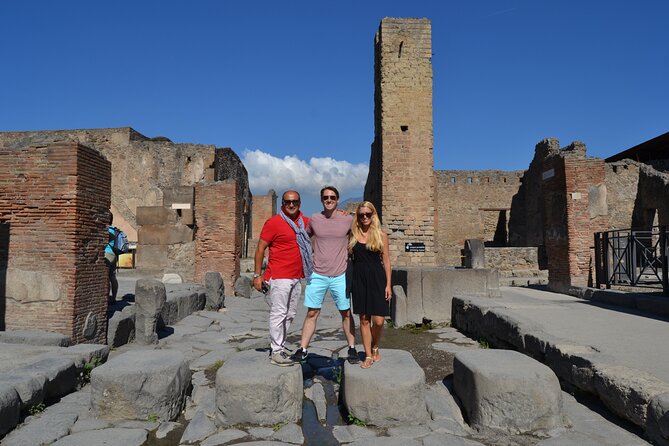
Guide quality is the biggest reason to book this experience rather than enter alone. The most praised guides include Giada, Italo, Fiorenza, Rosanna, Antonio, Barbara, Veronica, Loretta, and Andrea Fiorello. Assignments vary, so you cannot select a particular person from the details provided.
The strongest descriptions point to the same qualities: clear English, strong command of the site, warmth, humor, and the ability to answer detailed questions. Italo is praised for making the ruins easy to imagine as a living city. Giada is described as precise, energetic, and a gifted storyteller. Fiorenza is noted for adapting the tour to personal interests and allowing time for restrooms and photographs.
That flexibility is more than a pleasant extra. Pompeii can be tiring, and a guide who notices when you need a short break can make the final hour much better. One guide also helped with onward travel suggestions, which can be useful if Pompeii is part of a larger Italy itinerary.
There is one point to check before you pay. The experience is presented as being with an archaeologist or professional art historian, but one account specifically questioned whether the assigned guide had archaeological training. The guides are generally described as highly informed, but if a formal archaeologist is essential to you, ask the operator to confirm who will lead your departure.
Four hours or five, and how much walking?
The headline duration is about four hours. The detailed timing adds up to a route that can run closer to five hours, and several descriptions also call it a five-hour tour. Some departures may last four hours, while others extend to five depending on the chosen option, route, and group interests.
That difference matters. Four hours is enough to cover the principal areas at a steady pace. Five hours gives you more time for the restored houses, frescoes, questions, and photo stops. If you want the fullest version, confirm the exact duration when booking.
You will walk almost the entire time. The ancient streets are uneven, and Pompeii is larger than many first-time visitors expect. Wear supportive shoes, bring water, and add a hat because there is little shade. Clean restrooms are available in several places within the grounds, and working fountains may allow you to refill your bottle.
The tour is private, but that does not mean it is physically easy. If someone in your group tires quickly, tell the guide at the start. The route can be adjusted to your interests and, within reason, your pace.
Is $359.22 per person a fair price?
At $359.22 per person, this is expensive compared with entering Pompeii independently. You are paying for a private guide, professional interpretation, skip-the-line admission, and the ability to shape the visit around your group.
The value improves when you have several people sharing the experience or can use a group discount. It also improves if Pompeii is a major reason for your Italy trip and you want to understand the site rather than simply photograph it.
I would not recommend this price to someone who enjoys slow solo exploration with a guidebook and has plenty of time. You can spend less by entering independently or choosing a group tour. But you lose the direct answers, route planning, and time saved at the entrance.
For a family, a couple with limited time, or anyone arriving by cruise ship, the private format can make sense. Hotel or port pickup is available at extra cost, which adds convenience but pushes the price higher. For port passengers, confirm the total schedule before booking, since the walking tour alone can take several hours.
Best fit, and who may want another option
Book this tour if you want:
- A private guide who can explain art, architecture, myths, and daily life
- Access to whichever newly restored houses are open that day
- A route through Pompeii’s main public buildings and private homes
- Flexible timing and room for questions
- Help making a large archaeological site easier to navigate
- A more personal experience than a large group tour
Think twice if you want a guaranteed visit to every named villa. The houses rotate, and the operator cannot promise that all of them will be open together.
You may also prefer another option if you are watching your budget or if four to five hours of walking sounds too demanding. Pompeii is not a quick stop. Even the shorter version requires stamina, water, and good shoes.
Afterward, leave time for the small museum if your schedule allows. Several guides also recommend the Archaeological Museum in Naples, where many important mosaics and objects from Pompeii are displayed. That museum is not included in this tour, so treat it as a separate stop.
Final call: should you book it?
I would book this tour if Pompeii is high on your list and you want the site to make sense. The Forum, theaters, baths, House of Menander, and restored villas cover a strong range of Roman public and private life, while the private guide keeps the visit personal.
The price is the clear drawback, and you should confirm the four-hour or five-hour duration, pickup cost, and likely guide credentials before paying. Also accept that the newly opened houses rotate.
For a first visit, a private Pompeii tour is one of the better places to spend money on expert help. You will walk a lot, but you are far less likely to leave wondering what you just saw.
FAQ
Where does the Pompeii tour begin?
The meeting point is Coffee Shop Vittoria on Via Mare in Pompeii, near Piazza Porta Marina. Hotel or port pickup can be arranged for an additional cost.
How long does the experience last?
The advertised duration is approximately four hours. Some detailed tour descriptions and experiences describe a five-hour version, so confirm the exact duration of your selected departure.
Are the newly opened houses guaranteed to be open?
No. The houses rotate, and not all are open at the same time. Your guide customizes the route around the villas available on the day of your visit.
What is included in the price?
The tour includes a local guide, private touring, a professional guide or art historian guide, and skip-the-line admission to Pompeii.
Is hotel transportation included?
No. Hotel pickup and drop-off are not included in the listed price. Pickup from a hotel or port may be arranged at an additional cost.
What should I bring?
Wear comfortable walking shoes and bring water and a hat. A current valid passport is required on the day of the tour, and children must be accompanied by an adult.
Newest reviews from Pompeii Ruins
- Private Tour Pompeii and Winery★ 5.0 · 4 reviews
- Visit the Pompeii ruins from Salerno with Pizza Lunch★ 5.0 · 4 reviews
- Pompeii Private Tour for Kids and Their Families★ 4.8 · 4 reviews
- From Sorrento: Pompeii & Vesuvius tour small group★ 4.8 · 4 reviews
- Pompeii Sorrento and Positano Tour★ 5.0 · 4 reviews
- From Naples_ Pompeii Tour_Skip the line ticket + audioguide★ 4.3 · 4 reviews
- Pompeii Private Half-Day Tour from: Naples,Sorrento, Amalfi Coast★ 5.0 · 4 reviews
- Pompeii, skip-the-line ticket with smartphone audio guide on App★ 3.0 · 4 reviews
Archaeologist-Led Tours, compared.

Entry Ticket and Guided Tour with an Archaeologist
Read our review →
Pompeii Small Group Tour with an Archaeologist
Read our review →
Pompeii and Herculaneum Small Group Tour with an Archaeologist
Read our review →
Skip the Line Guided Tour of Pompeii led by an Archaeologist
Read our review →
Exclusive Tour with Archaeologist and Entry Tickets
Read our review →
Pompeii Private Tour with an Archaeologist and Skip The Line – 3 hours
Read our review →
Pompeii Skip-the-line Tour with Archaeologist Guide
Read our review →Browse the lists this tour appears in