
Reviewed · SKIP THE LINE
Skip the line Ticket Herculaneum Guided Tour 4 hrs
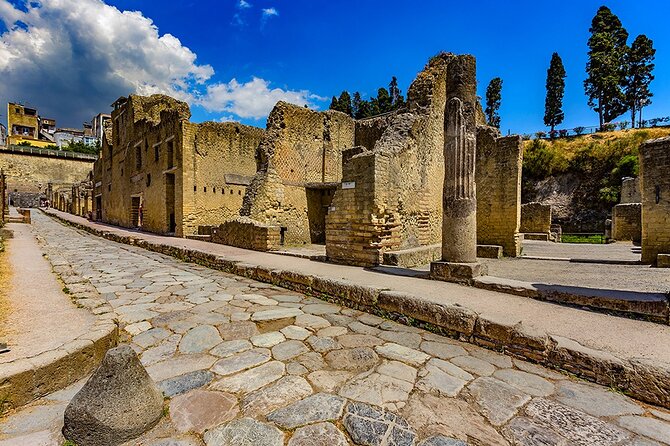
Herculaneum gives you something Pompeii often cannot: remarkably well-preserved Roman houses, painted rooms, wooden details, and mosaics left under volcanic material after Vesuvius erupted in 79 A.D. This four-hour tour takes you from Sorrento or Naples to the site by bus, then uses an authorized English-speaking guide to bring the ruins into focus.
I like the early start option, since it can help you avoid the worst heat and crowds. I also like the practical setup: transport, admission, and headsets are included, so you are not left sorting out several tickets and connections on your own.
The main drawback is time. Only about 1.5 hours is spent inside the ruins, and the scheduled pace may feel brisk if you want to study mosaics, read signs, or wander into every open room.
In This Review
- Key points to know before booking
- Why Herculaneum deserves your morning
- The bus from Sorrento or Naples
- Entering the archaeological park
- House of the Hotel and the city’s wealth
- Sacello degli Augustales and public religion
- House of the Deer and its sea view
- House of the Black Salon and private ambition
- House of the Skeleton and the cost of a fast pace
- House of Neptune and Amphitrite
- How much can you see in four hours?
- Is the $90.31 price fair?
- Who should book this Herculaneum tour?
- Booking, cancellation, and weather notes
- Should you book it?
- FAQ
- Where does the tour depart from?
- How long does the entire experience last?
- How long is the guided visit inside Herculaneum?
- Is the Herculaneum entrance ticket included?
- Is lunch included?
- What happens if bad weather cancels the tour?
Key points to know before booking
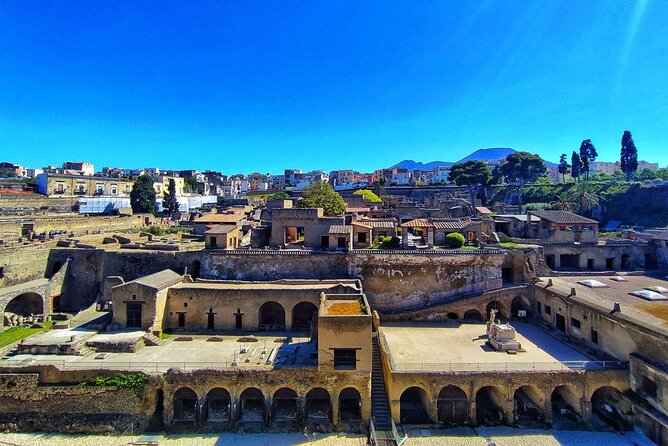
- Herculaneum is the main event: You see Roman streets, villas, frescoes, mosaics, and houses preserved by the eruption of Vesuvius.
- The guided visit lasts about 1.5 hours: This gives you a useful overview, but not much free time for independent exploring.
- Transport is included: A 30-seat bus takes you from the meeting point in Sorrento or Naples.
- Seven named areas are included: The route features the House of the Hotel, Sacello degli Augustales, House of the Deer, House of the Black Salon, House of the Skeleton, and House of Neptune and Amphitrite.
- The tour costs $90.31 per person: That price covers the bus, entry ticket, guide, and headsets, but not lunch.
- The tour has earned a 4.9 rating from eight published ratings: Praise focuses on the guide, clear English, punctual transport, and the way Roman life is explained.
Why Herculaneum deserves your morning
Herculaneum was smaller than Pompeii, but it was a sophisticated seaside town with substantial homes and elegant decoration. The eruption buried it under ash and pumice, preserving parts of the city in a way that can feel unusually immediate.
You will see streets, houses, villas, wall paintings, courtyards, and decorative floors. The appeal is not simply the age of the ruins. It is the level of detail. Herculaneum can show you how rooms were arranged, how wealthy families displayed status, and how ordinary city life fit around grander homes.
A guide helps because the ruins can otherwise look like a maze of walls and doorways. The English-speaking guide has about 90 minutes to explain what you are seeing, point out key decorations, and connect the eruption to Roman daily life. Headsets are included, which matters in a group setting where it is easy to lose the guide’s voice among other groups.
The tour is offered in English. No individual guide names are provided, so you should not expect to select a particular guide when booking. The quality of the experience will depend partly on the guide assigned that day, but the available feedback places strong emphasis on clear English and good explanations.
More Skip-the-Line Tickets in Herculaneum
- Herculaneum: 3D Walking Tour with Skip-the-Line Ticket
★ 4.3 · 313 reviews - Ercolano: Herculaneum Skip-the-Line Ticket & Audio Guide
★ 4.0 · 275 reviews - Herculaneum: Skip The Line Entrance ticket + Audioguide
★ 4.3 · 266 reviews
The bus from Sorrento or Naples
The tour includes pickup at a designated meeting point in Sorrento or Naples, followed by transport in a 30-seat bus. This is useful if you are staying in Sorrento and want to visit Herculaneum without arranging a separate train, local transfer, and entrance ticket.
The bus also simplifies the return trip. You do not need to work out how to get back after the archaeological visit, and the driver handles the road connection between the coast and the site. One published rating specifically praised the comfortable coach and its punctual departure.
Still, this is a shared excursion, not a private transfer. The stated maximum is 100 people, while the included vehicle is described as a 30-seat bus. That may mean the operator uses more than one vehicle or organizes a larger overall departure. If group size is important to you, ask the provider how many people are expected on your date.
A good practical move is to confirm the meeting point and arrival time carefully. The tour is commonly booked well ahead, on average 43 days in advance, which suggests that popular dates can fill early, especially during the warmer months.
Entering the archaeological park
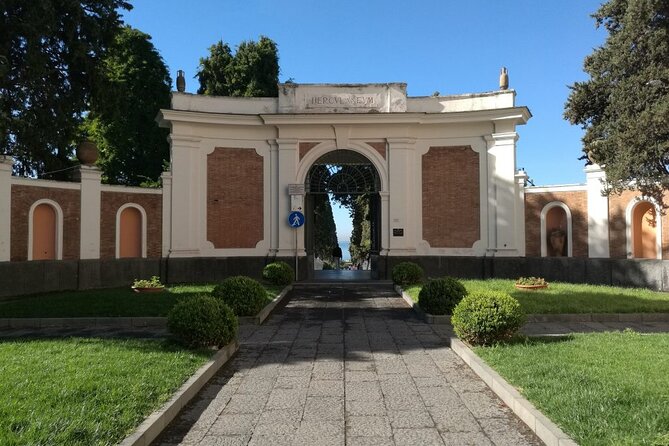
Once you reach Parco Archeologico di Ercolano, your included entrance ticket saves you from arranging admission separately. The guided archaeological visit lasts about 1 hour and 30 minutes, although the exact route can change at the guide’s discretion.
That flexibility can be useful. Open areas, restoration work, weather, and crowd levels may affect which rooms are easiest to visit. It also means the written route should be treated as a guide to the principal sights, not a promise that every stop will receive exactly ten minutes.
The first section gives you the basic setting. Herculaneum was buried during the eruption of Vesuvius in 79 A.D., along with Pompeii and other settlements around the Bay of Naples. The covering material protected parts of the town and left modern archaeologists with an unusually clear record of Roman construction and decoration.
The guide’s role is especially valuable here. You can look at a wall or courtyard and see only age and damage. With an explanation, the same space becomes part of a home, a public building, or a working neighborhood.
House of the Hotel and the city’s wealth
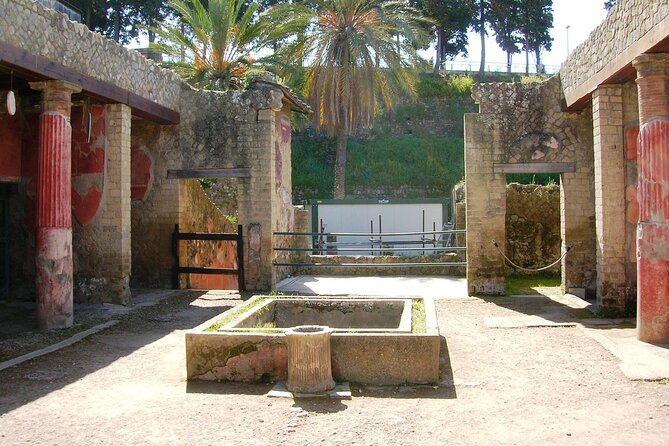
The House of the Hotel is described as the largest house found at Herculaneum, covering about 2,150 square meters. It sits at the edge of the hill in a panoramic position and includes a spa district.
The name comes from an early interpretation that the building may have been a hotel. It was later understood as a large Roman house. That change in interpretation is a useful reminder that archaeology is not a finished story. Experts continue to revise their ideas as buildings and objects are studied.
The house helps you see the wide range of Roman domestic life. Some homes were compact and practical. Others occupied vast areas, added bathing facilities, and used their position to make the most of the view. You might find that the scale alone makes this stop memorable, even if some areas are partially damaged or closed.
More Herculaneum excavation visits:
- Pompeii and Herculaneum Small Group Tour with an Archaeologist
★ 5.0 · 1,350 reviews - Pompeii: Small-Group Tour of Pompeii and Herculaneum
★ 4.8 · 867 reviews - Ercolano: Herculaneum Entry Ticket with Optional Audio Guide
★ 4.1 · 581 reviews - Guided Day Tour of Pompeii and Herculaneum with Light Lunch
★ 4.5 · 311 reviews
Sacello degli Augustales and public religion
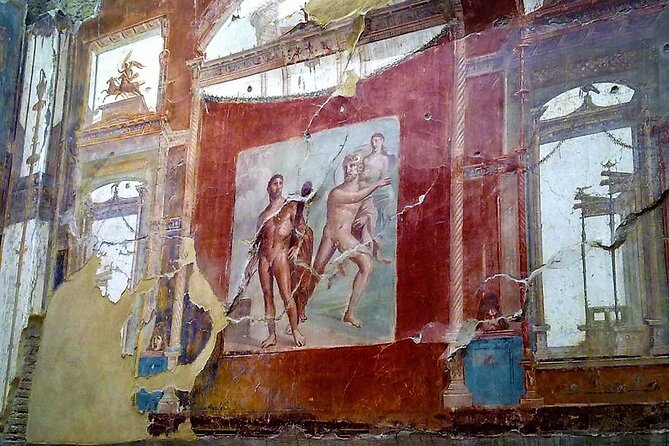
The Sacello degli Augustales was built near the forum and connected with the worship of the emperor. Its square plan is easy to understand, but the frescoes are the real reason to pay attention.
The paintings show Hercules entering Olympus with Jupiter, Juno, and Minerva, as well as Hercules fighting Achelous. These scenes link the building to Roman religion, civic identity, and the culture of the imperial period.
A particularly human detail is the skeleton of the janitor, found lying on a bed in his room. It brings the eruption down from grand imperial themes to one person caught in a sudden disaster. The guide can help you hold both parts together: the official public world represented by the frescoes and the private life represented by the remains.
Because the guided time is limited, listen closely here. Frescoes can be easy to miss if you are focused on the building’s walls and floor plan.
House of the Deer and its sea view
The House of the Deer was a luxurious home with a terrace overlooking the sea. It belonged to Q. Granius Verus, a formerly enslaved person who had been freed shortly before the destruction of Herculaneum.
That detail makes the house more than a display of wealth. It shows that social mobility existed in the Roman world, even within a deeply unequal society. A freed person could own an impressive residence and take part in the town’s upper social ranks.
The house takes its name from two deer statues in the garden, shown being attacked by a pack of dogs. These sculptures would have added drama and decoration to the garden, while the terrace offered a fine position above the coast.
You will want to look beyond the statues. The relationship between the home, the garden, and the sea view is part of the experience. The site gives you a sense of how wealthy residents used architecture to display taste and status.
House of the Black Salon and private ambition
The House of the Black Salon gets its name from a reception room painted black with geometric designs. Dark walls can make a room feel formal and theatrical, and this salon was likely intended for entertaining.
Wax tablets found in the house belonged to L. Venidius Ennychus, who was thought to own the property. The tablets refer to his eligibility for the office of Augustale, the purchase of a slave, and the birth of a daughter.
These small records are powerful because they connect the decoration to real decisions and relationships. You are not just seeing an attractive room. You are seeing traces of a household concerned with social rank, property, slavery, and family life.
The stop is brief, listed at about ten minutes, so let the guide point out the room and explain the tablets. If you want extensive time for close study, the schedule may frustrate you.
House of the Skeleton and the cost of a fast pace
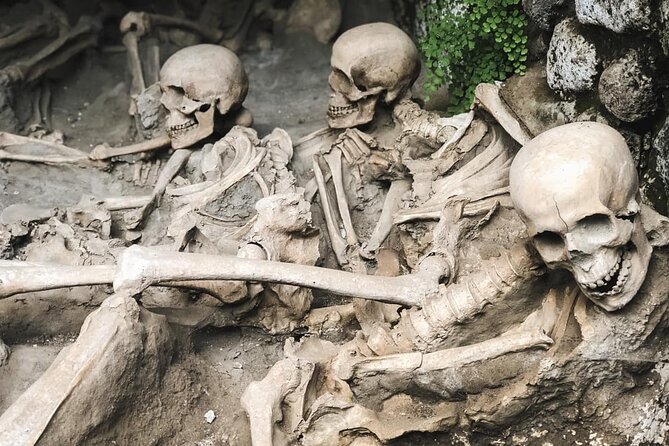
The House of the Skeleton appears to have been formed by combining three smaller buildings. Its name comes from human remains found in an upstairs room in 1831.
This is another place where the eruption becomes personal. Herculaneum is filled with impressive architecture, but the human remains remind you that the town was not abandoned gradually. Its residents faced a catastrophe that unfolded with little warning.
The building’s altered form also helps explain how Roman properties changed over time. Homes were not always built as a single perfect plan. They could be joined, adapted, and expanded as owners and needs changed.
This is one of the stops most affected by the tour’s tight timing. Ten minutes is enough for an explanation and a quick look, but not for wandering through the structure at your own speed. If you already know the site and want detailed photography or quiet study, a self-guided visit with more time may suit you better.
House of Neptune and Amphitrite
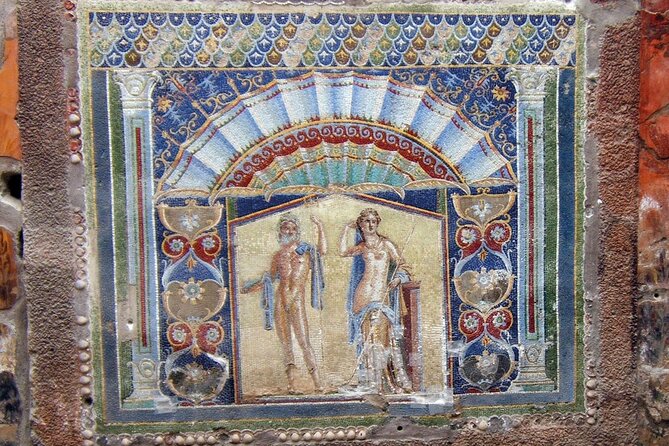
The House of Neptune and Amphitrite is one of the tour’s visual highlights. Its glass-paste mosaics use floral and hunting scenes, with a central mosaic showing Neptune and Amphitrite.
Glass-paste work was expensive in the Roman period, so these decorations signal wealth and taste. The colors and small pieces give the wall surface a different character from the painted plaster found elsewhere in the city.
The subject fits a coastal town. Neptune, the sea god, and Amphitrite, his companion, connect the household’s decoration to the sea outside the home. Even if you do not study Roman mythology, the central scene is easy to recognize and rewarding to see.
This stop is a good example of why Herculaneum often rewards a guide. You may notice the mosaic first, but the explanation adds information about materials, cost, symbolism, and the owner’s social position.
How much can you see in four hours?
The full activity lasts about four hours, but that includes the bus ride and the visit to the site. The archaeological tour itself lasts roughly 1.5 hours. The named stops after the main entry are each scheduled at about ten minutes, although the guide may adjust the route.
That format works well if you want a focused introduction. You can see the main houses, hear the story of the eruption, and return to Sorrento or Naples without giving up an entire day.
It is less suitable if you want to explore every street or wait patiently at each mosaic. One rating praised the guide and driver but found the time inside too short. That is a fair criticism, even though 1.5 hours is the stated duration.
I would treat this as an orientation tour. It gives you structure and context, especially if Herculaneum is one stop within a larger Italy trip. If you want a slower archaeological visit, look for an option that allows more independent time at the site.
Is the $90.31 price fair?
At $90.31 per person, the cost is not simply an entrance ticket. It includes transport from Sorrento or Naples, a 30-seat bus, the Herculaneum admission ticket, an authorized English-speaking guide, and headsets.
That bundle has real value if you are staying in Sorrento. Organizing the journey yourself may cost less in cash, but it requires more planning and leaves you responsible for timing, directions, and entry. The tour also reduces the risk of arriving without a ticket or missing the return connection.
The price is harder to justify if you are already near Herculaneum, prefer public transport, or want several hours inside the park. In that case, you are paying for convenience and explanation more than for extra time at the ruins.
Group discounts are available, and lunch is not included. Plan to eat before or after the tour rather than expecting a meal during the four-hour outing.
Who should book this Herculaneum tour?
I would recommend it to you if you are based in Sorrento or Naples and want a straightforward half-day visit. It suits first-time visitors who want the ruins explained in clear English rather than trying to identify each building alone.
It is also a good choice if you value a punctual coach, included admission, and a fixed return arrangement. The positive feedback places particular emphasis on the guide’s ability to explain Roman life and the volcanic eruption, which is exactly the kind of context that makes a short visit worthwhile.
Families and mixed-age groups may appreciate the structure, since most travelers can participate and the headsets make it easier to follow the commentary. The site itself contains uneven ancient surfaces, so anyone with mobility concerns should confirm the conditions directly with the operator before booking.
I would hesitate if your priority is photography, detailed study, or a relaxed pace. The tour covers a lot in 90 minutes, and the guide may change the route. You will see the key areas, but you may leave wishing for another hour.
Booking, cancellation, and weather notes
Confirmation is provided when you book, and the experience is near public transportation. Free cancellation is available until 24 hours before the start time for a full refund. Cancellations or changes made less than 24 hours before the start are not accepted for a refund.
The tour requires good weather. If poor weather causes cancellation, you will be offered another date or a full refund. Since the visit involves outdoor archaeological ruins, check the forecast and wear practical shoes and clothing suited to heat or rain.
Should you book it?
Book this tour if you want transport, admission, and a strong introduction handled in one package from Sorrento or Naples. The guide is the main reason to choose it, especially if you want Roman homes and the eruption explained rather than simply photographed.
Skip it if you need a long, independent visit. The 1.5-hour archaeological tour is the clear limitation. For many people, though, the combination of a comfortable bus, clear English commentary, headsets, and access to Herculaneum makes $90.31 a reasonable convenience price.
FAQ
Where does the tour depart from?
Pickup is available at a designated meeting point in Sorrento or Naples.
How long does the entire experience last?
The tour lasts approximately four hours, including transport and the visit to Herculaneum.
How long is the guided visit inside Herculaneum?
The authorized English-speaking guide leads an archaeological tour lasting about 1.5 hours.
Is the Herculaneum entrance ticket included?
Yes. Admission to Herculaneum is included in the tour price.
Is lunch included?
No. Lunch is not included.
What happens if bad weather cancels the tour?
You will be offered a different date or a full refund if the experience is canceled because of poor weather.
More Skip the Line in Sorrento
- Pompeii: Skip-the-Line Entrance Ticket with Audio Guide
★ 4.0 · 2,509 reviews - Sorrento: Skip-the-Line Pompeii Express Tour by Train
★ 4.8 · 2,038 reviews - Pompeii: Skip-the-line-Ticket and Guided Tour
★ 4.6 · 1,152 reviews - Pompeii: Guided Tour with Skip-the-Line Entry
★ 4.9 · 812 reviews
Newest reviews from Sorrento
- Private Stress-Free Tour from Sorrento: Ischia Island & Tastings★ 5.0 · 4 reviews
- Tour in the ruins of Pozzuoli with an archaeolgist.★ 5.0 · 4 reviews
- Vico Equense: Authentic Cooking Class at a Local’s Home★ 5.0 · 4 reviews
- Lemon Experience with Limoncello demonstration★ 5.0 · 4 reviews
- Path of the Lemons★ 5.0 · 4 reviews
- Private Tour Pompeii and Winery★ 5.0 · 4 reviews
- Positano Private Tour By Night from Sorrento★ 5.0 · 4 reviews
- Walking Secret Food Tours Sorrento with tastings★ 4.5 · 4 reviews
Skip the Line, compared.

Skip-the-Line Entrance Ticket with Audio Guide
Read our review →



Skip-the-Line Entry Ticket with Digital Guide App
Read our review →
Pompeii Ruins Private Tour with Optional Skip-the-Line Entry
Read our review →
Skip-the-Line Pompeii Guided Tour from Sorrento
Read our review →
Skip the Line Guided Tour of Pompeii led by an Archaeologist
Read our review →Browse the lists this tour appears in