
Reviewed · ARCHAEOLOGIST-LED TOURS
Private Tour: Explore Paestum with an Expert Archaeologist
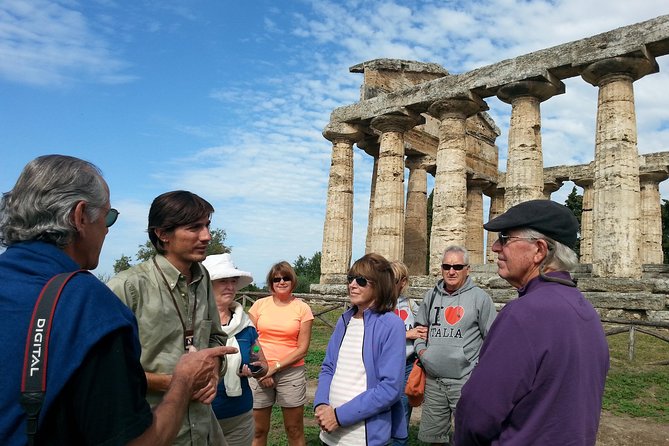
Paestum gives you something rare in Italy: huge Greek temples in an open archaeological park, followed by a museum that explains the people who built, used, and buried around them. This private two-hour tour pairs both places with an archaeologist, so you get more than a quick look at impressive columns.
I like the way the visit divides its time, about 90 minutes among the ruins and 30 minutes in the museum. I also like the small private format, with only your group of up to eight people. The main drawback is the fixed two-hour limit, which can feel short if you want a slow look at every corner, and the €15 entrance fee per person is extra.
In This Review
- Key points at a glance
- Why an archaeologist changes the Paestum visit
- The archaeological park: 90 minutes among the ruins
- The National Museum: 30 minutes with the objects
- What the private format is worth
- Timing, meeting point, and practical details
- Who will enjoy this tour most
- What makes the guide matter
- Is the two-hour plan enough?
- Should you book Explore Paestum with an Expert Archaeologist?
- FAQ
- How long does the private Paestum tour last?
- What does the tour include?
- How much is admission to the Paestum Archaeological Park?
- How many people can join the private tour?
- Where does the tour start and finish?
- What happens if bad weather cancels the tour?
Key points at a glance
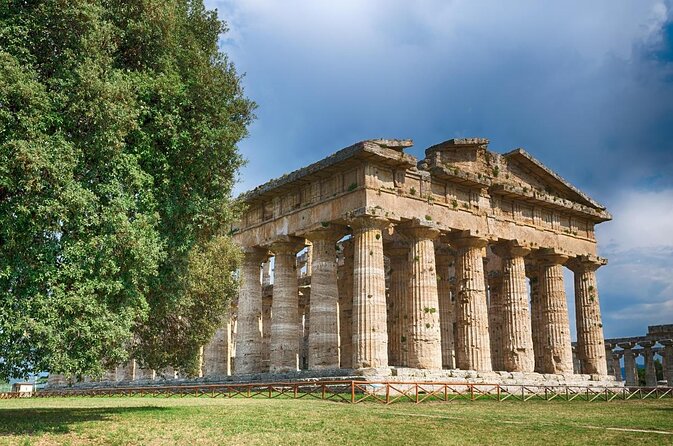
- Greek temples and Roman remains: See Paestum’s major temples, the Heroon, Roman Forum, and residential area in one guided walk.
- Archaeologist-led explanations: Your guide brings specialist training to the site rather than offering only dates and labels.
- Lucia’s clear English: Lucia is praised for careful diction, engaging explanations, and a kind manner.
- Museum highlights included: Spend 30 minutes with the Hera frieze, votive objects, Roman arms, and painted tombs.
- Private group of up to eight: You can ask questions and keep the pace within your own party.
- €15 admission is separate: The tour fee is $313.07 per group, but entrance to the Paestum Archaeological Park is not included.
Why an archaeologist changes the Paestum visit
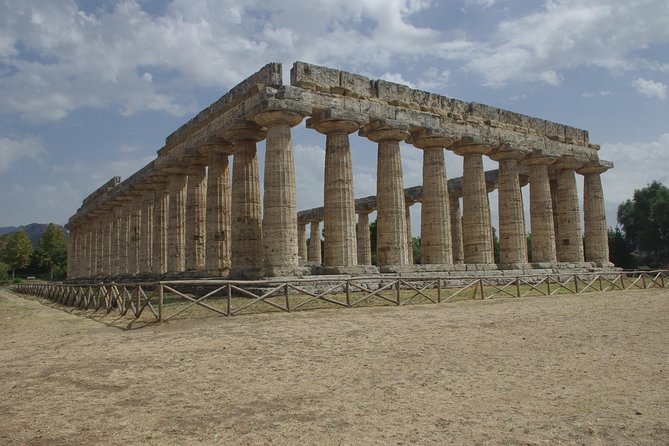
Paestum is easy to admire and surprisingly easy to misunderstand. You see grand columns, broad stone foundations, and long stretches of ancient masonry, but the meaning of each part is not always obvious from the site alone. A specialist can connect the temples to the Heroon, Roman public buildings, and private homes without leaving you to piece it all together from scattered signs.
That matters most at a place like Paestum, where Greek and Roman remains occupy the same archaeological area. The visit is not only about taking in three impressive temples. It is about seeing how the settlement changed over time, how sacred and civic spaces worked, and how later Roman buildings occupied an older Greek city.
The guide is an expert local archaeologist, and the tour is offered in English. Lucia is one guide specifically praised for clear diction, polite conversation, and an engaging way of explaining difficult material. That is useful here. Archaeology depends on small distinctions, and a guide who speaks plainly can make the ruins much easier to follow.
The format is private, too. Your party can include up to eight people, and no one outside your group joins the activity. I see this as a real advantage for families, couples, or a group of friends who want to ask questions without holding up a larger walking tour.
More Salerno and Paestum trips:
- From Naples/Salerno: Group Tour to Positano, Amalfi, Ravello
★ 4.7 · 2,033 reviews - Full-Day Amalfi Coast Experience from Sorrento, Naples or Salerno
★ 5.0 · 1,275 reviews - Salerno: Amalfi Coast Cruise with Lunch, Aperitif & Swimming
★ 4.5 · 879 reviews
The archaeological park: 90 minutes among the ruins
The first and longer part of the visit takes place in the Parco Archeologico di Paestum e Velia. You meet at the archaeological park at Via Magna Graecia 919 in Capaccio Paestum, then spend about an hour and a half examining the remains with your archaeologist.
The main draw is the group of Greek temples. Their scale is the first thing you notice, but a guide helps you look past the postcard view. You can ask about their purpose, construction, and place within the ancient city rather than simply walking around the columns and moving on.
The tour also includes the Heroon, described as the tomb of the mythical founder or hero of the Greek city. This is a different kind of sight from the temples. Instead of monumental public worship, it points toward local belief, memory, and the way a city honored an important figure.
Next comes the Roman Forum. This gives the site another layer, since Paestum was not frozen in its Greek period. Your guide can help you read the forum as a public center and set it against the older remains nearby.
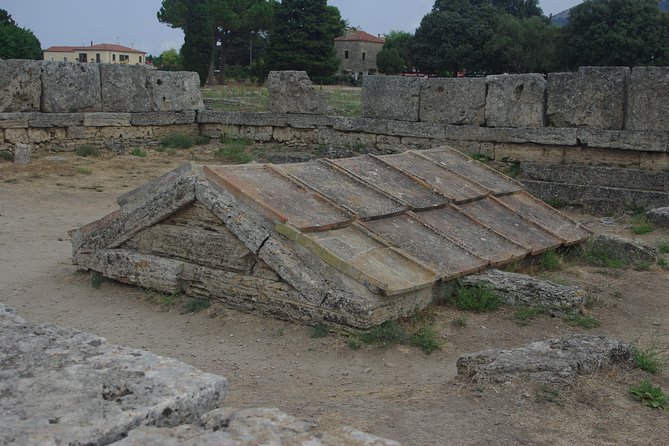
The Roman residential area rounds out the park visit. I like this part of the route because houses can make an ancient city feel less abstract. Temples show public ambition, while domestic remains suggest daily life, private space, and the practical shape of the settlement.
The stated schedule allows 90 minutes for the archaeological area. That is enough for a focused introduction to the major sights, particularly with an expert selecting the key points. It is not designed as an unhurried full-day study of every visible wall and stone. If you enjoy lingering, sketching, or reading every sign, you may want extra time at the park before or after the guided portion.
The National Museum: 30 minutes with the objects
The second stop is the Museo Archeologico Nazionale di Paestum. The museum visit lasts about 30 minutes, so expect a selected tour rather than a room-by-room examination.
One highlight is the stone frieze that decorated the Temple of Hera. Architectural fragments can be hard to understand when they are separated from their original building. Here, the guide’s role is especially useful, since you can connect the carved stone in the museum with the temple remains you have just seen outside.
The museum also contains objects made as offerings for the gods. These pieces give you a more personal view of ancient religious practice. The temples are massive, but offerings help show how individuals took part in worship and what they chose to dedicate.
You will also see armor and weapons associated with Roman warriors. These objects shift attention from sacred architecture to military life and Roman power. Taken alongside the forum and residential area, they help create a broader picture of the city’s later period.
The painted tombs are another important part of the museum. Tomb paintings can reveal ideas about death, ceremony, identity, and social life in ways that ruins alone cannot. With only half an hour here, the guide should keep the visit centered on the most significant objects.
Lucia is praised for making sure the museum’s key highlights were included, which is worth noting because short museum stops can easily become rushed or unfocused. If the museum is your main interest, ask at the start how the 30 minutes will be divided. The tour is built to give you the main story, not unlimited time with each display.
What the private format is worth
The listed price is $313.07 per group of up to eight people. That means the cost works differently depending on the size of your party. For one or two people, it is a substantial outlay for a two-hour visit. For a larger group, the per-person cost drops, making the private arrangement more attractive.
You are paying for the archaeologist’s time and attention, not for transportation, meals, or admission. The entrance fee to the Paestum Archaeological Park is €15 per person and is not included. Budget for that separately, and check how admission is handled for the museum when arranging your visit, since the supplied details identify the park entrance fee but do not state a separate museum charge.
I think the value is strongest if you care about understanding what you see. Paestum’s temples are impressive without a guide, but an expert can explain why the Heroon matters, how the Roman Forum fits into the site, and what the museum objects add to the outdoor ruins.
The value is also stronger for groups of four to eight. A private guide can answer questions from your own party, adjust the explanations to your interests, and avoid the stop-and-start rhythm that often comes with a large group. If you are visiting only for a quick photo stop, the price may be harder to justify.
More tours led by an archaeologist:
- Paestum Small Group Tour with an Archaeologist
★ 5.0 · 189 reviews - Paestum Private: Temples & Archaeological Museum with Your Local Archaeologist
★ 4.0 · 9 reviews - Pompeii: Entry Ticket and Guided Tour with an Archaeologist
★ 4.8 · 19,459 reviews - Pompeii: Small Group Tour with an Archaeologist
★ 4.8 · 12,264 reviews
Timing, meeting point, and practical details
The activity starts and ends at the archaeological park, at Via Magna Graecia 919, 84047 Capaccio Paestum. There is no included transfer from Salerno, despite Salerno being listed as the location. You need to arrange your own way to the meeting point.
The tour lasts approximately two hours. Plan for 90 minutes outside and 30 minutes inside the museum. This split makes sense, since Paestum’s outdoor remains cover the main setting and the museum works best as a concise explanation of selected objects.
Weather matters. The experience requires good weather, and poor conditions can lead to a different date or a full refund. The general cancellation policy is strict: the booking is non-refundable and cannot be changed for any reason if you cancel or request an amendment. That makes travel planning important, particularly if your schedule around Salerno is tight.
The tour is offered in English and uses a mobile ticket. Confirmation arrives within 48 hours of booking, subject to availability. Since the activity is often booked 26 days ahead on average, I would not leave it until the last minute if your date is fixed.
Service animals are allowed, and the meeting point is near public transportation. Most people can participate, though the tour takes place across an archaeological area and includes time outdoors. The supplied information does not specify the exact walking distance or surface conditions, so ask the operator if anyone in your party has particular mobility needs.
Who will enjoy this tour most
I would choose this experience if you want Paestum explained by a specialist rather than simply photographed. It suits first-time visitors who want a clear introduction, history-minded travelers who care about Greek and Roman layers, and small groups that value personal questions.
It is also a good choice for families with older children, provided they can manage a two-hour archaeological visit. A guide can turn unfamiliar ruins into a story with recognizable parts: temples for worship, the Heroon for civic memory, the forum for public life, homes for domestic life, and the museum for objects that do not survive in place.
Couples and small groups of friends may find the private format especially pleasant. You are not sharing the guide with strangers, and you can ask for more time on the temples or more attention to the museum objects.
I would hesitate if you want a full day at Paestum, prefer to explore alone, or need guaranteed flexibility. Two hours is a focused introduction, not an exhaustive archaeological study. The non-refundable policy also calls for care before booking.
What makes the guide matter
The most praised feature is not a single monument. It is the quality of the explanation. Lucia is described as educational, clear, kind, and engaging, with strong English diction. Those qualities matter more than fancy presentation at an archaeological site.
Another useful detail is her attention to comfort. She made sure explanations took place in the shade when possible. That is a small decision, but it can make a major difference during an outdoor visit, especially when you need to concentrate on dates, building phases, and unfamiliar terms.
A good guide also knows when to stop talking. The best use of this tour is not a constant stream of facts. It is having someone point out the detail that changes how you see a temple or artifact, then giving you enough quiet time to look.
The experience provider is Tours with an archaeologist, and the tour is built around that specialist role. Guide availability may vary, so Lucia is not guaranteed unless the operator confirms her for your date. Still, the qualities associated with her guidance give you a useful picture of the standard to expect: clear English, thoughtful pacing, and attention to the group.
Is the two-hour plan enough?
For a first visit, yes, if you treat it as an orientation. The 90-minute park walk covers the temples, Heroon, Roman Forum, and residential area, while the 30-minute museum stop covers selected objects and painted tombs. You will leave with a coherent outline of Paestum rather than a pile of disconnected facts.
For a slow, highly detailed visit, no. You may want more time to study the stonework, move at your own pace, or see museum displays beyond the main highlights. The tour does not prevent you from spending additional time at the site if your admission and schedule allow, but the supplied details do not promise extra guided time.
I like this arrangement for a day when Paestum is one major stop rather than the only purpose of the outing. You get an expert introduction without giving up an entire day. Just keep the schedule realistic, since the two-hour estimate begins at the archaeological park and does not include your journey to the meeting point.
Should you book Explore Paestum with an Expert Archaeologist?
Book it if you want the Greek temples, Roman remains, and museum pieces tied together by a trained local guide. The private group format, clear English explanations, and focused route offer strong value for groups of four or more, especially if this is your first visit to Paestum.
Think twice if you are a solo visitor on a tight budget, want a flexible booking, or plan to spend many hours exploring every part of the site. The €313.07 group price, extra €15 admission, two-hour limit, and strict non-refundable policy deserve careful thought.
For the right party, this is a smart way to see Paestum. You get the major monuments, the most useful museum objects, and an archaeologist who can turn a grand but puzzling ruin into a place with purpose and human detail.
FAQ
How long does the private Paestum tour last?
The tour lasts approximately two hours. About 90 minutes are spent in the archaeological area and 30 minutes in the National Museum.
What does the tour include?
The tour includes an expert local archaeologist and a private visit for your group only. It does not include entrance fees.
How much is admission to the Paestum Archaeological Park?
The entrance fee is €15 per person and must be paid separately from the tour price.
How many people can join the private tour?
The private tour is available for a group of up to eight people.
Where does the tour start and finish?
It starts at the Archaeological Park of Paestum, Via Magna Graecia 919, Capaccio Paestum. The activity ends back at the meeting point.
What happens if bad weather cancels the tour?
If poor weather causes the experience to be canceled, you will be offered a different date or a full refund. The standard cancellation policy is otherwise non-refundable and does not allow changes.
Newest reviews from Salerno & Paestum
- Visit the Pompeii ruins from Salerno with Pizza Lunch★ 5.0 · 4 reviews
- Amalfi coast tour with skipper from Salerno to Positano★ 4.8 · 4 reviews
- Amalfi Coast: one day tour from Salerno to Positano★ 5.0 · 5 reviews
- Full-Day archaeological site of Paestum★ 5.0 · 5 reviews
- Amalfi Drive from Salerno★ 5.0 · 5 reviews
- Amalfi coast: Rent boats in Salerno without license★ 5.0 · 5 reviews
- Salerno: Amalfi Coast Private Boat Excursion★ 5.0 · 5 reviews
- SALERNO: Amalfi Coast Cruise • Shore Excursion★ 4.4 · 5 reviews
Archaeologist-Led Tours, compared.

Entry Ticket and Guided Tour with an Archaeologist
Read our review →
Pompeii Small Group Tour with an Archaeologist
Read our review →
Pompeii and Herculaneum Small Group Tour with an Archaeologist
Read our review →
Skip the Line Guided Tour of Pompeii led by an Archaeologist
Read our review →
Exclusive Tour with Archaeologist and Entry Tickets
Read our review →
Pompeii Private Tour with an Archaeologist and Skip The Line – 3 hours
Read our review →
Pompeii Skip-the-line Tour with Archaeologist Guide
Read our review →Browse the lists this tour appears in