

Reviewed · ARCHAEOLOGIST-LED TOURS
Private Pompeii Tour with Archaeologist & Winery on Mt Vesuvius
Pompeii is best understood street by street, and this private tour gives you an archaeologist, Fabrizio Belleni, to explain what you are seeing rather than leaving you to decode a field of broken stones. After the ruins, you sit down at a family winery on Mount Vesuvius for local wine, pasta, and pastiera.
I like the custom walking pace and the easy hotel pickup in a Mercedes minivan. I also like the contrast between Pompeii’s public buildings and the relaxed winery meal, with five wines and views toward the Bay of Naples. The main consideration is cost: the listed price is $434.46 per person, while lunch and wine cost an additional €50 for the classic tasting or €60 for the superior option.
In This Review
- Key points at a glance
- Why a private archaeologist changes Pompeii
- Entering at Porta Marina and reaching the Forum
- The Basilica, Temple of Apollo, and Forum
- Markets, baths, and the practical Roman city
- The House of the Faun and House of the Vettii
- The Chaste Lovers and Pompeii’s active archaeology
- The Large Theatre and the Antiquarium
- From Pompeii to Cantina del Vesuvio
- Is the $434.46 price good value?
- Timing, fitness, and who should book
- Should you book it?
- FAQ
- Where does the tour begin?
- How long does the experience last?
- Is the tour private?
- Who guides the Pompeii visit?
- Is Pompeii admission included?
- Is lunch included in the tour price?
- What does the winery meal include?
- Does the tour climb to the top of Mount Vesuvius?
- Can I cancel for a full refund?
Key points at a glance
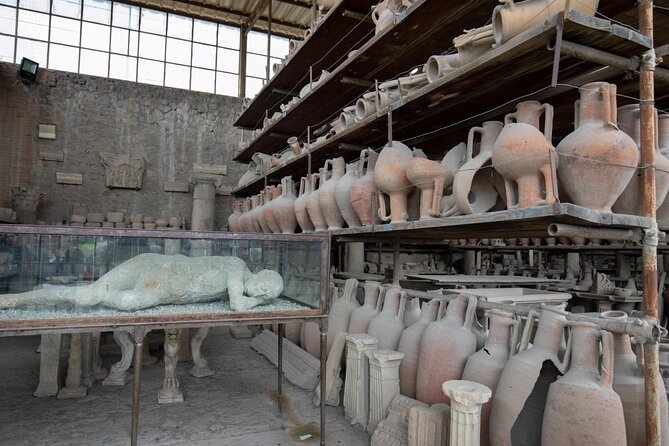
- Archaeologist Fabrizio Belleni leads the Pompeii walk, explaining daily life as well as dates and monuments.
- Your route can be shaped around your interests and energy, instead of forcing you through the entire 150-acre site.
- Porta Marina, the Forum, baths, theaters, bakeries, taverns, and private houses give you a well-rounded look at the city.
- Cantina del Vesuvio offers five wines, vineyard views, and a three-course Neapolitan meal, with lunch paid on site.
- Private Mercedes transport from Sorrento or Naples removes the need to manage trains, taxis, or parking.
- The tour lasts about four to seven hours, but Pompeii itself requires moderate physical fitness and plenty of walking.
Why a private archaeologist changes Pompeii
Pompeii can be overwhelming. The ancient city covers roughly 150 acres and once held about 18,000 people. On your own, you may spend much of your visit simply choosing which street to follow.
Fabrizio’s role is to turn the ruins into a city with purpose. At the Forum, you learn where politics, religion, trade, and law met. At a bakery, you can think about food production. In a private house, you see how wealth shaped daily life. The strongest part of this approach is the link between buildings and people.
Fabrizio also plans the walk around your interests and physical condition. You can ask ahead of time for special subjects or places, then agree on a route that makes sense for your group. That matters at Pompeii, where trying to see everything can leave you tired before the most rewarding details appear.
The tour is private, so only your party participates. That gives you room to ask questions, pause for explanations, or move on when a site no longer holds your attention. It also makes the experience a better fit for mixed-age groups or anyone who does not want to keep pace with a large walking tour.
More Wine Tastings in Pompeii
- Naples: Pompeii and Mt. Vesuvius with Lunch and Wine Tasting
★ 4.5 · 2,454 reviews - Pompeii Tour & Lunch with Wine Tasting Experience
★ 5.0 · 383 reviews - Pompeii Vineyard Escape: Private Wine Tasting & Lunch
★ 5.0 · 329 reviews
Entering at Porta Marina and reaching the Forum
Porta Marina is a fitting entry point. This was Pompeii’s main approach from the sea, with a double arch designed for pedestrians and carts. The gate is part of the city’s defensive walls, so it introduces two sides of Pompeii at once: a working port city and a fortified settlement.
From here, Via Marina leads gently toward the Forum. The route also gives you access to the Antiquarium and the Suburban Baths, although the exact order of your stops can change with your interests and available time.
I like beginning here because it gives the city a clear shape. You are not simply entering an archaeological park. You are passing through a gate, following a major street, and approaching the administrative and religious center of Pompeii as ancient residents once did.
The Basilica, Temple of Apollo, and Forum
The Basilica was Pompeii’s main secular public building. It served as a courthouse and a place for business, not as a church or temple. Its three aisles and the bases of 28 brick columns show how imposing the building once was.
At the far end, the raised tribunal helped magistrates oversee legal matters. Fabrizio can use this space to explain how the Roman basilica plan later influenced early Christian church architecture. That sort of connection is easy to miss without a guide who can link architecture to later European history.
The nearby Temple of Apollo is much older, with origins reaching back to the sixth century BC. Its Greek and Italic influences reflect Pompeii’s changing culture before Roman control. The portico once had 48 columns, and the courtyard still includes a marble altar and an Ionic column with a sundial.
The statues of Apollo and Diana are replicas, while the originals are held in Naples. That is common at Pompeii, and it is worth knowing before you arrive. The setting still works beautifully, with the temple and Mount Vesuvius sharing the same view.
The Forum was the city’s main public square. You can see the open rectangular space, travertine paving, and remnants of the columns and statue bases that once surrounded it. The Forum hosted religious ceremonies, public business, and trade, with the Basilica and other major buildings close by.
This is where a private guide earns his fee. The open plaza is impressive, but its meaning becomes clearer when you picture it as a place where people came to argue cases, conduct business, shop, worship, and display civic pride.
Markets, baths, and the practical Roman city
The Macellum, Pompeii’s main food market, sits at the northeast corner of the Forum. Its central courtyard had a round pavilion, while small shops around the edges sold food. Drainage remains containing fish scales and bones point to seafood preparation and sales.
You can also see the mensa ponderaria, a stone table used to check official weights and measures. That small detail gives the market a familiar human quality. Ancient commerce needed rules too, and buyers needed some protection from dishonest measuring.
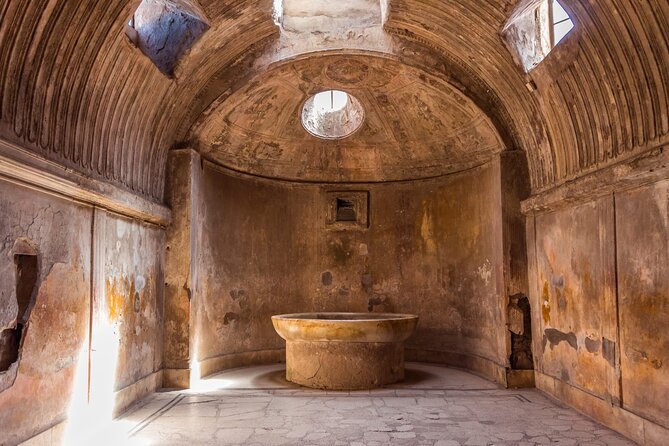
The Forum Baths provide another useful look at everyday life. The complex includes a changing room, cold room, warm room, and hot room. Its hollow walls and floors carried heated air, while a bronze brazier helped create the heat.
Stucco reliefs survive on the vaulted ceilings, and the women’s section has also opened after restoration. The baths were places for washing, exercise, and social contact. I find them more revealing than grand monuments because they show a normal routine shared by people from different levels of society.
Allow time for uneven paving and long periods on your feet. The route is adjustable, but Pompeii remains a large archaeological site. Comfortable shoes and water are sensible, even though Fabrizio has supplied water in a cooler in the van on some tours.
More Wine Tastings in Vesuvius
- Mount Vesuvius: Vineyard Tour with Wine Tasting and Lunch
★ 4.8 · 193 reviews - From Sorrento: Mount Vesuvius Tour with Lunch & Wine Tasting
★ 4.5 · 169 reviews - Pompeii: Archeological Tour & Wine Tasting at Mt. Vesuvius
★ 4.6 · 142 reviews - Amalfi Coast: Pompeii, Vesuvius, & Wine Tasting with Lunch
★ 4.8 · 114 reviews
The House of the Faun and House of the Vettii
The House of the Faun fills an entire city block, making its size the first thing you notice. It has two atriums and two peristyle gardens, a scale that tells you how wealthy its owners were.
The famous Dancing Faun and Alexander Mosaic are now displayed in the Naples Archaeological Museum, so you should not expect to see the originals inside the house. Replicas help you understand the layout, while the surviving rooms, gardens, frescoes, and geometric floors still communicate the scale of elite Roman living.
The House of the Vettii offers a more detailed look at decoration. Two brothers who had risen from slavery owned the house and built considerable wealth as merchants. Its Fourth Style frescoes are the main attraction, especially the Room of the Cupids and the mythological scenes in the dining rooms.
The entry painting of Priapus symbolized prosperity. A replanted peristyle garden, fountain statues, and restored rooms help you picture how the house functioned as a place for private life and social display.
I would give this stop extra attention if you care about Roman art or domestic life. If you are more interested in engineering or public buildings, Fabrizio can use the available time elsewhere.
The Chaste Lovers and Pompeii’s active archaeology
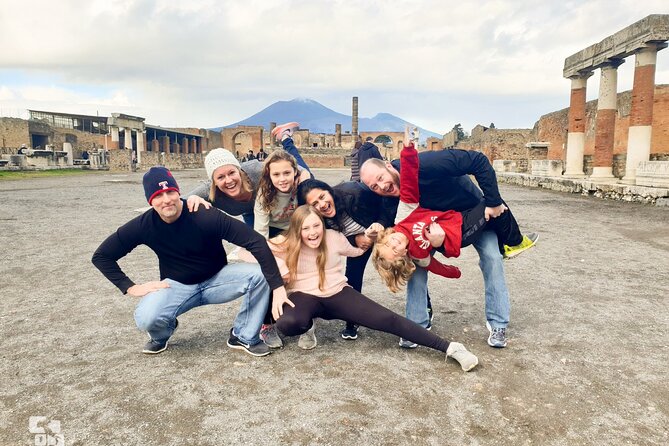
The Insula dei Casti Amanti, or Block of the Chaste Lovers, is especially interesting because it shows Pompeii as an active research site, not a finished museum. The block includes homes such as the House of the Painters at Work and a bakery.
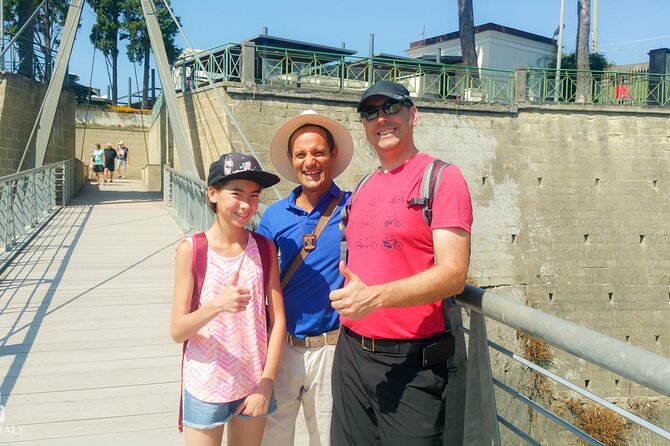
An elevated walkway opened to the public in 2024, giving you a view from above while excavation continues below. The design also forms part of Pompeii’s barrier-free route. You see the layout of the buildings while watching archaeology in progress.
This stop adds a modern layer to the ancient city. Pompeii is still being studied, repaired, and interpreted. If you have already visited famous houses and temples elsewhere in Italy, the active excavation makes this section feel different.
The Large Theatre and the Antiquarium
The Teatro Grande is a horseshoe-shaped theater cut into a natural slope. It held about 5,000 spectators and reflected Roman social order through its seating arrangements. The lower section was reserved for local elites, while higher seats served the general population.
The theater is also known for its acoustics. You can test them by speaking from the center of the orchestra. It remains a working cultural venue, with events such as the Pompeii Theatrum Mundi summer season and occasional choral performances.
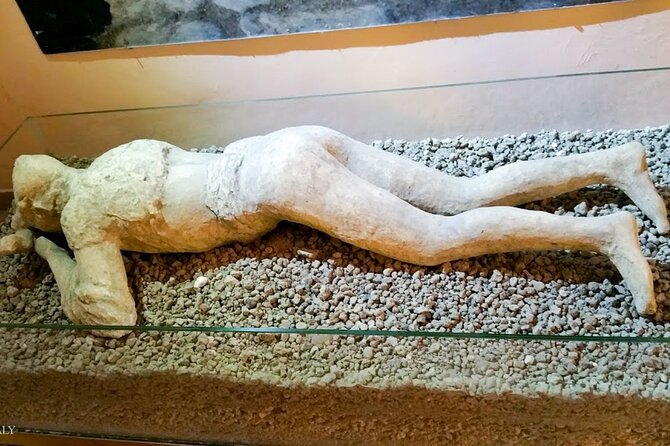
The Antiquarium near Porta Marina is a useful museum stop, especially if you are new to Pompeii. Its displays cover the city’s Samnite roots, Roman period, and destruction in AD 79. You can see objects such as the Moregine silver treasure, amulets, frescoes, and plaster casts of victims.
The casts, including the Dog of Pompeii, bring a human weight to the visit. They remind you that Pompeii is not only about columns and mosaics. It was a real city caught in a catastrophe.
The Antiquarium may be included in your route, but the timing can change. A four-hour tour will not allow the same level of detail as a seven-hour visit, so discuss priorities with Fabrizio before the day begins.
From Pompeii to Cantina del Vesuvio
After Pompeii, the Mercedes minivan takes you to Cantina del Vesuvio, a family winery in Mount Vesuvius National Park. The drive is reported to take about 10 to 15 minutes from Pompeii, making the winery a practical second stop rather than a major detour.
The winery visit begins with a guided 15-minute walk through the vineyards. You learn about Lacryma Christi wines while looking toward the volcano and the Bay of Naples. This is not a hike to the summit, and the tour does not reach the top of Mount Vesuvius.
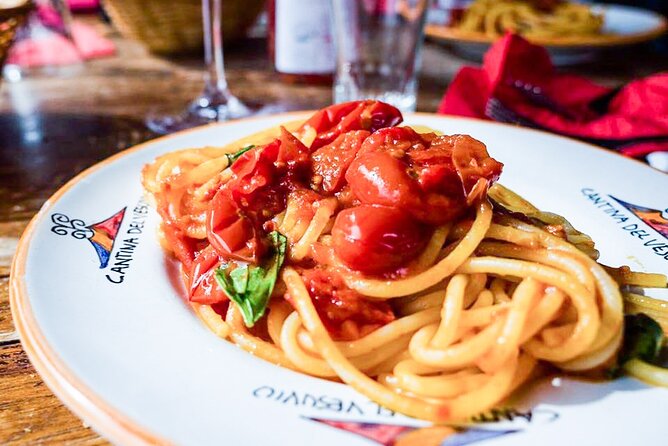
The tasting and lunch last about 90 minutes. Five local wines accompany a three-course meal. The classic menu includes ricotta, bruschetta with cherry tomatoes, provolone, salame, and capocollo, followed by spaghetti with Vesuvius cherry tomatoes and Neapolitan Pastiera for dessert.
The food is traditional rather than elaborate. That is part of the appeal. The pasta uses local cherry tomatoes and a named local pasta maker, while pastiera brings ricotta and wheat together in a classic Neapolitan dessert.
Vegetarian and gluten-free choices are available. The winery can also arrange shipping for wine and olive oil, useful if you find a bottle you want to remember the day by.
The winery reservation is included, but the meal and tasting are not included in the tour price. The additional cost is listed as €50 for the classic tasting or €60 for the superior wine experience. Fabrizio handles the reservation, and you pay at the winery by card or cash.
Is the $434.46 price good value?
At $434.46 per person, this is not a budget Pompeii visit. You are paying for a private archaeologist, private Mercedes transport, hotel pickup and drop-off, Pompeii admission under the included ticket option, and a winery reservation.
The cost makes more sense for a small group that values flexibility. A private ride from Sorrento or Naples saves you from coordinating regional transport, and a private guide can adjust the route instead of delivering a fixed speech to a crowd.
You must also add the winery charge. That brings the day’s total above the advertised tour price, so check the final cost before booking. The supplied details describe Pompeii admission as included, while another section presents entry fees as an option, so confirm exactly what your selected booking includes.
For two or more people, group discounts may improve the value. For a solo visitor, the price is harder to justify unless private transport and expert guidance are high priorities.
Timing, fitness, and who should book
The experience lasts about four to seven hours. The shorter version works for a focused visit around the Forum, while the longer version gives you more room for houses, baths, theaters, the Antiquarium, and personal requests.
You need moderate physical fitness. Pompeii is large, the ground can be uneven, and the tour involves walking through exposed archaeological areas. Fabrizio can match the route to your pace, but no guide can remove the basic demands of the site.
Pickup is offered from Sorrento and Naples, with the meeting location arranged in advance. Provide the meeting place and a phone number for the tour day. Children must be accompanied by an adult, and service animals are allowed.
The tour is offered in English. It is best for first-time Pompeii visitors, families who need a flexible pace, history-minded couples, and anyone who wants to pair an important archaeological site with an easy food and wine experience.
Should you book it?
Book this tour if you want Pompeii explained in human terms and prefer a private day with transport already handled. Fabrizio’s strongest qualities are his archaeological background, preparation, humor, and willingness to shape the route around your interests. He has also kept in touch with some clients well ahead of their arrival, which can help when planning a special request.
The winery is a strong finish, but remember the extra €50 or €60 charge and the fact that you will not climb Mount Vesuvius. If your main goal is the volcano summit, choose a different excursion.
For the best balance, allow the full seven hours, wear sturdy shoes, request the sites you care about before pickup, and confirm both Pompeii admission and the winery price. If those details fit your budget, this is a thoughtful and efficient way to see Pompeii without treating the city like a checklist.
FAQ
Where does the tour begin?
Pickup is offered from Sorrento and Naples. You arrange the meeting location and provide your phone number for the tour day.
How long does the experience last?
The tour lasts approximately four to seven hours. The exact length depends on the route and the time spent at Pompeii and the winery.
Is the tour private?
Yes. Only your group participates in the activity.
Who guides the Pompeii visit?
The private walking tour is led by official guide Fabrizio Belleni, an archaeologist.
Is Pompeii admission included?
The included services specify Pompeii Express skip-the-line admission. Another part of the tour information describes entry fees as an option, so confirm the exact ticket arrangement when booking.
Is lunch included in the tour price?
No. Fabrizio reserves the winery experience, but you pay separately at the winery. The classic tasting and lunch cost €50, while the superior wine experience costs €60.
What does the winery meal include?
The sample three-course meal includes a Neapolitan starter, spaghetti with Vesuvius cherry tomatoes, and Pastiera. The tasting includes five wines.
Does the tour climb to the top of Mount Vesuvius?
No. The tour visits a winery in Mount Vesuvius National Park but does not reach the summit.
Can I cancel for a full refund?
Yes, if you cancel at least 24 hours before the experience start time. Cancellations or changes made less than 24 hours in advance are not refunded or accepted.
More Tours Led by an Archaeologist
- Pompeii: Entry Ticket and Guided Tour with an Archaeologist
★ 4.8 · 19,459 reviews - Pompeii: Small Group Tour with an Archaeologist
★ 4.8 · 12,264 reviews - Pompeii Small Group Tour with an Archaeologist
★ 5.0 · 6,593 reviews - Pompeii and Herculaneum Small Group Tour with an Archaeologist
★ 5.0 · 1,350 reviews
More Wine Tastings in Sorrento
- Sorrento Farm and Food Experience including Olive Oil, Limoncello, Wine tasting
★ 5.0 · 2,524 reviews - Sorrento: Lemon, Olive Oil and Wine Tasting Tour with Lunch
★ 5.0 · 300 reviews - E-Bike Food and Wine Tour in the Sorrento Peninsula
★ 5.0 · 271 reviews - Genuine Home Cooking Class + Wine Tasting
★ 5.0 · 122 reviews
Newest reviews from Sorrento
- Private Stress-Free Tour from Sorrento: Ischia Island & Tastings★ 5.0 · 4 reviews
- Tour in the ruins of Pozzuoli with an archaeolgist.★ 5.0 · 4 reviews
- Vico Equense: Authentic Cooking Class at a Local’s Home★ 5.0 · 4 reviews
- Lemon Experience with Limoncello demonstration★ 5.0 · 4 reviews
- Path of the Lemons★ 5.0 · 4 reviews
- Private Tour Pompeii and Winery★ 5.0 · 4 reviews
- Positano Private Tour By Night from Sorrento★ 5.0 · 4 reviews
- Walking Secret Food Tours Sorrento with tastings★ 4.5 · 4 reviews
Archaeologist-Led Tours, compared.

Entry Ticket and Guided Tour with an Archaeologist
Read our review →
Pompeii Small Group Tour with an Archaeologist
Read our review →
Pompeii and Herculaneum Small Group Tour with an Archaeologist
Read our review →
Skip the Line Guided Tour of Pompeii led by an Archaeologist
Read our review →
Exclusive Tour with Archaeologist and Entry Tickets
Read our review →
Pompeii Private Tour with an Archaeologist and Skip The Line – 3 hours
Read our review →
Pompeii Skip-the-line Tour with Archaeologist Guide
Read our review →Browse the lists this tour appears in