
Reviewed · WALKING TOURS
Pompeii Walking Tour: The Real History of the Ruins
Pompeii becomes far more than a field of broken walls when you understand how its streets, homes, baths, theaters, and shops worked together. This two-hour guided walk takes you through the city buried by Vesuvius in AD 79, with the ancient pavement beneath your feet and daily Roman life at every turn.
I like the route’s variety: you move from the large Teatro Grande to a private house, a bath complex, a brothel, and the civic heart of the Forum. I also like that the admission ticket is included, and that the guide explains archaeology and Roman customs instead of simply pointing at ruins. The main drawback is the tight schedule. A late start has been reported, and two hours leaves little room for lingering.
I’d book this if you want a clear introduction to Pompeii without tackling the enormous site alone. Guides including Grace, Frederica, Vincenzo, and Igor have been praised for humor, care, and strong explanations, though one visitor found a guide difficult to understand and too focused on politics.
In This Review
- Key points to know before you book
- Why this short Pompeii tour works
- Teatro Grande and the quieter Odeon
- Via Stabiana, where the city feels most real
- Casa del Menandro and the world of a wealthy family
- Stabian Baths and the practical side of Roman life
- The Lupanar, with context rather than cheap spectacle
- Pompeii’s Forum, temples, and civic center
- The granaries and a glimpse of ancient trade
- What the $42.05 price gets you
- Timing, language, and practical concerns
- Who should book this Pompeii walk?
- Should you book it?
- FAQ
- How long does the Pompeii walking tour last?
- What time does the tour depart?
- Where does the tour start?
- Where does the tour end?
- Is the Pompeii entrance ticket included?
- What language is the tour offered in?
- Is lunch included?
- Can I cancel for a full refund?
Key points to know before you book
- The route covers Pompeii’s essential sights: theater, family house, baths, brothel, Forum, temples, Basilica, and old market area.
- The ancient street of Via Stabiana is a highlight: its cobbles, sidewalks, shops, and houses make Roman city life easy to picture.
- The guide matters here: Grace, Frederica, Vincenzo, and Igor have each received especially warm praise for clear and engaging tours.
- The tour lasts about two hours: that is enough for a strong overview, not a full exploration of Pompeii.
- The price is $42.05 per person: reasonable if you value context and do not want to study the site map on your own.
- Check the meeting time carefully: the tour is scheduled to depart at 10:30 am, but a timing mix-up caused serious confusion for one booking.
Why this short Pompeii tour works
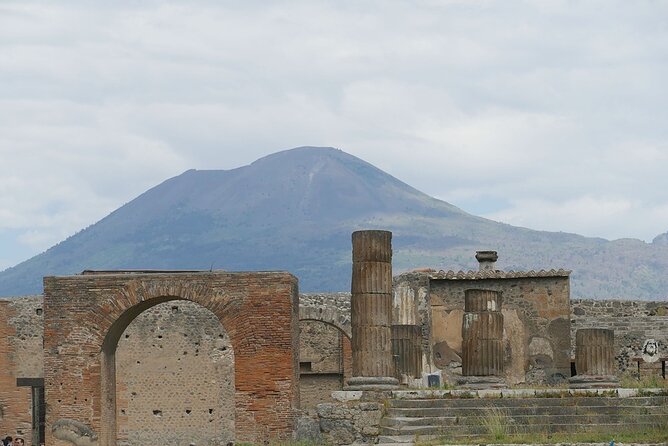
Pompeii is not just a collection of monuments. It is a whole Roman town, with political buildings, religious spaces, shops, entertainment venues, private houses, and public baths. Without some guidance, you can easily walk past an important building and see only another wall.
This tour gives you a route through several kinds of ancient life. You see where people watched plays, washed, worshipped, traded, argued, ate, and sought paid sex. That range is the strongest part of the experience.
The archaeological park is vast, and two hours is a firm limit. You will not see every house or street. Still, the selected stops form a useful introduction, especially if this is your first visit or you want the main sights explained in plain English.
The tour departs daily at 10:30 am from the InStazione help desk. After registration, you go with the guide to the Porta Anfiteatro entrance. The start point and the entrance are worth checking closely before you set out, since one booking had a 90-minute difference between the expected pickup time and the actual tour time. That sort of error can turn a calm morning into a scramble.
More Walking Tours in Pompeii
- Pompeii: Guided Walking Tour with Entrance Ticket
★ 4.3 · 1,423 reviews - Discover Pompeii: French Walking Tour of the Buried City
★ 4.8 · 253 reviews - From Salerno: Pompeii Guided Walking Tour
★ 4.5 · 235 reviews
Teatro Grande and the quieter Odeon
The tour begins with Pompeii’s theaters. The Teatro Grande is the larger Roman performance space, buried under the eruption of Vesuvius and later uncovered through excavation. Ancient audiences came here for comedies, mimes, pantomimes, and Atellan plays, a form of comic theater.
This is a useful first stop because it shows that Pompeii was not a sleepy provincial outpost. It had organized public entertainment and the buildings to support it. Your guide can also help you picture the theater as a working venue rather than a stone shell.
The route also includes the Odeon, a smaller theater linked to the earlier Samnite settlement and Pompeii’s later place within the Roman world. Its presence helps show that the city changed over time. Pompeii was not built in one grand burst. It grew through different political and cultural periods.
The theater section is especially good for visitors who like architecture, performance, or social history. The tradeoff is that the stop is viewed as part of the larger route, so you should not expect a long lecture on Roman theater.
Via Stabiana, where the city feels most real
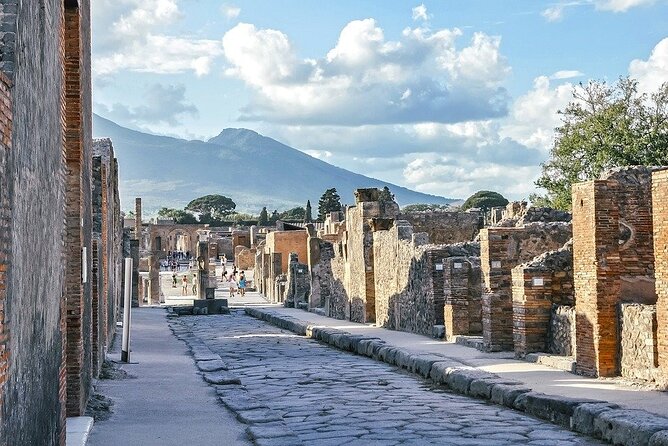
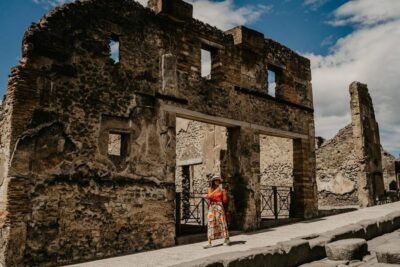
From the theaters, you reach Via Stabiana, one of the most effective parts of the walk. The cobbled surface is about 2,000 years old, and the street retains sidewalks and pedestrian walkways. Shops and houses line the route.
This is where Pompeii can suddenly feel like a town rather than an archaeological site. You can see how people moved along uneven paving, how commercial spaces faced the street, and how homes sat beside public activity. The preserved road also gives the guide a chance to explain practical details of Roman urban planning.
The route continues toward the Via dell’Abbondanza, another important street with shops, residences, and public facilities. Paintings connected with several businesses have been restored, including the thermopolium of Asellina, a well-known inn, and various workshops.
I find streets like these more revealing than isolated monuments. A temple tells you about religion, but a street shows how religion, shopping, craft work, and home life occupied the same few blocks. Keep your eyes down as well as up. The paving, curb lines, and raised walking surfaces are part of the story.
Casa del Menandro and the world of a wealthy family
Casa del Menandro is a large urban house covering almost 1,800 square meters. It was excavated between 1926 and 1932 and offers a strong picture of an affluent Pompeian home.
The name comes from an image of Menander, the Greek poet, found inside the house. It does not identify the original owner. That small detail is worth remembering because ancient sites often carry modern labels that can sound more certain than the evidence allows.
The house is known for its decoration and scale. Here, the guide can explain the difference between a modest dwelling and a large domus, as well as the role of art and layout in Roman household life. You spend about 15 minutes here, which is enough to understand the house’s importance but not enough to inspect every room.
Casa del Menandro is a good counterpoint to the public buildings. After seeing theaters and streets used by large numbers of people, you enter a place shaped around family status, domestic work, display, and private space.
More Pompeii excavation visits:
- Pompeii: Entry Ticket and Guided Tour with an Archaeologist
★ 4.8 · 19,459 reviews - Pompeii: Entry Ticket with Optional Audio Guide
★ 4.2 · 12,360 reviews - Pompeii: Small Group Tour with an Archaeologist
★ 4.8 · 12,264 reviews - Pompeii Small Group Tour with an Archaeologist
★ 5.0 · 6,593 reviews
Stabian Baths and the practical side of Roman life
The Stabian Baths are among the most useful stops for understanding everyday routines. They are described as Pompeii’s oldest bath complex of its kind, and the male and female sections remain remarkably clear in the ruins.
You spend about 15 minutes here. The guide’s job is important because a bath complex can otherwise seem like a maze of rooms. With an explanation, you can follow the division of spaces and understand that bathing was not simply about getting clean. It was a public and social activity, tied to exercise, conversation, business, and leisure.
This stop also shows how advanced Roman public infrastructure could be. The surviving layout gives you a sense of planning and shared services, even though the tour does not have time for a full technical study of heating systems or water management.
The baths are a strong choice for families and first-time visitors because they connect easily with modern life. You may find yourself comparing them with a gym, spa, and social club combined, though the exact use of each room is best taken from your guide’s explanation rather than guessed from the walls.
The Lupanar, with context rather than cheap spectacle
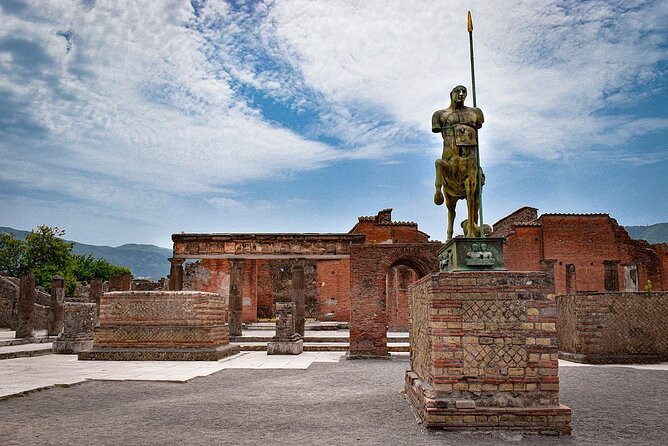
The Lupanar is Pompeii’s best-known brothel. Its walls preserve erotic scenes, and the small rooms make the purpose of the building clear.
The stop lasts about 10 minutes. That is enough to see the paintings and learn how prostitution fit into Roman urban life, but the pace may feel brisk if you want a longer discussion of gender, slavery, economics, or social attitudes.
This is one of the places where a guide adds real value. Without context, the erotic images can become a quick curiosity. With context, they form part of a broader picture of commerce, class, and private life in ancient Pompeii.
If you are visiting with children, you may want to decide in advance how you want to handle this stop. The tour includes it as a normal part of the route, and the material is plainly visible.
Pompeii’s Forum, temples, and civic center
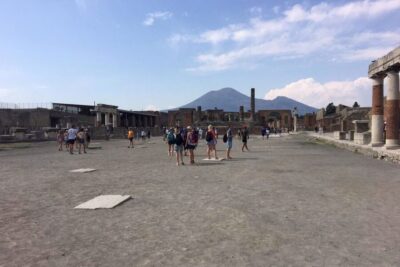
The route ends around the Forum, where Pompeii’s political, religious, and commercial life came together. The Forum began in the Samnite period, around the 4th century BC, near roads leading toward Neapolis, Nola, and Stabiae.
After the Roman conquest, the area was rebuilt and expanded, especially in the 2nd century BC. Shops and earlier structures were removed, while political and religious buildings were placed around the square. The Forum is therefore a good place to see Pompeii as a city shaped by changing power.
The Temple of Jupiter overlooked the Forum. It later became the Capitolium, dedicated to Jupiter, Juno, and Minerva, the three major Roman gods. Its basement held sacred objects, offerings, and the public treasury.
The Basilica was a large public building from the 2nd century BC. It functioned like an indoor forum, giving legal and commercial activity a place to continue when weather made the open square less useful. The raised tribunal helped separate judges from the people appearing before them, and access was controlled by a removable wooden staircase.
The Temple of Apollo reflects an older religious connection between the Greek world and Italic communities. By the time of the eruption, the cult of Apollo had lost some importance as Jupiter’s role grew. Bronze statues of Apollo and Diana remain visible.
You spend only about five minutes at each of these Forum-area stops. That is enough for orientation and key facts, but not for a detailed study of Pompeii’s political system or religious development. If the Forum is your main interest, plan to return on your own after the guided portion, provided site conditions and your admission arrangements allow it.
The granaries and a glimpse of ancient trade
The granaries near the Forum now hold archaeological material, including casts, but they once served as a market for cereals and legumes. The absence of plaster led archaeologists to think the structure may not have been finished when the eruption struck.
A particularly useful feature is the ponderary table. It held tools for checking measurements and converting different units used by merchants from across the Roman world into the units accepted in Pompeii.
This is a small detail, but it makes ancient trade easier to understand. Commerce depends on shared standards, and the table shows that Roman economic life involved practical systems as well as grand buildings.
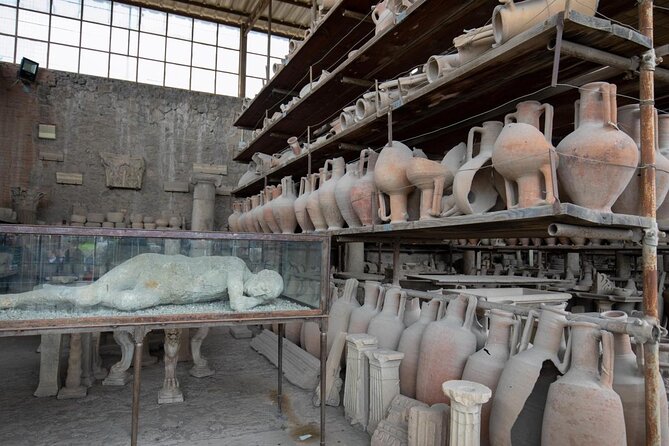
The casts displayed in this area can be emotionally difficult. They are a direct reminder that Pompeii was a living city when Vesuvius erupted. The tour’s short format means you may not have much time to process that material before moving on.
What the $42.05 price gets you
At $42.05 per person, this is not the cheapest way to enter Pompeii, but the price includes the admission ticket and guided tour. That matters because you are paying for both access and interpretation.
I see the value in this format if you have two hours, want the major sights explained, and do not want to spend your first visit sorting out a complicated route. Pompeii rewards context. A guide can point out why a street matters, explain the difference between a domus and public building, and connect the ruins with Roman social life.
The value is less clear if you plan to spend a full day in the park. In that case, the guided route may be a useful beginning, but you will likely want more time afterward. The tour is also capped at 35 people, so it is not a private walk. A group of that size can make it harder to hear or see everything, especially at crowded points.
The overall rating is 4.7 out of 5 from 16 ratings, with 94 percent recommending it. The strongest praise centers on the guides. Grace is described as funny and exceptionally well informed, Frederica as careful and entertaining, and Vincenzo as attentive to the whole group. One guide, Igor, is also praised for professional and engaging delivery.
Those individual guide reports are encouraging, but guide assignments can change. You should book for the route and format, not on the assumption that one particular person will lead your visit.
Timing, language, and practical concerns
The experience is offered in English and lasts about two hours. It is scheduled every day at 10:30 am, with the meeting process beginning at the InStazione help desk.
The start and end points are in the Pompeii area. The listed end point is Scavi di Pompeii on Viale delle Ginestre. The experience is near public transportation, and the provided information says most people can participate. Service animals are allowed.
The tour requires good weather and a minimum number of participants. If poor weather or low participation cancels the experience, you are offered another date or a full refund.
Free cancellation is available up to 24 hours before the start time. After that point, the payment is not refunded, and changes are not accepted. Read your confirmation carefully, especially the start time, before leaving for Pompeii.
No lunch is included. Bring your own plan for food before or after the walk rather than expecting a meal during the tour.
Who should book this Pompeii walk?
I’d recommend it to first-time visitors, history fans who want a guided framework, and people coming from Naples for a short visit. The itinerary gives you a strong sample of Pompeii’s public and private life without asking you to study the site beforehand.
It also suits anyone who prefers stories to silent inspection. The strongest guides described for this experience use humor, clear explanations, and relatable examples. That can make a two-hour walk pass quickly.
I’d be more cautious if you dislike group tours, need a slow pace, or want to focus on a particular area. The group may reach 35 people, the schedule is compact, and one account describes a late start and a guide who was harder to understand. The tour is also not ideal as your only Pompeii experience if you want to see a large number of houses and side streets.
Should you book it?
Book this Pompeii walking tour if you want the site’s main story in two focused hours, with the entrance ticket and an English-speaking guide included. The route is well chosen: theaters, a wealthy home, baths, a brothel, ancient streets, the Forum, temples, and trade facilities.
The best reason to choose it is the guide-led interpretation. Pompeii’s ruins can be visually impressive but confusing, and strong guides such as Grace, Frederica, and Vincenzo appear to make the ancient city easier to picture.
Skip it if you want a full-day archaeological visit or complete independence. If you do book, verify the 10:30 am meeting time and allow flexibility in case the group starts late. At $42.05, it is a fair introduction to Pompeii, provided you understand that it is an overview, not the whole city.
FAQ
How long does the Pompeii walking tour last?
The guided experience lasts approximately two hours.
What time does the tour depart?
The tour is scheduled to depart daily at 10:30 am.
Where does the tour start?
You meet at the InStazione help desk in Pompeii, at 80045 Pompei in the Metropolitan City of Naples.
Where does the tour end?
The listed end point is Scavi di Pompei on Viale delle Ginestre, 80045 Pompei NA.
Is the Pompeii entrance ticket included?
Yes. The entrance ticket and guided tour are included in the price.
What language is the tour offered in?
The experience is offered in English.
Is lunch included?
No. Lunch is not included.
Can I cancel for a full refund?
Yes, if you cancel at least 24 hours before the experience start time. Cancellations made less than 24 hours in advance are not refunded.
More Walking Tours in Pompeii Ruins
- Pompeii 3 Hours Walking Tour Led by an Archaeologist
★ 5.0 · 126 reviews - Pompeii: Highlights Guided Walking Tour
★ 4.6 · 105 reviews - Pompeii: 3D Walking Tour with Entry Ticket
★ 4.3 · 102 reviews - Explore Pompeii: 2-Hour Guided Walking Tour with Included Ticket
★ 4.5 · 77 reviews
More Historic Sites near Pompeii Ruins
- Guided Tours of Pompeii Excavations Historical and Cultural Itineraries
★ 5.0 · 56 reviews - Private Guided Multimedia Exhibition on the History of Sorrento
★ 4.5 · 90 reviews - Guided tour of a historic lemon grove in Sorrento
★ 4.5 · 71 reviews - Authentic Amalfi Lemon Tour & Tasting in the Historical Garden
★ 5.0 · 52 reviews
Newest reviews from Pompeii Ruins
- Private Tour Pompeii and Winery★ 5.0 · 4 reviews
- Visit the Pompeii ruins from Salerno with Pizza Lunch★ 5.0 · 4 reviews
- Pompeii Private Tour for Kids and Their Families★ 4.8 · 4 reviews
- From Sorrento: Pompeii & Vesuvius tour small group★ 4.8 · 4 reviews
- Pompeii Sorrento and Positano Tour★ 5.0 · 4 reviews
- From Naples_ Pompeii Tour_Skip the line ticket + audioguide★ 4.3 · 4 reviews
- Pompeii, skip-the-line ticket with smartphone audio guide on App★ 3.0 · 4 reviews
- Pompeii Private Half-Day Tour from: Naples,Sorrento, Amalfi Coast★ 5.0 · 4 reviews
Walking Tours, compared.

Walking Food Tour in Sorrento w/ Limoncello Factory Lemon Grove
Read our review →

Discover Pompeii: French Walking Tour of the Buried City
Read our review →

Browse the lists this tour appears in