
Reviewed · HISTORICAL TOURS
Guided Tours of Pompeii Excavations Historical and Cultural Itineraries
Pompeii’s famous ruins become far more legible when someone explains how the city worked. This four-hour route moves from temples and government buildings to bathhouses and private homes, ending at the Villa dei Misteri and its remarkable Dionysian frescoes.
I like the small group, capped at 15 people, and the way the tour connects Pompeii to the wider Hellenistic world rather than treating it as a collection of broken walls. I also like the focus on houses, mosaics, cults, and daily routines, not just the big public monuments.
The main drawback is clear: your Pompeii entrance ticket is not included in the $57.62 tour price. The itinerary is also quite full, with about 25 minutes at each of 10 stops, so you get broad coverage rather than long, quiet study of every building.
In This Review
- Key points at a glance
- A four-hour route through Pompeii’s public and private life
- Suburban spas: Pompeii begins with bathing culture
- Venus and Apollo: religion in Pompeii’s open spaces
- The Basilica and Forum: where Pompeii handled public business
- The Forum Baths reveal Pompeii’s engineering and taste
- The House of the Faun brings Hellenistic Pompeii into focus
- The House of the Vettii is Pompeii’s great painting lesson
- The House of the Golden Cupids mixes domestic life and worship
- The Villa dei Misteri provides the tour’s emotional finish
- Bruno Pisano’s teaching style is the main reason to book
- Is $57.62 good value when admission costs extra?
- Who will get the most from this Pompeii visit?
- Should you book Guided Tours of Pompeii Excavations?
- FAQ
- How long does the Pompeii guided tour last?
- What time and where does the tour begin?
- Where does the tour end?
- Is the Pompeii entrance ticket included?
- How large is the group?
- Can I cancel for a full refund?
Key points at a glance
- Bruno Pisano leads the tour: His approach blends archaeology, history, philosophy, ancient customs, and links to modern life.
- The Villa dei Misteri is included: You finish with Pompeii’s celebrated first-century BC Dionysian fresco cycle.
- Small groups matter here: A maximum of 15 people makes it easier to hear explanations in open courtyards and busy ruins.
- The route covers more than the Forum: You visit suburban baths, temples, the Basilica, major houses, and the city’s central thermal complex.
- The Hellenistic connection is central: Pompeii is presented as a trading and manufacturing city tied to the wider Mediterranean world.
- Budget for admission separately: The tour includes the guide and assistance, but not entry to the archaeological site.
A four-hour route through Pompeii’s public and private life
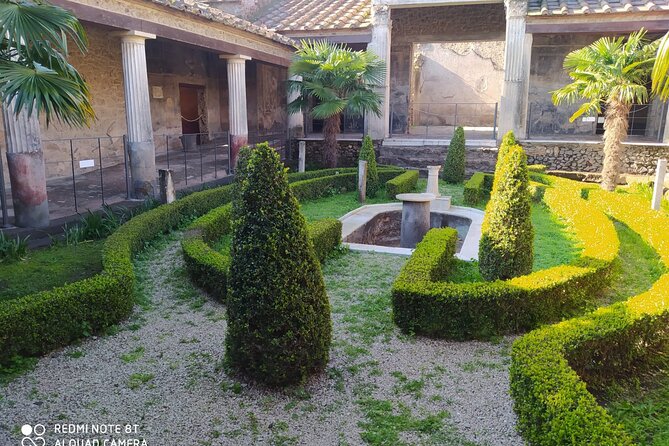
This is not a quick orientation walk. The scheduled experience lasts about four hours and 10 minutes, beginning at 9:30 a.m. at the official audioguide meeting point by Porta Marina on Via Villa dei Misteri.
You’ll spend roughly 25 minutes at each listed stop. That rhythm lets you cover a large section of Pompeii, but it also means the guide must keep the group moving. I would choose this tour if you want a structured first visit and a strong overview. If you prefer to sit with one mosaic for half an hour or wander at your own pace, the schedule may feel brisk.
The guide and assistance are provided for the full tour. The advertised group limit is 15 people per guide, a useful size in a sprawling archaeological park where sound can carry poorly and people often gather around the same doorways.
More Pompeii excavation visits:
- Pompeii: Entry Ticket and Guided Tour with an Archaeologist
★ 4.8 · 19,459 reviews - Pompeii: Entry Ticket with Optional Audio Guide
★ 4.2 · 12,360 reviews - Pompeii: Small Group Tour with an Archaeologist
★ 4.8 · 12,264 reviews
Suburban spas: Pompeii begins with bathing culture
The opening stop is the suburban bath complex, where you’ll see the frigidarium, or cold room, with a glass-paste nymphaeum made from polychrome and glazed tiles. The swimming pool carries frescoes with Nilotic subjects, linking Pompeii’s decorative world to imagery associated with the Nile and Egypt.
This is a good first stop because it shifts your attention away from the eruption and toward ordinary Roman-era habits. Baths were social spaces as well as places for washing. The surviving decoration also gives you an early sense of the craftsmanship used throughout the city.
The 25-minute visit is enough to understand the layout and notice the decorative details. You may want more time if ancient plumbing, wall painting, or bathing customs are your main interests.
Venus and Apollo: religion in Pompeii’s open spaces
At the Temple of Venus, the guide places the building within Pompeii’s religious and civic life. The temple occupies a terrace with broad views over the surrounding area and was linked to Venus, the city’s important goddess, as well as to sailors and the imperial cult.
This stop also includes an unusual modern addition: a bronze statue of Daedalus by Polish artist Igor Mitoraj. The contrast is striking. You are looking at an ancient sacred site while also encountering a contemporary sculpture inspired by classical mythology.
The Temple of Apollo follows. Its design reflects Greek influence, and bronze statues of Apollo and Diana are part of the presentation. The stop is useful for understanding that Pompeii’s identity was not simply Roman. The tour frames it as a Hellenistic city with Greek cultural influence, commercial reach, and ties to a broad Mediterranean network.
That interpretation gives the ruins more context. Pompeii was not an isolated provincial town waiting for Rome to define it. It was a commercial and industrial center connected, in the tour’s historical reading, with Asia Minor, India, and Persia.
The Basilica and Forum: where Pompeii handled public business

The Basilica was Pompeii’s main tribunal and largest public building. Its three-nave design later resembles the basic form of a Christian basilica, although the building served a civic and legal purpose in ancient Pompeii.
I like this stop because it helps you picture the city as a working community. The Basilica was not built merely for display. Legal matters, public business, and civic authority were part of its role.
Next comes the Forum, the city’s administrative, commercial, and religious center. The Temple of Jupiter, Juno, and Minerva dominates the area, giving the open square a strong sense of ceremony and authority.
Expect the Forum to be one of the busiest and most visually commanding portions of the visit. The guide’s explanation is especially useful here because the columns and paving stones can seem abstract without a sense of how people moved through the space.
At 25 minutes, you’ll get the main story and major architectural points. You will not have time to examine every surrounding building in detail, so take note of anything you want to revisit after the guided walk.
More historic sites near Pompeii Ruins:
- Pompeii Walking Tour: The Real History of the Ruins
★ 4.5 · 16 reviews - Private Guided Multimedia Exhibition on the History of Sorrento
★ 4.5 · 90 reviews - Guided tour of a historic lemon grove in Sorrento
★ 4.5 · 71 reviews - Authentic Amalfi Lemon Tour & Tasting in the Historical Garden
★ 5.0 · 52 reviews
The Forum Baths reveal Pompeii’s engineering and taste
The Forum Baths were a wellness center for the community. The tepidarium, or warm room, is decorated with stucco associated with the Neronian school, while the calidarium, or hot room, contains a large alabaster labrum of Egyptian origin.
These details show how practical buildings could also be carefully designed. The baths required heating systems, water management, and a sequence of rooms, but the interiors were not plain utility spaces.
I would pay attention to the materials here. The alabaster basin and decorated stucco help explain why Pompeii matters beyond its dramatic destruction. The city preserves small choices about comfort, ornament, and status that are rarely visible in surviving ancient cities.
The House of the Faun brings Hellenistic Pompeii into focus
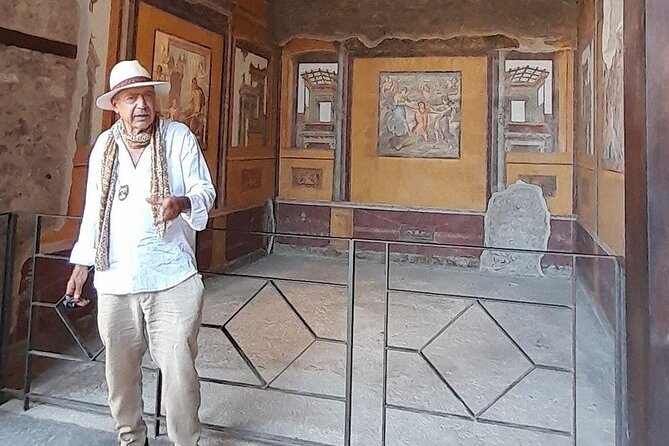
The House of the Faun is the largest private residence in Pompeii. Its size and design point to the wealth of the Hellenistic-era elite, and the home gives the guide a chance to discuss how private architecture could function like a palace.
The main attraction is a copy of the famous Alexander Mosaic, showing the Battle of Issus in 333 BC between Alexander the Great and Darius III of Persia. Even as a copy, it carries enormous interpretive value. It links one Pompeian house to the political and artistic world of the eastern Mediterranean.
This is one of the stops where the tour’s wider cultural argument makes the most sense. Pompeii’s decoration was not limited to local subjects. Its owners displayed Greek and eastern imagery, reflecting trade, taste, education, and political memory.
The home is large, so a 25-minute stop can feel short. Still, the guide’s explanation should help you understand why this is more than an attractive residence. It is evidence of the city’s money and international outlook.
The House of the Vettii is Pompeii’s great painting lesson
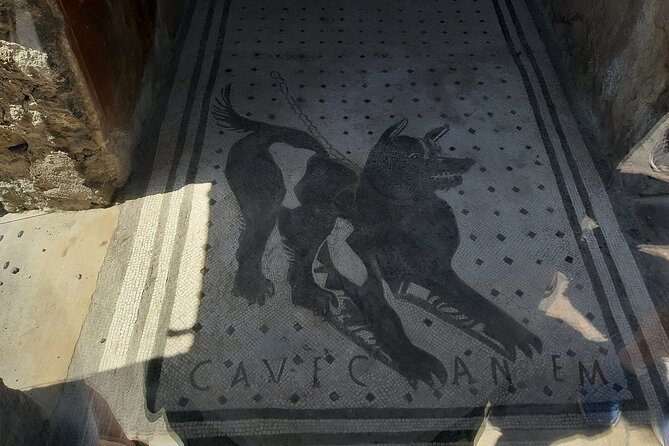
The House of the Vettii is known for its Fourth Pompeian Style frescoes. You’ll see the famous Priapus image, a grand hall, scenes of Cupids at work, and mythological paintings that include Daedalus and the Minotaur.
For me, this is one of the most rewarding stops for anyone interested in painting. The rooms show how Pompeian interiors used myth, humor, fantasy, and decoration to express the identity of the household.
The Cupids engaged in work are especially useful for making the ancient home feel active rather than frozen. They are not simply decorative figures. They suggest production, trade, and the display of abundance.
You should expect plenty to see in a short time. Listen for the guide’s explanation of the Fourth Style and how the paintings worked across rooms, since the visual effect is easier to understand as a complete interior than as a series of isolated panels.
The House of the Golden Cupids mixes domestic life and worship
The House of the Golden Cupids is a well-preserved domus with a Rhodian peristyle, a columned garden court associated with Hellenistic domestic design. Obsidian mirrors add a rare material detail, while a shrine dedicated to Isis points to the variety of religious practice in Pompeii.
The house also includes a lararium, a household shrine for protective gods. This is where I find the tour’s attention to daily life most useful. Public temples tell you how a city presented religion, but a lararium shows how belief could operate inside a family home.
Frescoes connected with the Trojan War add another layer. Mythological scenes were not random wall decoration. They helped homeowners display cultural knowledge and shape the mood of their rooms.
Again, the 25-minute format favors explanation over lingering. You’ll understand the house’s main themes, but you may want to return later if interiors and domestic religion are your priority.
The Villa dei Misteri provides the tour’s emotional finish
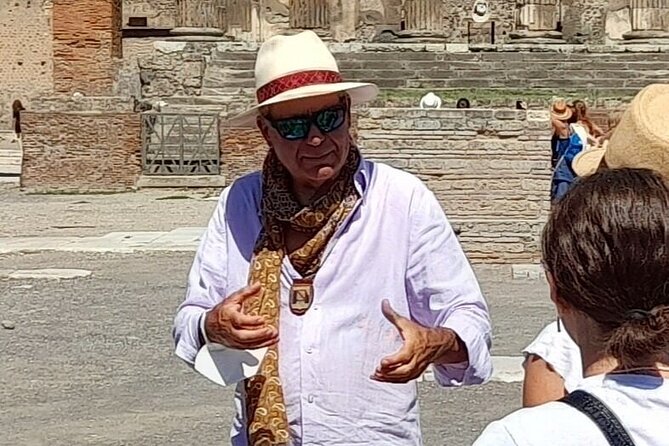
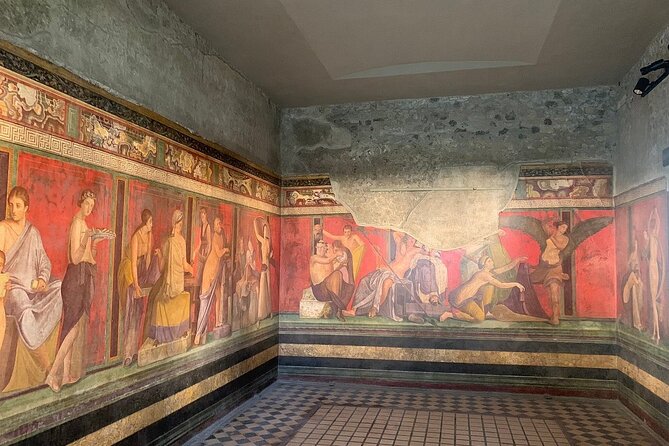
The final stop is the Villa dei Misteri, home to Pompeii’s renowned Dionysian fresco cycle from the first century BC. The paintings are famous for their state of preservation and for the mystery surrounding the ritual scenes associated with Dionysus.
The tour also places the frescoes within a broader discussion of the Dionysian and Isiac mystery cults. That context matters because the images are not just colorful wall paintings. They raise questions about initiation, ceremony, identity, and the relationship between private belief and public religion.
Ending here is a strong choice. After seeing public temples, legal buildings, baths, and large houses, you finish with a sequence of paintings that demands a more careful reading.
The guide’s cultural and philosophical approach should be most noticeable at this point. You are not asked to view the frescoes only as art. You are encouraged to consider what they may have meant to the people who lived with them.
The scheduled 25 minutes is enough for a guided explanation, but the Villa dei Misteri is the stop most likely to leave you wanting additional time. If the Dionysian frescoes are your main reason for booking, confirm how the group handles the timing and plan to see if you can return independently afterward, subject to site rules and your admission access.
Bruno Pisano’s teaching style is the main reason to book
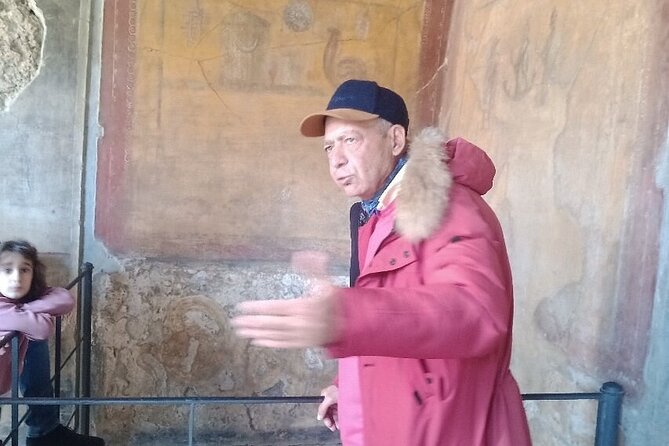
The guide for this experience is Bruno Pisano, identified as a specialist in archaeology, history, and philosophy. The strongest part of the experience is not simply the number of sites. It is the effort to connect architecture with ideas, customs, psychology, religion, and modern life.
That approach suits you if you enjoy interpretation rather than a string of dates. Pisano is also described as adapting his explanations well for younger people, making the tour a possible fit for families with older children and teenagers who respond to stories and connections.
The praise for his courtesy, professionalism, passion, and ability to link ancient customs with present-day psychology is consistent across the supplied comments. One practical note is worth keeping in mind: the experience is guide-led and intellectually framed, so it may feel more like a seminar in the ruins than a light sightseeing stroll.
Is $57.62 good value when admission costs extra?
At $57.62 per person, the tour is not the cheapest way to enter Pompeii, especially since the archaeological park ticket is separate. You are paying for the guide’s time, a four-hour route, and a small group rather than for admission itself.
I think the price can make sense for a first visit. Pompeii is large, and the meaning of a basilica, bath, shrine, or elite house is easy to miss when you walk alone without preparation. A guide who can connect the House of the Faun to the Hellenistic world and the House of the Golden Cupids to household religion adds value beyond pointing out famous walls.
The price deserves more scrutiny if you already know Pompeii well or want a slow photography walk. You may prefer to buy admission and explore independently, particularly if you want to spend much longer at the Villa dei Misteri or return to the Forum.
The tour is often booked about 23 days ahead, so advance planning is sensible. Confirmation is issued within 48 hours, subject to availability. The mobile ticket feature is convenient, but do not mistake it for included park admission. Check exactly what you need for entry before arriving at Porta Marina.
Who will get the most from this Pompeii visit?
I would recommend this experience to you if:
- You are visiting Pompeii for the first time and want a clear route through its major zones.
- You like archaeology, philosophy, ancient religion, and cultural connections.
- You want the Villa dei Misteri included rather than treated as an optional extra.
- You prefer a group of no more than 15 people.
- You want to understand houses and daily routines as well as temples and public squares.
- You are visiting with children or teenagers who benefit from a guide who makes links beyond dates and names.
I would hesitate if you want complete independence, a slow pace, or a tour focused only on the eruption of AD 79. The route gives the ancient city a broad cultural frame, including its Hellenistic identity and Mediterranean connections, rather than making the disaster the only story.
Most people can participate, and service animals are allowed. The meeting point is near public transportation, and the tour ends back at Via Villa dei Misteri, 2, which keeps the start and finish simple.
Should you book Guided Tours of Pompeii Excavations?
I would book this tour if you want a serious, well-organized introduction to Pompeii and value Bruno Pisano’s style of teaching. The strongest reasons are the small 15-person maximum, the inclusion of the Villa dei Misteri, and the unusual attention to philosophy, cult practice, domestic life, and Hellenistic culture.
I would skip it if the separate entrance fee pushes the total beyond your budget or if you dislike fixed 25-minute stops. Before booking, add the Pompeii admission cost to the listed tour price and decide if the four-hour route matches your pace.
The experience has free cancellation up to 24 hours before the 9:30 a.m. start time. That gives you some protection if your plans change, but changes or cancellations made inside that window are not accepted for a refund.
FAQ
How long does the Pompeii guided tour last?
The guided experience lasts approximately four hours and 10 minutes.
What time and where does the tour begin?
It begins at 9:30 a.m. at Porta Marina audioguide official, Via Villa dei Misteri, 2, 80045 Pompei, Italy.
Where does the tour end?
The tour ends at Via Villa dei Misteri, 2, the same address listed for the meeting point.
Is the Pompeii entrance ticket included?
No. The entrance ticket to the Pompeii ruins is not included in the tour price.
How large is the group?
The group is limited to a maximum of 15 people per guide.
Can I cancel for a full refund?
Yes. You can cancel at least 24 hours before the experience start time for a full refund. Cancellations or changes made less than 24 hours before the start are not accepted for a refund.
Newest reviews from Pompeii Ruins
- Private Tour Pompeii and Winery★ 5.0 · 4 reviews
- Visit the Pompeii ruins from Salerno with Pizza Lunch★ 5.0 · 4 reviews
- Pompeii Private Tour for Kids and Their Families★ 4.8 · 4 reviews
- From Sorrento: Pompeii & Vesuvius tour small group★ 4.8 · 4 reviews
- Pompeii Sorrento and Positano Tour★ 5.0 · 4 reviews
- From Naples_ Pompeii Tour_Skip the line ticket + audioguide★ 4.3 · 4 reviews
- Pompeii, skip-the-line ticket with smartphone audio guide on App★ 3.0 · 4 reviews
- Pompeii Private Half-Day Tour from: Naples,Sorrento, Amalfi Coast★ 5.0 · 4 reviews
Historical Tours, compared.

Guided tour of a historic lemon grove in Sorrento
Read our review →
Authentic Amalfi Lemon Tour & Tasting in the Historical Garden
Read our review →
Visit Costiera Sorrento Coast Between history and legend
Read our review →
Amalfi Organic Lemon Tour & Tasting in the Historical Garden
Read our review →
Guided tour of the history and tradition of the Sorrento lemon
Read our review →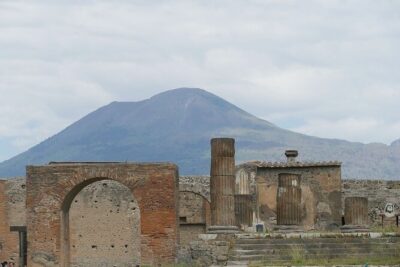
Pompeii Walking Tour: The Real History of the Ruins
Read our review →
Full-Day Private History Tour in Amalfi Coast with Pick Up
Read our review →Browse the lists this tour appears in