
Reviewed · ARCHAEOLOGIST-LED TOURS
Pompeii tour with archaeologist
Pompeii becomes far easier to understand when an archaeologist turns its broken streets into a working Roman town. This tour with Pina Esposito follows a brisk route through the Forum, homes, temples, theaters, baths, and brothel, linking each ruin to daily life before the eruption of 79 AD.
I like the small maximum group of 15, which gives you room to ask questions, and I like the carefully chosen highlights, including the Cave Canem mosaic, House of the Faun, ancient fast-food counter, and plaster casts of eruption victims. The main catch is important: your entrance ticket, food, drinks, and tip are not included in the $42.01 price.
In This Review
- Key points to know before booking
- Why an archaeologist changes the Pompeii visit
- Starting at the Forum, Pompeii’s public center
- Basilica, Apollo, and the city’s religious life
- Cave Canem and the House of the Faun
- Thermopolium and imperial power
- Via dell’Abbondanza and Pompeii’s street plan
- The Teatro Grande and the Doric Temple
- Stabian Baths and the Lupanar
- Is $42.01 good value for Pompeii?
- Practical details that affect your day
- Who should book this Pompeii tour?
- Should you book it?
- FAQ
- How long does the Pompeii archaeologist tour last?
- What language is the tour offered in?
- Who leads the Pompeii tour?
- What is the maximum group size?
- Is the Pompeii entrance ticket included?
- What else is not included?
- Where does the tour begin?
- Where does the tour end?
- Can I remain inside Pompeii after the tour?
- What is the cancellation policy?
Key points to know before booking
- The route covers 14 major stops in about two and a half hours, including Pompeii’s Forum, temples, theaters, baths, homes, and Lupanar.
- Pina Esposito leads the experience as an archaeologist and guide, with tours offered in English, Italian, or German.
- The group is capped at 15 people, a useful balance between personal attention and a lower price than a private tour.
- The tour ends at Pompeii’s Forum, so you can stay inside the excavations and continue exploring independently.
- Admission is extra, so check the current archaeological-site entrance price before comparing the total cost with other tours.
- The itinerary is dense, with most stops receiving 10 to 15 minutes, so this works best as an introduction rather than a slow study visit.
Why an archaeologist changes the Pompeii visit
Pompeii is not a tidy collection of ruins. It is a large ancient city with streets, houses, public buildings, shrines, shops, and theaters spread across a site that can quickly feel confusing. Without a plan, you may spend much of your time checking a map and wondering which doorway matters.
This route gives you a useful framework. You begin with public life in the Forum, move through religion and politics, enter private houses, then see how ordinary people ate, bathed, traveled, and watched performances. By the time you reach the Lupanar, you have a clearer sense of how the city functioned as a whole.
Pina’s strongest asset is her academic background. The supplied material describes her as a historian and teacher with expertise in classical Roman and Greek history, as well as later Italian history. That matters at Pompeii because the site raises constant questions: What was this room for? Who used it? How certain are archaeologists about its purpose? A guide with a serious grasp of the evidence can explain both the known facts and the limits of what can be proved.
The tour’s listed rating is 5 out of 5 from 21 ratings, with 100 percent recommending it. The praise centers on clear explanations, historical context, and the way Pina helps visitors see Pompeii as a place where people lived, worked, worshipped, ate, and entertained themselves.
More Pompeii excavation visits:
- Pompeii: Entry Ticket and Guided Tour with an Archaeologist
★ 4.8 · 19,459 reviews - Pompeii: Entry Ticket with Optional Audio Guide
★ 4.2 · 12,360 reviews - Pompeii: Small Group Tour with an Archaeologist
★ 4.8 · 12,264 reviews
Starting at the Forum, Pompeii’s public center
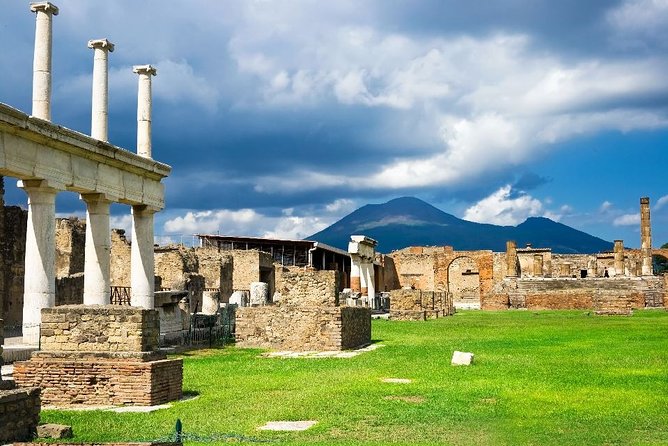
The tour begins at the Pompeii excavations entrance at Pompei Scavi Villa Dei Misteri, at Via Villa dei Misteri. From there, the route reaches the Foro di Pompei, the city’s main public square.
Allow about 15 minutes here. That may sound short, but the Forum is the right place to begin because it introduces Pompeii’s political, religious, and commercial life. Pina explains the city’s origins and the chain of events leading to the eruption in AD 79, giving you a timeline before the tour moves into smaller buildings.
Look around as you listen. The Forum is not simply an open plaza surrounded by columns. It was the place where civic business, religious ceremony, public announcements, and trade came together. The explanation helps you read the buildings around its edges instead of seeing only fragments of stone.
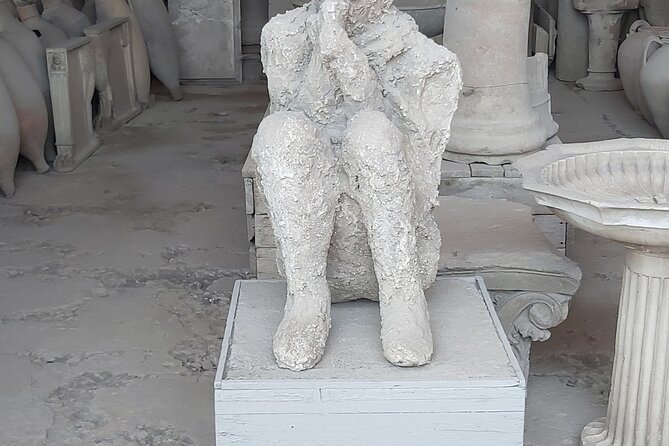
Next comes the Granaries of the Forum, where amphorae, sculptures, inscriptions, and other finds are displayed. The plaster casts of victims are among the most affecting objects connected with Pompeii. They can be difficult to see, particularly because they make the disaster personal rather than abstract.
The stop lasts about 10 minutes. That is enough for an introduction, though you may want to return later if you prefer to take time with the objects or examine the inscriptions closely.
Basilica, Apollo, and the city’s religious life
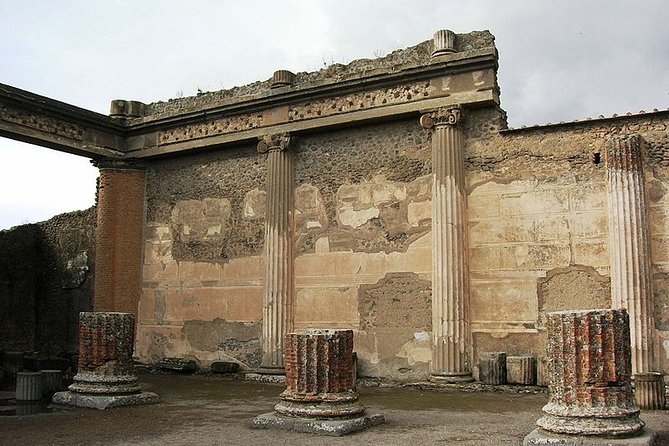
The Basilica is the next major stop, with about 15 minutes devoted to this large and important building. In Roman cities, a basilica was not a church in the later Christian sense. It served civic and legal functions, making it a key part of Pompeii’s public life.
This is one of the places where a guide adds real value. A ruined hall can be hard to interpret on your own, but an explanation of how the space worked gives the surviving columns and walls a practical purpose. You begin to picture legal proceedings, business, and public dealings taking place here.
The Temple of Apollo receives another 15 minutes. It contains an appealing mix of original features and surviving details, including sculptures, an altar, a fountain, inscriptions, columns, and a Roman sundial. The variety makes this more than a quick stop for photographs.
The temple also helps you see that Pompeian religion was part of daily civic life. Worship, architecture, public identity, and political authority were closely linked. The guide’s job here is not simply to name the god or building, but to explain how the temple fit into the city.
The route then passes Hotel Vittoria, an ancient gateway to Pompeii and a point from which Pina explains the surrounding area. This is only a five-minute stop, so think of it as a transition rather than a full visit.
Cave Canem and the House of the Faun
One of Pompeii’s most famous small details comes next: the mosaic with the words Cave Canem, meaning beware of the dog. It was placed at the entrance to the House of the Tragic Poet.
The stop lasts about 10 minutes. The mosaic is memorable because it connects a grand ancient house with a familiar household warning. It also gives you a glimpse of how decoration could send a message to anyone approaching the doorway.
The House of the Faun gets 15 minutes and is one of the route’s major highlights. It was the largest house in Pompeii, and its name comes from the bronze dancing Faun found there. The property also produced the celebrated Alexander Mosaic, made from more than a million tiny colored tiles and showing the battle between Alexander the Great and Darius III.
The original masterpieces are not all still in place, so it is worth listening carefully to the explanation of what was found here and where the objects are now. The house itself remains essential because its size, layout, and decoration reveal the wealth of Pompeii’s elite.
For me, this is one of the best parts of the itinerary because it moves the visit from public monuments into private ambition. You see how a wealthy family used architecture, art, and elaborate floors to display status.
More tours led by an archaeologist:
- Pompeii Small Group Tour with an Archaeologist
★ 5.0 · 6,593 reviews - Pompeii and Herculaneum Small Group Tour with an Archaeologist
★ 5.0 · 1,350 reviews - Skip the Line Guided Tour of Pompeii led by an Archaeologist
★ 5.0 · 703 reviews - Pompeii: Exclusive Tour with Archaeologist and Entry Tickets
★ 4.9 · 634 reviews
Thermopolium and imperial power
The Thermopolium in Regio VI, Insula VIII, 8 offers a different view of Pompeii. This preserved counter served food and drink, functioning much like ancient fast food. The guide explains what people ate and how these businesses fit into social life.
The stop lasts around 10 minutes. It is a useful counterweight to the grand houses and temples. Pompeii was not made up only of officials and wealthy homeowners. People also bought meals, met neighbors, ran small businesses, and ate away from home.
The painted and decorated counter makes the building visually appealing, but the real value lies in understanding its practical use. You get a sharper sense of the city’s working population and the routines that continued until the eruption interrupted them.
At the Temple of Vespasian, Pina discusses the imperial cult and the building’s connection with the Genius Augusti. Plan on about 10 minutes here. This stop shows how worship of the emperor formed part of Roman public culture.
The pairing of the Thermopolium and Temple of Vespasian works well. One stop focuses on ordinary food and social life, while the other turns to state power and political religion. Together, they show the different levels of Pompeian society.
Via dell’Abbondanza and Pompeii’s street plan
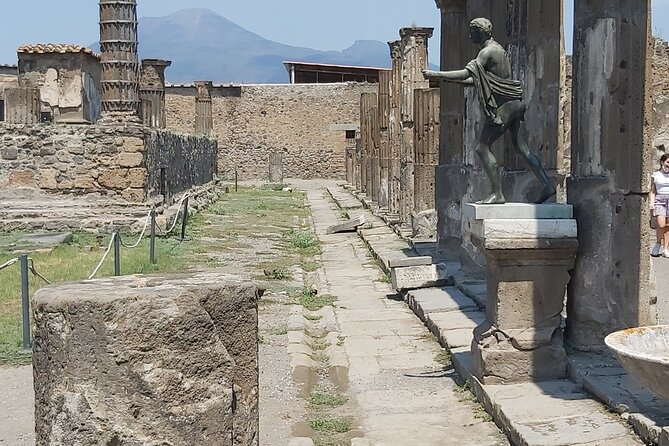
The tour then reaches Via dell’Abbondanza, Pompeii’s famous main street. The guide uses the road network to explain the city plan, rather than treating each building as an isolated ruin.
This is a valuable moment to look down at the paving, sidewalks, entrances, and street layout. The route does not promise a full study of Pompeii’s roads, but the 10-minute explanation helps you understand how the city was organized and how people moved through it.
A good guide can make an urban plan feel practical. You learn to ask where a street leads, which buildings open onto it, and how public and private spaces meet. That context helps the later theater and bath stops make more sense.
Because the route is tightly timed, you should not expect to linger at every doorway along Via dell’Abbondanza. If street design interests you most, stay afterward and explore this area at your own pace.
The Teatro Grande and the Doric Temple
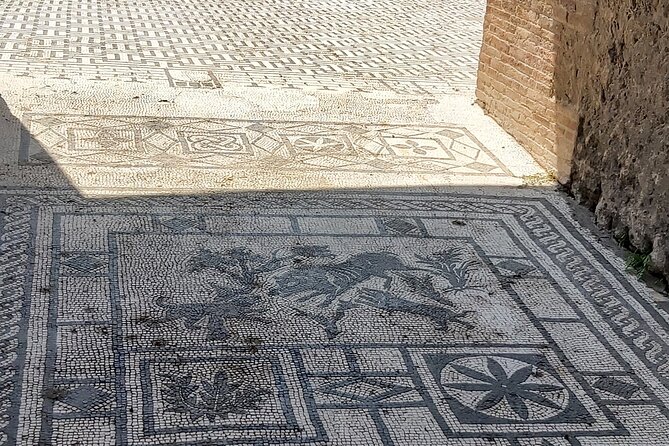
The Theater District includes the Teatro Grande, Teatro Piccolo, and Quadriportico dei Teatri. The tour spends about 10 minutes here, focusing on the theaters as a group.
The Teatro Grande is the main draw, but the smaller theater and the colonnaded space nearby help show how performance and public gathering worked in Pompeii. This is another place where scale matters. A photograph cannot fully explain how the buildings fit together, but a guide can point out their relationship.
You will not receive a long theatrical history in 10 minutes. Instead, expect a compact explanation of the district and its role in ancient entertainment. The short visit suits a first look, though theater fans may want to return alone.
The Doric Temple and Triangular Forum receive about five minutes. This is the shortest stop, but the site is important because the temple is described as Pompeii’s oldest. The Triangular Forum also adds an earlier layer to the city’s development.
Do not expect time for a detailed archaeological lecture here. The stop works as a quick reminder that Pompeii was built and rebuilt over many periods, rather than appearing all at once in the form preserved by the eruption.
Stabian Baths and the Lupanar
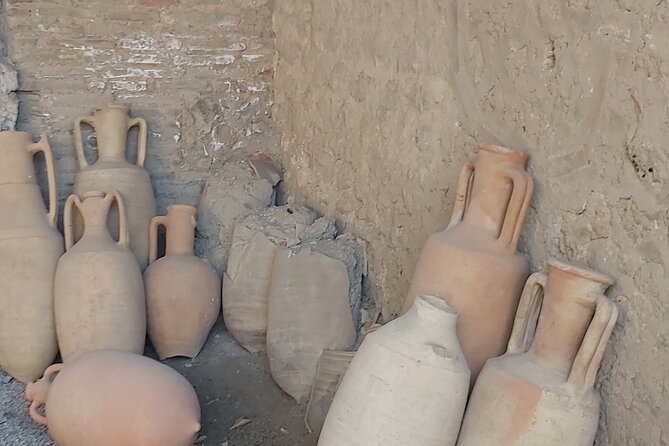
The Stabian Baths offer a close look at ancient bathing culture. The guide explains this important thermal complex in about 10 minutes.
Roman baths were not just places to wash. They were social and civic spaces, and the surviving rooms allow you to think about the routines that once filled them. The tour’s schedule gives you the basic structure and purpose, but anyone especially interested in Roman engineering or bathing customs may want extra time afterward.
The final stop is the Lupanar, Pompeii’s best-known brothel. You spend about 10 minutes seeing the small rooms and erotic frescoes, which are unusually well preserved.
This stop can attract plenty of attention, but it is more useful when placed in social context. Pina explains the building’s function and the role of commercial sex in the ancient city instead of treating the frescoes as a joke or novelty. The Lupanar is brief, direct, and likely to be one of the most memorable parts of the route.
The tour ends at the Forum. That is a practical finish because you can remain inside the excavations and see more on your own. You might use the remaining time to revisit the House of the Faun, spend longer with the casts and inscriptions, or follow Via dell’Abbondanza without a clock.
Is $42.01 good value for Pompeii?
The quoted cost is $42.01 per person, with a maximum group size of 15. Admission is not included, and neither are food, drinks, or a tip, so calculate the full cost before booking.
For a guided visit led by an archaeologist, the price can make sense if you want interpretation rather than simple access. Pompeii is large, and the tour covers a strong set of highlights in only two and a half hours. You are paying mainly for the route, explanations, and ability to ask questions.
The value is less clear if you want a slow photographic visit. Most stops last 10 or 15 minutes, and the schedule leaves little room to study every mosaic, inscription, or room. In that case, use this as your orientation, then stay inside and continue independently.
The maximum of 15 is another point in its favor. It is not the same as a private tour, but it should be easier to hear the guide and ask a question than in a very large group. The published feedback gives the experience a 5 out of 5 rating from 21 ratings, with full recommendation, and repeatedly emphasizes historical explanation and personal attention.
Pina also offers work around Naples and nearby archaeological sites, including Herculaneum, Oplontis, Stabiae, Paestum, and the National Archaeological Museum. Do not assume those places are part of this booking. They are separate options, but useful if you want to build a wider ancient-site program.
Practical details that affect your day
The meeting point is Pompei Scavi Villa Dei Misteri, at Via Villa dei Misteri, 80045 Pompei. The endpoint is the Pompeii Forum, where you may stay inside the site after the guided portion.
The experience is listed for Monday through Sunday from 9:00 AM to 7:30 PM during the stated operating period, from July 25, 2021 through November 25, 2026. Confirm the selected start time and current site conditions when booking.
The tour is offered in English, Italian, or German. Confirmation arrives at booking, and service animals are allowed. The site is near public transportation, and most people can take part, but expect extensive walking across ancient streets and uneven archaeological ground.
Book at least several weeks ahead if your schedule is fixed. The experience is booked an average of 44 days in advance, which suggests that popular dates can fill early.
You can cancel for a full refund up to 24 hours before the start time. The tour may also be canceled for poor weather or if the minimum number of participants is not reached, in which case you are offered another date or a full refund.
Who should book this Pompeii tour?
I would choose this tour if you are visiting Pompeii for the first time, want strong historical context, or find large ruins difficult to read without help. It also suits anyone who wants to connect public buildings with ordinary life instead of checking off only the most famous houses.
It is a particularly good match for curious adults, history students, and people interested in Roman society, architecture, religion, or archaeology. Pina’s teaching style, as described in the supplied information, is suited to people who like asking questions and want explanations that distinguish established evidence from changing interpretation.
I would hesitate if you already know Pompeii well or want to spend an entire day moving slowly through side streets. The route is efficient, but not leisurely. Also remember that the $42.01 price does not include site admission or a tip.
Should you book it?
Book this Pompeii tour if you want a well-planned introduction led by an archaeologist, especially if the Forum, House of the Faun, public baths, theaters, and everyday Roman life all interest you. The route covers an impressive range of subjects, and the chance to remain inside afterward adds useful flexibility.
Skip it if your main goal is independent exploration with no fixed pace. For most first visits, though, the cost is reasonable once you value the explanation, small group, and clear route. Bring water, wear comfortable shoes, and treat the final Forum stop as the beginning of your own second act rather than the end of your Pompeii visit.
FAQ
How long does the Pompeii archaeologist tour last?
The tour lasts approximately 2 hours and 30 minutes.
What language is the tour offered in?
The guided tour is offered in English, Italian, or German.
Who leads the Pompeii tour?
The experience provider is Pina Esposito, and the tour includes a guide or archaeologist.
What is the maximum group size?
The tour has a maximum of 15 participants.
Is the Pompeii entrance ticket included?
No. The entrance fee is not included in the tour price.
What else is not included?
Food, drinks, and tip are not included.
Where does the tour begin?
It begins at Pompei Scavi Villa Dei Misteri, 80045 Pompei, Metropolitan City of Naples, Italy.
Where does the tour end?
The guided tour ends at the Pompeii Forum on Via Villa dei Misteri.
Can I remain inside Pompeii after the tour?
Yes. You can stay inside the excavations after the guided portion and explore more on your own.
What is the cancellation policy?
You can cancel at least 24 hours before the start time for a full refund. Cancellations or changes made less than 24 hours before the start time are not refunded or accepted.
Newest reviews from Pompeii Ruins
- Private Tour Pompeii and Winery★ 5.0 · 4 reviews
- Visit the Pompeii ruins from Salerno with Pizza Lunch★ 5.0 · 4 reviews
- Pompeii Private Tour for Kids and Their Families★ 4.8 · 4 reviews
- From Sorrento: Pompeii & Vesuvius tour small group★ 4.8 · 4 reviews
- Pompeii Sorrento and Positano Tour★ 5.0 · 4 reviews
- From Naples_ Pompeii Tour_Skip the line ticket + audioguide★ 4.3 · 4 reviews
- Pompeii Private Half-Day Tour from: Naples,Sorrento, Amalfi Coast★ 5.0 · 4 reviews
- Pompeii, skip-the-line ticket with smartphone audio guide on App★ 3.0 · 4 reviews
Archaeologist-Led Tours, compared.

Entry Ticket and Guided Tour with an Archaeologist
Read our review →
Pompeii Small Group Tour with an Archaeologist
Read our review →
Pompeii and Herculaneum Small Group Tour with an Archaeologist
Read our review →
Skip the Line Guided Tour of Pompeii led by an Archaeologist
Read our review →
Exclusive Tour with Archaeologist and Entry Tickets
Read our review →
Pompeii Private Tour with an Archaeologist and Skip The Line – 3 hours
Read our review →
Pompeii Skip-the-line Tour with Archaeologist Guide
Read our review →Browse the lists this tour appears in