
Reviewed · ARCHAEOLOGIST-LED TOURS
Pompeii Private Tour with an Archaeologist Guide
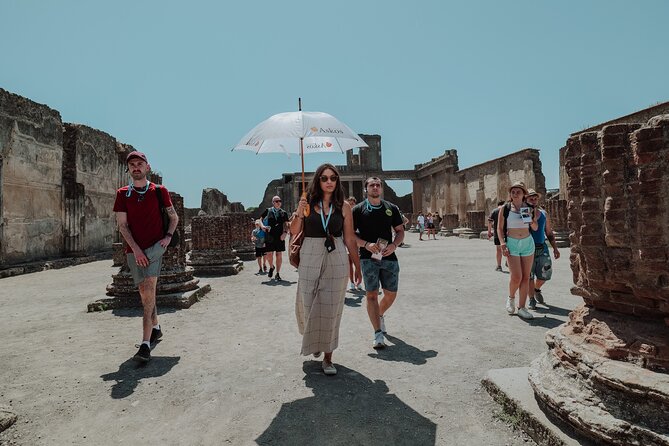
Pompeii makes far more sense when someone helps you read its streets, homes, shops, and public spaces. This private tour uses an archaeologist guide to turn scattered walls and faded paintings into a picture of daily Roman life, from fast-food counters to grand reception rooms.
I like the one-on-one attention and the chance to ask questions without holding up a large group. I also like the route’s mix of major sights and small details, especially the thermopolium, House of Menander, and Stabian Baths.
The main drawback is time. Two hours gives you a useful introduction, but Pompeii is enormous, and the tour price of $178.45 per person does not include the park entrance ticket. For a fuller visit, plan extra time after the guide leaves.
In This Review
- Key points at a glance
- Why a private guide changes Pompeii
- Meeting at Porta Marina Superiore
- House of the Vettii and Pompeii’s wealthy homes
- The Lupanar and Roman everyday life
- Theater, baths, and public Pompeii
- Via dell’Abbondanza and the commercial street
- Macellum, granaries, and the Forum
- What two hours can and cannot do
- Guide quality and the human side of the tour
- Price, timing, and practical value
- Who should book this Pompeii tour?
- Should you book it?
- FAQ
- How long does the Pompeii private tour last?
- What sights are included on the route?
- Is the Pompeii entrance ticket included?
- Where does the tour meet?
- How will I recognize the guide?
- Is transportation included?
- Is this a group tour?
- What should I wear for Pompeii?
Key points at a glance
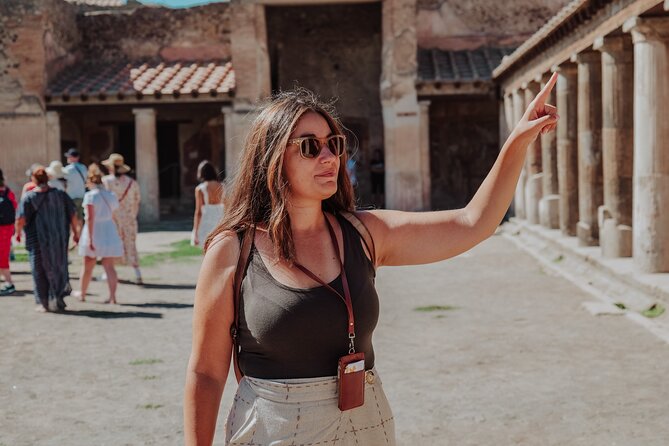
- An archaeologist leads your private group: Guides including Rossana, Paolo, Mena, Jolanta, and Silvia have been praised for making ancient life clear and engaging.
- The route covers Pompeii’s essential core: You visit the Forum, House of the Faun, Lupanar, theaters, baths, shops, homes, and a Roman market.
- Two hours is a focused introduction: The pace suits a half-day visit, but you will want more time if you hope to explore beyond the main route.
- Entrance is not included: The tour price covers the guide and private service only. A separate Pompeii admission ticket is required.
- A private format helps with families and mobility needs: Guides can slow down, find places to rest, and keep children involved.
- Wear proper walking shoes: Uneven ancient paving makes closed shoes a much better choice than flip-flops.
Why a private guide changes Pompeii
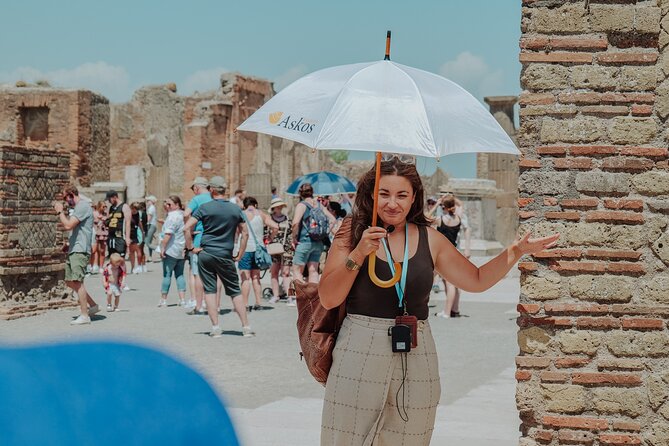
Pompeii is not a tidy museum with objects arranged behind glass. It is a vast ancient city, and much of what you see is incomplete, weathered, or difficult to interpret without context. A private archaeologist guide gives you a way into the site.
You will hear not only what a building was called, but how it may have worked. A house becomes a place for business, meals, clients, servants, and family life. A shop counter becomes evidence of how people bought prepared food. A public bath becomes part of the rhythm of an ordinary Roman day.
The private format matters most when you have questions. You can pause over a painting, ask about construction methods, or compare Roman customs with modern life without waiting for a group to move along.
Guides named in the tour feedback include Rossana, Mena, Jolanta, Paolo, Mimma, Silvia, Michele, Vito, Antonella, Julia, Sara, Sarah, Laura, and others. The strongest pattern is clear: the guide’s personality matters as much as the subject. Paolo is noted for helping visitors picture ancient life, while Julia used modern comparisons to make social history easier to grasp. Mena kept children involved, and Ivan adjusted the pace for a visitor with a broken foot.
That flexibility is hard to get on a large group tour.
More Pompeii excavation visits:
- Pompeii: Entry Ticket and Guided Tour with an Archaeologist
★ 4.8 · 19,459 reviews - Pompeii: Entry Ticket with Optional Audio Guide
★ 4.2 · 12,360 reviews - Pompeii: Small Group Tour with an Archaeologist
★ 4.8 · 12,264 reviews
Meeting at Porta Marina Superiore
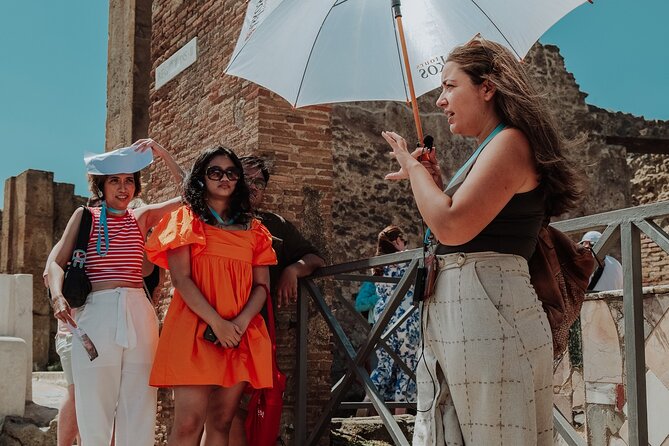
You meet at the main entrance to Pompeii’s archaeological area, at Via Villa dei Misteri 1. The guide meets you at Porta Marina Superiore and holds an Askos Tours sign.
The meeting point is useful because the entrance is also the natural starting place for a first visit. Still, pay attention to the wording of your booking: the guide service does not include your entrance ticket. The tour description says admission is separate, and one visitor reported paying about €20 per person at the park.
That extra cost is not a minor detail when you are comparing prices. At $178.45 per person, this is a premium experience for a private two-hour guide. The value depends on your group size and priorities. For two people, the price can feel steep. For a family or small group splitting the guide cost, it becomes easier to justify.
The guide also leaves you at the ruins rather than escorting you back to a hotel or station. You can ask for directions to nearby accommodation or the closest train station, but transportation is not part of the service.
House of the Vettii and Pompeii’s wealthy homes
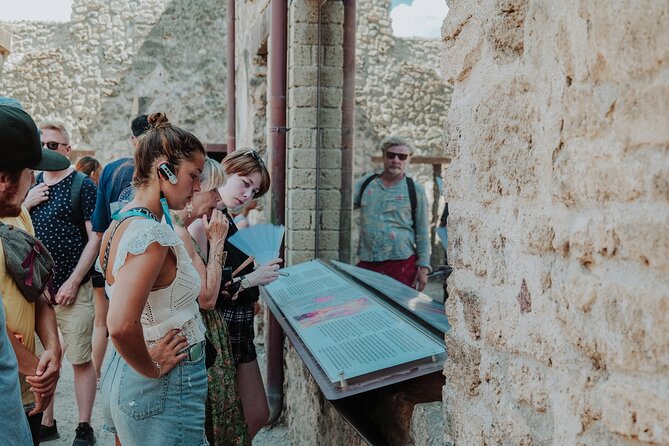
The House of the Vettii offers an early look at Pompeii’s upper-class domestic world. You can expect to see the layout of a grand private home, along with decorative details that help show how status was displayed.
This is where an archaeologist guide earns the fee. Walls and rooms alone do not tell you how the house functioned. Your guide can explain how Roman homes used courtyards, reception areas, painted decoration, and household spaces.
The tour also visits the House of the Faun, one of Pompeii’s most famous residences. Its scale and decoration give you a sense of wealth and ambition in the city. It is not simply a pretty ruin. The house helps you compare the lives of prosperous residents with the smaller shops and homes along the streets.
The House of Menander adds another useful point of comparison. Together, these residences show that Pompeii was not socially uniform. There were elite homes, commercial spaces, public buildings, and working streets packed into the same city.
The Lupanar and Roman everyday life
The Lupanar is one of Pompeii’s most discussed stops. Its small rooms and wall paintings have made it famous, but the value of seeing it with a guide is the chance to place it within the wider city.
Your guide can separate what is directly visible from what is interpretation. That matters at Pompeii, where some details are well documented and others require careful explanation. The best guides use the site to discuss social life without turning the visit into a string of sensational anecdotes.
The route then moves to the House and Thermopolium of Vetutius Placidus. A thermopolium was a food shop with a built-in counter, a Roman version of a convenient prepared-food stop. This is one of the most memorable places on the tour because it makes daily life feel close at hand.
A guide can point out how the shop was arranged and explain what it suggests about eating habits and commerce. One particularly useful theme in the tour feedback is the comparison between ancient Pompeii and modern society. Some basic needs and business patterns have changed less than you might expect.
More tours led by an archaeologist:
- Pompeii Small Group Tour with an Archaeologist
★ 5.0 · 6,593 reviews - Pompeii and Herculaneum Small Group Tour with an Archaeologist
★ 5.0 · 1,350 reviews - Skip the Line Guided Tour of Pompeii led by an Archaeologist
★ 5.0 · 703 reviews - Pompeii: Exclusive Tour with Archaeologist and Entry Tickets
★ 4.9 · 634 reviews
Theater, baths, and public Pompeii
The Teatro Grande is a brief stop, but it adds an important public dimension to the visit. Pompeii was not only a city of houses and shops. It had entertainment, civic spaces, and institutions that brought people together.
The Stabian Baths provide an even better look at public life. Roman baths were places for washing, exercise, conversation, and routine social contact. The surviving rooms and structures are easier to understand when your guide explains how the complex was used.
The Forum Baths offer a second look at bathing culture and help you compare different parts of the city. Seeing both the Stabian Baths and Forum Baths also shows how the site’s public buildings fit into separate neighborhood patterns.
You should expect to walk over uneven stone surfaces throughout this part of the visit. Closed shoes are strongly recommended. Flip-flops can be awkward and unsafe on the ancient streets, particularly if you are trying to keep up with a guide while watching your footing.
The tour is workable for most people, but Pompeii is not a smooth, modern attraction. If you need a slower pace, say so at the start. The private format makes this much easier than a fixed group schedule.
Via dell’Abbondanza and the commercial street
Via dell’Abbondanza is one of Pompeii’s most useful streets for understanding how the city worked. Walking along it links the separate monuments into a real urban setting.
Look for the relationship between homes, shops, public buildings, and the roadway. The street is not just a path between attractions. It helps you imagine where people moved, traded, met, and conducted business.
This is also a good place for questions. You might ask how archaeologists identify a shop, how streets were used, or what signs of daily activity remain. A private guide can follow your curiosity instead of giving the same fixed speech to everyone.
The street can be crowded, depending on the time of day. Several guides are praised for moving efficiently through busy areas and choosing quieter spots for explanations. That does not mean you will avoid every crowd, but it can save time and make the stops more comfortable.
Macellum, granaries, and the Forum
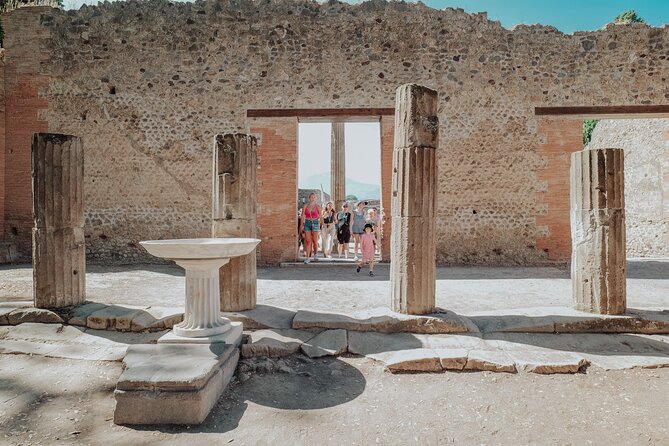
The Macellum was a market building, and it gives the route another practical side of city life. Its position near the Forum helps show how commerce and civic activity overlapped.
The Granaries of the Forum are now used to display archaeological material, including objects connected with Pompeii’s public and commercial life. The stop can feel less immediately dramatic than a decorated house, but it adds substance to the visit. It helps you think about storage, trade, food, and the work needed to support a city.
The Forum is the grand finish. This broad civic center brings together many of the themes from the earlier stops: politics, religion, commerce, public movement, and social status.
I like reaching the Forum after seeing the smaller pieces of Pompeii. You have already looked at a private house, a food counter, a bath complex, a theater, and a street. The Forum then feels less like an isolated field of columns and more like the center of a functioning city.
You may also get views connected with Mount Vesuvius from parts of the site. The contrast between the peaceful setting and the story of the eruption is one of Pompeii’s most powerful features.
What two hours can and cannot do
The planned stops are short, generally around five or ten minutes each. That keeps the route moving and allows you to cover a wide range of Pompeii, but it also means some visits will be introductions rather than long examinations.
Two hours works well if you have limited time or want a strong orientation before exploring alone. One visitor with only half a day found this format especially useful. Another wished for at least four hours because the site is so large.
I would think of the tour as a guided core route, not a complete Pompeii visit. Afterward, you can continue on your own if your ticket and schedule allow. The guide leaves you inside the ruins and can suggest other areas worth seeing.
Families may find the two-hour length helpful. It is long enough to hold attention but short enough to avoid turning the day into an endurance test. A private guide can also adjust explanations for teenagers and children instead of assuming every person wants the same level of detail.
For adults who enjoy archaeology, two hours may feel too brief. If you want to study frescoes, compare house plans, or wander far beyond the central route, look for a longer private option or plan independent time afterward.
Guide quality and the human side of the tour
The most important part of this experience is the person holding the Askos Tours sign. The tour is built around the guide, and the strongest experiences come from guides who combine solid archaeological training with clear storytelling.
Michele is described as an archaeologist who made the visit memorable. Vito connected the ruins to the way people lived, while Antonella encouraged visitors to think like archaeologists. Those are valuable habits at Pompeii. Instead of simply receiving answers, you start noticing clues.
The best guides also know when to stop talking. A private tour should leave room for your questions and for simply looking. Several guides are praised for waiting until the whole group was ready before explaining a site, which helps prevent the experience from becoming a rushed walk.
Communication before the tour is another practical plus. Messages and texts are used to help coordinate the meeting, though you should still read the booking details carefully, especially the statement that admission is separate.
One three-star experience points to a possible weakness: a guide may be informative but not always communicate with equal ease. That appears to be an exception among the supplied feedback, but it is worth keeping in mind. A private tour costs more precisely because clear communication is central to its value.
Price, timing, and practical value
The listed cost is $178.45 per person, with group discounts available. The price includes an archaeologist guide and private service, but not the Pompeii entrance ticket or transportation.
For a couple, that is a substantial outlay, especially after adding admission. You are paying for personal attention, route planning, and the ability to shape the experience around your interests. If you would otherwise spend hours trying to identify buildings from a map, the guide can save time and prevent Pompeii from becoming a blur of stones.
For a family or group, the economics are better because the private guide cost can be shared. It is also a strong choice when members of your group have different needs. You can slow down for someone with limited mobility, stop for rests, or keep children engaged with questions and stories.
The experience is offered in English. Confirmation arrives at booking, service animals are allowed, and the site is near public transportation. Most people can take part, but you should be ready for outdoor walking and uneven paving.
Free cancellation is available if you cancel at least 24 hours before the start time. Changes or cancellations made inside that window are not accepted for a refund, and the cut-off follows local time.
Who should book this Pompeii tour?
I would choose this tour if Pompeii is important to you but your time is limited. It is also a smart pick for first-time visitors who want the ancient city to make sense rather than simply collect photographs.
Families should consider it because a private guide can adapt the pace and keep younger visitors involved. History fans will appreciate the chance to ask detailed questions. The tour also suits anyone who feels uneasy navigating a huge archaeological site alone.
I would hesitate if you want four or more hours of guided exploration, or if your main goal is to visit every corner of Pompeii. In that case, two hours may leave you wishing for more. You should also compare the total cost after adding admission.
Should you book it?
Book this private Pompeii tour if you want a focused introduction led by an archaeologist and value personal attention over the lowest price. The route covers the major civic, domestic, commercial, and leisure spaces, while guides such as Rossana, Paolo, Mena, and Jolanta bring the ruins closer to everyday life.
Skip it if you are happy studying maps and signs on your own, or if you want a long full-site visit with no time pressure. For most first visits, though, the private format is a sensible way to get your bearings, ask real questions, and leave with a clearer picture of the city than the ruins alone can provide.
FAQ
How long does the Pompeii private tour last?
The tour lasts approximately two hours.
What sights are included on the route?
The route includes the House of the Vettii, Lupanar, Thermopolium of Vetutius Placidus, Teatro Grande, House of the Faun, Stabian Baths, Via dell’Abbondanza, Forum Baths, Macellum, House of Menander, Granaries of the Forum, and Pompeii’s Forum.
Is the Pompeii entrance ticket included?
No. The Pompeii entrance ticket is not included in the tour price and must be purchased separately.
Where does the tour meet?
You meet at Porta Marina Superiore, the main entrance to the archaeological site, at Via Villa dei Misteri 1 in Pompeii.
How will I recognize the guide?
The guide will hold a sign with the Askos Tours company name at the top.
Is transportation included?
No. Transportation is not included. The guide can provide useful information about returning to your accommodation or reaching the closest train station.
Is this a group tour?
No. This is a private activity, so only your group participates.
What should I wear for Pompeii?
Closed shoes are recommended because the ancient streets and ruins can be difficult to walk through in flip-flops.
Newest reviews from Pompeii Ruins
- Private Tour Pompeii and Winery★ 5.0 · 4 reviews
- Visit the Pompeii ruins from Salerno with Pizza Lunch★ 5.0 · 4 reviews
- Pompeii Private Tour for Kids and Their Families★ 4.8 · 4 reviews
- From Sorrento: Pompeii & Vesuvius tour small group★ 4.8 · 4 reviews
- Pompeii Sorrento and Positano Tour★ 5.0 · 4 reviews
- From Naples_ Pompeii Tour_Skip the line ticket + audioguide★ 4.3 · 4 reviews
- Pompeii Private Half-Day Tour from: Naples,Sorrento, Amalfi Coast★ 5.0 · 4 reviews
- Pompeii, skip-the-line ticket with smartphone audio guide on App★ 3.0 · 4 reviews
Archaeologist-Led Tours, compared.

Entry Ticket and Guided Tour with an Archaeologist
Read our review →
Pompeii Small Group Tour with an Archaeologist
Read our review →
Pompeii and Herculaneum Small Group Tour with an Archaeologist
Read our review →
Skip the Line Guided Tour of Pompeii led by an Archaeologist
Read our review →
Exclusive Tour with Archaeologist and Entry Tickets
Read our review →
Pompeii Private Tour with an Archaeologist and Skip The Line – 3 hours
Read our review →
Pompeii Skip-the-line Tour with Archaeologist Guide
Read our review →Browse the lists this tour appears in