
Reviewed · TICKETS
Pompeii & Herculaneum Family Adventure | Guide+Transport+Tickets
Herculaneum may be the surprise star of this full day. Its volcanic burial preserved wooden doors, furniture, painted walls, mosaics, and even a Roman boat, giving you a close look at ancient life that Pompeii’s ash-covered streets cannot always provide.
I like the private guide and vehicle, which let you set a family-friendly pace and arrange pickup from a hotel, port, station, airport, or vacation rental. I also like the smart pairing of Herculaneum first and Pompeii second: the smaller site helps children understand Roman homes before they face Pompeii’s enormous scale.
The main consideration is the price, $738.31 per person. That is a serious outlay, even with tickets and transport included, and both sites require several hours of walking in the sun. Families wanting a relaxed, tailored day will get the most value.
In This Review
- Key points to know before booking
- Why Herculaneum deserves the first half of your day
- Boats, carbonized wood, and the human story
- Herculaneum homes that still feel domestic
- Shops, baths, schools, and Roman routines
- The move to Pompeii and the afternoon advantage
- Entering through Porta Marina and reaching the Forum
- Markets, baths, and the practical Pompeii
- Streets, city blocks, and the theater
- What the private format is really worth
- Who will enjoy this day most
- Should you book Pompeii and Herculaneum together?
- FAQ
- How long does the experience last?
- Which sites are included?
- Is transport included?
- Are entrance tickets included?
- Can the tour pick me up from a hotel or cruise port?
- Does the tour go to the top of Mt. Vesuvius?
- Is lunch included?
Key points to know before booking
- Herculaneum preserves the details Pompeii often loses: Look for carbonized wood, upper floors, doors, furniture, mosaics, and the ancient boat pavilion.
- The day covers two major archaeological parks: You receive about two and a half hours at Herculaneum and two and a half hours at Pompeii, with transport between them.
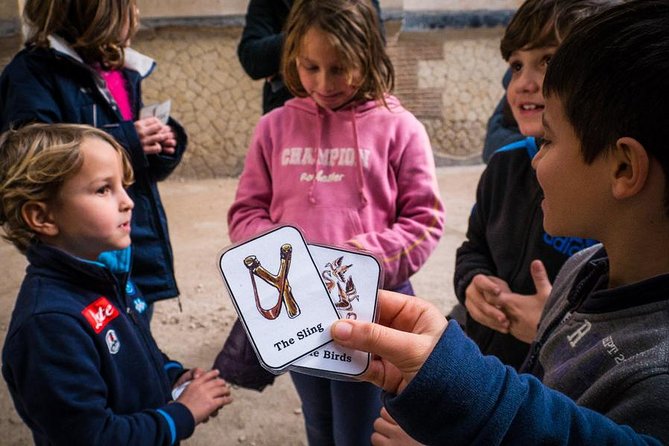
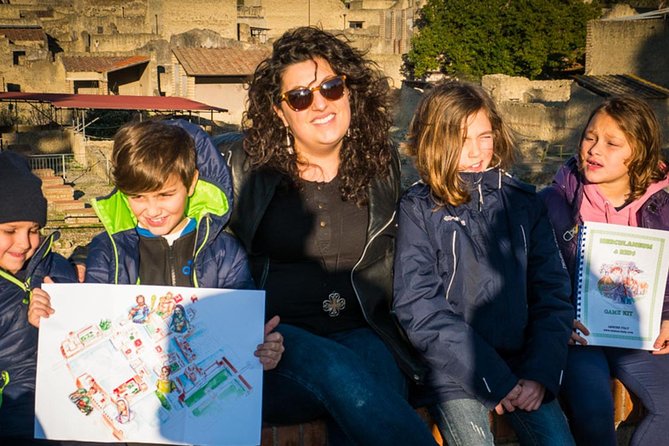
- A private guide keeps the history usable for children: Riddles, maps, stickers, and observation activities turn streets and houses into a hands-on lesson.
- Pickup is flexible: The private vehicle can collect you in Naples, Sorrento, Pompeii, and other stated locations, including hotels, ports, airports, train stations, and vacation rentals.
- Giuseppe D’Angelo is a name worth requesting: He is specifically praised for being kind, thoughtful, and well informed.
- The volcano is viewed from below: The tour does not drive you to the summit of Mt. Vesuvius.
Why Herculaneum deserves the first half of your day
Pompeii gets the fame, but Herculaneum often makes the sharper first impression. The two towns were destroyed in the eruption of 79 AD, yet the volcanic material treated them differently.
Pompeii was covered mainly by ash and pumice. Herculaneum was struck by a superheated surge that sealed buildings quickly. That heat carbonized wood instead of simply destroying it, and the burial protected upper floors, shutters, beams, shelves, and household objects.
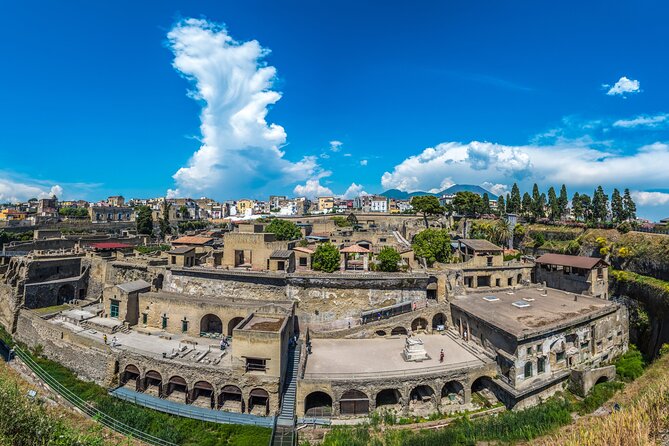
You begin with about two and a half hours inside the Archaeological Park of Herculaneum. A private Blue Badge guide can help you read the site as a town, not just as a collection of ruins. You will see where people lived, shopped, bathed, trained, worshiped, and waited for escape.
The compact size matters with children. You can cover important parts of the town without the same sense of endless distance that Pompeii can create. You will still walk on uneven ancient streets, but the experience is easier to hold together.
More Pompeii excavation visits:
- Pompeii: Entry Ticket and Guided Tour with an Archaeologist
★ 4.8 · 19,459 reviews - Pompeii: Entry Ticket with Optional Audio Guide
★ 4.2 · 12,360 reviews - Pompeii: Small Group Tour with an Archaeologist
★ 4.8 · 12,264 reviews
Boats, carbonized wood, and the human story
The Boat Pavilion gives Herculaneum a strong sense of place. It contains a Roman vessel and maritime equipment, reminders that this was a port town connected to movement across the Bay of Naples. Children can picture fishermen and sailors preparing to leave, while you get a clearer idea of how trade shaped daily life.
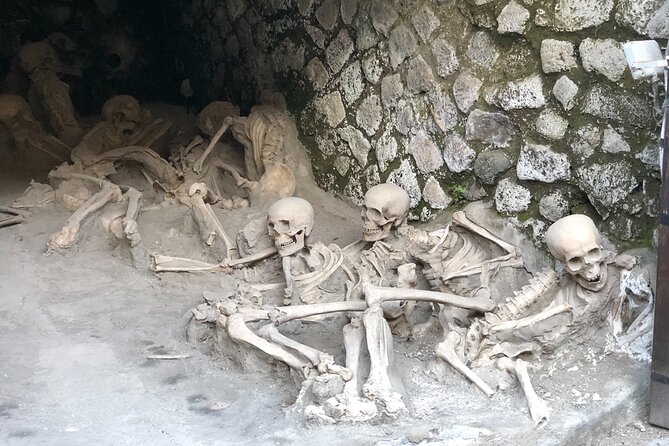
The ancient shoreline brings a more difficult part of the story. Archaeologists found more than 300 skeletons in the boathouses in 1980. Men, women, and children had gathered there while seeking escape by sea.
This stop is not light entertainment, and it should not be rushed. A private guide can explain the discovery in a measured way, giving your family time to absorb what happened. For older children and adults, it gives the eruption a human scale. You are no longer looking only at walls and mosaics.
Inside the Antiquarium, you will see objects that rarely survive at archaeological sites. Carbonized pieces of furniture, doors, beams, and shelving show how volcanic conditions preserved ordinary materials. This is one of the best places to help children understand that archaeology is not only about statues and temples. A shelf or wooden door can reveal just as much about home life.
Herculaneum homes that still feel domestic
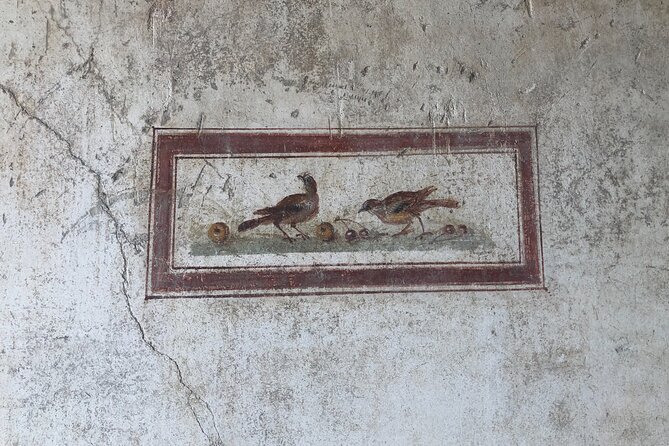
Several houses make Herculaneum unusually easy to picture. The House of the Deer shows how wealthy residents used terraces, gardens, art, and sea views to display comfort and status. Its marble sculptures of deer attacked by dogs add a dramatic focal point that children can recognize at once.
The House of the Telephus Relief offers another look at a large Roman residence. Preserved wall paintings, wooden shutters, and upper-floor structures make it possible to imagine a home with more than one level. The restoration work also gives you a useful reminder: what you see is both ancient material and the result of careful modern protection.
The House of Neptune and Amphitrite is especially memorable for its mosaic panel. Deep blue and golden glass tesserae create a scene of Neptune and Amphitrite, while the dining area, painted walls, and fountain niche show how Roman families used decoration to impress visitors.
I find these homes more useful than a long list of names. Your guide can connect a mosaic to dining, a shutter to privacy, and a garden to social status. Children can search for colors and figures while you consider how much effort went into making a Roman house feel comfortable and important.
Shops, baths, schools, and Roman routines
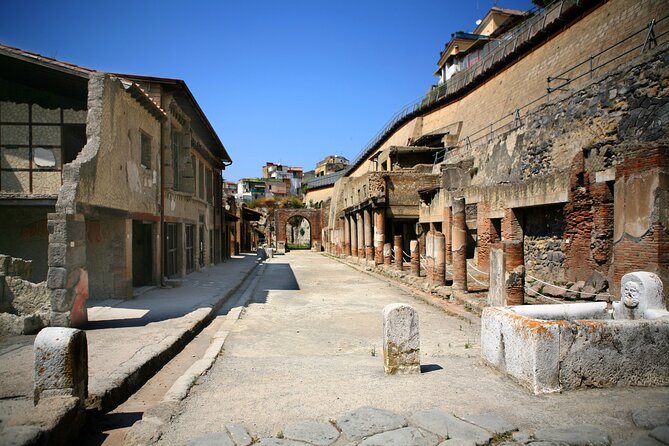
The ancient shop with terracotta jars set into a marble counter is a simple but effective stop. It functioned much like a food and drink counter. The original shelving and storage features help you picture quick purchases and everyday commerce instead of imagining the town as a silent residential quarter.
The women’s section of the public baths is another detailed space. You will see benches, painted walls, wooden shelving, a changing room, and warm and hot rooms. Your guide can explain that bathing involved hygiene, relaxation, conversation, and social contact.
For children, the easiest comparison is a mix of a modern spa and social club. For adults, the preserved fittings show how much routine and organization went into Roman public life.
The large exercise courtyard adds a civic angle. Young citizens trained there among porticoes and classrooms. It was not simply a sports field. Physical training, rhetoric, discipline, and public identity were tied together, especially for boys preparing for adult responsibilities.
The Hall of the Augustales shifts the focus to religion and politics. Mythological frescoes cover a space dedicated to the cult of the Emperor. Your guide can explain the role of the Augustales, a prestigious group of freedmen, and show how social rank, civic duty, and imperial loyalty overlapped.
These stops are valuable because they prevent the day from becoming a parade of famous houses. You see how people worked, washed, ate, trained, worshiped, and organized their community.
More Herculaneum excavation visits:
- Pompeii and Herculaneum Small Group Tour with an Archaeologist
★ 5.0 · 1,350 reviews - Pompeii: Small-Group Tour of Pompeii and Herculaneum
★ 4.8 · 867 reviews - Guided Day Tour of Pompeii and Herculaneum with Light Lunch
★ 4.5 · 311 reviews - Private Day Tour to Vesuvius, Herculaneum & Pompeii with Pick Up
★ 5.0 · 279 reviews
The move to Pompeii and the afternoon advantage
After Herculaneum, your private vehicle takes you to Pompeii. The precise timing can be adjusted around your preferences or a cruise schedule, and your guide may suggest the afternoon when the site is sometimes less crowded.
Pompeii is far larger than Herculaneum. It has temples, theaters, baths, bakeries, villas, shops, and long streets marked by cart tracks. That scale is thrilling, but it can also tire younger children. The value of a private guide is clear here: you can focus on the parts that fit your family instead of trying to cover every corner.
You receive about two and a half hours at Pompeii. That is enough for a strong introduction, not enough for every major building. You should see this as a carefully chosen route through the city, not a complete archaeological survey.
Entering through Porta Marina and reaching the Forum
Porta Marina is a good opening because it introduces Pompeii as a connected city. Merchants and sailors once came through this gateway from the port. Passing under the stone arch, you begin with movement, trade, and city walls before reaching the public center.
The Basilica shows Pompeii’s civic side. Legal disputes, contracts, and business dealings took place here. Even without its roof, the columns communicate the authority of the building and the importance of public business in Roman life.
The Temple of Apollo adds religion and a clear view toward Mt. Vesuvius. The volcano is not a distant abstraction here. You can see it from the site that it destroyed. The tour views Vesuvius from ground level and does not include a drive to the summit, so do not book this expecting a crater walk.
The Forum was Pompeii’s main public square. It brought together politics, trade, religion, and public ceremony. A good guide helps you read the surrounding buildings as parts of one civic system rather than as isolated ruins.
Markets, baths, and the practical Pompeii
At the Macellum, Pompeii’s main marketplace, marble counters and storage vessels help you imagine meat, fish, fruit, and imported foods being sold. It is easier for children to grasp an ancient city when they can connect a ruin with shopping and meals.
The Forum Baths offer another familiar comparison. You will pass through changing rooms and heated bathing spaces with surviving mosaics and stucco decoration. The baths were places to wash, relax, exercise, and exchange news. That mixture makes Roman life feel surprisingly close to your own.
The House of the Faun gives you the grandest look at elite Pompeii. Its gardens, mosaics, courtyards, dining rooms, and private rooms show how wealthy families displayed status. The small bronze dancing faun is an easy detail for children to spot, while the mosaic of Alexander the Great in battle gives adults a major example of Roman decorative taste.
The House of the Vettii brings the focus to frescoes and household presentation. Mythological scenes fill the rooms, and the garden courtyard helps you understand how houses were planned around light, decoration, and entertaining. Your guide can also explain how the Vettii brothers built wealth and used art to signal their place in society.
Streets, city blocks, and the theater
Walking along Pompeii’s busiest ancient street may be the most accessible part of the visit. You will see bakeries, bars, storefronts, fountains, counters, signs, and stepping stones. Children can imagine carts crossing the basalt pavement, while you notice how many daily errands took place at street level.
A raised platform gives you a view into a whole city block. With roofs gone, the rooms create a useful dollhouse effect. You can see how kitchens, workshops, courtyards, dining rooms, and sleeping areas fitted together in a dense urban plan.
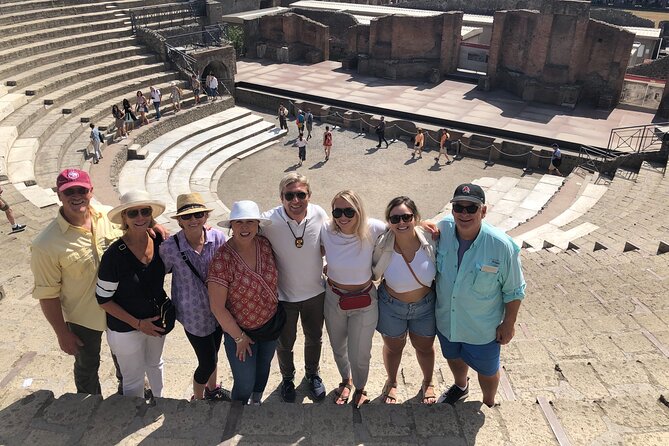
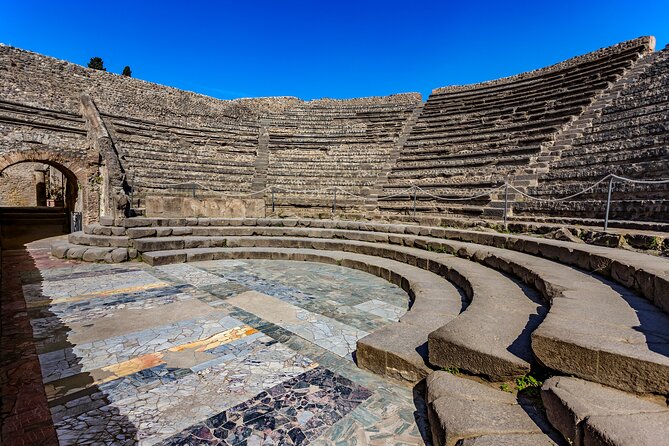
The main theater provides a welcome change of pace. It was built into a hillside to help carry sound, and your children can test the acoustics from the stage. The stone seating makes the setting tangible, while the guide explains how comedy, music, and public entertainment fit into Roman social life.
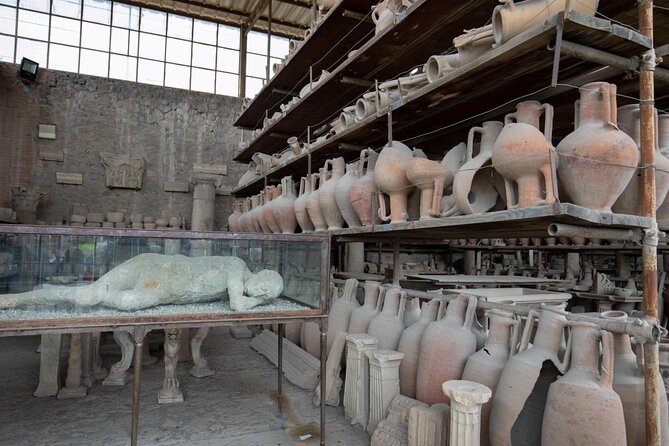
The Antiquarium closes the Pompeii visit with objects rather than buildings. Jewelry, coins, tools, and household goods connect the large ruins to individual lives. Plaster casts of eruption victims are presented as part of the human story, and the guide can handle this section with care if younger children are in your group.
What the private format is really worth
At $738.31 per person, this is not a budget excursion. Its value depends on how much you want control, explanation, and transport in one package.
You are paying for a private vehicle, a private Blue Badge guide at both sites, express skip-the-line tickets, and family materials including a booklet and map. Pickup can be arranged from several points around Naples and the Sorrento area, as well as from a cruise terminal, airport, station, hotel, or vacation rental.
That convenience matters if you are coordinating children, luggage, or a cruise timetable. It also avoids the stress of getting between two archaeological parks on your own. Meals are not included unless you select the pizza lunch option, and bottled water is not included, so bring your own supply.
The private format also lets the guide adjust the pace. You can spend more time on mosaics, shorten a difficult section, or use the family activities when attention starts to fade. A group tour may cost less, but it will not give your family the same control.
Giuseppe D’Angelo is specifically praised for his kindness, thoughtfulness, and well-informed guiding. If he is available, you can ask for him when booking, though guide assignment is not guaranteed by the tour details.
Who will enjoy this day most
I would choose this experience for families who want both Pompeii and Herculaneum without managing transport and tickets themselves. It is also a strong fit for cruise passengers who need flexible pickup and a private schedule.
Children benefit from the booklet, map, riddles, stickers, and object-spotting activities. Still, this is an eight-hour archaeological day, not a light sightseeing outing. Comfortable walking shoes, sun protection, and a moderate level of fitness are important.
Adults who want a broad introduction will appreciate the range: homes, shops, baths, temples, civic buildings, markets, theaters, and the shoreline. Visitors hoping to climb Mt. Vesuvius should choose a different excursion, since this day only views the volcano from below.
Free cancellation is available up to 24 hours before the start time. After that point, the amount paid is not refunded, and changes are not accepted. Confirmation is normally received at booking, though reservations made within one day of departure are subject to availability.
Should you book Pompeii and Herculaneum together?
Book it if you want a private, family-focused day with transport handled from start to finish. The combination works well because Herculaneum gives you intimate details, while Pompeii supplies the scale of a full Roman city.
Think twice if $738.31 per person strains your budget, if you want a slow visit at one site only, or if your main goal is reaching the top of Vesuvius. For families with limited time, a private guide such as Giuseppe D’Angelo, skip-the-line entry, flexible pickup, and child-focused activities can make the high price easier to justify.
FAQ
How long does the experience last?
The tour lasts approximately eight hours.
Which sites are included?
The experience includes the Archaeological Park of Herculaneum and the Archaeological Park of Pompeii.
Is transport included?
Yes. Transport is provided by private vehicle.
Are entrance tickets included?
Yes. Herculaneum and Pompeii Express skip-the-line tickets are included.
Can the tour pick me up from a hotel or cruise port?
Yes. Pickup can be arranged from hotels, vacation rentals, train stations, airports, cruise terminals, and ports in places such as Naples, Sorrento, and Pompeii. You should provide your pickup location when booking.
Does the tour go to the top of Mt. Vesuvius?
No. You will view the volcano from below at Pompeii and Herculaneum, but the vehicle does not drive to the summit.
Is lunch included?
Lunch is included only if you select the pizza lunch option. Bottled water is not included.
Newest reviews from Pompeii Ruins
- Private Tour Pompeii and Winery★ 5.0 · 4 reviews
- Visit the Pompeii ruins from Salerno with Pizza Lunch★ 5.0 · 4 reviews
- Pompeii Private Tour for Kids and Their Families★ 4.8 · 4 reviews
- From Sorrento: Pompeii & Vesuvius tour small group★ 4.8 · 4 reviews
- Pompeii Sorrento and Positano Tour★ 5.0 · 4 reviews
- From Naples_ Pompeii Tour_Skip the line ticket + audioguide★ 4.3 · 4 reviews
- Pompeii Private Half-Day Tour from: Naples,Sorrento, Amalfi Coast★ 5.0 · 4 reviews
- Pompeii, skip-the-line ticket with smartphone audio guide on App★ 3.0 · 4 reviews
Tickets, compared.

Entry Ticket and Guided Tour with an Archaeologist
Read our review →

Skip-the-Line Entrance Ticket with Audio Guide
Read our review →
Archaeological Park Tour with Ticket on request
Read our review →


Skip-the-Line Entry Ticket with Digital Guide App
Read our review →
Pompeii Ticket + Tour with Optional Tasting Experience at Pompeii
Read our review →Browse the lists this tour appears in