Reviewed · TICKETS
Pompeii: Family-Friendly Augmented Reality Tour with Ticket
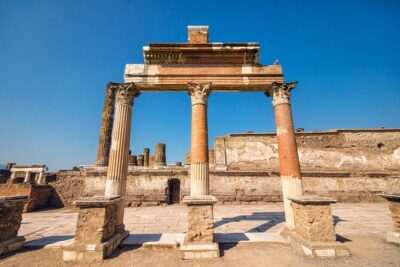
Pompeii looks impressive as a ruin, but the AR glasses aim to show you what is missing: painted walls, complete buildings, busy public spaces, and daily life before the eruption of 79 A.D. The images overlap the surviving stones, so you can compare ancient Pompeii with the site in front of you. That visual comparison is the tour’s main appeal.
I like the family focus and the choice of languages. Children age 8 and up get a more active way to read the ruins, while adults can listen to detailed commentary in English, French, Italian, Spanish, German, or Portuguese. I also like that an assistant stays with the group instead of simply handing over the glasses and sending you off.
The main caution is that the technology may not match every visitor’s expectations. One published rating described the meeting point as hard to find and felt the experience was closer to virtual reality than true augmented reality, with weak execution. You’ll need to arrive early, follow the directions carefully, and book this for the visual layer, not as a replacement for seeing Pompeii directly.
In This Review
- Key points at a glance
- Seeing Pompeii with the missing pieces restored
- Meeting at Porta Marina Inferiore
- What the two-hour route shows you
- Temples and religious spaces
- Houses and domestic life
- Squares and public buildings
- Theaters
- Other important buildings
- How the glasses and audio guide work together
- Is $52.38 a fair price?
- Who should book this Pompeii tour?
- Practical tips for a smoother visit
- Should you book it?
- FAQ
- Where does the Pompeii AR tour start?
- How long does the experience last?
- What languages are available?
- Are children allowed to use the AR glasses?
- Is the Villa dei Misteri included?
- Can I wear the glasses over my normal eyeglasses?
- Is the tour suitable for wheelchair users?
- What should I bring?
Key points at a glance
- Holograms over real ruins: The glasses show reconstructed temples, houses, theaters, squares, and other buildings while you look at their remains.
- Built for children age 8 and up: The technology gives younger visitors a clear reason to look closely at the stones and streets.
- Two-hour small-group walk: The assistant guides the route and helps with the equipment throughout the visit.
- Six audio-guide languages: Commentary is available in English, French, Italian, Spanish, German, and Portuguese.
- Easy-to-find-in-theory meeting point: Meet at Vittoria coffee shop in Piazza Esedra, beside the Porta Marina Inferiore entrance, with an assistant holding an AR Tour sign.
- You can stay afterward: Once you return the glasses, you may remain in the archaeological park and continue exploring independently.
Seeing Pompeii with the missing pieces restored
Pompeii can be hard to read at first. You walk past low walls, broken columns, open courtyards, and fragments of decoration, then try to picture the finished building. The AR system tackles that problem by placing digital reconstructions over the physical remains.
You look through the glasses at the site as it exists today, while holographic images show how important spaces may have appeared before the eruption. That means you do not have to rely only on your imagination to understand the scale and purpose of a temple, house, theater, or public square.
This is especially useful for families. A child may not care much about a weathered wall, but a reconstructed building gives that wall a job. The glasses can help connect the surviving foundation with the home, shop, religious building, or public place it once supported.
The tour is not presented as a free-roaming gadget experience. An assistant welcomes you, explains the route, shows you how to use the glasses, and remains with the group. That support matters because new equipment can slow down a visit if nobody explains what to do when the image does not line up or the audio needs adjusting.
The reconstructions were developed with archaeologists and other experts. That does not mean every digital image should be treated as absolute fact, but it does give the presentation a stronger basis than a purely decorative computer graphic. You are being shown an interpretation tied to archaeological work.
More Pompeii excavation visits:
- Pompeii: Entry Ticket and Guided Tour with an Archaeologist
★ 4.8 · 19,459 reviews - Pompeii: Small Group Tour with an Archaeologist
★ 4.8 · 12,264 reviews - Pompeii: Skip-the-Line Entrance Ticket with Audio Guide
★ 4.0 · 2,509 reviews
Meeting at Porta Marina Inferiore
Your meeting point is Vittoria coffee shop in Piazza Esedra, next to the Porta Marina Inferiore entrance. The tour assistant should be holding a sign marked AR Tour. This is a useful landmark, but do not treat it as a place to find at the last second.
One published rating specifically called the meeting point difficult to locate. I would arrive with enough time to look for the coffee shop, identify the correct entrance, and find the assistant before the scheduled start. The late-arrival rule is strict: the group will wait for a maximum of five minutes.
At check-in, the assistant provides the AR glasses and explains the route. Tickets are issued in each participant’s full name, so your booking must include every person’s first and last name. If you book a reduced fare for an EU citizen aged 18 to 24 or a youth ticket, bring a valid identity document or passport. Without proof, you may be asked to pay the full fare.
The tour begins and ends at the same meeting point. Hotel pickup, hotel drop-off, food, and drinks are not included, so plan your route to Piazza Esedra on your own.
What the two-hour route shows you
The supplied itinerary does not promise a fixed list of named houses or temples, and stops can change. Instead, the route focuses on Pompeii’s most significant public and private buildings. You should expect a walking tour through the main archaeological setting, with the glasses used to compare present-day remains with pre-eruption reconstructions.
Temples and religious spaces
Temples are often difficult to understand from foundations and scattered columns alone. The AR images can help you see the original volume of the building and how it related to the surrounding public area.
The audio guide adds the basic explanation while the assistant keeps the group moving. If you are using the glasses, try not to stare only at the reconstruction. Look back and forth between the digital image and the actual stones. The value comes from the comparison, not from the hologram by itself.
More Pompei Campania tours worth comparing
- Pompeii: Skip-the-line-Ticket and Guided Tour
★ 4.6 · 1,152 reviews - Pompeii: Skip-the-Line Entry Ticket with Digital Guide App
★ 4.1 · 770 reviews - Pompeii: Afternoon to Sunset Guided Tour with Ticket
★ 4.9 · 484 reviews - Pompeii: Skip-the-Line Ticket with Audio Guide and Map
★ 4.0 · 117 reviews
Houses and domestic life
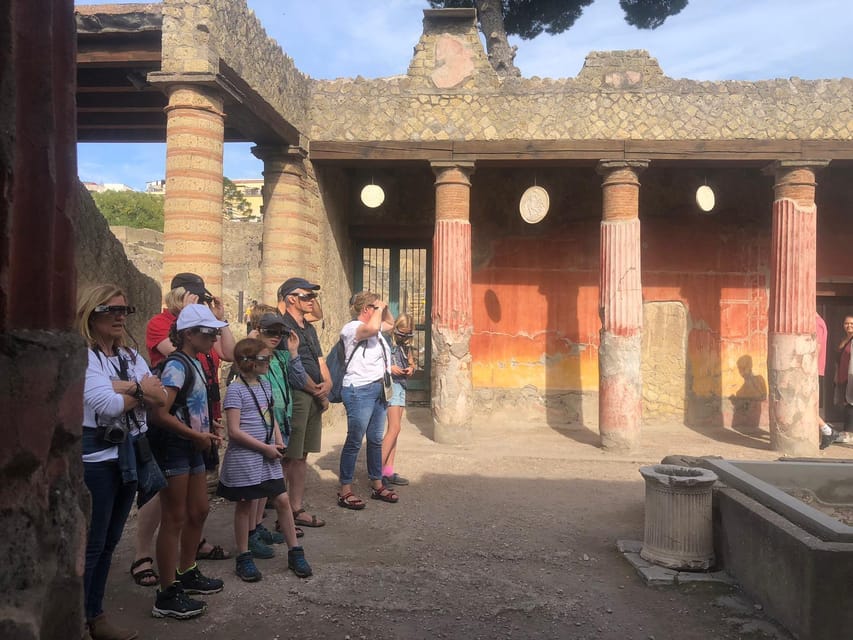
Pompeii’s homes can be rewarding but confusing. Rooms may survive without roofs, doors, or upper stories, and a visitor can easily lose track of how the spaces connected. A reconstruction gives you a clearer sense of the house as a complete building.
This part should work well for families because it brings the visit down to human scale. Instead of only hearing about a city destroyed long ago, you can picture the rooms where people lived and the courtyards and streets they used.
The limitation is that digital reconstruction can make the past look more certain than the evidence allows. Listen to the audio guide and the assistant’s explanation, but keep in mind that the glasses present an informed reconstruction, not a time machine.
Squares and public buildings
Public squares show how Pompeii worked as a city. The AR layer can help you understand the relationship between open spaces and the buildings around them. A square that looks empty today may have been framed by complete facades and used as a central gathering place.
The tour’s guided structure is helpful here. Pompeii is large, and it is easy to spend too long at the first few ruins. A two-hour route gives you a planned introduction rather than an unstructured walk through whichever streets you happen to notice.
Theaters
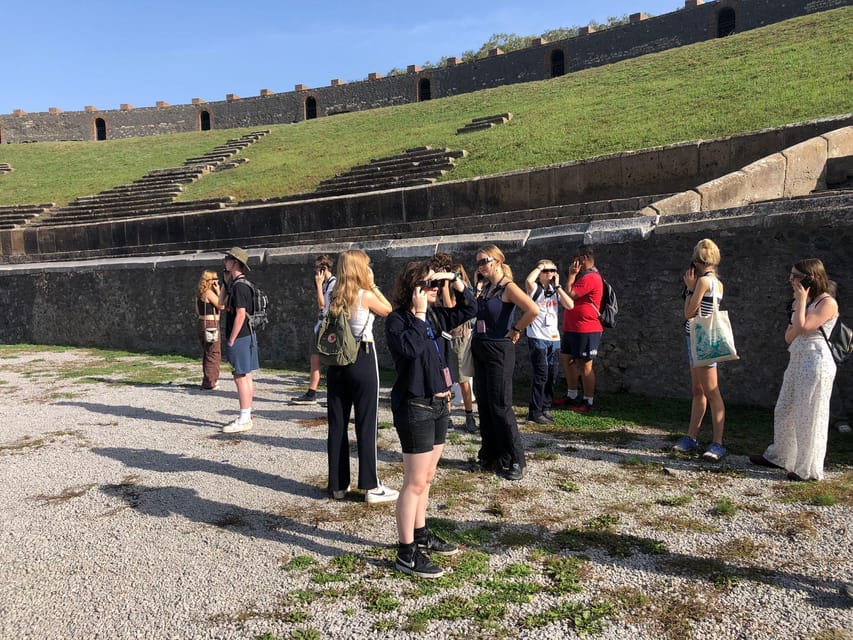
Theaters are easier to appreciate when you can see their original seating, stage area, and architectural shape. The AR glasses are well suited to places where the surviving stone outlines remain but the finished appearance has faded.
This is also a good point for children who need a change from house walls and temple remains. A theater has an obvious purpose, and a reconstruction can make the connection between the building and public entertainment easier to grasp.
Other important buildings
The route also covers other major structures chosen by the archaeological team. Because the exact stops may change, you should not book this expecting a guaranteed visit to one particular building.
The experience does not include Pompeii’s suburban villas, including the Villa dei Misteri. If that villa is a priority for you, you will need to make separate plans. The two-hour AR tour concentrates on the principal area reached through Porta Marina Inferiore.
How the glasses and audio guide work together
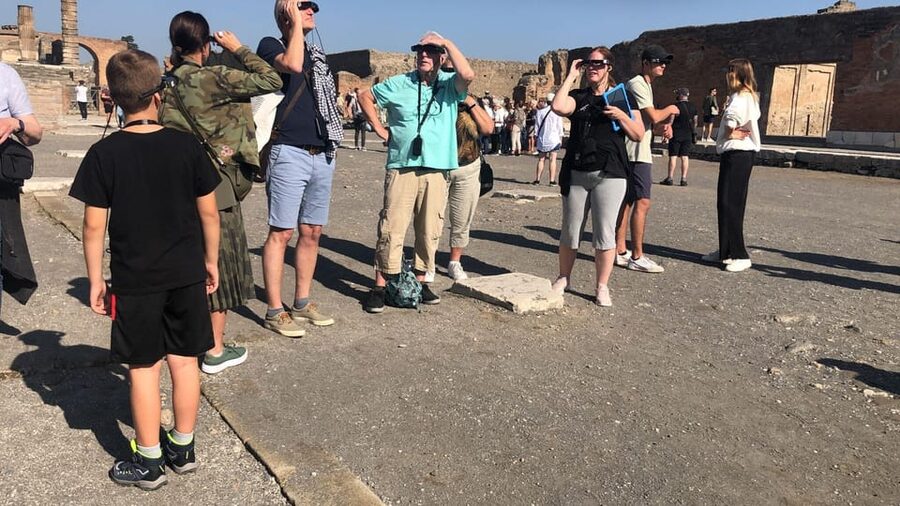
The AR glasses are meant to place digital images over the ruins. This is different from watching a reconstruction on a screen away from the site. You are looking at the actual remains and the proposed earlier appearance at the same time.
The audio guide supplies commentary in six languages: English, French, Italian, Spanish, German, and Portuguese. The live tour assistant speaks English and Italian and stays with the group to help with the equipment and itinerary.
You can wear the glasses over regular eyeglasses. That is a practical detail for many adults, though you should still bring sunglasses because Pompeii offers little relief from strong sun in exposed areas. The recommended packing list is sensible: comfortable shoes, water, a sun hat, sunscreen, sunglasses, and clothing suited to the weather.
The tour operates in rain or shine. That matters because the glasses and the ruins are not an indoor activity you can easily shift around. Check the forecast, dress in layers when needed, and accept that poor weather may affect comfort and visibility.
The equipment may feel less natural than an ordinary walking tour. One published rating criticized the experience as poorly executed and said it felt more like virtual reality than augmented reality. That criticism is worth taking seriously. If you want a polished, game-like digital show, the result may disappoint. If you mainly want help understanding the ruins, the audio and guide support may be just as important as the visual effect.
Is $52.38 a fair price?
At $52.38 per person, this is not the cheapest way to enter Pompeii. You are paying for the admission ticket, AR glasses, multilingual audio guide, archaeological planning, and an accompanying assistant, rather than for entry alone.
The price makes the most sense for a family that wants a structured two-hour introduction. Buying the equipment, getting the route, and having someone available to help can be worth the extra cost if your children are likely to lose interest in a standard archaeological tour.
The value is less clear for experienced history readers or visitors who prefer to move slowly. You may get more from ordinary entry and independent exploration if you want to stop for long periods, study inscriptions, or choose your own buildings. This tour follows a planned route, and the glasses must be returned at the end.
The strongest value comes from combining the guided portion with extra time afterward. You can stay inside the archaeological park once the tour ends and explore independently. That gives you the best of both approaches: digital help for the first look, then freedom to revisit the places that caught your attention.
The current rating is 3.6 from five published ratings, so the feedback record is small and mixed. There is one clear positive rating but no detailed praise to identify beyond that. The useful takeaway is that the concept appeals to some people, while the meeting point and quality of the AR presentation deserve caution.
Who should book this Pompeii tour?
I would put this near the top of the list for families with children aged 8 to 14 who want a guided route and a visual aid. The glasses give children a reason to study the ruins, and the assistant reduces the stress of handling unfamiliar equipment.
It can also suit adults who find archaeological sites hard to picture. You do not need to know much about Pompeii before arriving. The route and audio guide provide a basic framework, while the reconstructions show how the pieces fit together.
You should think twice if you use a wheelchair, since the activity is not suitable for wheelchair users. It is also not a good choice if you need to bring luggage or a large bag, as these are not allowed.
Children under 8 may enter the park with a standard ticket, but they cannot use the 3D technology. If your family includes younger children, confirm that the older children and adults still make the tour worthwhile without giving the youngest participant the same equipment.
Practical tips for a smoother visit
Arrive well before the start time. The five-minute waiting limit leaves little room for confusion at Piazza Esedra, especially if you have children, reduced-fare tickets, or several people in your party.
Wear shoes suited to uneven archaeological paths. Bring water and sun protection, and dress for the forecast because the tour runs in all weather.
Keep your booking names accurate and carry proof for any EU citizen or youth fare. Also remember that the tour does not include the Villa dei Misteri, meals, drinks, or transportation.
If the AR image feels less impressive than expected, use the audio guide and assistant as the main structure of the visit. The glasses are an aid, not the whole archaeological experience. After returning them, use your remaining park time to look again at the areas that made more sense with the reconstructions.
Should you book it?
Book this tour if you want a family-friendly introduction that puts Pompeii’s missing walls, roofs, and public spaces back into view. The two-hour format, on-site assistant, multiple audio languages, and permission to remain in the park afterward make it practical for a first visit.
Skip it if you expect flawless technology, need wheelchair access, want to visit the Villa dei Misteri, or prefer complete freedom to set your own pace. The mixed 3.6 rating and the specific complaint about the meeting point and AR quality suggest you should keep expectations reasonable.
For families, the extra cost can be justified by the clearer visual story. For independent adults, standard admission may offer better value. Arrive early, bring sun protection, and treat the holograms as a helpful interpretation of Pompeii, not a substitute for the actual ruins.
FAQ
Where does the Pompeii AR tour start?
The meeting point is Vittoria coffee shop in Piazza Esedra, beside the Porta Marina Inferiore entrance. Look for the tour assistant holding an AR Tour sign.
How long does the experience last?
The guided activity lasts two hours. After returning the AR glasses, you can stay in the archaeological park and explore independently.
What languages are available?
The live tour assistant speaks English and Italian. The audio guide is available in English, French, Italian, Spanish, German, and Portuguese.
Are children allowed to use the AR glasses?
Children age 8 and up can use the 3D technology. Children under 8 can enter the park with a standard ticket but cannot use the AR equipment.
Is the Villa dei Misteri included?
No. The tour does not include Pompeii’s suburban villas, including the Villa dei Misteri.
Can I wear the glasses over my normal eyeglasses?
Yes. The AR glasses can also be worn by participants who already wear eyeglasses.
Is the tour suitable for wheelchair users?
No. The activity is listed as not suitable for wheelchair users.
What should I bring?
Bring comfortable shoes, sunglasses, a sun hat, sunscreen, water, and clothing suitable for the weather. Luggage and large bags are not allowed.
Newest reviews from Pompei Campania
- From Sorrento: Pompeii & Vesuvius tour small group★ 4.8 · 4 reviews
- Pompeii Private Tour for Kids and Their Families★ 4.8 · 4 reviews
- From Naples_ Pompeii Tour_Skip the line ticket + audioguide★ 4.3 · 4 reviews
- Pompeii, skip-the-line ticket with smartphone audio guide on App★ 3.0 · 4 reviews
- Pompeii Guided Experience – Tour Service Only★ 4.6 · 4 reviews
- From Naples Port:Pompeii+Vesuvius tour★ 4.3 · 4 reviews
- 2-Hour Pompeii Child-Friendly Tour★ 5.0 · 4 reviews
- Naples: Amalfi Coast, Sorrento and Pompeii Day Trip★ 4.4 · 5 reviews
Tickets, compared.

Entry Ticket and Guided Tour with an Archaeologist
Read our review →

Skip-the-Line Entrance Ticket with Audio Guide
Read our review →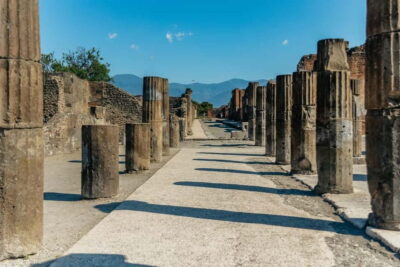
Archaeological Park Tour with Ticket on request
Read our review →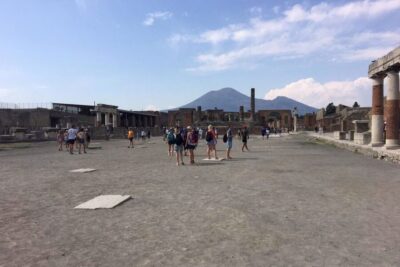


Skip-the-Line Entry Ticket with Digital Guide App
Read our review →