
Reviewed · ARCHAEOLOGIST-LED TOURS
PompeiI Exclusive Tour with your Archaeologist in a Small Group
Pompeii is far too large and layered to understand by simply wandering in. This two-hour archaeologist-led tour gives you a clear route through the western entrance, Forum, temples, baths, homes, shops, and theater, with the guide explaining not just what you are seeing but how archaeologists know it.
I like the small-group format, capped at 15 people, and the practical route through the city’s main public spaces. I also like that guides such as Ricardo, Raffaele, Antonio, and Ornella are repeatedly praised for clear English, humor, and genuine enthusiasm. The main catch is price clarity: the advertised $30.25 covers the tour, but Pompeii admission costs another €19 per adult.
In This Review
- Key points to know before you book
- Why an archaeologist makes Pompeii easier to read
- Meeting at Porta Marina Superiore
- Venus, the Basilica, and the first look at power
- Apollo, Jupiter, and Pompeii’s main square
- The Macellum and the human cost of the eruption
- Forum Baths and the practical Roman city
- The Thermopolium and Pompeii’s everyday food culture
- The House of the Faun and the House of the Vettii
- Via dell’Abbondanza and the working city
- The theater and what the two-hour route leaves out
- Guide style, group size, and pace
- What the $30.25 price really buys you
- Who should book this Pompeii tour
- Final verdict: a strong first look, with one important extra cost
- FAQ
- How long does the Pompeii archaeologist tour last?
- What language is the tour offered in?
- Are Pompeii entrance tickets included?
- Where does the tour meet?
- Is the Viator booking confirmation the Pompeii entry ticket?
- How do I use the priority entrance?
- How large is the group?
- Can I cancel for a full refund?
Key points to know before you book
- A real archaeologist leads the walk: Guides explain buildings, Roman customs, excavation methods, and the evidence behind what you see.
- The route covers Pompeii’s core sights: You visit the Forum, temples, baths, food shops, grand homes, Via dell’Abbondanza, and the theater.
- The tour lasts about two hours: That is enough for a strong first look, but not enough to see every major corner of the park.
- Admission is extra: The $30.25 tour price does not include the €19 adult entrance fee.
- The group is intended to be small: The stated maximum is 15 people, though it is wise to confirm the size if this matters to you.
- Wear serious walking shoes: Ancient streets are uneven, and the site is broad and exposed to the weather.
Why an archaeologist makes Pompeii easier to read
Pompeii is not a tidy museum. It is a huge ancient town made up of streets, courtyards, shrines, homes, public buildings, shops, and half-excavated areas. Without help, you can look at a wall, a column, or a painted room and miss the reason it mattered.
An archaeologist can connect those pieces. Instead of only hearing that a building was a bath or a market, you learn how it fitted into everyday Roman life. You may also hear how excavation methods reveal details about the eruption and the people caught in it.
That point comes through strongly in the guides’ teaching style. Ricardo is noted for explaining the Latin, Greek, and Roman roots of familiar words. Antonio is praised for connecting the visible ruins with current excavation and preservation work. Raffaele is described as both friendly and able to keep a group interested for the full two hours.
The best guides also leave room for questions. One approach described by a participant had the guide covering the main route first, then asking what the group wanted to see or understand better during the final part. That flexibility matters at Pompeii, where different people arrive with different priorities: houses, religion, engineering, food, politics, or the eruption itself.
More Pompeii excavation visits:
- Pompeii: Entry Ticket and Guided Tour with an Archaeologist
★ 4.8 · 19,459 reviews - Pompeii: Entry Ticket with Optional Audio Guide
★ 4.2 · 12,360 reviews - Pompeii: Small Group Tour with an Archaeologist
★ 4.8 · 12,264 reviews
Meeting at Porta Marina Superiore
The meeting point is outside the archaeological park at Via Villa dei Misteri 1, by Porta Marina Superiore. Look for the guide holding a sign marked Pompeii Vip. This entrance forms the western approach to the ancient city, and its name comes from the old road leading toward the sea.
The first stop is brief, about 10 minutes, but it gives the guide a useful place to explain how Pompeii was connected to the coast and how visitors entered the city. The actual entry ticket is not included in the tour price.
The operator sends a link on the afternoon before the tour so you can buy a skip-the-line ticket online. The booking confirmation for the tour itself is not your admission ticket. This distinction is important, since you still need to purchase the Pompeii Park ticket, listed at €19 for adults, while admission is free for children under 18.
The separate priority line can save time at the gate, especially when the entrance is busy. Still, read the ticket instructions carefully and allow enough time to sort out admission before the group begins.
Venus, the Basilica, and the first look at power
After entering, the route heads toward the Temple of Venus. Pompeii’s patron goddess received a major temple in a prominent position near the western side of town. The setting helps you see that religion was not tucked away from public life. Temples, government buildings, commercial spaces, and streets worked together as part of the city’s daily rhythm.
The next stop is the Basilica, one of the most important buildings around the Forum. It was used for business and the administration of justice, and its scale hints at the money and status tied to Roman civic life.
This is one of the tour’s strengths. A guide can point out the difference between a religious building, a law court, and a commercial space, even when all you initially see are broken walls and columns. The explanation turns the Forum area from a collection of ruins into a working center of government and trade.
Apollo, Jupiter, and Pompeii’s main square
The Sanctuary of Apollo is among Pompeii’s oldest places of worship. It sits along the route from Porta Marina toward the city’s public center, making it a useful stop for understanding both religion and urban planning.
From there, the tour reaches the Forum, Pompeii’s main square. This was the center of civic life, and the surrounding buildings show how public decisions, worship, commerce, and ceremony were packed into one area.
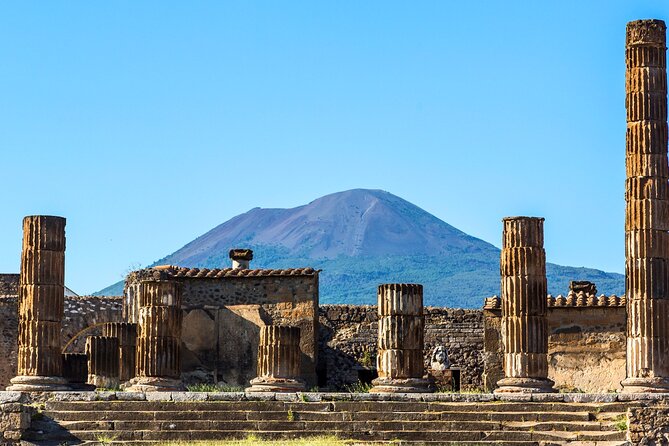
The Temple of Jupiter closes the northern side of the Forum. Behind it, Mount Vesuvius rises dramatically, providing the view that makes the volcanic disaster feel close rather than abstract.
You will want photographs here, but keep listening. The guide’s value is not only in naming Jupiter or identifying the Forum. It is in explaining how these places worked together and what their position tells you about Roman society.
More tours led by an archaeologist:
- Pompeii Small Group Tour with an Archaeologist
★ 5.0 · 6,593 reviews - Pompeii and Herculaneum Small Group Tour with an Archaeologist
★ 5.0 · 1,350 reviews - Skip the Line Guided Tour of Pompeii led by an Archaeologist
★ 5.0 · 703 reviews - Pompeii: Exclusive Tour with Archaeologist and Entry Tickets
★ 4.9 · 634 reviews
The Macellum and the human cost of the eruption
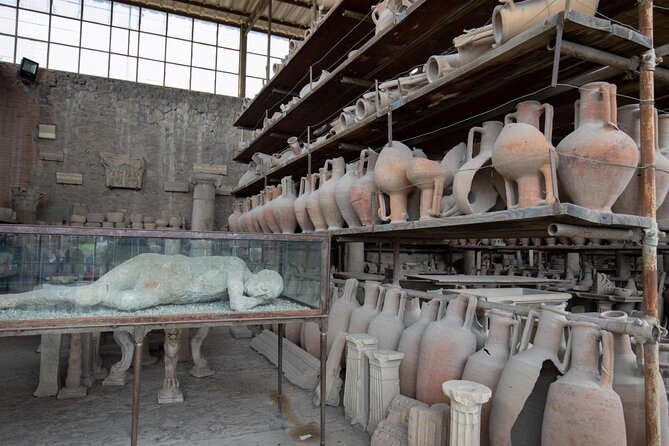
The Macellum was a monumental food market where people bought daily supplies. It helps bring Pompeii down to an ordinary level. This was not only a city of emperors, temples, and grand houses. It was also a place where people came to buy food and carry on with routine business.
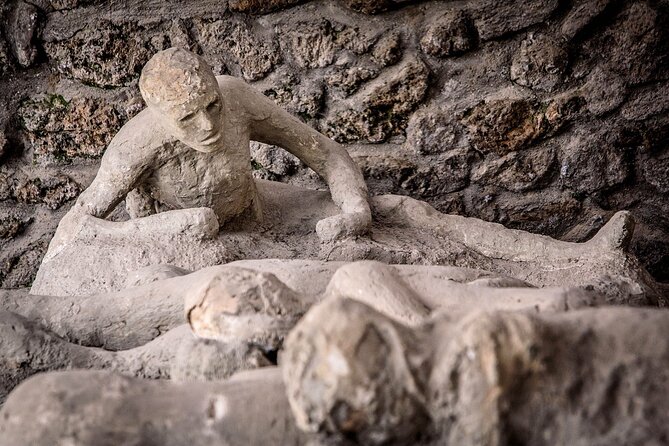
Plaster casts connected with the eruption may be shown here. They were made using an archaeological method that filled cavities left in the hardened volcanic material, revealing the shape of bodies as they lay at the time of the disaster.
This can be one of the most moving parts of the tour. It also deserves a respectful presentation. The guide’s explanation helps you understand that these casts are not simple statues or theatrical displays. They are evidence of individual lives interrupted by the eruption.
Forum Baths and the practical Roman city
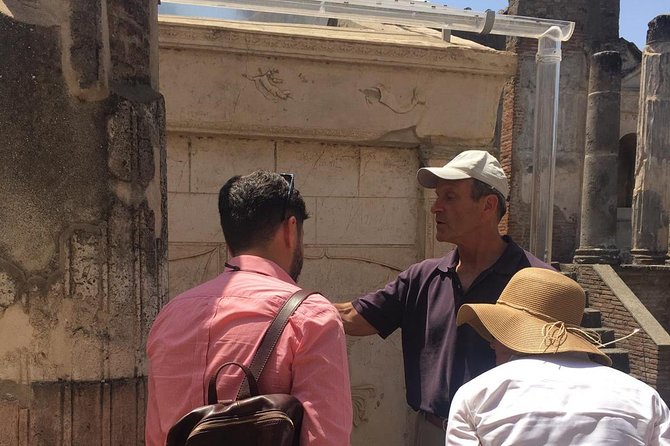
The Forum Baths are among Pompeii’s best-preserved public buildings. The male and female sections had separate entrances, offering a direct look at how Roman bathing facilities were organized.
A stop here adds balance to the tour. Pompeii is often reduced to temples and tragedy, but the baths show ordinary infrastructure and social life. Roman bathing was tied to cleanliness, conversation, leisure, and public routine.
The itinerary gives this stop around 10 minutes. That is enough for a guided explanation, but not enough to study every surviving room at length. If baths are your main interest, you may want to return after the tour and spend more time looking at the preserved details.
The Thermopolium and Pompeii’s everyday food culture
The Thermopolium of Vetuzio Placido was an old diner or refreshment shop. Stops like this are especially useful because they make the ancient town feel familiar.
A food shop tells you about ordinary habits, not just formal Roman ideals. People needed quick meals, drinks, and places to buy prepared food. Seeing a thermopolium beside grand public buildings and private homes helps you picture a functioning town rather than a frozen archaeological site.
The guide can also help you separate what is clearly known from what archaeologists infer. That is a recurring benefit of this experience, especially for visitors who want more than a string of dates and names.
The House of the Faun and the House of the Vettii
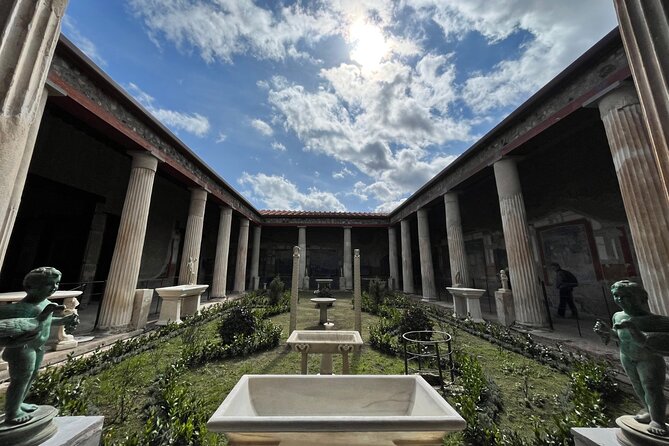
The House of the Faun is one of Pompeii’s largest residences. Its pavement carries the Latin greeting HAVE, a small but memorable detail that shows how a private home could address people arriving from the street.
The House of the Vettii is another major residence, associated with wealth and decorated under the protection of Priapus, a god linked with prosperity. Both houses are subject to seasonal opening and closing, so do not treat their inclusion as guaranteed on every departure.
This is a key practical point. The route includes these houses when access allows, but archaeological sites change constantly. Rooms may close for preservation, staff needs, or seasonal schedules. A strong guide can still explain the importance of a building even if a particular interior is unavailable.
The homes also show why Pompeii can be hard to manage alone. A large house may contain courtyards, reception rooms, service areas, shrines, gardens, and decorative features. Without context, the layout is easy to misread.
Via dell’Abbondanza and the working city
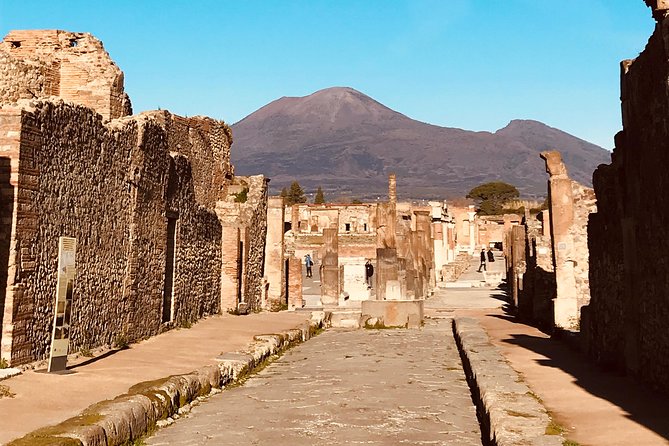
Via dell’Abbondanza was Pompeii’s main street, the ancient decumanus maximus. Walking along it gives you a sense of movement through the city. This is where the tour shifts from large public monuments to the street-level life linking them.
The guide may point out how homes, shops, baths, and civic spaces faced the road. Look down as well as up. Ancient paving, sidewalks, thresholds, and street arrangements help explain how people moved through Pompeii.
This section can be crowded and noisy at busy times, so stay close to the guide. One participant had trouble with an earpiece during a tour, and the issue was not resolved. That appears to be an isolated complaint among many positive comments, but it is still sensible to test any audio equipment at once and speak up immediately if you cannot hear.
Some guides use no distorted earphones and speak clear English directly to the group. That can make the experience easier, but the exact setup may vary by departure.
The theater and what the two-hour route leaves out
The tour ends at the Teatro Grande, where comedies and tragedies were performed in the Greco-Roman tradition. It is a fitting final stop because the theater shows Pompeii as a place of entertainment and shared public culture, not only business and religion.
A two-hour tour must make choices. This route focuses on the Forum district, important temples, baths, homes, food shops, the main street, and the theater. It does not promise every major site in Pompeii.
One participant specifically wished the route had included the amphitheater or brothels. Those sites may not be part of this standard path. The advantage is focus: you get a guided introduction without trying to race across the entire park. The drawback is that you may need extra time afterward if one of those places is high on your list.
The tour ends back at the meeting point. You can then continue exploring on your own if opening hours and access permit, but the experience itself is designed as a concentrated overview rather than a full-day archaeological visit.
Guide style, group size, and pace
The guide is the heart of this experience. Names associated with departures include Ricardo or Riccardo, Raffaele, Rafael, Antonio, PierLuigi, and Ornella. You cannot assume a particular guide will lead your date, but the recurring strengths are clear: strong subject knowledge, friendly delivery, good English, and enthusiasm for Pompeii.
The small group is another practical advantage. A maximum of 15 people should make it easier to hear explanations and ask questions than on a large coach tour. Several accounts describe groups of roughly 12 as comfortable and personal.
One account reported a group of about 20, despite a stated maximum of 12 at the time of booking. The current information gives a maximum of 15, but group sizes can change, so ask the operator to confirm if the limit is central to your decision.
The pace is steady. Each listed stop is allocated about 10 minutes, though the guide may adjust the timing. You should expect plenty of standing and walking over uneven ancient surfaces. Comfortable shoes are not a minor suggestion here.
Weather also matters. The activity requires good weather, and rain or poor conditions can lead to a new date or a full refund. In wet or windy conditions, one guide was able to use covered areas while continuing the explanation, but you should still dress for the forecast.
What the $30.25 price really buys you
The listed price is $30.25 per person, but the adult entrance ticket adds €19. That makes the real cost higher than the first price suggests. Children under 18 enter free, but the tour fee still applies unless your booking terms say otherwise.
For that combined cost, you are paying mainly for interpretation and time saved, not for the ruins themselves. The priority entrance can reduce waiting, and the archaeologist can prevent you from spending two hours guessing what each building was used for.
I consider the price fair for a first visit if you value expert explanation and want to cover the main civic center efficiently. It is less attractive if you already know Pompeii well or plan to spend several days studying the site independently.
The two-hour length is also part of the value. It is short enough to fit into a busy Naples or Pompeii day, yet long enough to build a useful framework. You will not see everything, but you will know what to look for when you continue alone.
Free cancellation is available up to 24 hours before the start time for a full refund. Changes or cancellations inside that window are not accepted, and poor weather or failure to meet the minimum group size may result in a new date or refund.
Who should book this Pompeii tour
I would choose this experience for a first visit, especially if you want the main sights explained by an archaeologist rather than read plaques or follow an audio guide. It also suits families, since the guides use stories, questions, humor, and everyday Roman details to keep the route moving.
The tour works well for people staying in Naples or nearby areas who need a focused visit. It is also a good fit if you prefer a small group but do not need a private guide.
I would think twice if you want the amphitheater, brothels, or far corners of the archaeological park. You may also prefer a longer private tour if you want to set the route around a specific interest such as frescoes, domestic architecture, religion, or the eruption.
Final verdict: a strong first look, with one important extra cost
This is a sensible way to meet Pompeii. The route covers the ancient city’s public heart and adds enough homes, shops, baths, and street life to show how the town functioned. The archaeologist’s explanations are the main reason to book, and guides such as Ricardo, Raffaele, Antonio, and Ornella are praised for making complex material clear and lively.
Book it if you want a focused introduction, a small group, and help with the park’s enormous scale. Just budget for the separate €19 adult entrance ticket, wear sturdy shoes, and understand that two hours covers the key sights rather than the whole city.
FAQ
How long does the Pompeii archaeologist tour last?
The tour lasts approximately two hours.
What language is the tour offered in?
The tour is offered in English.
Are Pompeii entrance tickets included?
No. The tour price does not include admission to Pompeii Archaeological Park. The listed adult ticket price is €19, and admission is free for people under 18.
Where does the tour meet?
Meet at Via Villa dei Misteri 1, 80045 Pompei, near Porta Marina Superiore. The guide waits outside the park with a sign marked Pompeii Vip.
Is the Viator booking confirmation the Pompeii entry ticket?
No. The booking confirmation is for joining the tour. You must also buy the separate ticket for entry to the archaeological site.
How do I use the priority entrance?
The operator sends a link on the afternoon before the tour so you can purchase a skip-the-line Pompeii ticket online. You can also buy the entry ticket on site with assistance.
How large is the group?
The stated maximum is 15 people.
Can I cancel for a full refund?
Yes, if you cancel at least 24 hours before the experience start time. Cancellations or changes made less than 24 hours in advance are not refunded or accepted.
Newest reviews from Pompeii Ruins
- Private Tour Pompeii and Winery★ 5.0 · 4 reviews
- Visit the Pompeii ruins from Salerno with Pizza Lunch★ 5.0 · 4 reviews
- Pompeii Private Tour for Kids and Their Families★ 4.8 · 4 reviews
- From Sorrento: Pompeii & Vesuvius tour small group★ 4.8 · 4 reviews
- Pompeii Sorrento and Positano Tour★ 5.0 · 4 reviews
- From Naples_ Pompeii Tour_Skip the line ticket + audioguide★ 4.3 · 4 reviews
- Pompeii Private Half-Day Tour from: Naples,Sorrento, Amalfi Coast★ 5.0 · 4 reviews
- Pompeii, skip-the-line ticket with smartphone audio guide on App★ 3.0 · 4 reviews
Archaeologist-Led Tours, compared.

Entry Ticket and Guided Tour with an Archaeologist
Read our review →
Pompeii Small Group Tour with an Archaeologist
Read our review →
Pompeii and Herculaneum Small Group Tour with an Archaeologist
Read our review →
Skip the Line Guided Tour of Pompeii led by an Archaeologist
Read our review →
Exclusive Tour with Archaeologist and Entry Tickets
Read our review →
Pompeii Private Tour with an Archaeologist and Skip The Line – 3 hours
Read our review →
Pompeii Skip-the-line Tour with Archaeologist Guide
Read our review →Browse the lists this tour appears in