
Reviewed · SELF-GUIDED TOURS
Pompeii Audioguide – TravelMate app for your smartphone
Pompeii is best seen at your own speed, and this $9 smartphone audio guide gives you a simple way to add commentary without joining a group. It covers frescoes, theaters, temples, homes, baths, and other key sights through 16 audio tracks totaling 48 minutes.
I like the offline listening option, especially in a vast archaeological site where a signal may not always behave. I also like the long validity period: activate it once, then use it as often as you want for up to 1,095 days. The catch is that setup can be fiddly, and the commentary may feel thin if you want vivid storytelling or detailed coverage of every corner.
In This Review
- Key points at a glance
- What the TravelMate app actually gives you
- Starting the app without wasting time
- The Pompeii introduction sets the scene
- Frescoes bring the walls back to life
- The Grand Theatre and Regio VIII
- The Basilica of the Friars
- Houses of Marcus Rufus and the Golden Bracelet
- The Lupanare in Regio VII
- The Temple of Apollo in Regio VII
- Roman domus and the Thermae
- How much value do you get for $9?
- Languages, comfort, and access
- Who should choose this Pompeii guide?
- Should you book the TravelMate Pompeii app?
- FAQ
- Is there a meeting point for the Pompeii TravelMate audio guide?
- How long is the Pompeii audio content?
- How long does the activation remain valid?
- Can I use the audio guide without an internet connection?
- Which languages are available?
- Does the app include anything besides audio?
Key points at a glance

- Sixteen tracks cover major Pompeii sights: The program includes the Pompeii introduction, frescoes, Grand Theatre, Basilica of the Friars, Roman houses, Lupanare, Temple of Apollo, Roman domus, and baths.
- Forty-eight minutes of audio keep the visit focused: This is a short orientation guide, not an all-day scholarly lecture series.
- Offline playback is available: Download the content before you enter, then avoid relying on mobile signal inside the site.
- Seven languages are included: Choose Italian, English, Spanish, German, Russian, Chinese, or French.
- A quiz section adds a small learning game: Short questions help you recall facts instead of simply listening and moving on.
- Your own phone and earphones keep things personal: No shared audio equipment is involved, and earphones are recommended.
What the TravelMate app actually gives you

This is a self-guided audio product rather than a live walking tour. There is no guide waiting at a gate, no fixed departure time, and no group to follow. You download the TravelMate app, enter the activation code, and begin when you are ready.
The app includes 16 audio contents with a total running time of 48 minutes. That figure matters. Pompeii is a large site, so 48 minutes will not explain every street, building, inscription, and painted wall. Instead, the app gives you selected points of interest and enough background to add shape to a visit that might otherwise feel like a long walk through ancient ruins.
The audio is professionally written and performed by people from television and radio. That should give the tracks a more polished delivery than a basic computer-generated recording, though the quality of the writing still matters more than the voice alone. One available assessment found the delivery too flat and the content less lively than expected, so I would treat this as a practical guide with a limited script, not a substitute for a full expert-led tour.
You can also read the text of the audio files in the app. That helps if you are in a noisy part of the site, prefer reading, or want to check a detail without replaying a whole track.
More Pompeii excavation visits:
- Pompeii: Entry Ticket and Guided Tour with an Archaeologist
★ 4.8 · 19,459 reviews - Pompeii: Small Group Tour with an Archaeologist
★ 4.8 · 12,264 reviews - Pompeii: Skip-the-Line Entrance Ticket with Audio Guide
★ 4.0 · 2,509 reviews
Starting the app without wasting time
The main practical challenge comes before Pompeii itself: getting the app working. You need to download the correct version and locate a 10-digit activation code.
For Android, search the Play Store for TRAVELMATE. For iPhone, search the App Store for TRAVELMATE TM. The similar names make it worth checking that you have the intended app before trying to activate it.
Your activation code appears beneath the black and white barcode in your booking information. In an email, open Show activity details or Show your tickets here, then tap the large barcode in the orange box. The 10-digit number under it is the code you need.
If you are using the GetYourGuide app, open the ticket there and tap the barcode. The code again appears below it. If GetYourGuide is not already installed, you may be sent to the app store first.
I strongly suggest handling this at your hotel or another place with a reliable connection. Download the app, enter the code, and test the audio before reaching the ruins. A poor signal or rushed setup can turn a bargain into a frustrating first half-hour. The guide can work offline, but you need to prepare that offline access in advance.
There is no physical meeting point. You can start wherever you prefer, and the activity is not tied to a particular entrance time. The lack of a meeting point is convenient, but it also means you are responsible for knowing where you want to begin inside Pompeii.
The Pompeii introduction sets the scene

The opening track provides a general introduction to Pompeii. This is the logical place to begin because the site can feel confusing at first. Streets, houses, public buildings, and open areas spread across a large area, and a short overview helps you understand that you are not simply looking at isolated ruins.
Use this track before wandering too far. It should give you the broad frame for the city and help explain why the individual stops matter. At 48 minutes for the full program, the introduction is likely designed to be concise.
The limitation is the same one that affects the whole app: the guide does not promise a detailed explanation of Pompeii’s entire urban plan. If you want a full account of daily life, government, religion, commerce, and the eruption, you will need to supplement it with another source.
Frescoes bring the walls back to life

The frescoes are among Pompeii’s most memorable remains, and giving them a dedicated track makes sense. Painted walls are easy to admire but harder to interpret without some context. An audio explanation can help you notice the subject matter, decorative style, and role these paintings played inside Roman homes.
This is one of the places where the app’s text option may be useful. You can pause and compare what you are reading with what you see, instead of trying to remember a spoken explanation while moving through a busy room.
Do not expect the frescoes track to cover every painted surface in Pompeii. The site contains far more art than a short audio program can address. Think of this stop as a guide to looking carefully, not a complete catalog.
More Pompei Campania tours worth comparing
- Pompeii: Skip-the-Line Entry Ticket with Digital Guide App
★ 4.1 · 770 reviews - Pompeii: Skip-the-Line Ticket with Audio Guide and Map
★ 4.0 · 117 reviews - From Naples: Vesuvius & Pompeii with Transfer & Audio Guide
★ 4.0 · 58 reviews - Pompeii & Herculaneum: Skip-the-line & Digital Guide App
★ 4.0 · 35 reviews
The Grand Theatre and Regio VIII

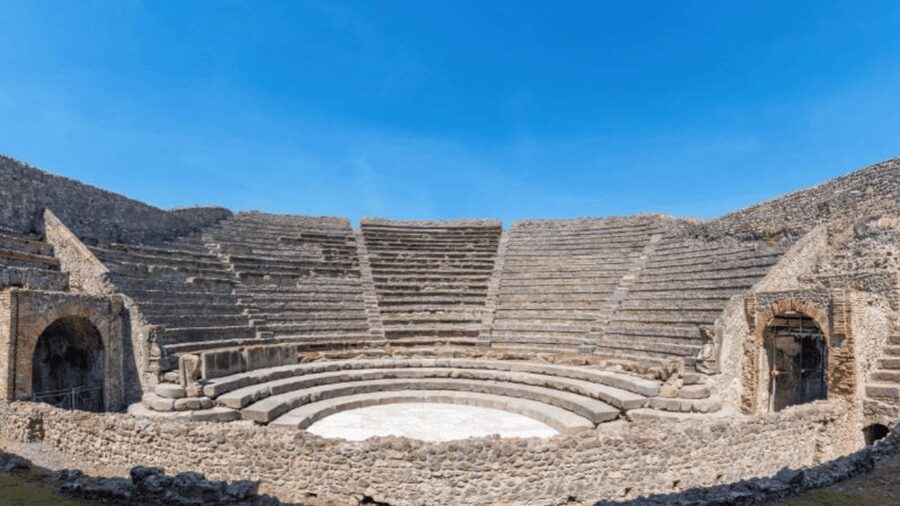
The Grand Theatre gives the program a public setting. Here, the focus shifts from private interiors to entertainment and the way a Roman city used shared spaces. The reference to Regio VIII places the theater within Pompeii’s larger neighborhood system.
I like having a theater on the route because it breaks up the house-by-house rhythm of the visit. You get a clearer sense that Pompeii was a working city with public life, not only a collection of wealthy residences.
The track is also a reminder to check the app’s route against your position. Pompeii’s regions and buildings can blur together when you are walking, and a self-guided app cannot physically point you in the right direction. Keep your map or site signage in view as you go.
The Basilica of the Friars

The Basilica of the Friars is another stop connected with the city’s public and religious life. Its inclusion gives the program a little more range than a tour devoted only to famous houses and painted rooms.
This stop may appeal to you if you like seeing how a place functioned as a community. The audio can provide the basic story and help you understand what you are looking at before you move on.
As with the other locations, the value depends on your expectations. The app names this point of interest, but the supplied details do not promise a long treatment of the building. If you want technical architectural analysis, a specialist guide will offer more.
Houses of Marcus Rufus and the Golden Bracelet

Private homes often make Pompeii feel personal. The Houses of Marcus Rufus and the Golden Bracelet, both associated with Regio VII, let the program move from broad city history to the spaces where people lived.
A house-focused stop gives you a chance to think about rooms, decoration, status, and domestic routines rather than only monumental buildings. The name of the Golden Bracelet adds a specific human detail, which can make the site easier to remember than a numbered street or anonymous ruin.
These houses are also a good test of the app’s level of detail. If the track simply identifies the owners and offers a short explanation, you will get useful orientation but not a full reconstruction of household life. Listen first, then take your time looking around. The audio should support your visit, not dictate its speed.
The Lupanare in Regio VII

The Lupanare is one of Pompeii’s most recognizable buildings, and its inclusion is essential for a first visit. This stop deals with a part of Roman urban life that is often discussed in a sensational way, so a calm explanation is more useful than a string of easy jokes.
The app places the Lupanare in Regio VII, helping you connect the building with the wider district. You may find the text transcript especially handy here if the area is noisy or crowded and you want to follow the explanation closely.
Do not expect the audio to turn the Lupanare into the whole focus of Pompeii. It is one stop among 16, and the guide also gives time to art, religion, theaters, houses, and baths.
The Temple of Apollo in Regio VII

The Temple of Apollo adds a religious center to the route. Its presence helps balance the more familiar stops, showing that the program is not built only around domestic rooms and dramatic stories.
The audio should help you read the remains as part of a sacred space rather than as scattered columns. That kind of basic framing is where a short guide earns its keep. Without it, many ancient structures can look alike after several hours on foot.
Again, keep the limits in mind. Forty-eight minutes across 16 tracks means the average recording is short. You will receive an introduction to the site rather than an extended lecture on Roman religion.
Roman domus and the Thermae
The Roman domus and the thermae round out the selection with two important parts of city life. A domus points you toward private living spaces, while the thermae introduce the public bathing culture that shaped Roman social life.
This pairing is useful because it lets you compare private and shared spaces. Homes can show decoration and status, while baths help explain how people gathered, relaxed, and maintained daily routines.
The guide’s selected subjects create a sensible spread: art, entertainment, religion, homes, commerce or social life at the Lupanare, and bathing. Still, the list is not a complete walking route through Pompeii. You may pass many buildings without a track, so do not assume silence means a building is unimportant.
How much value do you get for $9?
At $9 per person, this is priced as a low-cost add-on rather than a major tour purchase. I see the best value in the flexibility. You do not need to match a group schedule, and you can replay the content as many times as you want during its validity period.
The 1,095-day validity is unusually generous for a travel app. It begins with first activation, not simply with the date of purchase. That means you can buy ahead, keep your plans flexible, and activate when you are ready. If you return to Pompeii within that period, the guide remains available.
The value is weaker if you expect every major building to receive a detailed explanation. One low rating described the setup as difficult, the voice as Siri-like, and the commentary as lacking memorable facts. That criticism is important. A cheap guide is not automatically a good guide if it slows you down or leaves you wanting more.
The overall rating is 3.9 from 10 reviews, which points to a mixed but not disastrous experience. The strongest positive point is simple: the guide can work well when there are not many people around and you want an uncomplicated audio companion. I would buy it for independence and price, not for dazzling storytelling.
Languages, comfort, and access
The app offers Italian, English, Spanish, German, Russian, Chinese, and French. That is a useful range for mixed-language families and groups, and you can select the language that suits you before beginning.
Use your own smartphone, and bring earphones. The personal device is cleaner and more familiar than shared equipment, and you already know how to adjust volume, pause, rewind, and read the transcript.
Wheelchair access is listed for the activity. That describes the app experience, but conditions across a large archaeological site can vary by route and surface. If access is important for your visit, confirm the current site conditions separately before relying on a particular path.
The program is valid online or offline. Downloading it first is the safer choice. One available assessment specifically warned that a decent signal may be needed for the guide to work properly, so do not wait until you are standing among the ruins to solve the technical side.
Who should choose this Pompeii guide?
I would choose TravelMate if you want a cheap, private, flexible introduction and are comfortable managing an app yourself. It suits independent visitors who dislike fixed departure times, families who want to pause often, and repeat visitors who may appreciate long-term access.
It also works for people who want commentary in one of the seven listed languages and prefer reading along with audio. The quiz section gives children and curious adults a reason to stay engaged, though it is a small extra rather than a full educational program.
I would look elsewhere if you want a guide to cover nearly every major building, tell memorable stories, answer questions, or lead you through the site in a carefully ordered route. The short recordings and mixed feedback on delivery make this a basic companion, not a replacement for a live specialist.
Should you book the TravelMate Pompeii app?
Book it if your priority is independence at a low price. The offline option, text transcripts, seven languages, quiz section, and 1,095-day validity give you more flexibility than a one-time audio rental.
Skip it if you need polished storytelling, thorough coverage, or guaranteed technical ease. Prepare the app before you arrive, download the content, and bring earphones. With those steps, the $9 price is reasonable for a short orientation guide. Without them, the experience may feel more like a software chore than help among the ruins.
FAQ
Is there a meeting point for the Pompeii TravelMate audio guide?
No. There is no meeting point. Download the app and begin the experience wherever you prefer.
How long is the Pompeii audio content?
The app includes 16 audio contents with a total listening time of 48 minutes.
How long does the activation remain valid?
The guide is valid for 1,095 days from first activation and can be used as many times as you want during that period.
Can I use the audio guide without an internet connection?
Yes. The audio guide can be used offline, but you should arrange the download before arriving because a reliable signal may be needed during setup.
Which languages are available?
The audio guide is available in Italian, English, Spanish, German, Russian, Chinese, and French.
Does the app include anything besides audio?
Yes. You can read the audio text in the app and use a quiz section with short questions about Pompeii.
Newest reviews from Pompei Campania
- From Sorrento: Pompeii & Vesuvius tour small group★ 4.8 · 4 reviews
- Pompeii Private Tour for Kids and Their Families★ 4.8 · 4 reviews
- From Naples_ Pompeii Tour_Skip the line ticket + audioguide★ 4.3 · 4 reviews
- Pompeii, skip-the-line ticket with smartphone audio guide on App★ 3.0 · 4 reviews
- Pompeii Guided Experience – Tour Service Only★ 4.6 · 4 reviews
- From Naples Port:Pompeii+Vesuvius tour★ 4.3 · 4 reviews
- 2-Hour Pompeii Child-Friendly Tour★ 5.0 · 4 reviews
- Naples: Amalfi Coast, Sorrento and Pompeii Day Trip★ 4.4 · 5 reviews
Self-Guided Tours, compared.


Skip-the-Line Entrance Ticket with Audio Guide
Read our review →
Skip-the-Line Entry Ticket with Digital Guide App
Read our review →
Herculaneum Entry Ticket with Optional Audio Guide
Read our review →



Pompeii & Herculaneum: Skip-the-line & Digital Guide App
Read our review →Browse the lists this tour appears in