Reviewed · GUIDED
From Naples: Pompeii Wheelchair-accessible with a Guide
Pompeii is not an easy ruin to tackle in a wheelchair, but this tour gives you a workable route through the ancient city, a guide who knows how to avoid needless barriers, and time to focus on Roman life rather than logistics. The visit begins at the Amphitheater entrance, where your guide supplies the tickets and leads you along accessible paths.
I like the private format, since the pace can be adjusted to your needs. I also like the ramp-equipped van from Naples, which removes the stress of arranging transport with a wheelchair. The catch is real: Pompeii still has steep, uneven sections, and some areas may require you to stand or walk briefly. An all-terrain wheelchair or rugged freewheel is a smart help.
In This Review
- Key points to know before booking
- Pompeii from a wheelchair: what this tour gets right
- Meeting at the Amphitheater entrance
- A route designed around ramps and paved paths
- What you see inside ancient Pompeii
- The guide makes the difference
- The Naples transfer and wheelchair van
- Is $88 a fair price?
- How the timing works
- Who should book this Pompeii experience?
- Booking details that matter
- Should you book it?
- FAQ
- Is the Pompeii tour wheelchair accessible?
- Does the tour include transport from Naples?
- How many people can the wheelchair-accessible van carry?
- Where do I meet the Pompeii guide?
- Are Pompeii admission fees included?
- Which languages are available for the guided tour?
Key points to know before booking
- A three-hour guided route through Pompeii: You see major parts of the excavations without trying to find the most usable paths alone.
- A private van for four passengers and one wheelchair user: The vehicle has a ramp, and the driver assists with boarding and leaving.
- Meeting at the Amphitheater entrance: Choose transport from Naples or arrange your own way to Pompeii.
- Paved paths and ramps through selected areas: These reduce barriers, but they do not make every ancient street smooth or level.
- Guides in five languages: Tours are offered in English, Spanish, Italian, French, and German.
- Wheelchair admission rules can reduce the cost: Wheelchair users and one personal assistant may enter free with proof of qualifying disability from their home country.
Pompeii from a wheelchair: what this tour gets right

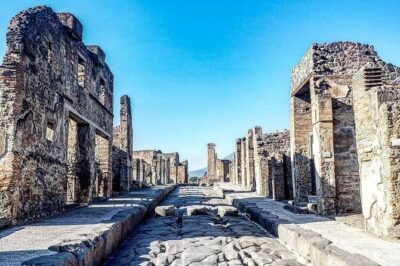
Pompeii is a remarkable place because it feels less like a collection of statues and more like a Roman town interrupted. Streets, houses, shops, public buildings, and open courtyards remain in place after the eruption of Mount Vesuvius in A.D. 79 buried the city under ash.
That same preservation creates the access problem. Pompeii was built for Roman feet, carts, and animals, not modern wheelchairs. Its old paving stones can be rough. Some streets slope. Ancient thresholds and broken surfaces can make a short distance surprisingly tiring.
This tour addresses the problem with a planned wheelchair-accessible route. You are not simply dropped at the gate and left to locate the smoothest path. Your guide takes you along paved sections and ramps designed to get around architectural barriers, then explains what you are seeing along the way.
That help matters. Without a guide, you could spend much of your visit searching for routes that work, then miss the meaning of the buildings themselves. A good guide turns a difficult archaeological site into a clear story about daily Roman life.
More Pompeii excavation visits:
- Pompeii: Entry Ticket and Guided Tour with an Archaeologist
★ 4.8 · 19,459 reviews - Pompeii: Small Group Tour with an Archaeologist
★ 4.8 · 12,264 reviews - Pompeii: Skip-the-Line Entrance Ticket with Audio Guide
★ 4.0 · 2,509 reviews
Meeting at the Amphitheater entrance
The tour begins at Piazza Anfiteatro, by the Pompeii Amphitheater entrance. If you book the guide-only option, this is your meeting point. Your guide meets you there with the entrance tickets and takes care of the start of the visit.
The separate entrance is useful because it avoids the main line. You should still arrive with the names and dates of birth for everyone in your group already supplied during booking. Bring a passport or national ID card as well.
The Amphitheater is a fitting place to begin. It was built for public spectacles and gives you an immediate sense of Pompeii as a functioning city, not simply a ruin. From there, the accessible route leads into the excavations.
Your guide is especially valuable at this early stage. Pompeii can look like a maze of stone walls if you do not know what you are seeing. The guide helps you understand how streets, homes, shops, and public spaces connected.
A route designed around ramps and paved paths
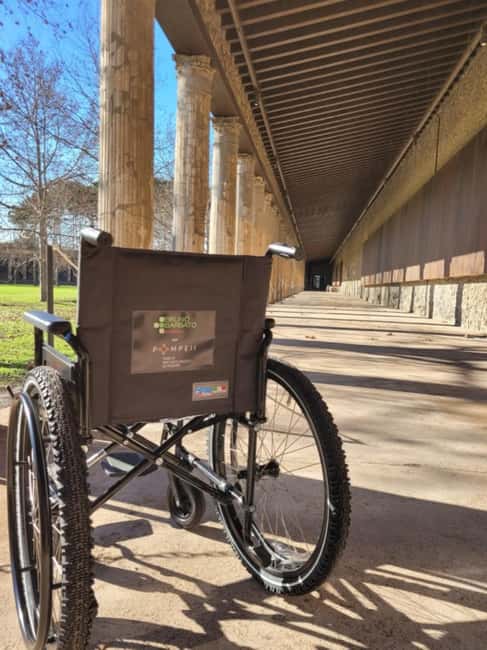
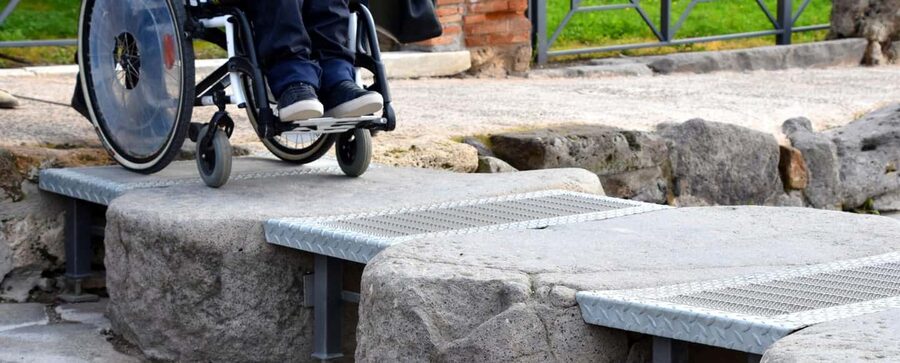
The accessible itinerary uses paved paths and ramps where possible. That makes a large part of the visit manageable, but you should not expect modern museum flooring throughout the site.
The terrain remains steep and uneven in places. One wheelchair user found a freewheel helpful over moderate bumps and noted that some sections were hilly. Another visitor found the sidewalks manageable for the most part but needed to stand and walk in a few harder areas.
Take that advice seriously when deciding if this outing is right for you. The tour is a strong option if you use a sturdy manual or powered chair that can manage uneven ground, or if you can stand and walk for short periods with assistance. It may be less suitable if every bump, slope, or brief gap creates a serious problem.
After booking, send detailed information about the wheelchair, including its size, and explain the support you need. The operator specifically asks for this so the vehicle and route can be prepared properly. That simple step can prevent a difficult surprise on the day.
The site does not become fully smooth just because the route is labeled accessible. Accessibility here means a practical route through selected areas, not access to every street, building, or archaeological corner.
What you see inside ancient Pompeii
The tour lasts about three hours inside the excavations, depending on the selected arrangement and your pace. The guide explains the remains as evidence of ordinary Roman life, which is the real strength of Pompeii.
You can expect to learn how people lived, worked, shopped, and gathered in a city frozen by disaster. The experience is less about rushing from one famous wall to another and more about understanding how the town functioned.
Your guide may point out the relationship between public buildings and residential areas, explain the purpose of shops and streets, and put the eruption into context. The exact stops can vary, but the route is built around the accessible parts of the excavation.
This is where a private guide earns the fee. You can ask for more explanation when a building catches your interest, or move on when a rough stretch becomes tiring. A fixed large-group tour would have less room for that kind of adjustment.
One recent visit also included a view of an area where excavation work was still in progress. That possibility adds a useful reminder: Pompeii is not a finished display. Archaeologists continue to uncover and study the city, and some parts may change as work continues.
You should not expect every part of the site to be open or reachable. Ancient ruins are an active archaeological area, and the accessible route is necessarily selective. Still, seeing a well-preserved street or building with a guide can be far more rewarding than covering a larger area without context.
More Pompei Campania tours worth comparing
- Pompeii: Skip-the-line-Ticket and Guided Tour
★ 4.6 · 1,152 reviews - Pompeii: Guided Tour with Skip-the-Line Entry
★ 4.9 · 812 reviews - Pompeii: Skip-the-Line Entry Ticket with Digital Guide App
★ 4.1 · 770 reviews - Pompeii: Afternoon to Sunset Guided Tour with Ticket
★ 4.9 · 484 reviews
The guide makes the difference
The strongest praise for this experience centers on the guides’ care and flexibility. Jasmine, one of the named guides, is described as friendly, well informed, and especially helpful when a visitor had difficulty navigating certain sections.
That kind of support is more important here than polished speeches. A Pompeii guide needs to explain the ruins clearly while watching the surface ahead, judging slopes, and adapting the pace. The best part of this tour is the combination of interpretation and practical awareness.
Guides are available in English, Spanish, Italian, French, and German. You should select the language that lets you ask questions easily, since communication is a key part of managing the route.
The tour is private, so you are not tied to the speed of strangers. If you need a pause, a slower crossing, or a different way around a rough patch, the guide can respond to your group rather than to a crowd.
That does not mean the guide can remove every barrier. Pompeii remains uneven, and the guide cannot change the ancient paving or guarantee access to every location. What the guide can do is help you use the route well and avoid wandering into sections that are poor choices for your chair.
The Naples transfer and wheelchair van
If you choose the option with transport, the day begins with pickup in Naples. The driver can collect you from a hotel, the Naples cruise terminal, train station, or airport, provided you select the pickup option and identify your accommodation.
The special vehicle holds up to four passengers plus one person in a wheelchair. It has a ramp, and the driver assists you getting in and out. For a wheelchair user arriving in Naples by cruise ship or train, that is a major practical advantage.
Transport is not included in every version of the experience. You can book a private tour with a car and guide, or a private tour with only a guide and meet at the Amphitheater entrance. Check the option carefully before paying, since the lower-cost choice may not include the Naples pickup.
The drive gives you a simple door-to-door connection between Naples and Pompeii, rather than requiring you to manage a separate transfer. That convenience is part of the value of the $88 price, especially for a small private group with equipment needs.
The vehicle rules are basic. Smoking is not allowed, and alcohol, drugs, bags, food, and drinks are not permitted inside the van. Bring water for the site if needed, but follow the operator’s instructions about the vehicle itself.
Is $88 a fair price?
At $88 per person, this is not the cheapest way to see Pompeii. But price comparisons can be misleading when wheelchair transport, a private guide, ticket handling, and route planning are involved.
The value is strongest if you need pickup from Naples and a ramp-equipped vehicle. The van can carry four passengers and one wheelchair user, so a small family or group may find the arrangement practical. You also avoid the work of finding suitable transport independently.
The private guide adds value in a different way. Pompeii is large and confusing, and an accessible route may not be obvious. A guide helps you spend your limited time on the parts you can reach comfortably, with explanations that make the remains meaningful.
Admission also works differently for wheelchair users. The site provides free admission for wheelchair users and one personal assistant when you show proof of eligibility from your home country. That may affect how you judge the ticket portion of the price, since the main expense is really the private service, transport, and assistance.
Lunch and extra fees are not included. Plan for those separately, and do not expect a meal stop to be built into the three to four-hour schedule.
For a visitor who can reach Pompeii independently and only needs a guide, the guide-only option may offer better value. For someone arriving from Naples with a wheelchair, the accessible van can justify the higher cost by removing several difficult steps.
How the timing works
Allow three to four hours for the complete experience. The Pompeii visit itself lasts about three hours, with time for arrival and departure included in the overall plan.
The exact starting time depends on availability, so check before booking. The schedule is long enough to see the site properly, but not so long that you must spend an entire day on rough ground.
You will have some free time in Pompeii as part of the arrangement. Use it to pause, take photographs, or look again at an area that interested you. Do not feel pressure to cover every corner. For wheelchair users, a slower visit with fewer buildings is often more enjoyable than an ambitious route that leaves you exhausted.
Wear practical clothing and bring sunglasses and a hat. Pompeii can be exposed, and the information specifically recommends protection from the sun. Good wheelchair preparation matters more than stylish footwear here.
Who should book this Pompeii experience?
I would recommend this tour most strongly to:
- Wheelchair users who want a private, planned route through Pompeii
- Families or small groups needing a ramp-equipped vehicle from Naples
- Cruise passengers looking for pickup from the Naples cruise terminal
- Visitors who want explanations rather than a self-guided wander
- People who can manage moderate bumps and slopes, or stand and walk briefly when needed
I would be more cautious if you use a chair that struggles on uneven surfaces or if you cannot leave the chair for any part of the route. Ask detailed questions about your chair’s dimensions and your mobility needs before booking.
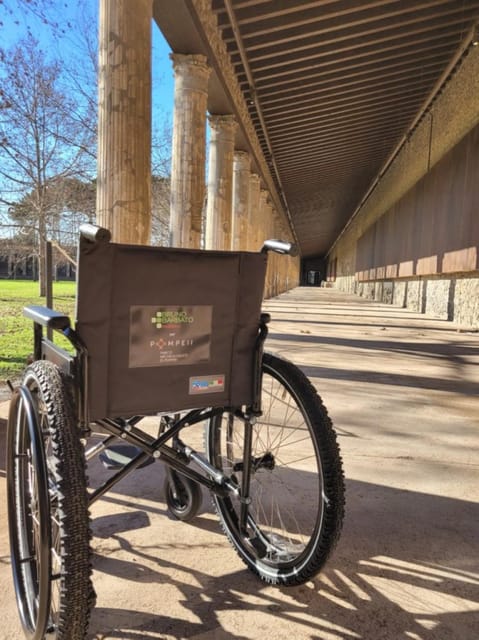
An all-terrain wheelchair with rugged wheels is recommended because of the steep and uneven ground. One visitor found a freewheel especially useful for the bumps. That is a practical piece of advice, not a minor extra.
The tour also suits people who value control over speed and focus. You can ask the guide to explain Roman daily life, spend more time at a particular site, or take a break when needed.
Booking details that matter
You can cancel up to 24 hours before the start for a full refund. The reserve-now, pay-later option lets you hold a place without paying immediately, which is useful while you confirm your Naples schedule and transport needs.
At booking, provide:
- The names of all travelers
- The dates of birth for all travelers
- Your accommodation or pickup point, if you want transport
- The wheelchair’s size
- Details about your mobility and assistance needs
Bring a passport or ID card. You may also need proof of disability from your home country to receive the free admission available to wheelchair users and one assistant.
The guide meets you at Pompeii, even when the driver brings you from Naples. Keep those two parts clear in your plan: the driver handles the accessible transfer, while the guide handles the archaeological visit.
Should you book it?
Book this tour if reaching Pompeii independently would be stressful, or if you want a private guide who can adjust the route and pace around your wheelchair. The ramp-equipped van, ticket assistance, accessible paths, and personal attention create a practical way to see a site that can otherwise be hard to manage.
Do not book it expecting a perfectly level archaeological park. Pompeii remains rough, hilly, and uneven, with a few areas that may require standing or walking. If you bring an all-terrain chair, explain your needs in advance, and accept that the route will cover selected parts of the city, this is one of the more sensible ways to include Pompeii in a Naples visit.
FAQ
Is the Pompeii tour wheelchair accessible?
Yes. The tour follows a wheelchair-accessible itinerary using paved paths and ramps in selected areas of the excavations. Pompeii still has steep and uneven terrain, so an all-terrain wheelchair with rugged wheels is recommended.
Does the tour include transport from Naples?
Transport is included only when you select the option with pickup. The accessible vehicle can collect you from a hotel, Naples cruise terminal, train station, or airport.
How many people can the wheelchair-accessible van carry?
The special vehicle can carry four passengers plus one person in a wheelchair. It has a ramp, and the driver assists with getting in and out.
Where do I meet the Pompeii guide?
You meet the guide at the Pompeii Amphitheater entrance, also called Piazza Anfiteatro. The guide provides the entrance tickets there.
Are Pompeii admission fees included?
Pompeii fees are included. Wheelchair users and one personal assistant can receive free admission with proof of identification from their home country.
Which languages are available for the guided tour?
The live guide is available in English, Spanish, Italian, French, and German.
Newest reviews from Pompei Campania
- From Sorrento: Pompeii & Vesuvius tour small group★ 4.8 · 4 reviews
- Pompeii Private Tour for Kids and Their Families★ 4.8 · 4 reviews
- From Naples_ Pompeii Tour_Skip the line ticket + audioguide★ 4.3 · 4 reviews
- Pompeii, skip-the-line ticket with smartphone audio guide on App★ 3.0 · 4 reviews
- Pompeii Guided Experience – Tour Service Only★ 4.6 · 4 reviews
- From Naples Port:Pompeii+Vesuvius tour★ 4.3 · 4 reviews
- 2-Hour Pompeii Child-Friendly Tour★ 5.0 · 4 reviews
- Naples: Amalfi Coast, Sorrento and Pompeii Day Trip★ 4.4 · 5 reviews
Guided, compared.

Entry Ticket and Guided Tour with an Archaeologist
Read our review →

Skip-the-Line Entrance Ticket with Audio Guide
Read our review →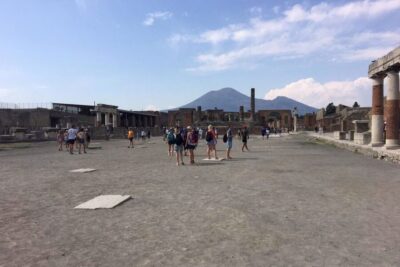



Skip-the-Line Entry Ticket with Digital Guide App
Read our review →