Reviewed · VIP
From Naples: Pompeii Ruins VIP Guided Tour
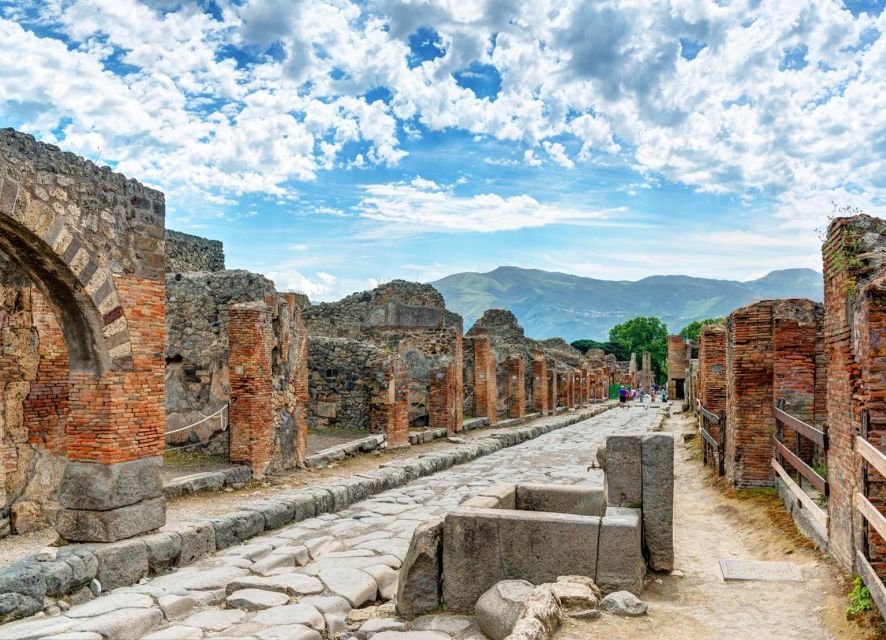
Pompeii is not a museum of isolated objects. It is a Roman city you can walk through, with streets, bakeries, villas, baths, theaters, and colorful mosaics still in place after the eruption of Vesuvius in 79 AD. This small-group tour from Naples gives you a useful two-hour route through the ruins without leaving you to figure out the site alone.
I like the round-trip transfer with air conditioning, especially on a hot Campania day, and I like the chance to hear the city’s story while standing in the actual places where Romans worked, shopped, relaxed, and watched performances. The main consideration is that a live guide is provided only when at least six people book in the same language. Smaller language groups receive an audio guide instead.
In This Review
- Key points to know before booking
- Leaving Naples for the streets of Pompeii
- Entering the archaeological park with less waiting
- What you see during the two-hour Pompeii walk
- The ancient shopping street and preserved food shops
- The forum and public buildings
- The theaters and amphitheater
- Villas, mosaics, and the Villa of the Mysteries
- The necropolis and bath houses
- Why the eruption story matters here
- Live guide, audio guide, and language limits
- The possible cameo and coral workshop
- Is $135.94 a fair price?
- Timing, comfort, and what to bring
- Who will get the most from this Pompeii tour?
- Should you book the From Naples Pompeii VIP Guided Tour?
- FAQ
- How long does the Pompeii tour last?
- What is included in the price?
- Is a live guide guaranteed?
- Which languages are available?
- Where does pickup take place in Naples?
- What should I bring?
- Is the tour suitable for wheelchair users?
Key points to know before booking

- Two hours inside Pompeii: Enough time for major sights, but not enough to see every corner of this large archaeological park.
- Separate entrance for skip-the-line access: This can save useful time during busy periods.
- Groups capped at 12 participants: Smaller than a standard coach excursion, though the actual group may vary.
- Live guide or audio guide: Italian, English, and Spanish tours may have a guide with six or more participants. French, Portuguese, Polish, Chinese, German, and Japanese use audio guidance.
- Possible cameo and coral stop: If time permits, you may visit a local workshop to learn about jewelry made from coral and seashells.
- Not designed for limited mobility: The tour involves walking over an ancient archaeological site and is not suitable for wheelchair users or people with mobility impairments.
Leaving Naples for the streets of Pompeii
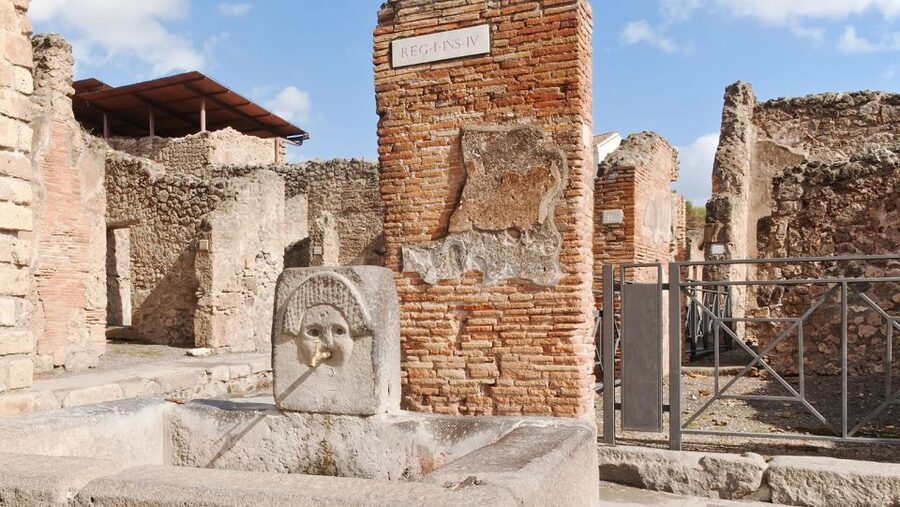
The experience begins with pickup at a selected meeting point in Naples. This is not a door-to-door service from every hotel, so you need to confirm the exact meeting place and pickup time with NapoliCityVision before the morning of the tour. Arrive early. The driver waits only five minutes for late arrivals, which is not much time in Naples traffic.
The transfer matters because Pompeii is outside central Naples, and arranging your own train or taxi adds another layer to the day. Here, transport, admission, and the walking tour are bundled together. The ride is also a welcome break from the sun. The vehicle used on this experience has air conditioning, a detail that becomes especially valuable in hot weather.
The total activity lasts about three and a half hours, including transport and the visit. That makes it a practical choice if you have only part of a day in Naples, though you should not expect a slow, all-day exploration of Pompeii.
More Pompeii excavation visits:
- Pompeii: Entry Ticket and Guided Tour with an Archaeologist
★ 4.8 · 19,459 reviews - Pompeii: Small Group Tour with an Archaeologist
★ 4.8 · 12,264 reviews - Pompeii: Skip-the-Line Entrance Ticket with Audio Guide
★ 4.0 · 2,509 reviews
Entering the archaeological park with less waiting
The tour uses a separate entrance for skip-the-line access. It does not mean you will walk straight in without any possible checks or crowding, but it can cut down on the time spent in the main admission queue. That is important when your visit inside the ruins is scheduled for roughly two hours.
Pompeii is spread across a broad area, and the ground is uneven. Ancient paving stones can be awkward underfoot, with changes in level and worn surfaces. Comfortable shoes are essential, not just a nice extra. You should also bring a hat and sunscreen, since much of the route is exposed.
The site’s scale can be hard to grasp at first. You are not simply moving from one monument to the next. You are crossing a complete Roman town, where the remains of private homes sit beside commercial streets and public buildings. A guide helps connect those pieces so the ruins feel less like scattered walls.
What you see during the two-hour Pompeii walk
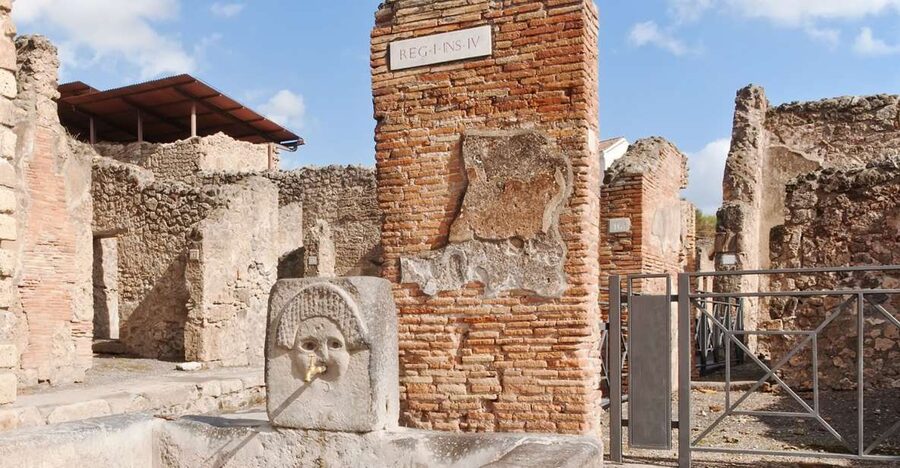
The exact order can change, but the route is designed around Pompeii’s main sights and the daily life of its residents. You can expect to visit several of the following areas during the guided walk.
The ancient shopping street and preserved food shops
One of the most memorable parts of Pompeii is its commercial side. You walk along an old shopping street lined with shops, bakeries, and food counters. The preserved structures give you a clearer sense of how ordinary business worked in the city than a grand villa alone could provide.
The mention of pizzerias needs a little care. These were not modern restaurants serving the familiar dish you might order in Naples today. The route uses the term to describe preserved bakeries and food shops, places that show how Romans bought and prepared food. The point is not to find a slice of pizza, but to see the working spaces of an ancient town.
I find this part especially useful because it shifts attention away from wealthy homeowners and famous mosaics. Pompeii also belonged to shopkeepers, bakers, laborers, performers, and customers moving through the streets.
More Pompei Campania tours worth comparing
- Pompeii: Skip-the-line-Ticket and Guided Tour
★ 4.6 · 1,152 reviews - Pompeii: Guided Tour with Skip-the-Line Entry
★ 4.9 · 812 reviews - Pompeii: Skip-the-Line Entry Ticket with Digital Guide App
★ 4.1 · 770 reviews - Pompeii: Afternoon to Sunset Guided Tour with Ticket
★ 4.9 · 484 reviews
The forum and public buildings
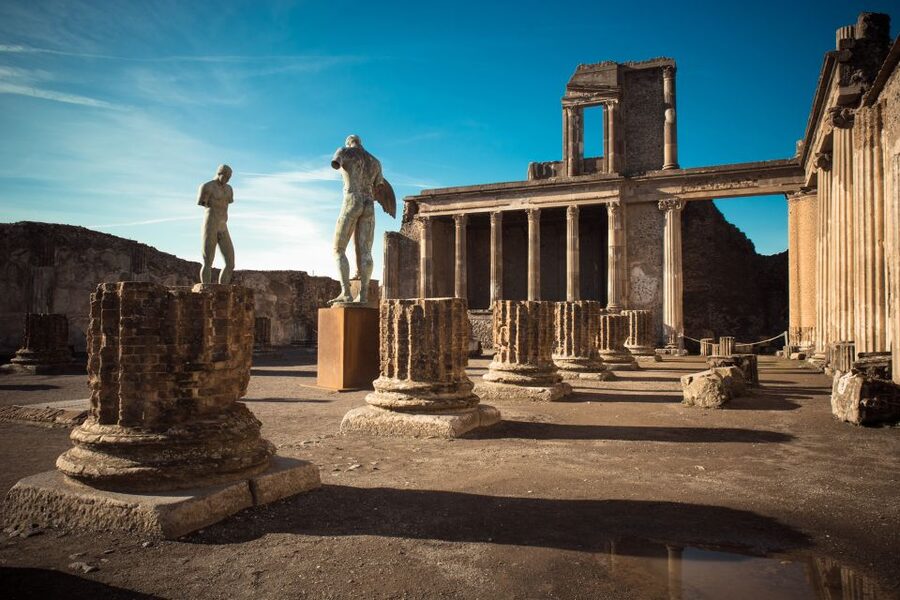
The forum was Pompeii’s civic center. It is the place to think about public life, politics, trade, religion, and ceremony. Standing among its remains helps you picture the city as an organized community rather than a collection of private houses.
You also visit public buildings connected with Roman leisure and daily routines. The itinerary includes the bath houses, where social life and bathing were closely linked, and the theaters, where citizens watched performances.
The guide’s storytelling is important here. A row of stone seats or a broad open square does not explain itself. A good explanation turns architecture into a picture of how people spent their time. The guide is also expected to tell the story of the eruption in 79 AD and explain how ash and volcanic material buried the city.
The theaters and amphitheater
Pompeii had places for public entertainment, including a theater and an amphitheater. These remains show that performance and spectacle were not side issues in Roman life. They were part of the city’s rhythm.
The amphitheater is one of the traditional highlights included on the route. You may not have much time to linger, since the overall Pompeii visit lasts about two hours, but the stop gives you a sense of the size and planning of public venues.
If you like ancient architecture, pay attention to how the buildings use seating, entrances, and open space to handle large crowds. If you prefer domestic life to monuments, the theaters may feel less personal than the homes and shops. The route balances both.
Villas, mosaics, and the Villa of the Mysteries
Pompeii’s private homes are where the city’s social differences become visible. The tour includes villas, including the house described as belonging to the richest man in Pompeii. Large residences, decorated rooms, and carefully laid floors provide a contrast with the more practical spaces along the shopping streets.
The colorful mosaics are another highlight. They survived because the eruption buried the city under layers of ash and debris, protecting details that would otherwise have been lost to weather, rebuilding, and time. You can see decorative art in its original setting rather than behind glass in a modern gallery.
The Villa of the Mysteries is among the best-known sites on the planned route. Its name comes from the mysterious painted scenes found inside. You should not expect the full villa to be open in every possible configuration, since access at archaeological sites can change, but the tour specifically identifies it as a sight to see.
These homes are visually impressive, yet they also need explanation. Without context, it is easy to admire the paint and mosaic patterns without understanding how rooms were arranged or how a wealthy Roman household differed from a shop or bakery.
The necropolis and bath houses
The necropolis, or burial area, adds another piece to the city’s story. It sits outside the main urban zone and shows how Pompeii marked the boundary between the world of the living and the dead.
The bath houses offer a different view of routine. Roman bathing was not only about washing. It was part of social life, and the remains help explain how public facilities served the community.
These stops may appeal most if you want more than the famous forum and amphitheater. They also make the city feel more complete. Pompeii had homes, businesses, entertainment, public services, and spaces connected with death. In two hours, you will get a sample of each.
Why the eruption story matters here
Pompeii’s appeal comes from the unusual condition of the remains. The eruption of Mount Vesuvius buried the city in 79 AD, preserving streets, buildings, wall paintings, mosaics, shops, and household details for centuries.
The experience is not simply a lesson about a disaster. The eruption explains why the city can be read so clearly. You see a place interrupted, not just a ruin slowly worn down over many centuries. That sharp break in daily life gives the walking tour its emotional weight.
A guide can make the difference between hearing a date and understanding the event’s effect on the city. The route is built around Roman life before the eruption, then shows how the disaster preserved that life in place.
Live guide, audio guide, and language limits
Live guiding is available in Italian, English, and Spanish, but only if at least six people join in the same language. Groups of up to five participants receive an audio guide instead. This is the most important uncertainty to understand before booking.
A live guide brings flexibility. You can follow a story, hear explanations matched to the building in front of you, and possibly ask questions as you walk. The supplied feedback points to strong storytelling and an informative, friendly approach, including a particularly complete French-language experience when that option was available.
The audio guide is not necessarily a deal breaker. It can let you move at your own pace and focus on the rooms that interest you. Still, it is less personal, and you should not book this tour assuming a live guide is guaranteed in your language.
The tour may also be bilingual. That can be efficient, but it may mean explanations take longer or alternate between languages. If you want a fully private or single-language experience, this is not that kind of tour.
The possible cameo and coral workshop
If time permits, the transfer or outing may include a stop at a local factory where you learn about cameo and coral craft. These are jewelry-making traditions using coral and seashells.
This stop is secondary to Pompeii. It is not guaranteed, and the two-hour archaeological walk is the central reason to book. If you enjoy local crafts, it may add a useful look at a Campania tradition. If you want every available minute among the ruins, you may see it as an interruption.
The wording matters: this is a factory visit, not a second major attraction with a separate sightseeing program. Keep your expectations modest and treat it as an optional addition if the schedule allows.
Is $135.94 a fair price?
At $135.94 per person, this is not the cheapest way to reach Pompeii. The value comes from combining round-trip transport from Naples, the Pompeii entry ticket, skip-the-line access through a separate entrance, and a planned walking tour.
You are also paying for simplicity. You do not need to buy a separate ticket, work out the route from Naples, or build your own two-hour plan inside the park. For a first visit, that can be worth a fair part of the cost.
The price is harder to justify if you already know Pompeii well, prefer an independent visit, or are comfortable managing public transport and admission yourself. You also need to remember that food and drinks are not included.
The small-group limit of 12 is another part of the value. It should feel more manageable than a large coach group, though it is not a private tour. The actual guide arrangement depends on the number of people who book in each language.
Timing, comfort, and what to bring
The tour lasts about three and a half hours, with around two hours at Pompeii. That is enough for a focused first look, but you will need to keep moving. If you want to study every villa, spend long periods photographing mosaics, or explore side streets at your own pace, plan a longer independent visit instead.
Wear shoes with firm soles. The ancient streets are uneven, and the route is a walking tour rather than a drive through the site. A hat and sunscreen are strongly advised. Bring water even though food and drinks are not included.
Oversize luggage is not allowed. Pack lightly and leave large bags elsewhere before pickup. The tour is not suitable for wheelchair users or people with mobility impairments, so anyone concerned about walking conditions should consider a different arrangement.
Who will get the most from this Pompeii tour?
I would choose this experience if you are staying in Naples, want transport handled for you, and prefer a focused introduction to Pompeii. It is also a good fit if you want the major Roman sights explained rather than simply photographed.
The tour suits first-time visitors who value structure. The route covers the forum, theaters, amphitheater, baths, necropolis, villas, shops, mosaics, and the Villa of the Mysteries, giving you a broad sample of the city in limited time.
It is less suitable if you need a fully accessible route, dislike fixed schedules, want a guaranteed live guide in a specific language, or hope to spend most of the day at the archaeological park. The five-minute late policy also makes punctuality important.
Should you book the From Naples Pompeii VIP Guided Tour?
Book it if you want a practical half-day outing with transport, admission, skip-the-line access, and a compact Pompeii route handled in one reservation. The air-conditioned transfer is a real benefit in hot weather, and the two-hour walk covers the city’s most important types of places.
Before paying, confirm the pickup location, start time, and whether your language group is large enough for a live guide. If you understand that the tour may be bilingual or audio-guided, and you are comfortable with a brisk walk over uneven ground, the $135.94 price can be reasonable for convenience.
Skip it if you want a private guide, a guaranteed language-specific live tour, or a full day to explore every open section. Pompeii rewards time, but this experience gives you a well-organized first look without asking you to manage the logistics alone.
FAQ
How long does the Pompeii tour last?
The full activity lasts about three and a half hours. The guided visit inside Pompeii lasts approximately two hours.
What is included in the price?
The price includes round-trip transfer from selected meeting points in Naples, Pompeii Archaeological Park admission, and the Pompeii walking tour. Food and drinks are not included.
Is a live guide guaranteed?
No. A guide is provided when at least six participants book in the same language. Groups of up to five participants receive an audio guide instead.
Which languages are available?
Live tours are available in Italian, English, and Spanish. Audio guides are available in French, Portuguese, Polish, Chinese, German, and Japanese.
Where does pickup take place in Naples?
Pickup is available from selected meeting points in Naples. You should contact NapoliCityVision to confirm the exact location and pickup time.
What should I bring?
Bring comfortable shoes, a hat, and sunscreen. Oversize luggage is not allowed.
Is the tour suitable for wheelchair users?
No. The experience is not suitable for wheelchair users or people with mobility impairments.
Newest reviews from Pompei Campania
- From Sorrento: Pompeii & Vesuvius tour small group★ 4.8 · 4 reviews
- Pompeii Private Tour for Kids and Their Families★ 4.8 · 4 reviews
- From Naples_ Pompeii Tour_Skip the line ticket + audioguide★ 4.3 · 4 reviews
- Pompeii, skip-the-line ticket with smartphone audio guide on App★ 3.0 · 4 reviews
- Pompeii Guided Experience – Tour Service Only★ 4.6 · 4 reviews
- From Naples Port:Pompeii+Vesuvius tour★ 4.3 · 4 reviews
- 2-Hour Pompeii Child-Friendly Tour★ 5.0 · 4 reviews
- Naples: Amalfi Coast, Sorrento and Pompeii Day Trip★ 4.4 · 5 reviews
VIP, compared.

Private Luxury Minivan Full-Day Amalfi Coast Driving Tour
Read our review →



From Sorrento or Positano: Capri Island Private Boat VIP Tour
Read our review →
Capri Exclusive Premium Semi-Private Luxury Tour
Read our review →
VIP Pompeii Tour including Newly Opened Houses With Archaeologist
Read our review →