
Reviewed · SKIP THE LINE
Skip the line Pompeii Guided Tour
Pompeii is too large to tackle casually. This four-hour guided visit gives you a clear route through the city’s Forum, baths, brothel, theater, and main street, with an English-speaking guide explaining what you are seeing instead of leaving you to decode a maze of stones. I like the included entrance ticket and transport from Sorrento or Naples, two details that remove much of the day’s usual fuss.
I also like the early-tour advantage: Pompeii can become intensely hot, and one family found the morning timing much easier with young children. The trade-off is pace. You get a useful introduction to a large section of the ruins, but you will not have time to roam every open lane or linger at each house.
In This Review
- Key points to know before booking
- Why a guided Pompeii visit makes sense
- From Sorrento or Naples to the archaeological park
- The Forum and Temple of Jupiter
- The Macellum, Pompeii’s ancient food market
- Walking Via dell’Abbondanza
- The Stabian Baths and Roman daily life
- The brothel and Pompeii’s less polished side
- Teatro Grande and the final stretch
- How fast is the pace?
- Price, group size, and what you receive
- Who should book this Pompeii tour?
- Should you book it?
- FAQ
- How much does the Skip the Line Pompeii Guided Tour cost?
- How long does the Pompeii tour last?
- Where does the tour depart from?
- Is transportation included?
- Is Pompeii admission included?
- Is the tour offered in English?
- Are headsets provided?
- Is lunch included?
- What happens if I need to cancel?
Key points to know before booking
- Pompeii’s main sights in one focused route: See the Forum, Temple of Jupiter, food market, Via dell’Abbondanza, baths, brothel, and Large Theatre.
- Transport from Sorrento or Naples: A 30-seat bus and meeting-point pickup make this practical if you do not want to arrange regional transport yourself.
- Two hours with an authorized English guide: Headsets help you follow the explanation in a large archaeological site.
- Strong guide reports: Gino receives particular praise for making Pompeii understandable and engaging.
- Good value for a first visit: The $96.38 price includes admission, transport, and the guided portion, though lunch is extra.
- A quick taste, not a full-day excavation visit: The route moves briskly, and unexpected transport changes have caused delays for at least one booking.
Why a guided Pompeii visit makes sense
Pompeii is not a single monument with a neat entrance, one grand staircase, and a quick exit. It is an ancient city, with streets, homes, public buildings, shops, bath complexes, religious sites, theaters, and commercial spaces spread across a wide archaeological park.
That scale is the reason I would consider a guide here. Without context, a broken wall can look like just another broken wall. A guide can point out how the Forum worked, explain the layout of a Roman bath, and show why a modest-looking building mattered to daily life.
This tour gives you about two hours with an authorized English-speaking guide inside the park. You will wear headsets, which is useful when the group is walking across open spaces or when other groups are nearby. The group can be large, with a stated maximum of 100 people, although transport is described as a 30-seat bus. That means you should expect a group experience rather than a private walk.
The strongest guide feedback is specific. Gino is praised for being informative and for making the site easier to understand. Other guide comments describe a well-organized visit in which the guide kept the group moving while still covering a substantial section of Pompeii.
The value is not just the admission ticket. You are also paying for the transport connection, a planned route, and help putting the ruins into human terms. At $96.38 per person, this is not the cheapest way to enter Pompeii, but it can make sense if you are staying in Sorrento or Naples and want one booking to handle the main pieces.
More Pompeii excavation visits:
- Pompeii: Entry Ticket and Guided Tour with an Archaeologist
★ 4.8 · 19,459 reviews - Pompeii: Entry Ticket with Optional Audio Guide
★ 4.2 · 12,360 reviews - Pompeii: Small Group Tour with an Archaeologist
★ 4.8 · 12,264 reviews
From Sorrento or Naples to the archaeological park
The tour includes pickup at a designated meeting point in Sorrento or Naples. The exact meeting location matters, so check your confirmation carefully and allow enough time to reach it. The tour is near public transportation, but the point of the package is to avoid arranging the full journey to Pompeii on your own.
Transport is generally by 30-seat bus. One booking had an unusual problem when a bus suffered a mechanical issue and a small group was moved into a private minivan while the operator reorganized the day. That solution avoided cancellation, but it also led to a wait, a stop at a gift shop, and an earlier departure from Pompeii than expected.
I would treat that as a useful warning rather than a reason to reject the tour. Shared excursions can be affected by vehicle problems and by the need to coordinate several groups. Still, if completing every minute of the planned visit is essential to you, ask at the meeting point how the return arrangements work and keep your confirmation details handy.
The trip lasts about four hours overall. Since only part of that time is spent inside the ruins, the remainder covers transport and the tour’s organization. This format suits you if you want Pompeii as a half-day outing, perhaps with time left for Sorrento or Naples afterward.
The Forum and Temple of Jupiter
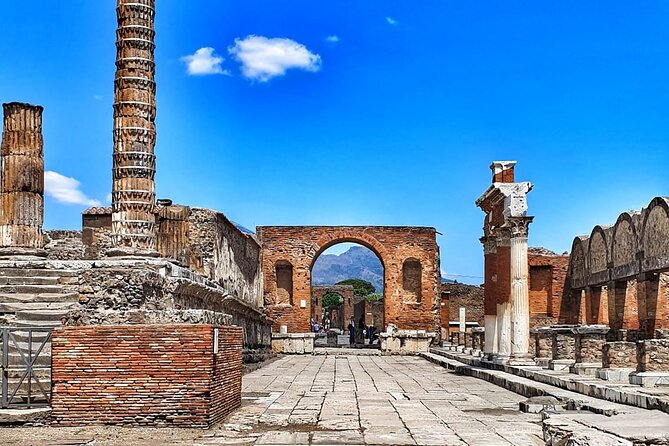
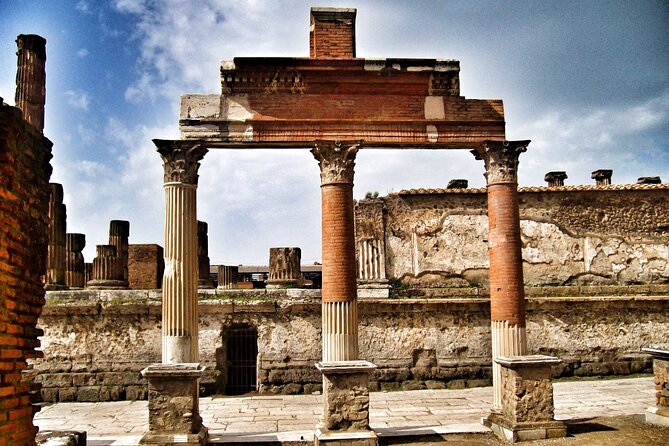
The Forum is the natural place to begin understanding Pompeii. This broad public center held the city’s main administrative, legal, commercial, and religious buildings. It was where public business happened and where the city’s major institutions faced one another.
The tour allows about 10 minutes at the Forum, followed by 15 minutes at the Temple of Jupiter. That is enough for a guide to orient you and explain the major buildings, but not enough for a slow photographic study of every column and pavement.
The Temple of Jupiter sits at the north end of the Forum, with Mount Vesuvius rising behind it. The view connects the city’s public life with the volcano that buried it in 79 AD. After Pompeii became a Roman colony in 80 BC, the temple was reshaped as a Capitolium dedicated to Jupiter, Juno, and Minerva.
This is one of the most useful guided moments because the ruins are easier to read when you know what stood here. Look for the high base and the temple’s dominant position at the end of the Forum. You may also find this stop crowded, since it is one of the most recognizable views in the park.
The Macellum, Pompeii’s ancient food market
The Macellum was the city market, located northeast of the Forum. Its covered porticoes helped contain the activity of people buying food, while keeping the market from clogging the main public square.
You have about 15 minutes here. The complex included a raised hall used for worship, and the portico walls were decorated with scenes from daily life, including the sale of fish and poultry, along with mythological subjects.
This stop adds something important to the visit: Pompeii was not only a city of temples and grand public buildings. People also had to buy food, conduct business, and move through ordinary commercial spaces. The Macellum helps connect the grand Forum with the practical routines of city life.
Because the route is brisk, listen for the guide’s explanation rather than trying to inspect every surviving detail. The value lies in seeing how the market fitted into the city’s plan.
More Sorrento tours worth comparing
- Pompeii: Skip-the-Line Entrance Ticket with Audio Guide
★ 4.0 · 2,509 reviews - Sorrento: Skip-the-Line Pompeii Express Tour by Train
★ 4.8 · 2,038 reviews - Pompeii: Skip-the-line-Ticket and Guided Tour
★ 4.6 · 1,152 reviews - Pompeii: Guided Tour with Skip-the-Line Entry
★ 4.9 · 812 reviews
Walking Via dell’Abbondanza
Via dell’Abbondanza is one of Pompeii’s main streets, linking the Forum with the Amphitheatre. The tour spends about 10 minutes here, using the street as a passage between major sights and as an example of how the city was laid out.
A street in Pompeii can tell you a great deal. Its direction, buildings, storefronts, and connection to public spaces show how residents moved around the city. The route also gives you a sense of Pompeii’s size, which is difficult to grasp from a map or a few isolated buildings.
Do not expect a long free walk along the entire street. This is a guided section of a larger route. If you enjoy wandering without a schedule, you may wish for more time, but the organized pace helps you reach the baths, brothel, and theater within the four-hour outing.
Wear sensible shoes and be ready for uneven ancient paving. The tour information does not list special mobility restrictions, and most people can participate, but Pompeii is an archaeological ruin rather than a smooth modern museum.
The Stabian Baths and Roman daily life
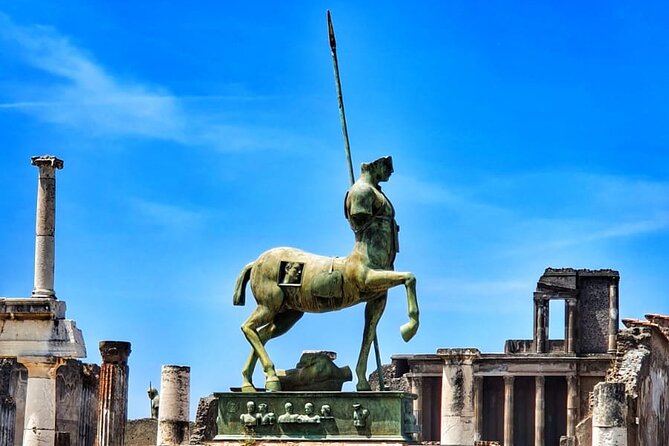
The Stabian Baths are among the best places on this route to see how Roman public facilities worked. The complex developed over several periods, with its first construction dating to the fourth century BC. Its entrance from Via dell’Abbondanza leads into a large courtyard.
The men’s section included an apodyterium, or changing room, a frigidarium for cold baths, a tepidarium for warm baths, and a caldarium for hot baths. The women’s area followed a similar pattern, though it was smaller and less decorated.
You have about 15 minutes here. That sounds brief, but a guide can explain the basic sequence quickly and point out the heating system. Hot air moved through pipes in the walls and spaces beneath double floors, using heat from furnaces and portable braziers.
The baths are valuable because they reveal the engineering behind Roman comfort. They also show that bathing was a social and civic activity, not simply a private chore. I would pay close attention to the layout rather than rushing to take photographs of every room.
The brothel and Pompeii’s less polished side
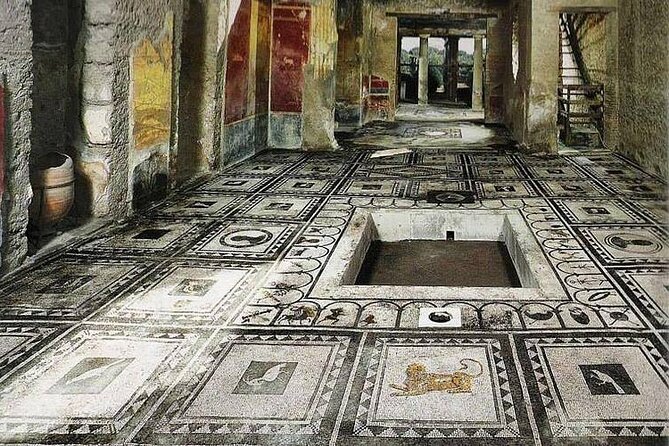
The building commonly identified as Pompeii’s brothel is one of the site’s most talked-about stops. It contains erotic paintings and five small lower rooms, each fitted with a built-in bed. The upper floor held living areas for the owner and enslaved workers.
The tour allocates about 15 minutes. The building gives you a direct look at a commercial side of Roman life that is often softened in general museum presentations. The prostitutes were mostly enslaved people from Greek and Eastern regions, an important reminder that the building’s history also involves coercion and social inequality.
The name comes from lupa, a Latin word associated with a prostitute. Its popularity can create congestion, and the small rooms do not allow much space for lingering. Keep your expectations practical: this is a short interpretive stop, not an extended museum visit.
For many people, the brothel is memorable because the erotic paintings survive in place and because the building is so compact. A good guide can give the site social context instead of reducing it to a sensational curiosity.
Teatro Grande and the final stretch
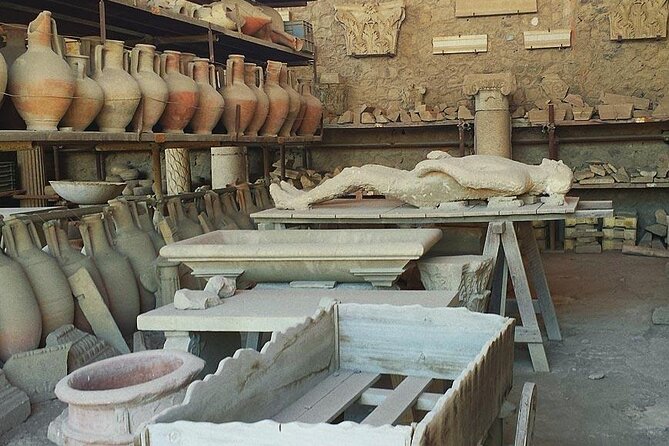
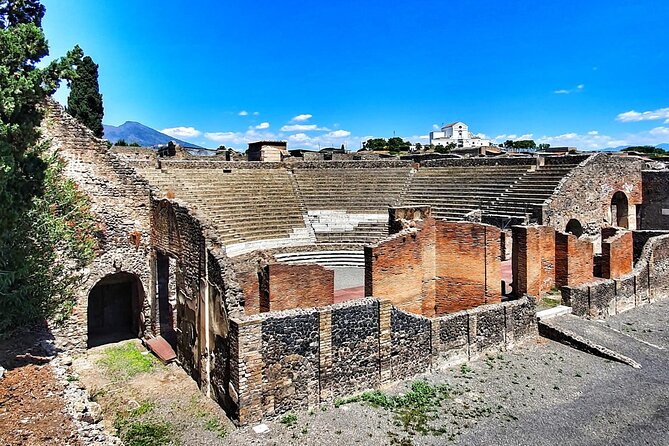
The Large Theatre was built around the middle of the second century BC and later restored in Roman style. Comedies and tragedies based on Greek and Roman traditions were performed here, making it one of Pompeii’s clearest reminders that the city had a serious public culture.
The theatre was the first large public building at Pompeii to be fully cleared of volcanic deposits after the eruption. You have about 15 minutes to see it and hear how it functioned.
This is a fitting final stop because it brings together the public character of the city. The Forum handled civic life, the baths served social routines, the market handled food and commerce, and the theater provided entertainment and performance.
By the end of the route, you will have seen a broad cross-section of Pompeii. You will not have covered every neighborhood or open building, but you should leave with a clearer sense of how the city worked.
How fast is the pace?
The pace is one of the most important booking decisions. The listed stops add up to a little over three hours, while the guided portion is stated as two hours, so you should expect some stops to be brief and some of the route to be covered while walking between sites.
One family traveling with very young children found the tour useful and felt it offered good value, but also found the guide moved faster than expected. That is normal for a group trying to cover major sights in a limited window. You may need to stay close, especially in crowded areas.
The early timing is a real advantage in warm weather. Pompeii has little shade across some sections, and the heat can become tiring by lunchtime. If you are visiting with children, older relatives, or anyone who struggles in hot conditions, an early departure is worth favoring when available.
You should also plan for no included lunch. The tour is designed as a half-day experience, not a full-day outing with a meal break. Bring what you need for the morning according to the operator’s instructions, and do not assume there will be time to stop during the guided route.
Price, group size, and what you receive
At $96.38 per person, the package includes:
- Pickup at a meeting point in Sorrento or Naples
- Transport by 30-seat bus
- An authorized English-speaking guide for two hours
- Headsets
- Pompeii admission
Lunch is not included. The maximum group size is listed as 100 people, so the total booking capacity can be much larger than one bus. That makes the headsets especially useful, but it also reinforces that this is a shared excursion.
I see the price as reasonable for someone who values convenience. Buying your own Pompeii ticket and arranging transport may cost less, but you would also need to manage the route, timing, and interpretation yourself. The tour earns its keep when you want a direct connection from Sorrento or Naples and a guide to explain the site.
It is less attractive if you already have transport, prefer audio guides, or want several hours to explore independently. In that case, the fixed route and short stops may feel restrictive.
The experience is recommended by 92 percent of participants and carries a 4.7 rating from 24 reviews. That is a positive signal, though the sample is not huge. The praise centers on the guides, organization, comfortable transport, and drivers. The main caution concerns transport changes, delays, gift-shop stops, and leaving before the full planned time.
Who should book this Pompeii tour?
I would choose this tour if you are based in Sorrento or Naples, want Pompeii in half a day, and prefer a planned visit over a do-it-yourself route. It is especially suitable for a first visit, since the guide introduces the Forum, public buildings, streets, baths, commercial spaces, and theater in one coherent circuit.
Families may appreciate the transport and early timing, but small children still need patience and close attention on uneven ground. The tour can move quickly, so it is not ideal if you need frequent breaks or want to inspect every room.
History fans who want to study houses, frescoes, and lesser-known corners should look for a longer visit instead. The same is true if you want free time for photographs or a relaxed lunch near the site.
Before booking, check the meeting point, make sure the English language suits your group, and note the cancellation rule. You can cancel for a full refund up to 24 hours before the start time. Changes made inside that window are not accepted, and poor weather may lead to a new date or a full refund.
Should you book it?
Book this Pompeii tour if your priority is easy transport and clear guidance. You will see the city’s essential public and social spaces, hear useful explanations through a headset, and avoid spending your limited holiday time planning every step.
Skip it if you want to wander freely, stay inside the ruins for most of a day, or control the return time yourself. For a first look at Pompeii from Sorrento or Naples, though, this is a sensible and fairly efficient choice. Keep close to the guide, expect a brisk walk, and treat the route as a strong introduction rather than the final word on the ancient city.
FAQ
How much does the Skip the Line Pompeii Guided Tour cost?
The listed price is $96.38 per person.
How long does the Pompeii tour last?
The experience lasts approximately four hours.
Where does the tour depart from?
Pickup is provided at a meeting point in Sorrento or Naples.
Is transportation included?
Yes. Transportation is provided by a 30-seat bus.
Is Pompeii admission included?
Yes. The entrance ticket to Pompeii is included.
Is the tour offered in English?
Yes. It includes an authorized English-speaking guide for two hours.
Are headsets provided?
Yes. Headsets are included so you can hear the guide clearly.
Is lunch included?
No. Lunch is not included in the tour price.
What happens if I need to cancel?
You can cancel up to 24 hours before the experience starts for a full refund. Cancellations or changes made less than 24 hours before the start time are not accepted, and poor weather may result in a different date or a full refund.
Newest reviews from Sorrento
- Private Stress-Free Tour from Sorrento: Ischia Island & Tastings★ 5.0 · 4 reviews
- Tour in the ruins of Pozzuoli with an archaeolgist.★ 5.0 · 4 reviews
- Vico Equense: Authentic Cooking Class at a Local’s Home★ 5.0 · 4 reviews
- Lemon Experience with Limoncello demonstration★ 5.0 · 4 reviews
- Path of the Lemons★ 5.0 · 4 reviews
- Private Tour Pompeii and Winery★ 5.0 · 4 reviews
- Positano Private Tour By Night from Sorrento★ 5.0 · 4 reviews
- Walking Secret Food Tours Sorrento with tastings★ 4.5 · 4 reviews
Skip the Line, compared.

Skip-the-Line Entrance Ticket with Audio Guide
Read our review →



Skip-the-Line Entry Ticket with Digital Guide App
Read our review →
Pompeii Ruins Private Tour with Optional Skip-the-Line Entry
Read our review →
Skip-the-Line Pompeii Guided Tour from Sorrento
Read our review →
Skip the Line Guided Tour of Pompeii led by an Archaeologist
Read our review →Browse the lists this tour appears in