
Reviewed · HERCULANEUM TOURS
Private Pompeii & Herculaneum Tour from Sorrento
Pompeii and Herculaneum tell the same volcanic story in two very different ways. Pompeii gives you broad streets, forums, shops, theaters, and public life under the shadow of Vesuvius. Herculaneum is smaller, but its homes, mosaics, wooden fittings, and seaside remains often feel more personal. This tour handles both sites in one long day from Sorrento.
I like the private air-conditioned transport, which saves you from sorting out trains and local connections. I also like the guided focus, since a good guide can turn a wall, bath, or market counter into a picture of Roman life. The drawback is the price, $769.43 per person, and the day can feel full, especially in summer heat.
In This Review
- Key points to know before booking
- Leaving Sorrento for the ruins of Vesuvius
- Pompeii: a city preserved in ash
- The Forum and Temple of Jupiter
- The Macellum and Via dell’Abbondanza
- The Stabian Baths and the Lupanar
- The House of the Faun and the theater
- Lunch between two archaeological parks
- Herculaneum: smaller, more intimate, and finely preserved
- The House of the Deer
- The Augustales and the House of the Skeleton
- The Central Baths
- The Wooden Partition House
- The boat and the ancient shore
- Why the guide matters at both sites
- Is $769.43 per person a fair price?
- Who should book this Sorrento day trip?
- Should you book it?
- FAQ
- Where does the tour begin and end?
- How long does the experience last?
- Are Pompeii and Herculaneum admission tickets included?
- Is transportation included?
- Is lunch included?
- Is this a private tour?
Key points to know before booking
- Two major Roman sites in one day: See Pompeii and Herculaneum without arranging separate transport.
- Pre-booked admission: Skip-the-line entry is included for both archaeological parks.
- A guide gives the ruins meaning: Learn about Roman homes, baths, elections, trade, religion, and entertainment.
- Pompeii is broad and demanding: Expect more walking across uneven ancient streets.
- Herculaneum offers finer preservation: Look for mosaics, woodwork, murals, and the famous boat.
- Lunch is not included: You get free time between sites, but food and drinks are your responsibility.
Leaving Sorrento for the ruins of Vesuvius
The day begins with pickup at your hotel or a central location in Sorrento. The listed meeting point is Piazza Torquato Tasso, 16, but hotel pickup in the Sorrento area is included when arranged in advance.
You ride in a private, air-conditioned vehicle toward Pompeii. That matters more than it may sound. Public transport from Sorrento is possible, but combining two large archaeological parks in one day requires careful timing. A private vehicle keeps the day moving and brings you back to Sorrento rather than leaving you to find your own way home.
The schedule lasts about eight hours, with a return around 4pm to 5pm. Exact timing depends on the agreed pickup time and the pace of your group. Wear shoes with good support. Pompeii has long stretches of ancient paving, and Herculaneum also requires steady walking.
Summer sun is a real concern. Bring sunscreen, water, and a hat. One practical weakness is that water is not included, so do not assume refreshments will be waiting in the vehicle.
More Pompeii excavation visits:
- Pompeii: Entry Ticket and Guided Tour with an Archaeologist
★ 4.8 · 19,459 reviews - Pompeii: Entry Ticket with Optional Audio Guide
★ 4.2 · 12,360 reviews - Pompeii: Small Group Tour with an Archaeologist
★ 4.8 · 12,264 reviews
Pompeii: a city preserved in ash
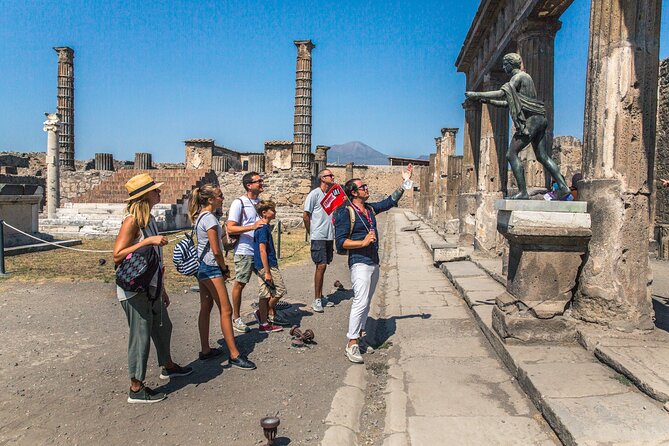
At Pompeii, you meet your private guide near the entrance to the archaeological park. The guide helps you get oriented before leading you through the key parts of a site that is too large to understand by wandering at random.
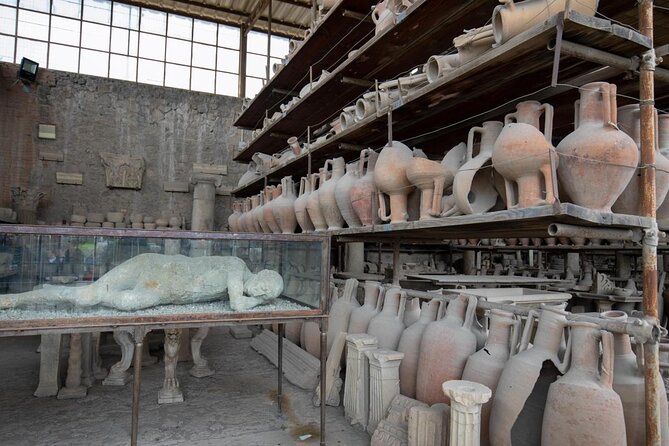
The eruption of Mount Vesuvius in AD 79 buried the city under ash and pumice. That sudden covering preserved streets, walls, shops, public buildings, wall paintings, and household objects in a way that lets you see more than grand ruins. You can follow the shape of ordinary life.
The guided Pompeii visit lasts about two hours, with a series of focused stops. That is enough time to see major highlights, but not every open house and street. Pompeii is vast, so this tour works best if you want a well-chosen introduction rather than an all-day archaeological survey.
The Forum and Temple of Jupiter
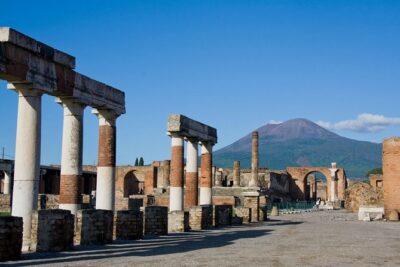
The Civil Forum was Pompeii’s main public square. Government, justice, business, trade, and religious life met here, so it is the right place to begin understanding how the city worked.
At the north end, the Temple of Jupiter looks toward Mount Vesuvius. Its high base once supported statues of Jupiter, Juno, and Minerva. Your guide can explain how the temple changed when Pompeii became a Roman colony in 80 BC.
The view toward Vesuvius gives the stop an added charge. You are not simply looking at an old temple. You are looking toward the volcano that destroyed the city.
The Macellum and Via dell’Abbondanza
The Macellum was a market complex with a covered courtyard and rooms connected to worship and trade. A masonry counter may have been used for selling fish, while other spaces related to the imperial cult.
From there, Via dell’Abbondanza gives you a more everyday picture. This was Pompeii’s main commercial street, running from the Forum toward the Sarno Gate. Shops and workshops lined the route, and electoral graffiti once covered the walls.
The raised stepping stones are among the most memorable details. They let people cross the street while avoiding runoff and mud. Look at the gaps between the stones, which were arranged so carts could pass.
More Herculaneum excavation visits:
- Pompeii and Herculaneum Small Group Tour with an Archaeologist
★ 5.0 · 1,350 reviews - Pompeii: Small-Group Tour of Pompeii and Herculaneum
★ 4.8 · 867 reviews - Ercolano: Herculaneum Entry Ticket with Optional Audio Guide
★ 4.1 · 581 reviews - Herculaneum: 3D Walking Tour with Skip-the-Line Ticket
★ 4.3 · 313 reviews
The Stabian Baths and the Lupanar
The Stabian Baths were Pompeii’s oldest and largest public bathing complex. Roman baths were not just places to wash. They were social centers, with separate sections for men and women, a changing room, heated rooms, a cold bath, an open-air exercise area, and a large pool.
The hypocaust heating system, which warmed floors from below, shows the engineering behind Roman comfort. Stucco decoration and the layout of the rooms help you picture the baths as an active public space rather than a bare ruin.
The Lupanar is a small but famous stop, known for its erotic wall paintings and compact rooms. It offers a blunt reminder that Pompeii was a working city with many kinds of business. The visit is brief, around five minutes, and the subject matter may not suit young children or every group.
The House of the Faun and the theater
The House of the Faun was one of Pompeii’s grandest private residences. Built in the second century BC, it reflects the wealth of an aristocratic Roman family. The house once contained major works of art, including the famous Faun sculpture that gives the residence its name.
The Teatro Grande provides a change of scale. This horseshoe-shaped theater held roughly 5,000 people and was built into a natural slope. It hosted comedies, tragedies, and pantomimes, showing how public entertainment reached well beyond Rome itself.
The Basilica, near the Forum, completes the civic picture. Despite its religious-sounding name, it was mainly used for business and the administration of justice. Its size, about 1,500 square meters, hints at the importance of legal and commercial life.
Lunch between two archaeological parks
After Pompeii, you have free time for lunch at your own expense before continuing to Herculaneum. This pause is useful. Two archaeological parks in one day require a break, and lunch gives you a chance to sit down, drink something, and reset before the second site.
Food and drinks are not included in the tour price. One account of the day described a convenient restaurant stop, but arrangements can vary, so ask your guide or driver where the break will take place. Budget for lunch and water separately.
This is also the point where the full-day pace becomes clear. You are not getting a slow, leisurely visit to either park. You are getting a practical way to see the strongest sights at both.
Herculaneum: smaller, more intimate, and finely preserved

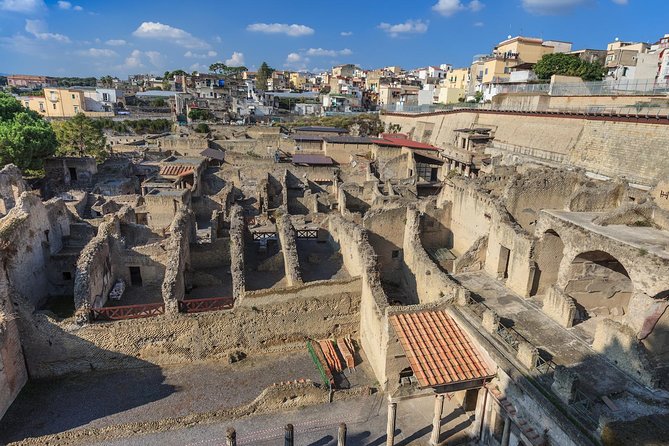
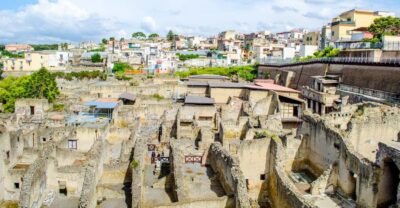
Herculaneum was buried by the same AD 79 eruption, but its fate differed from Pompeii. Mud and volcanic material encased the town, preserving details that are often lost elsewhere.
The site is smaller and more compact, which makes it easier to grasp during a shorter visit. The guided portion is listed at about two hours, followed by some free time to look around at your own pace.
I find Herculaneum especially valuable after Pompeii because the contrast becomes clear. Pompeii gives you the city’s public scale. Herculaneum brings you into the homes.
The House of the Deer
The House of the Deer was a large villa associated with a wealthy family. Before the eruption, it had a seafront position. Its central courtyard, two-storey design, murals, and still-life paintings show how much comfort and decoration could fit inside a Roman residence.
The setting helps you understand that Herculaneum was not only a modest town. Some homes were designed for status, leisure, and views toward the sea.
The Augustales and the House of the Skeleton
The College of the Augustales was linked to the worship of the emperor Augustus. It may also have served as a local civic headquarters. The building gives your guide a chance to explain how political loyalty and religion were joined in Roman public life.
The House of the Skeleton gets its name from human remains found in an upper room in 1831. The site also offers a sobering reminder that not everyone escaped the eruption. Some residents stayed inside their homes and died from suffocation or extreme heat.
This is one reason a guided visit helps. The physical remains are limited, but the circumstances behind them are powerful and easy to miss without context.
The Central Baths
Like Pompeii’s Stabian Baths, Herculaneum’s public baths had separate male and female sections. The basic sequence was practical: changing room, cold bath, warm room, and hot room.
The rooms remain unusually clear in their arrangement. You can follow the movement through the bathing complex and picture the system that made public bathing part of daily Roman routine.
After seeing both cities’ baths, you can compare their scale and decoration. Pompeii’s complex feels more expansive. Herculaneum’s is easier to read as a set of connected rooms.
The Wooden Partition House
The House of the Wooden Partition takes its name from a folding wooden door used to separate the atrium from the owner’s study. The survival of wood is one of Herculaneum’s great surprises.
Outside the façade, benches remain where clients waited to meet the head of the household. That small detail gives you a direct look at the social structure of a Roman home. The house was not only a private retreat. It was also a place for business, favors, and status.
The boat and the ancient shore
The Boat Room contains a wooden boat recovered from the ancient beach. Resinous material helped preserve it, and the boat was restored and displayed in position so you can see it as part of Herculaneum’s seaside story.
The beach area is tied to the final efforts of people who fled toward the shore. Men tried to protect women and children, but the volcanic flows and waves destroyed the port and beach.
This is a strong final stop because it shifts your attention from houses and public buildings to the human cost of the disaster.
Why the guide matters at both sites
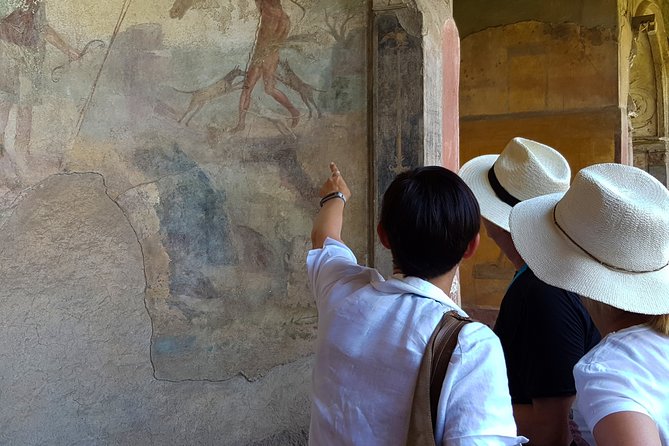
Pompeii and Herculaneum are not difficult because they lack things to see. They are difficult because they contain too much. Without help, you can walk past a market, bath, temple, or election notice without understanding its purpose.
A strong guide turns the route into a story about daily life. Guides named Ugo, Connie, Carmela, and Nella have led versions of this experience, with praise for clear explanations, answers to questions, and an engaging approach. Your assigned guide may differ, but the tour’s value depends heavily on that person’s ability to connect small details to the larger picture.
The private format should also let your group ask questions and adjust its attention. Still, check the group arrangement when you book. The activity is described as private, yet one account of a departure described a group of about 20. That may reflect a different operating setup, but it is worth confirming if privacy is important to you.
Is $769.43 per person a fair price?
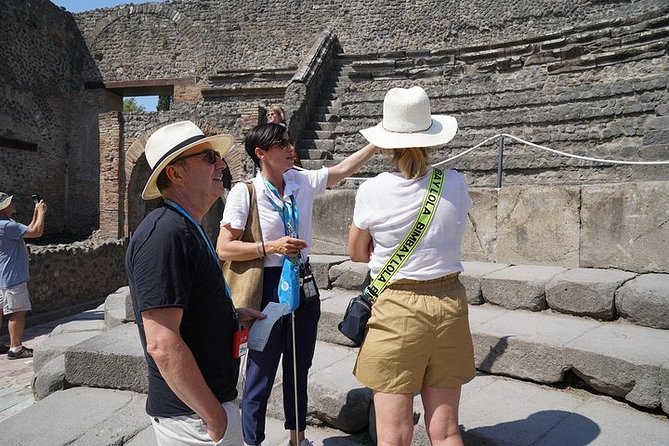
At $769.43 per person, this is an expensive day. The price makes more sense for a small private group that values door-to-door convenience, a dedicated guide, and the chance to cover both parks without planning transport.
You are paying for:
- Pickup and return in the Sorrento area
- Private transportation in an air-conditioned vehicle
- Guided visits at Pompeii and Herculaneum
- Skip-the-line admission at both parks
- A full day organized around two major sites
You are not paying for lunch, drinks, or personal extras. Group discounts are offered, so the per-person cost may change for larger bookings.
For a family or group that would otherwise need separate tickets, trains, taxis, and guides, the package may be reasonable. For a solo visitor or a couple on a tight budget, it is harder to justify. A cheaper shared option may offer similar sightseeing, though this particular experience emphasizes private transport and a private activity.
Who should book this Sorrento day trip?
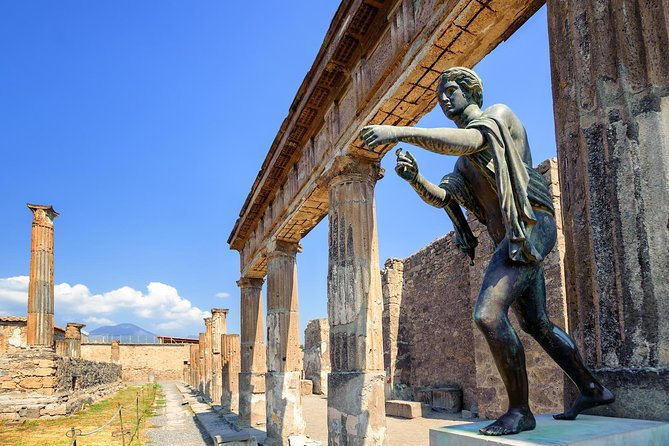
I would choose this tour if you are staying in Sorrento and want Pompeii and Herculaneum handled in one clean plan. It suits families, older adults who prefer vehicle transfers, and anyone who wants a guide to explain the ruins instead of reading every sign alone.
It also works well for a first visit. You get the main civic buildings, houses, baths, theater, market, and volcanic remains without having to decide in advance which parts of each park matter most.
I would hesitate if you want a slow archaeological study. The eight-hour schedule, two parks, lunch stop, and return drive leave limited time for quiet exploration. You should also think twice if summer heat affects you strongly. The sites offer little shade across long stretches, and comfortable shoes are essential.
Cancellation is free if you cancel at least 24 hours before the start time. Changes or cancellations made inside that window are not accepted for a refund.
Should you book it?
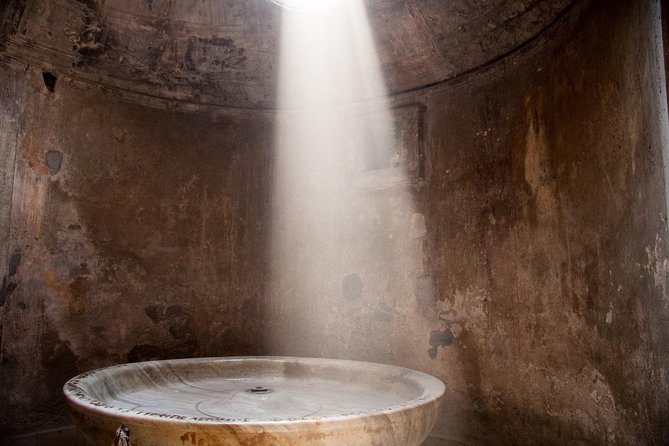
Book this Pompeii and Herculaneum tour if time and convenience matter more than price. The private vehicle removes much of the transport work, and the guide helps you make sense of two complicated sites in a single day.
The strongest reason to go is the contrast: Pompeii shows a broad Roman city, while Herculaneum brings you close to preserved homes, wood, mosaics, and the old shore. The main caution is cost and pace. If $769.43 per person fits your budget and you are ready for a warm, active day, this is a practical way to see both sites from Sorrento. If not, choose one park and spend more time there.
FAQ
Where does the tour begin and end?
Pickup is offered from hotels in the Sorrento area or from a central Sorrento location. The listed meeting point is Piazza Torquato Tasso, 16. The activity ends back at the meeting point or with return transfer to Sorrento.
How long does the experience last?
The tour lasts about eight hours. Return to Sorrento is expected around 4pm to 5pm, depending on the starting time and the day’s schedule.
Are Pompeii and Herculaneum admission tickets included?
Yes. Skip-the-line entrance tickets for both archaeological parks are included.
Is transportation included?
Yes. Pickup and drop-off in the Sorrento area are included, along with private transportation in an air-conditioned vehicle.
Is lunch included?
No. You have free time for lunch between the two sites, but food and drinks are at your own expense.
Is this a private tour?
The activity is described as private, meaning only your group should participate. Since group arrangements can vary, confirm the expected group size when booking if this is a key reason for your choice.
Newest reviews from Sorrento
- Private Stress-Free Tour from Sorrento: Ischia Island & Tastings★ 5.0 · 4 reviews
- Tour in the ruins of Pozzuoli with an archaeolgist.★ 5.0 · 4 reviews
- Vico Equense: Authentic Cooking Class at a Local’s Home★ 5.0 · 4 reviews
- Lemon Experience with Limoncello demonstration★ 5.0 · 4 reviews
- Path of the Lemons★ 5.0 · 4 reviews
- Private Tour Pompeii and Winery★ 5.0 · 4 reviews
- Positano Private Tour By Night from Sorrento★ 5.0 · 4 reviews
- Walking Secret Food Tours Sorrento with tastings★ 4.5 · 4 reviews
Herculaneum Tours, compared.

Pompeii and Herculaneum Small Group Tour with an Archaeologist
Read our review →
Herculaneum Entry Ticket with Optional Audio Guide
Read our review →
Guided Day Tour of Pompeii and Herculaneum with Light Lunch
Read our review →
Private Day Tour to Vesuvius, Herculaneum & Pompeii with Pick Up
Read our review →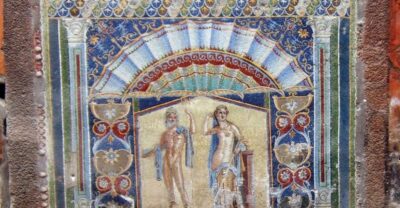
Browse the lists this tour appears in