
Reviewed · WALKING TOURS
Pompeii walking tour
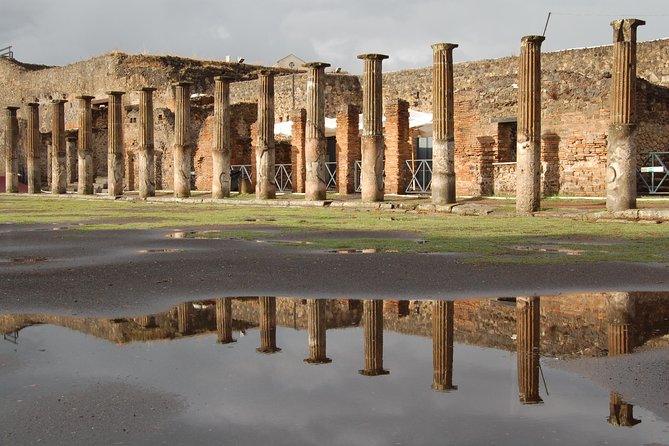
Pompeii is best understood on foot, where worn paving stones, grand public buildings, and ordinary homes reveal how a Roman city worked. This private two-hour tour gives you a guide’s help without adding strangers to your group, and it focuses your limited time on the park’s major sights.
I like the flexible start time, which makes it easier to fit Pompeii around trains, lunch, or a visit to nearby sights. I also like the chance to ask questions freely and pause for good photo points that are easy to miss when you wander alone.
The main drawback is the short duration. Pompeii is enormous, and two hours gives you a useful introduction rather than a full look at the site. The guide’s quality also matters: one account praised the strong background and pacing, while another noted phone distractions and an unprepared opening.
In This Review
- Key points to know before booking
- Why a guide helps at Pompeii
- Beginning at Piazza Esedra
- Walking through Pompeii Archaeological Park
- The Forum and Pompeii’s public life
- The Amphitheatre and the city beyond the postcard
- Private houses and personal stories
- What the two-hour limit means
- The value of a $240.28 private tour
- Who should book this Pompeii walk
- Practical booking advice
- Should you book this private Pompeii tour?
- FAQ
- How long does the Pompeii walking tour last?
- How much does the tour cost?
- Is the Pompeii admission ticket included?
- Where does the tour begin?
- Where does the activity end?
- Is this a private tour?
- Is hotel pickup included?
- What is the cancellation policy?
Key points to know before booking
- Private access for up to 10 people: Your group tours together instead of joining a large public party.
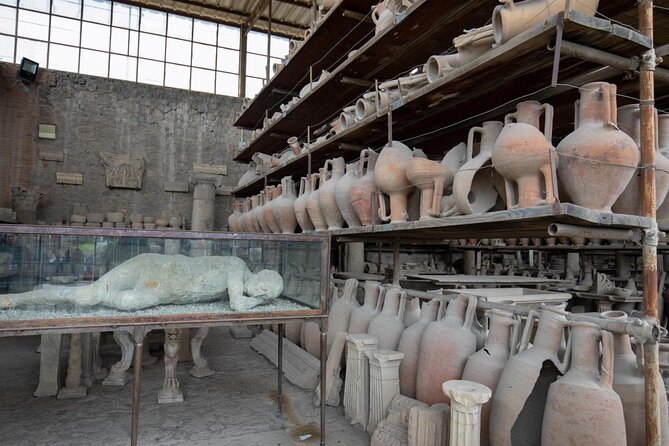
- Two hours inside Pompeii: The route concentrates on the Forum, Amphitheatre, private houses, and other major remains.
- Flexible start time: You can choose a departure that fits your Pompeii plans, subject to availability.
- Skip-the-line service included: The long-entry-line issue is handled, but the archaeological park admission ticket itself is not included.
- Meeting point at Piazza Esedra: You must make your own way to the start and return there when the tour ends.
- Strong overall satisfaction: The experience has a 4.8 rating from 29 reviews, with 93 percent recommending it.
Why a guide helps at Pompeii
Pompeii can look simple at first glance: stone streets, roofless houses, columns, walls, and open courtyards. The difficulty is knowing what you are looking at and why it matters.
A private guide can connect the physical remains to daily life. The Forum was not just an attractive plaza. It was a central public space tied to civic, religious, and commercial activity. A private house was not merely a ruin with painted walls. Its rooms, layout, and decoration can show how status, family life, and social customs worked.
That context matters even more here because Pompeii is a city rather than a single monument. You are moving through a large urban setting, not following one neat path from entrance to exit. Without guidance, it is easy to spend too much time on one interesting corner and miss a major building nearby.
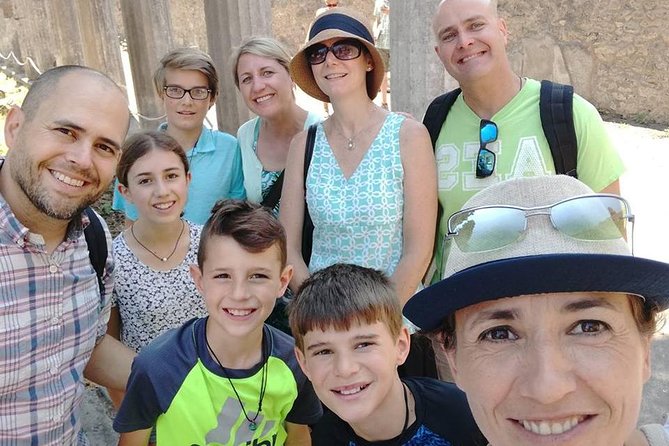
I also value the private format for families and small groups. You can ask a basic question without feeling self-conscious, stop briefly for a photograph, or signal that you need a slower pace. A guide can also adjust the emphasis to match your interests, though you should communicate those interests before the tour begins.
One practical warning comes from the mixed feedback about preparation. A strong guide can make two hours count, but you should not assume every guide will arrive with the same plan. One person found the guide patient and effective at covering the highlights in a short visit. Another felt the guide began by asking what the group wanted to see and seemed distracted by phone calls. If you have firm priorities, send them ahead of time and repeat them at the meeting point.
More Walking Tours in Pompeii
- Pompeii: Guided Walking Tour with Entrance Ticket
★ 4.3 · 1,423 reviews - Discover Pompeii: French Walking Tour of the Buried City
★ 4.8 · 253 reviews - From Salerno: Pompeii Guided Walking Tour
★ 4.5 · 235 reviews
Beginning at Piazza Esedra
The tour starts at Piazza Esedra in Pompei. Since hotel pickup and transportation are not included, you need to reach this meeting point on your own.
That arrangement keeps the tour focused on Pompeii itself, but it adds planning work. Check your route to Piazza Esedra before the day of the visit, especially if you are arriving by train or combining Pompeii with another stop. The meeting point is near public transportation, which helps, but the tour does not provide a vehicle from your hotel or from another attraction.
A clear meeting plan is important. Arrive with enough time to identify the meeting point and settle any admission details before the two-hour visit begins. The activity ends back at the same location, so you have a simple reference point for continuing your day.
The confirmation is sent within 48 hours of booking, subject to availability. That is worth noting if you are building a tightly timed Italian itinerary. The experience is often booked about 30 days ahead, so reserving early is sensible if your Pompeii date and preferred start time are fixed.
Walking through Pompeii Archaeological Park
The heart of the experience is Pompeii Archaeological Park, the ancient city preserved under volcanic ash after the eruption of Mount Vesuvius on October 24, 79 AD. The remains offer an unusually direct look at an ancient urban society because so much of the city was covered and later brought back to light from the 18th century onward.
The site is powerful because it combines public monuments with private spaces. You are not seeing only temples or official buildings. You are also looking at streets, houses, and rooms that help explain how people lived.
A guide may point out the difference between a grand public setting and a private home, then show how the two fit into the same city. That shift from large civic spaces to personal stories is one of Pompeii’s strongest features. It keeps the visit from becoming a parade of impressive walls with no human meaning.
Because the tour lasts about two hours, expect a selective route. The exact order is not stated, but the planned focus includes the Forum, Amphitheatre, private houses, and other important findings. You should see this as a highlights visit, not a complete exploration of the park.
The Forum and Pompeii’s public life
The Forum is one of the key sights named for the tour. It gives you a sense of Pompeii as an organized city with shared public spaces, rather than a collection of isolated ruins.
This is where a guide can save you time. A wide open area surrounded by remains may be visually striking, but its purpose is not always obvious. With explanation, the Forum becomes part of a larger picture of public life, civic activity, religion, and commerce.
The Forum also makes a good orientation point. It helps you understand the scale of Pompeii and the relationship between public buildings and residential areas. If you are interested in architecture, politics, religion, or everyday routines, tell the guide early. A private visit can give more attention to your interests than a standard group walk.
The limitation is that two hours can pass quickly around the Forum. It is easy to linger while the guide explains the setting, then realize there is little time left for houses or the Amphitheatre. Ask how the guide plans to divide the visit so you know what you will cover.
More Pompeii excavation visits:
- Pompeii: Entry Ticket and Guided Tour with an Archaeologist
★ 4.8 · 19,459 reviews - Pompeii: Entry Ticket with Optional Audio Guide
★ 4.2 · 12,360 reviews - Pompeii: Small Group Tour with an Archaeologist
★ 4.8 · 12,264 reviews - Pompeii Small Group Tour with an Archaeologist
★ 5.0 · 6,593 reviews
The Amphitheatre and the city beyond the postcard
The Amphitheatre is another major stop. It shows Pompeii’s connection to public entertainment and gives the ruins a different scale from the intimate rooms of a house.
The contrast is useful. One moment you are thinking about personal spaces and household routines. The next, you are considering a large venue built for public events. That change helps you see Pompeii as a functioning city with many layers of life.
The tour description also highlights impressive photo points. The Amphitheatre and Forum may provide obvious images, but your guide can help you notice angles, buildings, and views you might skip when walking alone. That is a practical benefit for anyone who wants photographs with a sense of place rather than a quick snapshot of a famous wall.
Still, photography should not take over the visit. If your group wants time for pictures, say so. A private guide can usually respond to that preference more easily than a large scheduled group, but the two-hour limit remains.
Private houses and personal stories
The private homes may be the most revealing part of the tour. Public monuments explain how the city presented itself. Houses show how people arranged their daily surroundings and how social status appeared in domestic architecture and decoration.
Pompeii is often described as a city frozen in time, but that phrase can make the place sound static. The homes help correct that impression. They point to people making choices about space, privacy, decoration, work, family, and display.
A guide’s explanations can turn a room into evidence of a lived experience. You may find yourself paying attention to the shape of a courtyard, the position of a doorway, or the remains of painted decoration. The value is not simply in seeing an old building. It is in understanding what the building tells you about its occupants.
This is also an area where your own questions can improve the visit. Ask how the house differed from a public building, what a room may have been used for, or what the remains reveal about the people who lived there. The private format gives you room to ask without holding up a larger group.
What the two-hour limit means
Two hours is enough to get a clear introduction to Pompeii, especially if you want the principal sights and a guide’s explanation. It is a good fit if you have limited time or are combining the archaeological park with other plans in the area.
It is not enough for a leisurely look at every section. Pompeii is famous precisely because it is a whole ancient city, and whole cities take time. You may leave with a strong sense of the Forum, Amphitheatre, and selected houses while still knowing that many streets and buildings remain unexplored.
I would book this length if your goal is orientation, major highlights, and historical context. If you already know Pompeii well or want to examine many individual homes, inscriptions, and smaller buildings, you may find the schedule too compressed.
The flexible start time helps soften that limitation. You can choose a departure that fits your day rather than being locked into one fixed public schedule. Just remember that flexibility is subject to availability, and the park admission ticket is separate.
The value of a $240.28 private tour
The price is $240.28 per group of up to 10 people. That is not a low-cost walking tour, but the comparison changes when you divide the amount across a full group.
For 10 people, the cost works out to about $24 per person before admission. For 5 people, it is about $48 each before admission. For 2 people, it is about $120 each before admission. The value is strongest for a family or group that can fill most of the 10-person limit.
The price pays for a private professional guide and skip-the-line service. It does not pay for hotel pickup, transport, or admission to the archaeological park. You need to budget for those separately, which makes the total cost higher than the headline figure.
I see the main value in time and attention. If avoiding a long entry line protects a tightly planned day, that can matter. If your group wants to ask many questions or move at its own pace, private guiding may justify the cost. If you are happy to read signs and explore independently, the price may be harder to defend.
A 4.8 rating from 29 reviews and a 93 percent recommendation rate suggest that the format works well for many people. The lower-scoring feedback is still useful: private does not automatically mean perfectly prepared or phone-free. Your best protection is to state your priorities before the start and expect the guide to keep the visit focused.
Who should book this Pompeii walk
I would recommend it most to first-time visitors who want a clear introduction without joining a large group. It also suits families, couples traveling with friends, and groups that prefer to set their own start time.
The tour is especially useful if you want to ask questions about ancient daily life rather than simply walk past ruins. People who care about photographs may also appreciate help finding strong viewpoints.
It may be less suitable for independent history enthusiasts who want several hours to explore on their own. It is also not the best match if you need transport from your hotel, since you must reach Piazza Esedra independently.
Children must be accompanied by an adult. Smart-casual dress is required, and the guide may be multilingual. Most people can participate, but this is a walking visit through an archaeological park, so consider your group’s comfort with two hours on foot.
Practical booking advice
Reserve early if you need a particular time. The tour is commonly booked around 30 days ahead, and confirmation arrives within 48 hours, subject to availability.
Before the day, decide what matters most to your group. You might choose the Forum, Amphitheatre, private houses, photography, or a broad overview of Pompeii. Send those priorities in advance rather than waiting for the guide to ask at the entrance.
Remember three separate costs and tasks:
- Reach Piazza Esedra on your own.
- Pay for admission to Pompeii Archaeological Park separately.
- Allow time to return to the meeting point at the end.
Free cancellation is available if you cancel at least 24 hours before the local start time. Cancellations or changes made within that 24-hour window are not accepted for a refund.
Should you book this private Pompeii tour?
Book it if you want a short, private introduction to Pompeii, value a flexible start time, and are traveling with enough people to share the $240.28 group price. The guide can help you connect public monuments, private houses, and daily life while steering you toward important sights and photo points.
Skip it if you want a full-day examination of the ruins, need transport included, or prefer to explore independently at a lower cost. If you do book, send your priorities ahead of time and confirm that the separate park admission fits your budget.
FAQ
How long does the Pompeii walking tour last?
The tour lasts approximately two hours.
How much does the tour cost?
The price is $240.28 per group of up to 10 people.
Is the Pompeii admission ticket included?
No. Admission to Pompeii Archaeological Park is not included in the tour price.
Where does the tour begin?
The tour begins at Piazza Esedra, 80045 Pompei NA, Italy.
Where does the activity end?
The tour ends back at the meeting point.
Is this a private tour?
Yes. Only your group participates, with a maximum group size of 10 people.
Is hotel pickup included?
No. Hotel pickup and drop-off are not included, and transportation to and from the attractions is also not included.
What is the cancellation policy?
You can cancel at least 24 hours before the local start time for a full refund. Cancellations or changes made less than 24 hours before the start are not accepted.
More Walking Tours in Pompeii Ruins
- Pompeii 3 Hours Walking Tour Led by an Archaeologist
★ 5.0 · 126 reviews - Pompeii: Highlights Guided Walking Tour
★ 4.6 · 105 reviews - Pompeii: 3D Walking Tour with Entry Ticket
★ 4.3 · 102 reviews - Explore Pompeii: 2-Hour Guided Walking Tour with Included Ticket
★ 4.5 · 77 reviews
Newest reviews from Pompeii Ruins
- Private Tour Pompeii and Winery★ 5.0 · 4 reviews
- Visit the Pompeii ruins from Salerno with Pizza Lunch★ 5.0 · 4 reviews
- Pompeii Private Tour for Kids and Their Families★ 4.8 · 4 reviews
- From Sorrento: Pompeii & Vesuvius tour small group★ 4.8 · 4 reviews
- Pompeii Sorrento and Positano Tour★ 5.0 · 4 reviews
- From Naples_ Pompeii Tour_Skip the line ticket + audioguide★ 4.3 · 4 reviews
- Pompeii Private Half-Day Tour from: Naples,Sorrento, Amalfi Coast★ 5.0 · 4 reviews
- Pompeii, skip-the-line ticket with smartphone audio guide on App★ 3.0 · 4 reviews
Walking Tours, compared.

Walking Food Tour in Sorrento w/ Limoncello Factory Lemon Grove
Read our review →


Discover Pompeii: French Walking Tour of the Buried City
Read our review →

Browse the lists this tour appears in